
Budget! It is something that we all have waited for! On 1st Feb finally, the budget 2025-2026 was released. Presented by the honorable Finance Minister Nirmala Sitharaman, it’s not just numbers but the future of India. You can consider it as the government’s annual financial plan that reflects income and expenses. It gives a quick view of the economic strategies and priorities for the year. The budget for this year has a strong emphasis on economic expansion, promoting private sector investment and raising middle-class consumers’ purchasing power. So let’s find out how it affects the hr budget, businesses, salaried professionals, and other taxpayers.
Sneak Peek of the Union Budget 2025-2026

The main objective of 2025 is to take major steps towards becoming a ‘Viksit Bharat’, so from poverty to education and healthcare, every domain will be tackled. Here the government will focus on four powerful engines: agriculture, MSME, investment, and exports. The tax budget 2025 also mentions transformative reforms in various sectors, such as taxation, power, urban development, and financial services. The Union Budget 2025-2026 stresses 4 main things. Fiscal consolidation, economic growth, tax relief, and strategic capital expenditure. With an intent to increase domestic manufacturing, promote investment, and improve infrastructure, the budget aims to create long-term financial stability and job creation.
Income Tax Reforms:
A major part of the tax budget 2025 falls around taxation which affects the middle class to a great extent. The government made significant changes in the personal income tax system.
One such noteworthy change is the zero income tax for individuals who are earning up to 12 lakh RS annually. It is covered under the “New Tax Regime”.
The cherry on top is an additional standard deduction of 75000 Rs which increases the tax-free threshold to Rs12.75 lakh. Reduction in tax compliance burden will also be seen. Under this, the simplification of TDS (Tax Deducted at Source) provisions will be observed.
Example: If you are a salaried employee earning around ₹12.5 lakh per year, you must pay zero tax, and all your money will go straight into your pocket. If you are a business owner, you can skip the hassle by simply getting Payroll software. It will do wonders and assist you in automating entire payroll processes, taking care of accurate and timely payments, and staying compliant with tax regulations.
Fiscal Deficit & Government Receipts
The fiscal deficit target is now set at 5.3% of GDP, following a path of gradual fiscal consolidation.
Government receipts are believed to grow. It will be driven by higher tax revenue and disinvestment plans.
Infrastructure & Capital Expenditure
A 22% increase in capital expenditure to ₹11.1 lakh crore seeks to improve transport, urban planning, and industrial corridors.
A dedicated Urban Challenge Fund is introduced to modernize smart cities and public infrastructure.
Increased infrastructure support for railways, highways, and metro projects will also be provided.
Manufacturing & Investment Growth
National Manufacturing Mission was also discussed. It will expand domestic manufacturing capacities in key industries.
Customs duty exemptions on raw materials for electronics manufacturing facilities.
Foreign Direct Investment (FDI) policy reforms to improve private sector investments.
Agriculture & Rural Development
Crop diversification programs will also be taken in action to encourage sustainable farming.
Expansion of agricultural credit will be done majorly for small and marginal farmers.
Investment in government secondary schools in rural areas to improve education access.
Boost to Digital & Financial Sector
The introduction of a National Digital Repository will be done to simplify regulatory processes.
Focus will be made on financial sector reforms to promote investment-friendliness and improve India’s role as a global hub for financial services.
Regulatory reforms will be brought into action to support the growth of the sovereign wealth funds and pension funds.
Healthcare & Education
Comprehensive healthcare initiatives will be taken. It will cover opening new medical colleges and expanding healthcare access.
Investments in higher education and skill development programs will be made with a focus on skilled labour.
Budget Estimates & Economic Impact
The total expenditure for FY 2025-2026 is decided at ₹47.7 lakh crore, with a strong hold on maintaining balanced growth across sectors. Tax revenue is believed to rise by 12.5%. This will work as a contributor to higher net tax receipts.
This budget will act as the base for long-term economic stability, job creation, and a simplified tax structure. When it comes to beneficiaries- both businesses and individuals will be a part of this evolving financial environment.
Tax Slabs Under the New Regime for FY 2025-26
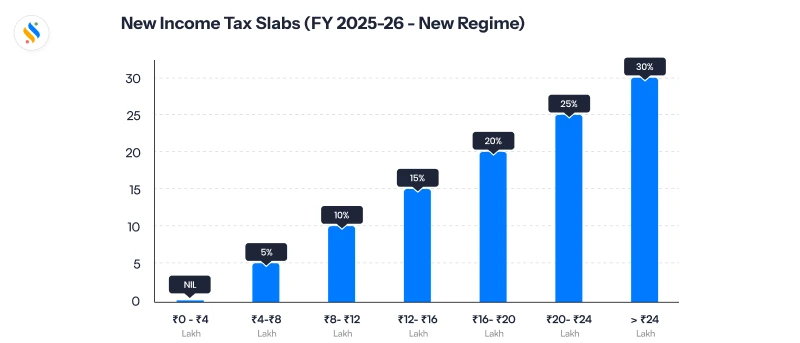
Key Differences: The new tax regime provides different tax slab rates in comparison to the old one mainy for the lower income brackets.
Deductions: The old regime permits various deductions and exemptions (like HRA, 80C, etc.), which are mostly not available in the new tax regime. This is a critical factor that affects the division pf which regime is more beneficial.
Which Regime Should You Choose?
The decision between the old and new tax regime depends on your personal circumstances. If you are dependent on deductions and exemptions, the old regime might be more advantageous. However, if you like a simpler structure with lower rates and fewer complexities, the new tax regime under budget 2025 could be the better option.
New Reforms in Union Budget 2025-2026
1. Taxation Reforms
One of the most anticipated changes in this budget is the change in the old structure. It will especially affect salaried individuals, businesses, and senior citizens.
Income Tax Changes
- The tax-free income threshold as per the new tax regime has been raised from ₹7 lakh to ₹12 lakh.
- A new tax slab 2025 structure has been introduced (details are shared in the next section).
- Standard deduction increased to provide further relief to corporate employees.
- Nil tax for individuals who earn up to ₹4 lakh per year. This will make sure tax is relieved for low-income groups.
Corporate Tax & Business Incentives
- Turnover limits for the Presumptive Taxation Regime have been increased. As a result, the compliance burdens will be decreased for small and medium businesses (SMEs).
- There will be observed a reduction in the compliance burden through digitization of tax filings and automatic GST return processing.
- Tax incentives for startups even cover an extended exemption period for newly registered businesses.
2. Investment & Fiscal Reforms
Foreign Direct Investment (FDI) & Private Sector Growth
- 100% FDI permitted in the insurance sector. But it will be subject to domestic reinvestment conditions.
- Private sector investments are encouraged in infrastructure, healthcare, and R&D.
- Sovereign wealth funds and pension funds will receive tax exemptions when it will be used to invest in specified sectors.
Fiscal Deficit & Revenue Management
- The government has decreased the fiscal deficit target to 5.3% of GDP. It is done to align with fiscal consolidation goals.
- Government receipts are predicted to grow with enhanced tax compliance measures and strategic disinvestment plans.
- Net tax receipts are estimated to increase by 12.5%. This will make revenue flow better.
3. Infrastructure & Urban Development
Capital Expenditure Expansion
- ₹11.1 lakh crore is allocated for capital expenditure, which is a 22% increase from the previous year.
- Urban Challenge Fund is introduced to support the modernization of cities. It will contribute to smart infrastructure, public transportation, and green energy projects.
- Infrastructure support to major industrial corridors and logistics hubs will be provided to make India a global hub for supply chains.
- The second Asset Monetization Plan was launched too. It is done to optimize public assets and attract private investment.
Railways & Transport
- There will be a major investment in railways. The semi-high-speed and bullet train projects will be executed.
- Higher budget for metro expansion in Tier 1 and Tier 2 cities.
- Tax incentives will be there for electric vehicle (EV) infrastructure, it will also cover charging stations.
4. Manufacturing & Industrial Growth
Boost to Domestic Manufacturing
- National Manufacturing Mission launched to improve domestic manufacturing capacities in pivotal industries, including electronics, pharmaceuticals, and automobiles.
- Basic customs duty exemptions will be provided for capital goods used to produce solar PV cells, semiconductors, and lithium-ion batteries.
- To accelerate India’s role in global supply chains electronics manufacturing facilities will be expanded.
Incentives for MSMEs & Private Sector R&D
- The credit availability for MSMEs is increased through simplified term loans.
- Private sector-driven research is encouraged through tax incentives and grants.
5. Agriculture & Rural Development
- Crop diversification incentives will be planned to reduce over-reliance on wheat and rice. As a result, the government will support millet and pulses farming.
- Soil rejuvenation initiatives under the “Just Its Soil” program will be considered. It would be done to improve agricultural sustainability.
- A new Makhana Board is established in Bihar to support domestic makhana (fox nut) production.
- The irrigation and rural infrastructure projects will be expanded.
6. Healthcare & Education
Comprehensive Healthcare Initiatives
- Investment in medical colleges in underserved regions will be prioritized.
- Healthcare infrastructure boosts will cover public hospitals and vaccine research centers.
Education & Skill Development
- The higher education budget is now increased. It is done with a focus on developing new universities and research institutions.
- The government will invest in government secondary schools to improve education quality in rural areas.
- There will be an emphasis on meaningful employment through vocational training in skilled labour programs.
7. Digital & Financial Sector Reforms
- National Digital Repository was introduced to enhance digital documentation for businesses.
- Regulatory reforms in non-financial sector regulations, improving ease of business.
- Investment Friendliness Index will be developed to measure India’s global competitiveness.
Impact of Budget 2025 Reforms
The new reforms in Budget 2025-2026 aim to:
- Reduce the tax load for salaried employees & middle-class taxpayers.
- Embrace private sector investments in key industries.
- Accelerate manufacturing & boost domestic capacities.
- Improve infrastructure & create more job opportunities.
- Support agriculture, rural areas development & food security.
The strategic policy changes are the foundation for a stronger economic outlook. It will help the Indian government to position India as a competitive global hub for trade, finance, and technology.
Key Effective Dates for Budget 2025 Provisions
The provisions announced in the Union Budget 2025 tax slab will be effective from April 1, 2025, as it marks the start of the new financial year (FY 2025-26). However, the implementation timeline will vary for different aspects of the budget.
| Budget Provision | Effective Date |
|---|
| New Income Tax Slabs & Regime | April 1, 2025 |
| Changes in Tax Deduction at Source (TDS) & Tax Collected at Source (TCS) | April 1, 2025 |
| GST Reforms & Compliance Changes | April 1, 2025 |
| Increased Tax Rebate under Section 87A (₹7 lakh tax-free income) | April 1, 2025 |
| Changes in Presumptive Taxation Limits for Businesses | April 1, 2025 |
| Customs Duty Revisions on Imports & Capital Goods | As per Government Notification (expected in Q2 2025) |
| Investment Incentives & FDI Policy Revisions | Expected to be rolled out in phases from April – July 2025 |
| Infrastructure & Capital Expenditure Allocations | April 1, 2025, but actual project funding is phased over the financial year |
| Government Schemes & Subsidy Reforms | Staggered implementation throughout FY 2025-26 |
Wrapping Up
That’s all for this budget report. The Union Budget 2025-26 is a baby step towards fostering economic growth, rising employment, and streamlining tax structures. While the tax benefits reduce the financial burden on individuals, the push for capital expenditure, domestic manufacturing, and digital transformation will decide India’s long-term economic trajectory.
What should you do next?
- Plan your tax strategy as per the new tax regime.
- Plan your payroll budget using payroll software if you have a business with 20+ employees.
- Businesses should be ready for GST & compliance changes starting April 2025.
- Watch government notifications for sector-specific reforms and incentives.
With smart planning and strategic financial decisions, you can try to take the maximum benefits from Budget 2025 and stay ahead in a rapidly growing economy.










