TL; DR
There is a general notion among employees that employee monitoring in the workplace is not only illegal, but unethical too. It is important to understand that workplace monitoring around the world is legal and ethical. That’s because there are laws in place that keep the monitoring done by companies in check. So why does the ethical question arise when it comes to workplace monitoring? It has to do with the fact that companies ignore employees’ consent, blurs into personal life, or feed decisions employees never see. Indian law gives employers room to track work activity under the DPDP Act’s “legitimate use” clause, but that legal cover doesn’t make every monitoring decision ethical. This guide breaks down a practical code of ethics for employee monitoring alongside what India’s DPDP Act and IT Act actually require before you switch on advanced tracking tools.
Ask five HR managers, C-level executives, and SMB founders if employee monitoring is ethical, and you’ll get five different answers.
Most of them legally accurate and ethically incomplete. When it comes to India, the law allows employers to track attendance, screen activity, productivity, and performance under the DPDP Act. That doesn’t settle the harder question: should you, and how far?
This is where employee monitoring ethics earns its keep. It isn’t a compliance checkbox tacked onto a privacy policy. It’s the difference between a monitoring program employees tolerate and one they quietly work around or quit over.
What does employee monitoring ethics actually mean?
Employee monitoring ethics covers the principles that decide whether tracking work activity respects an employee’s dignity, privacy, and reasonable expectations, separate from whether it’s permitted by law. The ethics of employee monitoring sit on a sliding scale, not a yes/no switch. The same keystroke logger can be ethical for a finance team handling client funds and questionable for a content team with no comparable security stake. Context, purpose, and proportion decide the answer, not the existence of a software license.
There’s also a useful line between ethical monitoring and surveillance. Ethical monitoring tracks work to improve processes, flag genuine risk, or confirm attendance. Surveillance watches people to catch them out.
Is it ethical for employers to monitor employees?
Honestly, it depends on what is going to get monitored, why, and how transparently it is going to get monitored. Monitoring tied to a clear business purpose — security, productivity insight, statutory compliance and disclosed to employees in advance- sits on solid ethical ground. Monitoring that exists because the technology is available, that captures personal messages alongside work activity, or that employees only learn about after the fact, doesn’t.
Indian employers get a legal head start here. The DPDP Act’s “legitimate use” provision lets you process routine employment data – attendance, payroll-linked activity, basic security logs – without separately requesting consent each time. But legitimate use covers routine processing, not every monitoring feature a vendor bundles into a dashboard. The moment monitoring moves into keystroke logging, screen recording, or social media tracking, the legal ground shifts, and your ethical bar should shift with it.
Employee monitoring ethics under India’s DPDP Act
Most employee monitoring ethics content online leans on the US wiretap law or the EU’s GDPR. Neither applies directly in India. If you’re building a monitoring policy here, the Digital Personal Data Protection Act, 2023 (DPDP Act) and its 2025 Rules are the framework that matters, alongside the older IT Act provisions sitting underneath it.
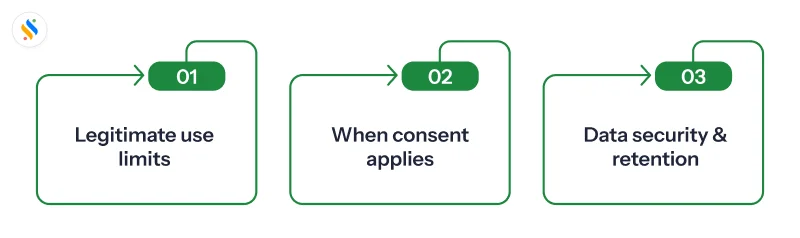
The legitimate-use exemption and its limits:
Under the DPDP Act, your company is a “Data Fiduciary” and every employee is a “Data Principal.” The Act’s legitimate-use provision lets employers process personal data for routine employment purposes — payroll, attendance, statutory PF and ESI compliance, basic workplace security checks — without separately obtaining consent. This is narrower than it sounds. It covers necessary, proportionate processing tied directly to running the employment relationship. It doesn’t hand you a blanket pass to switch on every monitoring feature a vendor offers.
Where consent re-enters the picture:
The moment monitoring goes beyond routine, consent matters again. Keystroke logging, screen recording, and social media tracking generally fall outside the legitimate-use exemption. Before turning these on, you need consent that’s free, specific, informed, unconditional, and backed by a plain-language notice — not a clause buried in the offer letter. Employees also retain the right to withdraw that consent later, so your policy needs a real answer for what happens to access and stored data when they do.
Security and retention obligations apply regardless:
Two DPDP obligations hold no matter which legal ground you rely on. You’re required to maintain reasonable security safeguards for any personal data you hold — this is where the older IT Act framework still bites, since the Sensitive Personal Data or Information (SPDI) Rules, 2011, effectively set the bar at ISO 27001 or an equivalent standard. You’re also required to delete monitoring data once its purpose is served, rather than retaining it indefinitely “just in case.” Get it wrong, and the penalty will be massive.
(A quick caveat: This section does not offer a legal opinion on your specific policy. Loop in your legal or compliance team for more understanding.)
A code of ethics for employee monitoring
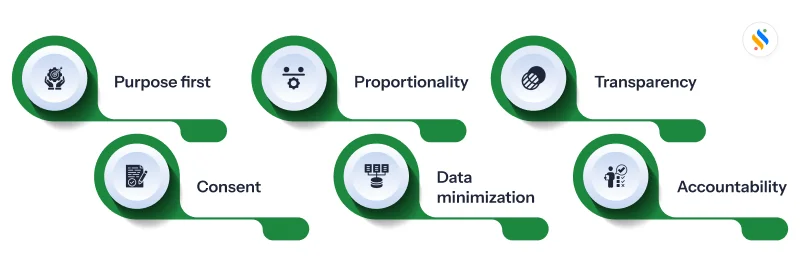
A working code of ethical monitoring comes down to six checkable principles:
Purpose first:
Every monitoring decision should trace back to one specific, defensible reason — security, productivity insight, compliance — written down before the tool is switched on, not justified afterwards.
Proportionality:
Match the intrusiveness of monitoring to the actual risk. A finance team handling sensitive transactions justifies tighter oversight than a team with no comparable exposure.
Transparency:
Employees should know what’s tracked, why, and who can see it — in writing, before monitoring starts, not discovered through a leaked dashboard screenshot.
Consent where it’s due:
Rely on legitimate use for routine processing, but get real, informed consent the moment monitoring moves into advanced or non-routine territory.
Data minimization:
Collect what the stated purpose needs, nothing extra. If you can’t explain why a data point is being captured, stop capturing it.
Accountability:
Restrict who can see monitoring data, audit that access, and give employees a real channel to question or correct what’s recorded about them.
A practical checklist on how to monitor employees ethically?
- Write the policy before you deploy the tool, not after.
- Tell employees what’s tracked, in plain language, before day one — not in a clause they’ll never reread.
- Limit monitoring to company devices and work hours wherever the role allows it.
- Keep “monitoring” data and “disciplinary” data separate. Not every metric should become a warning letter.
- Give employees access to their own data so the program feels like visibility, not interrogation.
- Review the policy on a fixed schedule, not only after something goes wrong.
A monitoring tool built around these principles from the start makes this far easier to operationalize than retrofitting ethics onto a tool that wasn’t designed for it. Super Track is built to keep monitoring purpose-bound and visible, the kind of setup that supports a policy like this instead of working against it. If you’re evaluating tools, our employee monitoring software breaks down what to look for.
Conclusion
Employee monitoring ethics isn’t a debate you settle once. It is something that you need to revisit every time a new tracking feature gets added, every time a manager asks for more visibility, and every time the DPDP Rules get clarified further. Build your policy around purpose, proportionality, and transparency, and most of the hard calls answer themselves.
If you’re rebuilding your monitoring policy from scratch and looking for a tool to meet your policy criteria, then you should definitely check this tool. Super Track keeps monitoring purpose-bound and transparent by design, so your policy and your software are finally saying the same thing. Get your free trial and see what ethical workplace monitoring looks like.










