TL; DR
If you are a manager and you see the productivity reports, you might think that your employees are lazy. But if you go beyond reports, you will realize that you don’t have a single lazy employee. So, why do you feel this way? It is not because you don’t know. It’s because there are various factors behind the productivity drop. Unclear goals, poor tools, a noisy environment, delayed salary, and a manager who keeps hovering on head. The blog will discuss factors affecting productivity, and along with that, provide ways to fix them. Along with that, you will also learn about how to diagonzing the problem early, before it becomes a problem. So, do read it till the end!
If you are a manager, have you ever wondered,
Why are two individuals with similar skills unable to deliver similar results?
While one can be super proactive in meeting deadlines and delivering projects on time, the other might be struggling. So is he lazy? No! So why does his productivity drop? Now, this is the question worth asking.
Look, productivity drop is a problem because it directly affects the goals and the environment of the organization. But the problem is that top management, in some cases, often ignores the factors affecting productivity.
There could be several reasons, from no proper tools to a toxic work environment, anything can possibly be affecting an employee’s productivity. And when employees start to feel that their complaints are going unnoticed, they slowly start to get detached, and in the end, exit the organization.
This blog focuses on various factors that affect the employees’ productivity, and breaks them down in detail, so that you can take prompt action before the next employee submits their resignation.
Why is it important to understand the factors affecting the productivity of employees?
One of the biggest qualities of any manager is their ability to identify the reasons why their team. What they don’t know is why it is happening. They blame the attitude when the real issue is a broken laptop. They accuse employees of being lazy when the real issue is that he is assigned five different tasks, and their deadline is the same week.
And this is where understanding the factors affecting the productivity of employees becomes important, because that’s where the solution lies.
List of factors affecting productivity!
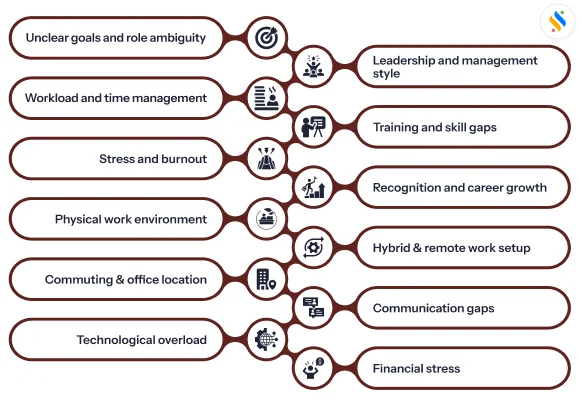
1. Unclear goals and role ambiguity:
When employees don’t know exactly what “good work” looks like for their role, they default to looking busy instead of being effective. This is one of the most common factors affecting employee productivity, and it’s almost always a leadership gap, not a worker gap.
Fix it: Write goals that are specific and time-bound, not vague statements like “improve sales.” Review them every month, not once a year during appraisals. A goal nobody revisits is just a sentence in a document.
2. Leadership and management style:
For decades and even today, most Indian industries have a strong hierarchical structure. Now, there is nothing wrong with it; the only issue is that managers start micromanaging teams, and keep their position and designation in mind, and employees are, in some cases, scared or reluctant to push back. Micromanaging is detrimental to the growth of the organization, and is also one of the key factors affecting productivity. After all, no employee enjoys their manager hovering over their shoulders.
Fix it: Providing training to managers on aspects like checking progress and controlling every step.
3. Workload and time management:
Overloaded employees don’t produce more; they produce worse. They skip steps, rush reviews, and burn out within a quarter. Underloaded employees aren’t much better; idle time breeds disengagement just as fast.
Fix it: Cap the number of active priorities per person at any given time, ideally three or fewer. Protect at least one uninterrupted focus block daily, where meetings are off-limits by default.
4. Training and skill gaps:
Skill gap is one of the biggest factors affecting productivity in the workplace. In the era of AI, upskilling yourself has become a need of the hour. If an employee has an avoidable approach or doesn’t know how to do prompting, how to use tools like Claude, ChatGPT, or Gemini to their full potential, they will keep performing tasks manually that, if automated, could have been done in seconds to minutes.
Fix it: Build short, role-specific learning paths. Set aside a time that will be used to provide training and assistance in the latest technology and advancements.
5. Stress and burnout:
Stress and burnout have become a global workplace issue. Just last, the burnout in the workplace was 66%! What top management fails to acknowledge or even understand is that workplace stress and burnout aren’t ignorable problems. These are the issues that need to be addressed with great sensitivity and care. A stressed employee will make relatively more mistakes, and will take hours to complete the task that used to get done in minutes.
Fix it: Instead of judging employees’ capabilities of delivering, watch actual work hours. If someone is clocking in at their regular time and working beyond their clock-out time, that’s a workload problem disguised as dedication.
6. Recognition and career growth:
Employees who can’t see a path forward stop trying to climb. They do the minimum required and look for the next opportunity elsewhere. Recognition isn’t only about year-end bonuses. Public, specific, and timely recognition (naming the actual contribution, not a generic “great job”) tends to matter more day-to-day.
Fix it: Recognize work close to when it happens, not three months later in a review cycle. Tie growth conversations to actual skill milestones, not just tenure.
7. Physical work environment:
One of the biggest factors that affects employees’ productivity, which sometimes goes unnoticed, is the physical environment of the office. Bad lighting, poor chairs with creaking noise, constant noise and chatter from peers and from the other office members might not be dramatic reasons. But stitch them together for an 8-9-hour job, and they become a significant factor that affects employees’ productivity.
Fix it: The keyword here is basic. Fix the basic requirements like seating, lighting, and ensure that the noises are minimum to moderate, so that employees can focus on their work.
8. Hybrid and remote work setup:
Gone are the days when employees used to visit the office daily to show that they were working. With the rise in hybrid and remote working models, major industries, including IT, are offering the option. The only problem here is that not every employee is blessed with exceptional fiber broadband. Someone who is residing in a location where power cuts are more prone to face internet-related issues. On the surface, this might not be a major issue, but enough to affect productivity.
Fix it: Set a minimum home-office standard and support employees in meeting it, instead of assuming everyone’s setup is equal.
9. Commute and office location:
If you are an employee working in a corporation that is located in Bengaluru or Mumbai, you know that it is a task in itself to catch a local to reach the office on time. Commute fatigue is real. An employee who spends 30 minutes to 1 hour of downtime daily can easily be identified as one who is mentally checked out and physically exhausted.
Fix it: The ideal solution here is to offer flexible working options so that employees can avoid heavy commuting. This way, they can be in a relaxed state and be able to perform to the best of their ability.
10. Communication gaps:
Modern Indian workplaces are multilingual, multi-regional, and diversified. This means that teams that are working from home are spread across cities, time zones, and sometimes speak different languages. Add scattered tools, and instructions get lost or misread. This is one of the various factors affecting productivity that’s easy to underestimate because it doesn’t look like a “communication problem” on the surface.
Fix it: Pick one platform and make it a primary point of communication for all types of internal communication.
11. Technology and tool overload:
Today, the general notion is that with the advancement in technology, the issue of productivity drop isn’t going to be a problem. What many people aren’t discussing is that too much reliance can also be the reason also affect productivity. Think about it – employees need to keep switching tabs to log their attendance, apply for leave, claim their performance, track their projects and tasks, and communicate with peers. Different tools to perform these tasks will eventually lead to a waste of time.
Fix it: Audit your tool stack every quarter. If two tools do the same job, kill one. Consolidating attendance, payroll, and task tracking into a single HRMS removes a surprising amount of daily friction that nobody notices until it’s gone.
12. Financial stress and salary delays:
Money is, and can be, one of the core reasons that motivate employees to leave their homes and work. See the joy on the faces of your employees the day their salaries get credited. But what happens when the streamlining of timely payment suddenly gets stalled? Delayed salaries or a mismatch in PF and ESIC creates financial anxiety in employees.
Fix it: Automate payroll calculations and statutory deductions so errors don’t compound month over month. The fewer times an employee has to follow up on their own money, the more mental bandwidth they have for actual work.
Better productivity starts with better visibility!
See the factors affecting performance before they turn into bigger problems.
How to diagnose which factors are hurting your team?
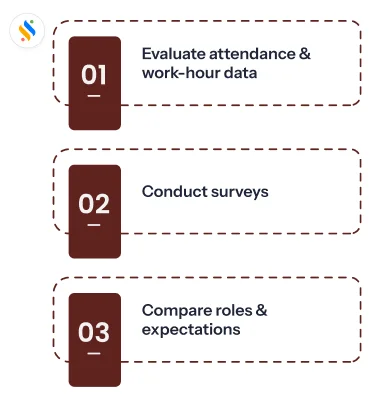
You don’t need an R&D department to figure out which of these factors affecting productivity apply to your team. Three steps get you most of the way there:
1. Look at attendance and work-hour data first:
Having attendance and leave data will give you a good hint at what’s going on with employees. When the reports show aspects like consistent late logins, frequent short leaves, or working unusually long hours, it is something you can’t afford to ignore.
2. Ask, don’t assume:
One of the biggest mistakes management makes is that they assume employees’ problems, which is a wrong approach. The best approach is to do a pulse survey that will help in understanding the employees better.
3. Compare role expectations against actual output:
If a role’s goals haven’t been reviewed in over a year, that’s often the root cause sitting in plain sight.
Wrapping Up
There’s no universal solution to productivity challenges because productivity is influenced by multiple factors. What’s holding one team back may have nothing to do with another. Performance issues for most organizations are a handful of underlying causes.
Now, most companies make the mistake of tackling every problem at once. The result? Solution gets delayed, and in some cases, the problem escalates further. The ideal fix is to first understand the factors that are affecting the productivity of employees. Fix small problems rather than take everything head-on.
This blog has a list of all the potential factors affecting employees’ productivity. And if you are an HR manager, a C-level executive, or a founder of a business, there is an absolute certainty that one or maybe more than one factor might be the reasons why your employees are failing to attain their productivity mark.
Now, it is good if you manage to spot the factor and act on it, but you also have the right solution at your disposal to make things better and more efficient for you. Super Track is one such smart solution. Workforce’s activity tracking, live activity tracking, engagement insights, productivity insights, screenshot capturing, active & idle time, and real-time and accurate productivity reporting – all this and more you get from one of the best employee monitoring software out there!
Apart from that, it is user-friendly and extremely affordable, so for SMBs and mid-sized businesses, this can easily be the go-to option. Book your free trial now and see it in action!