If you’re a CEO or an HR manager, this one question must have come to your mind.
How is it that when you measure the productivity of two people, the results are always different?
Maybe the difference isn’t the employees, how much time they give to their work, or their skills.
Maybe it’s how you measure them. Yes! Your way of evaluation makes a difference.
Organizations often do not understand how to measure employee productivity or productivity metrics. Part of this is because they focus too much on numbers, while ignoring the intangible aspects that equally play a role in employee productivity report.
Learning how to measure employee productivity helps you understand patterns, trends, and bottlenecks, and here, you’ll learn it all, from how to measure productivity to how to analyze productivity, what metrics to measure, and best practices that can help you improve efficiency in your workplace.
Employee productivity: An overview for How Productivity
Often, employee productivity is considered to be how efficiently employees complete certain tasks within a given timeframe. Employees with high productivity levels mean that they complete their work on time, utilize their time and resources efficiently. This eventually plays a key role in the organisational growth. On the other hand, employees with low productivity indicate several underlying issues.
What makes measuring employee productivity important for businesses?
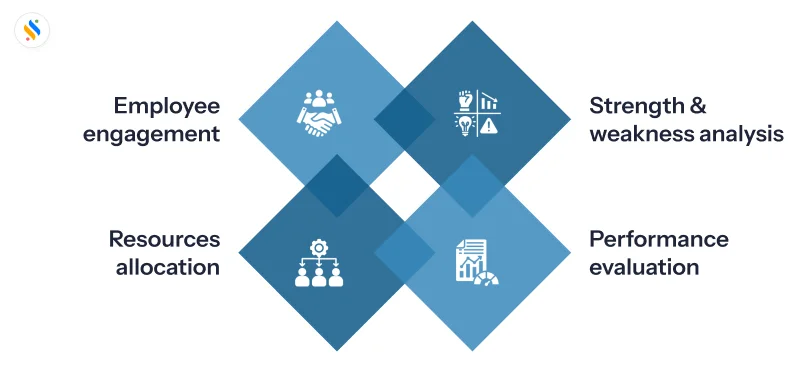
Apart from its cons, staff productivity tracking has its pros too.
Strengths and weaknesses get identified:
It gives clear data to see how each person and team is doing, showing both strengths and where they can improve.
Performance management gets better:
Assessing employee productivity helps management understand how well their staff is performing and gives them a clear way to provide constructive feedback for improvement. These assessments also help employees understand what their managers expect from them and what standards they should meet in the workplace.
Smart resource allocation:
Another benefit is that managers learn about how the workforce and departments are using the resources. Evaluating the output levels enables managers to allocate the resources efficiently, so that the maximum results are assured.
Boosts staff engagement:
Measuring employee productivity also benefits employees by boosting their overall satisfaction. It helps them see that their efforts are being noticed and appreciated. When employees feel recognized for their hard work, they become more motivated and inspired to improve their performance.
Challenges associated with measuring staff productivity
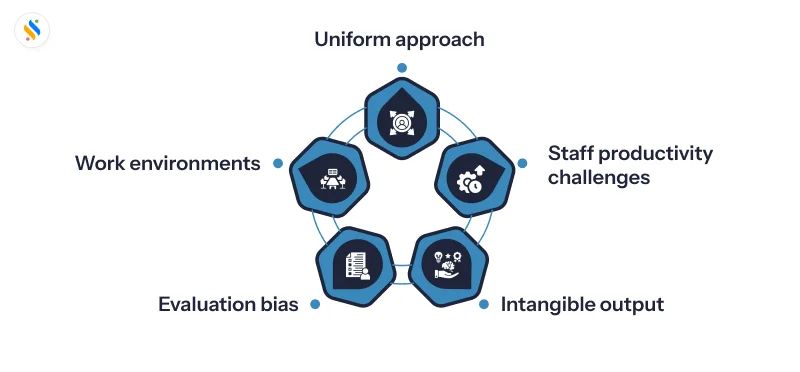
While the results generated from measuring staff productivity enable managers to take strategic measures, the whole process has its own challenges.
Quantity is bigger than quality:
This is one of the classic issues while measuring staff productivity. As said in the introduction, businesses often focus too much on the employees’ output. How many hours did they work, and the tasks did they complete? Things like these that are numerical in nature take the spotlight, while the work’s value, impact, and areas for improvement often get neglected.
Defining “output”:
In the context of employee productivity, output basically means results. However, what happens when the “output” is intangible in nature? In such cases, organisations usually go with the traditional way and ignore the value employees bring through creativity and strategic thinking. These contributions also have a lasting impact.
Bias in evaluation:
The nature of employee productivity measurement is such that biases are frequent. Managers may favor employees who are more of a “one-man army” in some way, while overlooking those who contribute quietly but effectively.
Different work environments:
Measuring employee productivity has evolved a lot, especially after the remote and hybrid style came into existence. Employee performance metrics that measure the amount of time spent in the office are not the only ones that are taken into consideration. Productivity can no longer be defined by visibility. However, different work environments bring unique challenges that influence the employee’s performance.
One size fits all approach:
When it comes to productivity tracking, metrics can’t be the same for two departments. The metrics to measure the productivity of department A cannot be the same for department B. However, when organizations use standard metrics, the results will always be similar.
Still guessing who’s your top-performing employee?
Go beyond guesswork and reward with real-time data
Key metrics that help in measuring staff productivity
Quantitative metrics:
Output per hour worked:
The ratio of total output to the total labor hours worked.
Task completion rate:
The ratio of finished tasks or projects against the total assigned within a specific timeframe.
Average processing time:
The average time it takes an employee or team to complete a single task or process a request. Shorter times indicate efficiency.
Billable hours:
The amount of time spent directly on client work can be charged, linking productivity directly to revenue generation.
Overtime Hours:
Excessive overtime can signal potential burnout or some unaddressed issue.
Error Rate:
The percentage of tasks with errors or defects. A low error rate is essential to ensure high output does not come at the expense of quality.
Qualitative metrics:
Quality of work:
Assessed through regular errors, work standards, accuracy, and timely completion.
Customer satisfaction scores:
Feedback from customers provides insights into how effectively staff are meeting client needs and providing any additional benefits.
Employee engagement and satisfaction:
Measured by how much employees generally feel motivated and productive when they are in the organisation.
360-degree feedback:
Collects insights from multiple sources to provide complete feedback on an employee’s overall performance.
Skill development and initiative:
Evaluates how forthcoming the employee is in learning new skills that can improve their work, and is ready to take ownership of their work.
Tools to measure staff productivity
The most widely used tool is employee monitoring software. The software is extremely beneficial to measure work hours, analyze employee activity, productivity, and performance, and identify areas where efficiency can be improved. All these with absolute transparency.
Best practices to effectively measure employee productivity in your business
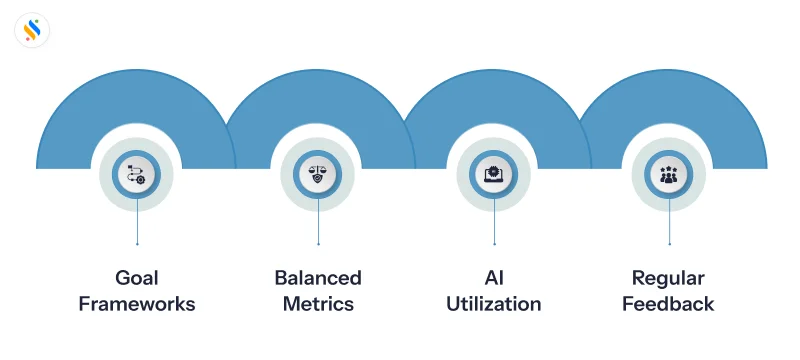
Use goal-setting frameworks:
Efforts get converted into progress when there is clarity. First, you must set SMART goals that will help you ensure everyone is working toward attaining the same objectives.
Quantitative and qualitative metrics are equally necessary:
Numbers are definitely effective, but they don’t present the whole picture. Organisations often make mistakes in choosing quantitative metrics over qualitative ones. The ideal way here is to use both the metrics and create a balance.
Leverage AI and advanced tools:
If you’re not using AI-powered tools in today’s age, you’ll eventually end up guessing everything. These tools reveal more than just numbers. They also reveal the reasons behind tasks getting delayed.
Provide feedback:
Apart from evaluating analytics and reports, give feedback to your employees. Try to make it a week. This will help employees understand the areas where they need to improve.
What does Superworks offer to measure employee productivity?
Superworks is a solid option for measuring employee productivity. Here’s why:
- It gives you real-time visibility into work. Clock-ins/outs, active vs. idle time, app & website usage, screenshots of work in progress.
- You get a user-friendly dashboard with reporting features, so that you can learn about the productivity of not just an individual employee but also of the department.
- It also supports activity monitoring across web apps and websites visited.
- Beyond tracking, it addresses automation of workflows, performance management, goal tracking, and more.
Conclusion on the How Productivity Role and Responsibilities
Measuring employee productivity is about understanding the impact and quality of your employees’ work, along with how much time they spend in the office. Certain metrics that we have discussed here will help you make informed decisions and boost your workforce’s efficiency. Businesses in India can also leverage Employee monitoring software in india for deeper, real-time insights into team performance and output. In this, Superworks will help you. Considered the best HRMS payroll software in India, Superworks offers features and functionalities that help you measure productivity effectively and make smarter decisions. Take charge of your team’s performance. Try Superworks. Book a demo today.










