TL; DR
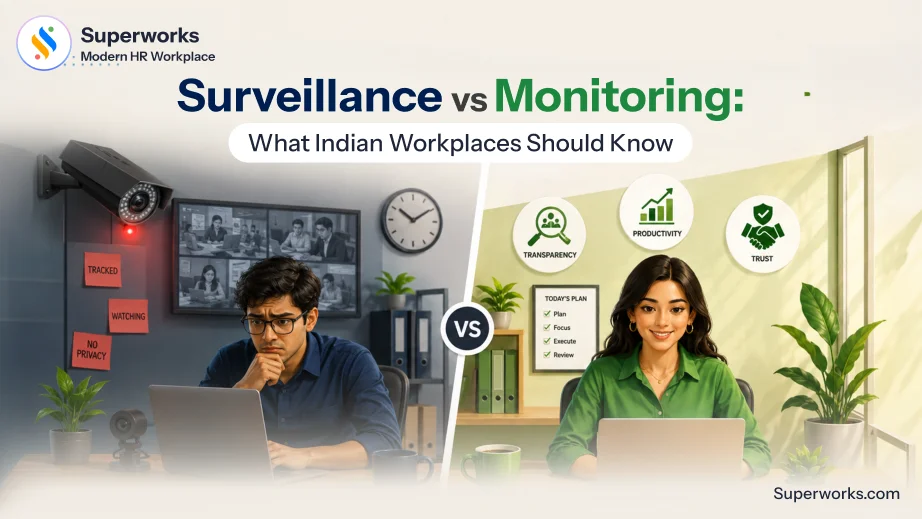
Surveillance vs monitoring sounds like one debate, but they’re two different tools with two different intents. Surveillance watches behaviour, often without full disclosure, to catch problems or protect assets. Monitoring tracks work output, openly and with employee awareness, to improve how teams perform. The line between employee surveillance vs monitoring comes down to three things: what data gets collected, whether employees know about it, and what happens to that data afterwards. For Indian employers, this distinction also carries legal weight — the IT Act, the incoming DPDP framework, and India’s labour codes all treat covert observation differently from disclosed performance tracking. This blog breaks down both approaches, the law behind them, and how to build a policy that protects the business without breaking employee trust.
Google “surveillance vs monitoring,” and most results read like a dictionary entry. They explain the two words mean different things, then move on. That is not enough when you are deciding whether to put cameras on a warehouse floor or roll out monitoring software for a hybrid sales team.
Both approaches watch how people work. But they sit on opposite sides of trust, intent, and, increasingly in India, legal exposure. Having a camera on the factory floor and a time-tracking dashboard might collect overlapping data. But one can land an employer in front of the Data Protection Board, while the other usually won’t.
This guide will give you a walkthrough of surveillance vs monitoring, where Indian law draws that line today, and how to build a policy that holds up if anyone ever asks.
Employee surveillance: An overview
Employee surveillance in the workplace means watching what employees do without telling them everything. CCTV cameras, badge logs, and keystroke recorders are all forms of surveillance of employees at work. The goal is to have absolute control. It exists to catch theft, prevent unauthorised access, or build a case during an investigation.
Employee monitoring: An overview
Employee monitoring works differently. It tracks work, not people. Time spent on a task. Application usage during office hours. Project progress on a dashboard. The intent is operational: spot bottlenecks, balance workloads, support remote teams a manager can’t physically see.
Good monitoring tools tell employees upfront what they track and why. Many even let employees view their own activity data, turning monitoring into a self-management tool rather than a one-way mirror.
This is the core of the monitoring vs surveillance split: surveillance is something done to employees. Monitoring is something built with them, even when it runs on similar technology underneath.
Surveillance vs monitoring: The differences that actually matter
| Factors | Surveillance | Monitoring |
|---|
| Intent | Control, security, investigation | Performance and operational visibility |
| Disclosure | Often partial or covert | Disclosed upfront, usually in writing |
| Data Focus | Behaviour: movements, footage, keystrokes | Work output: time, tasks, app usage |
| Employee Data Access | Rarely, held by management only | Often visible to the employee too |
| Legal Exposure | Higher, especially without documented basis | Lower, when scope and notice are clear |
The technology behind employee surveillance vs monitoring often overlaps. A screen-recording feature can run as silent surveillance or as a disclosed monitoring feature; the line is set entirely by configuration and communication, not by the software itself.
Employee surveillance laws in India: What actually applies right now
India doesn’t have one law titled “surveillance act.” Employee surveillance laws here sit across a few layers, and most generic guides written with a US or EU audience in mind miss this completely.
Start with the Constitution. The Supreme Court has settled that privacy is a fundamental right under Article 21. Any workplace surveillance that goes beyond what a role genuinely needs can be challenged on that basis, regardless of company size.
Next, the IT Act, 2000, and its Sensitive Personal Data or Information (SPDI) Rules, 2011. Until India’s newer data protection framework is fully enforceable, these remain the operative rules for how companies collect, store, and secure any data pulled from monitoring or surveillance tools.
Then there’s the Digital Personal Data Protection (DPDP) Act, 2023. Its Rules were notified in November 2025, but enforcement is phased: full obligations around notice and consent for employers become enforceable only by May 2027. That said, smart HR teams aren’t waiting. Building consent and disclosure into a monitoring program now costs far less than retrofitting it later under regulatory pressure.
On the labour-law side, introducing new surveillance or monitoring systems in establishments governed by Standing Orders, now folded into the Industrial Relations Code, one of India’s four central Labour Codes, can count as a change in service conditions. That usually means employees, and sometimes a works committee, need advance notice before the system goes live, not after.
None of this stops employers from monitoring or watching employees. It just means doing it without a documented basis is a bigger legal exposure in 2026 than most companies realise.
Video surveillance and employee rights in India
Cameras in entrances, common areas, and production floors are generally defensible; security and safety justify them. Cameras in washrooms, changing rooms, or anywhere with a reasonable expectation of privacy are not, and they expose an employer to both criminal liability and civil claims.
Beyond camera placement, employees have a few practical rights worth writing into any policy:
- The right to know that a camera or monitoring tool exists, and broadly why.
- The right to have monitoring limited to company devices and work hours.
- The right to raise concerns without retaliation.
- The right to expect that footage or activity data isn’t shared outside its stated purpose.
None of these rights forces a company to give up surveillance or monitoring. They just demand documentation and restraint.
Tips to write an employee surveillance policy that holds up
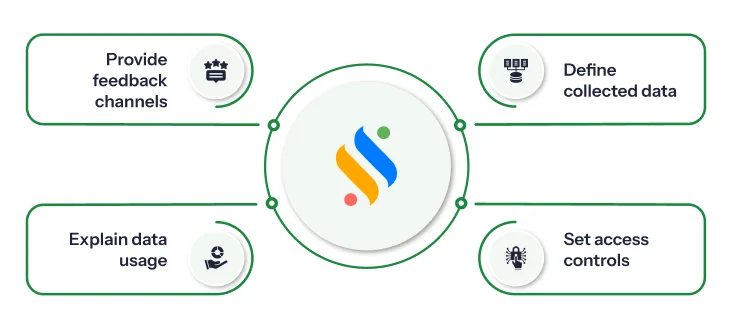
Most employee monitoring and surveillance disputes in Indian workplaces trace back to one missing document: a policy nobody actually saw. At minimum, an employee surveillance policy should state:
Define what data each system collects:
Cameras capture footage. Monitoring software might capture screenshots, app usage, or keystrokes. Spell out exactly what each system records, not just that it “monitors activity.” Employees can’t meaningfully consent to something left vague.
Set clear access and retention rules:
State who can view the data – a manager, HR, IT – and how long it stays on file before deletion. Unrestricted access and indefinite retention are two of the fastest ways a monitoring program starts to look like surveillance, even when that was never the intent.
Clarify how the data gets used:
Be upfront about whether the data feeds performance reviews, security investigations, or both. Mixing the two without disclosure is where employee trust usually breaks down. Nobody minds being tracked for productivity insights — they mind discovering that the same data quietly became evidence in a disciplinary hearing.
Give employees a way to raise concerns:
Include a simple process for employees to ask questions, flag issues, or request their own data. A policy that only speaks to employees, and never lets them speak back, rarely survives a legal challenge — or a morale hit.
Skip the legal jargon. Disputes rarely start because a policy was worded wrong. They start because the policy didn’t exist, or because practice on the ground didn’t match what it promised.
Choosing between surveillance and monitoring for your team
| Use Case | Better Fit |
|---|
| Remote or hybrid productivity | Monitoring |
| Warehouse or factory floor safety | Surveillance (CCTV), light monitoring for shift data |
| Finance or compliance-heavy roles | Documented monitoring; surveillance only for specific investigations |
| Field sales or delivery teams | GPS-based monitoring with clear disclosure |
Most Indian SMBs don’t need true surveillance at all. They need monitoring communicated clearly enough that it never starts feeling like surveillance in the first place.
How Super Track supports transparent monitoring
Super Track is built around the monitoring side of this divide. Activity and time data stay visible to managers and employees, not locked away in an admin-only panel. Screenshots, app usage, and productivity reports come with configurable disclosure settings, so HR teams can match the tool’s behaviour to whatever their employee surveillance policy already promises.
For Indian businesses preparing for the DPDP Act’s full rollout, this matters more than it looks. A monitoring tool already built around consent and visibility gives HR a head start, not a retrofit project, once enforcement catches up.
If you’re rethinking how your team tracks work, see what transparent monitoring with Super Track actually looks like before you commit to anything.
Conclusion
Surveillance vs monitoring was never really about semantics. It’s about what an organisation chooses to build: a culture of control, or a culture of clarity.
Surveillance has its place – security investigations, high-risk industries, specific incidents that need evidence. But for most Indian workplaces, especially remote and hybrid teams, monitoring does the same job without the trust tax. It gives managers visibility, gives employees context, and gives HR a defensible paper trail if the DPDP Act’s full enforcement ever puts that policy under a microscope.
The real test isn’t which buzzword sits in your employee handbook. It’s whether your team would recognise their own workplace from the description.
Ready to make monitoring something your team trusts instead of fears?
Super Track is an employee monitoring software that gives you the visibility you need — time, activity, and productivity data — without the secrecy that turns monitoring into surveillance. See it in action and decide for yourself.
Book a free Super Track trial.










