The Time Management Matrix Explained! A Guide for Smart Prioritizing
Time matrix
7 min read
December 17, 2025
Sticky notes
One of human beings ‘most colourful inventions has managed to find its place in the workplace.
We even wonder how.
Because there are so many advancedworkforce trackingtools that are making a difference in the workplaces globally and transforming their task management.
Yet, some still pick these tiny paper squares that fly away if the fan speed is even slightly high.
And the funniest part?We use them as if they’re some kind of official productivity system.
A pink sticky note becomes “urgent,” a yellow one is “important,” and the random blue one, you don’t even remember writing that one. It feels organised for a moment… until it doesn’t.
That’s the reason you must start looking for something smarter. Something that doesn’t fall off the desk or disappear mid-task. That’s where this blog on time management matrix steps in to save you from this sticky chaos.
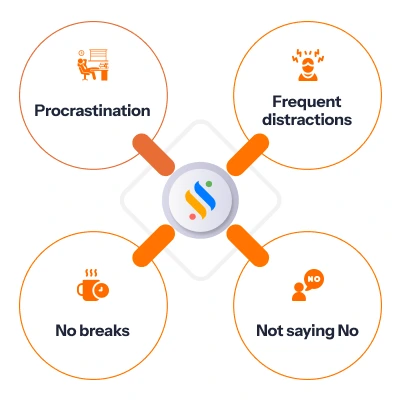
Challenges associated with time management in the workplace
Because we know, you face them too!
Procrastination:
Even disciplined people procrastinate. You keep moving a small task to “later,” it becomes tomorrow, and before you know it, it feels like mountain climbing.
Frequent distractions:
From notifications to random calls to co-workers stopping by “for a minute,” distractions steal more time than most people realise. You think you’re just checking one message, but your brain needs several minutes to get back into focus mode.
Inability to say “no”:
This is a struggle for pretty much everyone, including me. You don’t want to upset someone or look like you’re not supportive, so you end up saying “yes” to pretty much everything – even when your whole brain is screaming “SAY NO!!!” In the end? You get too many tasks… and some stress too.
Lack of breaks in the middle:
There is a myth in the corporate space – if the employees are working non-stop, then they are surely super productive. In reality, skipping breaks drains your brain and weakens your focus.
Covey Time management matrix: An introduction
“I have two kinds of problems, the urgent and the important. The urgent are not important, and the important are never urgent.”
Ever heard this quote? No?
Oh, don’t Google it! Allow me to tell you.
It was Dwight D. Eisenhower, the 34th President of the US and a five-star general during World War II, who said this in a speech in 1954. Back then, it was called the Eisenhower matrix.
Some decades later, an American educator and business guru, Stephen Covey, in his book The 7 Habits of Highly Effective People, discussed this concept.
He named it the time management matrix.
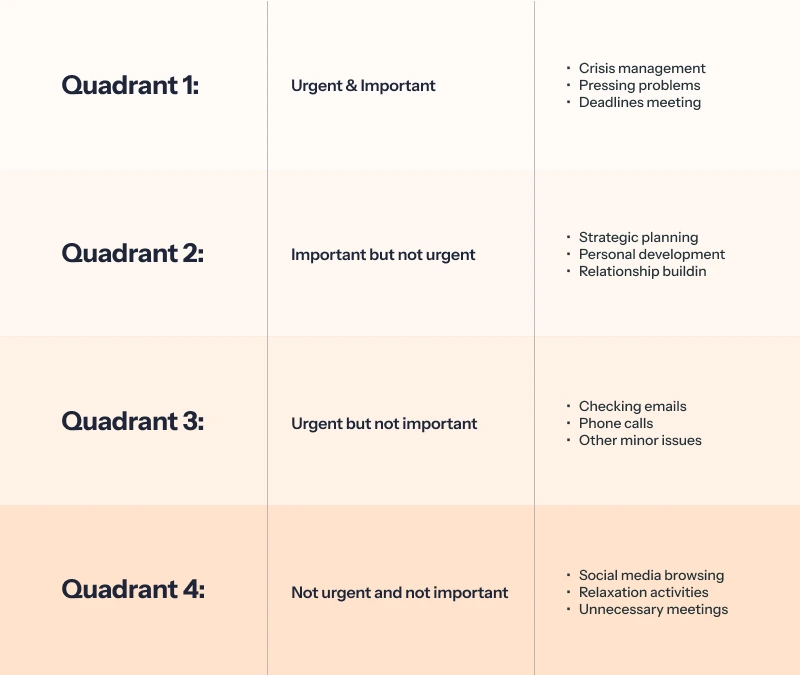
Also known as the Covey time management matrix, the tool is widely used for prioritizing tasks by how urgent and important they are. It’s split into four distinct quadrants.
This way, managers and teams have absolute clarity on their tasks, and they will never get involved in unnecessary activities.
Four quadrants: How does it work?
Quadrant 1:
Businesses often operate in this area. The tasks that fall are critical tasks that demand undivided attention. This includes meeting deadlines of important projects and tasks or achieving some key goals. It is extremely important to prioritize this quadrant smartly.
Quadrant 2:
The Q2 focuses on tasks that are essential in building the overall well-being. Self-improvement, engaging in recreation, personal growth – tasks and activities like these come here. Prioritising tasks in this quadrant leads to significant improvements in personal and project outcomes.
Quadrant 3:
The third quadrant of “urgent but not important” is interruptions that may not be important, but are urgent. This category covers distractions like sudden emails or meetings that don’t really add value. The key is to judge them quickly and smartly so they don’t hijack your day.
Quadrant 4:
This quadrant consists of tasks that are extremely low in priority. They don’t contribute significantly in any way. Activities like spending excessive time on social media fall in this quadrant.
Tired of prioritizing tasks chaotic way?
Start organising your work smartly and breathe again.
So that you know why this system works better than managing through sticky notes.
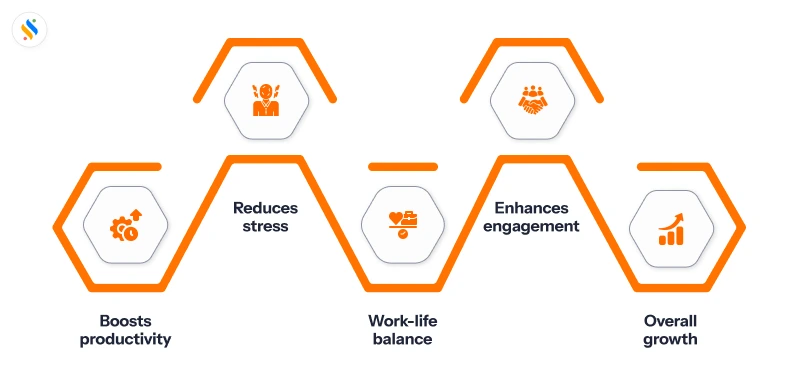
It boosts productivity:
Once tasks are sorted by what’s urgent and important, productivity rises without extra effort. Managers can step back from micromanaging, and teams handle priorities more sensibly.
Mitigates stress:
Now, when your efficiency goes up, you will start to get more and more tasks. Chances are that you will also start to get stressed. But with the time management matrix, stress leaves the room. Its quadrants help you identify and prioritize tasks easily.
Brings work-life balance:
Once you start focusing on what really needs your attention, the unimportant stuff falls away. That’s how you avoid burnout and keep your work-life balance in check.
Enhances engagement:
When people actually know what they’re supposed to focus on, they naturally get more involved in their work. With the time management matrix, work suddenly feels a bit clearer and lighter.
Overall growth:
When you find the hack to manage your time smartly, the growth just kind of starts to happen. You learn to say no to things that don’t add value, and you focus on stuff that actually helps you or the business move forward.
How can you implement the time management matrix in your workplace?
These steps will help you go beyond sticky notes and maintain tasks efficiently!
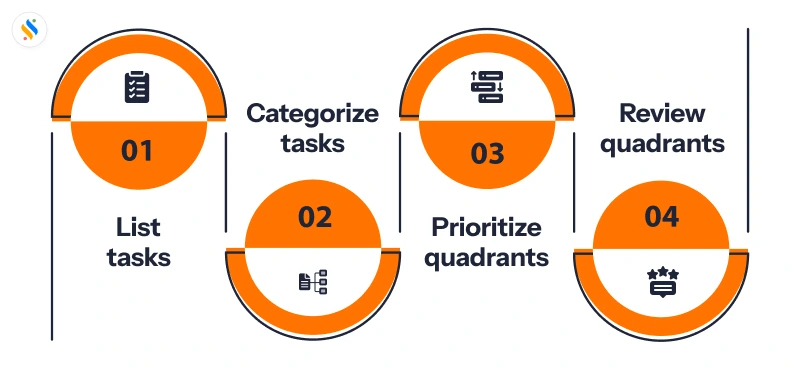
List down all your tasks:
Start by making a list and dump literally every task you have in your mind. Big tasks, small tasks, what you’ve been trying to avoid – everything. Don’t overthink it or try to organize it.
Categorize all your tasks:
Now start sorting tasks into urgent and important. You may change their category a few times, and that’s fine. The goal is to understand what matters now and what doesn’t.
Start prioritizing in the quadrants:
The next step is to place your tasks in Quadrants 1, 2, 3, and 4. What truly needs immediate attention? What can be scheduled for later? What can be delegated to others? And what can you finally stop pretending you’ll ever do? Once you place tasks in the right quadrants, you’ll notice that the work starts to look manageable.
Review your quadrants frequently:
Remember that your quadrants won’t stay perfect forever. Work changes, priorities shift, and new tasks randomly pop up (because that’s how workplaces “work”). Suddenly, what was in Q2 last week might jump straight to Q1 today. Keep revisiting your quadrants every now and then. Check to see if something needs to be moved, updated, or kicked out completely.
Tips for using the time management matrix effectively
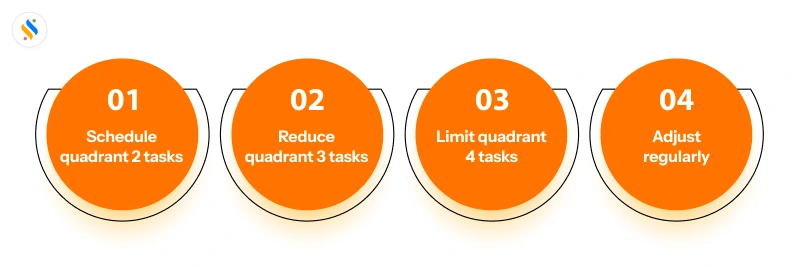
Schedule your quadrant 2 tasks smartly:
Quadrant 1 is the quadrant where you operate daily. But your Q2 is where you actually grow. Because quadrant 2 tasks don’t feel urgent, they’re often ignored. But you should not. Add them to your calendar to keep them on track.
Try to minimise your quadrant 3 tasks:
Tasks that fall under quadrant 3 look urgent, but they don’t add much value. These are usually interruptions or random requests that appear to be important. Try to delegate tasks like these to others whenever you can.
Keep your quadrant 4 tasks within limits:
Quadrant 4 is basically the “stuff you do when you’re avoiding real work” zone – tasks that don’t matter but somehow feel relaxing to do. It’s fine to have a little bit of Q4 in your day because nobody can be productive 24/7, but don’t let it eat up your time.
Review and adjust accordingly:
Keep tweaking your quadrants as you go. Think of the matrix as a living thing rather than a one-time setup. The more you adjust it, the more aligned it stays with your actual workload.
Conclusion
Honestly, the time management matrix is one of those approaches that makes a huge difference once you actually start using it. By categorising tasks into four quadrants, you stop wasting energy on unnecessary things and start focusing on important matters. This way, you reduce the mental clutter and stay organised. So, if you’re looking to manage time, tasks, and productivity in a smarter, more efficient way, the best HRMS & payroll software in India, Superworks, makes the whole process even easier. From attendance to task tracking, everything stays organised in one place. Book a free demo now!
FAQs
Can you provide time management matrix examples?
One of the biggest time management matrix examples is that if you are working on a project that does not have a definite time, you can decide on your own. You do not need to follow an exact deadline, but some fixed time.
Why are quadrant 2 tasks considered to be important?
It is because they are important but not urgent. Tasks in this quadrant focus on long-term goals and proactive growth rather than immediate crises. By scheduling these tasks, you can build a foundation for future success, prevent crises from developing, and achieve personal and professional growth.
Is it necessary to minimize or remove quadrant 4 tasks?
Yes. It is because they are non-urgent tasks, representing time-wasting activities that hinder productivity. While some minor activities can be beneficial for relaxation, excessive time spent in this quadrant reduces overall productivity.
How does a time management matrix help in reducing burnout?
The time management matrix, also known as the Eisenhower Matrix, helps in reducing burnout by providing a structured framework of urgent and important tasks. This prevents the feeling of being constantly overwhelmed by daily crises.
Do advanced tools help in creating a time management matrix?
Yes. Advanced tools like employee monitoring software significantly help. They provide structure, automation, and integration, making the process more efficient and effective. These tools allow for visual task organization, real-time progress tracking, and synchronization across devices, all while helping to prioritize and streamline workflows.
Written By :
Alpesh Vaghasiya
The founder & CEO of Superworks, I'm on a mission to help small and medium-sized companies to grow to the next level of accomplishments.With a distinctive knowledge of authentic strategies and team-leading skills, my mission has always been to grow businesses digitally The core mission of Superworks is Connecting people, Optimizing the process, Enhancing performance.
Superworks is providing the best insights, resources, and knowledge regarding HRMS, Payroll, and other relevant topics. You can get the
optimum knowledge to solve your business-related issues by checking our blogs.