TL; DR
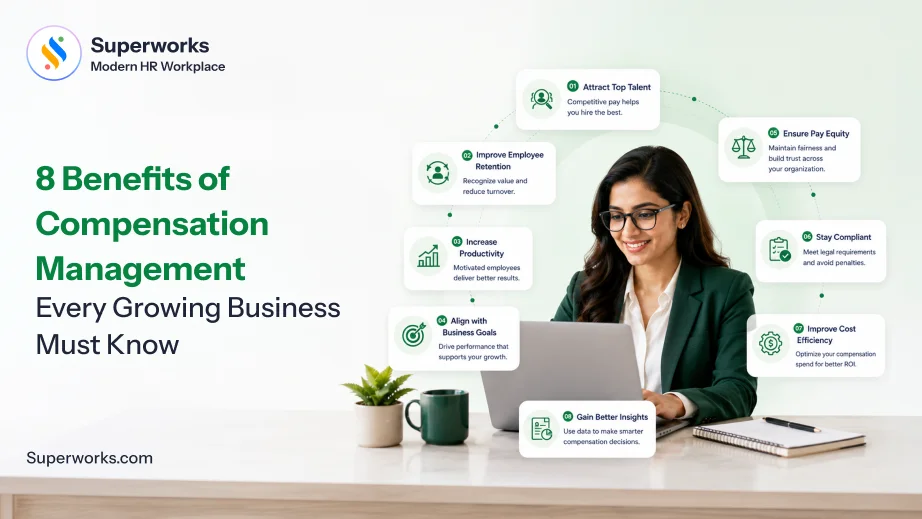
Every HR leader eventually hits the same question: are we paying people right? Not just enough to stay compliant, but enough to keep top performers from browsing job boards. That question is what compensation management exists to answer. It’s the structure behind every salary decision, bonus payout, and benefits rollout, and when it’s done well, the payoff shows up in retention numbers, engagement scores, and fewer awkward pay conversations. In this blog, we’ll walk through the benefits of compensation management.
Here’s a little task for you. Just visit a thriving organization, and you will realize how engaged and dedicated employees are working. Indeed, they are hardworking; after all, that’s the reason why they are there. But the truth is that they are aware of the fact that their organization also rewards them graciously.
Now, take a look at the ones that aren’t doing well. You might easily point out that the workforce is extremely dissatisfied with the environment and management. Why? Because they know that even if they work hard, they don’t get rewarded properly.
Notice the difference here? Every HR manager, C-level executive, and business founder knows that a satisfied workforce is the key to the growth of their business. In this, compensation plays an extremely crucial part.
Most organizations believe that compensation is paying out salaries and bonuses on time. While this is true, compensation management isn’t just that. It is about creating a transparent and structured system that rewards people for their skills, performance, responsibilities, and contributions.
Not to mention that its benefits are immense, and this blog addresses exactly that. Let’s take a closer look at it, and by the end of it, you will learn how it can not only benefit employees but the organization too.
Compensation management: An overview!
Compensation management is all about planning, structuring, and administering how employees are paid. It covers direct compensation such as base salary and bonuses, as well as indirect compensation such as employee benefits and retirement plans. Together, these form different types of compensation that organizations use to attract, reward, and retain employees. Effective compensation management also brings consistency to compensation structures, pay structures, and compensation practices.
Most companies even today use spreadsheets for compensation calculation and management. The problem is that it is extremely ineffective in handling complex compensation structures, tracking salary changes, calculating incentives, and maintaining accuracy as the workforce grows. It is because of this reason, many businesses look for comprehensive payroll software that automates the process of managing compensation.
Objectives of compensation management
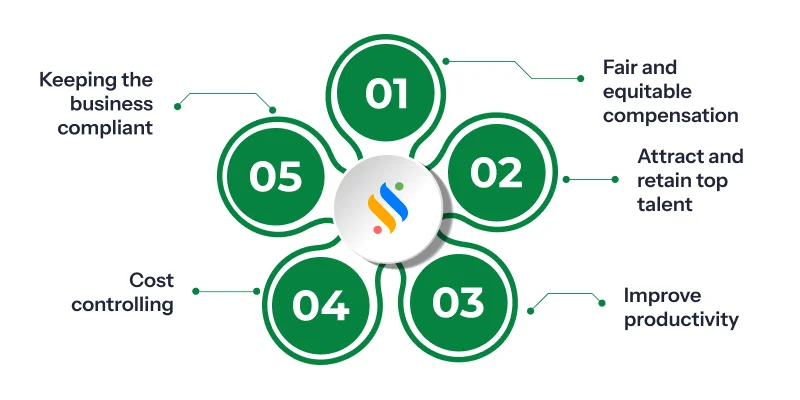
The core of compensation management is to ensure that fair and equitable compensation is paid to employees, and that too on time. However, there are objectives to it too. Let’s understand them.
1. Ensure fair and equitable compensation:
Effective compensation management helps ensure fair compensation through transparent pay practices. It also promotes internal equity, so employees in comparable roles are rewarded consistently based on their responsibilities, skills, and performance.
2. Attract candidates and retain talent:
Another core role of compensation management is to develop compensation strategies that help companies attract top talent and retain existing employees. Offering competitive salaries and well-designed compensation packages becomes especially important in a competitive job market, where skilled professionals have more options.
3. Improve productivity:
Compensation is a key motivating factor, and well-designed compensation strategies can motivate employees by connecting rewards with their contribution. When employees see a clear link between performance and rewards, they are more likely to stay engaged, improve employee performance, and contribute to a motivated workforce.
4. Helps in controlling costs:
Compensation management controls unnecessary expenditure. It is equally effective in helping companies to keep their budget under control and utilise existing resources sensibly.
5. Keeping the business compliant:
Under Indian statutory compliance, compensation is an essential component. Effective compensation management ensures that the organization stays aligned with the state and central government rules and regulations.
8 essential benefits of compensation management
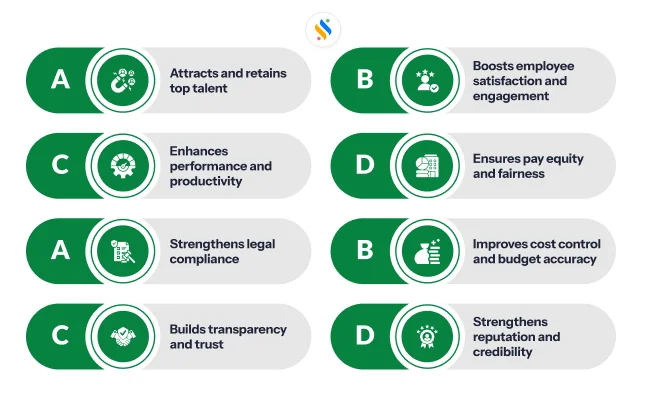
1. Attracts and retains top talent:
A clear, competitive compensation management system in place is the first thing every employee evaluates, especially the new ones. When your pay structure is solid, you win better talent and lose fewer good employees.
2. Boosts employee satisfaction and engagement:
When employees understand how their pay is calculated and how rewards are determined, it creates transparency and improves employee satisfaction. A clear approach to compensation and benefits also helps employees understand what they receive beyond their salary. When people see that their contributions are recognized and employees feel valued, it can strengthen employee engagement and job satisfaction.
3. Enhances employees’ performance and productivity:
When compensation is tied to performance, employees have a clear reason to improve their results. Structured compensation management makes it easier to connect bonuses, incentives, and performance-based rewards with measurable outcomes. This gives employee performance a direct connection to compensation and helps organizations build compensation practices that reward meaningful contributions.
4. Ensures pay equity and fairness:
When your compensation system is unstructured, employees can perceive bias and inconsistency in how people are paid. A defined compensation structure helps establish pay equity by creating consistent criteria for salaries, raises, and rewards. HR teams can also conduct pay equity audits to identify gaps and assess internal and external equity. This makes compensation practices more transparent while reducing the risk of employee dissatisfaction.
5. Strengthens legal compliance:
Labour laws, minimum wage laws, and other regulations around employee pay keep changing and can vary by state and industry. Proper compensation management helps organizations maintain compliance with labour laws while keeping pay practices consistent. It also reduces the risk of errors when HR teams review salaries, deductions, bonuses, and benefits against changing regulatory requirements.
6. Improves cost control and budget accuracy:
Compensation is usually a company’s biggest expense. Effective compensation planning helps organizations use compensation data to forecast payroll costs, manage budgets, and make informed decisions during appraisal cycles. With the right compensation planning tools, HR can identify where spending is increasing and control labor costs without compromising fair pay.
7. Builds transparency and trust:
Transparency is the soul of compensation management. When employees can see how compensation decisions are made, there remains no room for any kind of doubt or confusion. Transparency reduces friction and cuts down on repetitive pay-related queries to HR.
8. Strengthens your reputation and credibility:
For any business, no matter whether you are a mid-sized business with 200-400 employees or a large enterprise with a 1000+ workforce, nothing precedes its reputation in the market. So imagine when word travels that your company has stable compensation management; it is an indicator that you treat your workforce fairly and reward them transparently. This builds your reputation that keeps on compounding.
Ready to structure your compensation the smart way?
Choose a smart solution that simplifies compensation management from day one.
Key components of compensation management
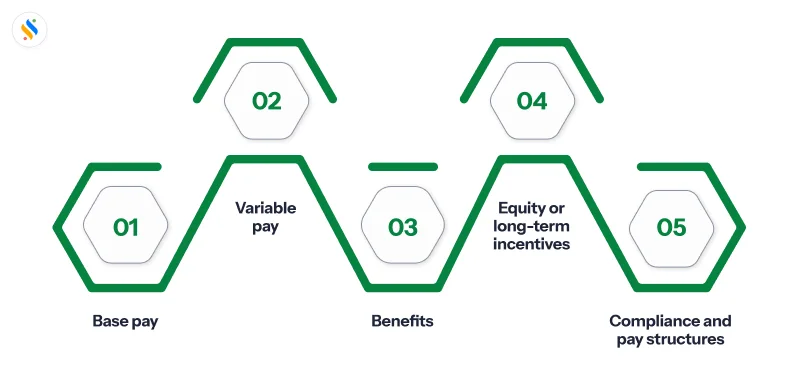
The fixed salary an employee earns, usually benchmarked against market rates.
Variable pay is tied to performance. This includes bonuses, commissions, and incentives.
Benefits can sometimes be both monetary and non-monetary too. Non-monetary benefits include job security and flexible working hours.
Equity or long-term incentives:
Rewards like stocks are used to retain employees and align them with long-term goals.
Compliance and pay structures:
The pay bands, grades, and legal guardrails that keep compensation consistent and audit-ready.
Why is compensation management software the need of the hour for businesses?
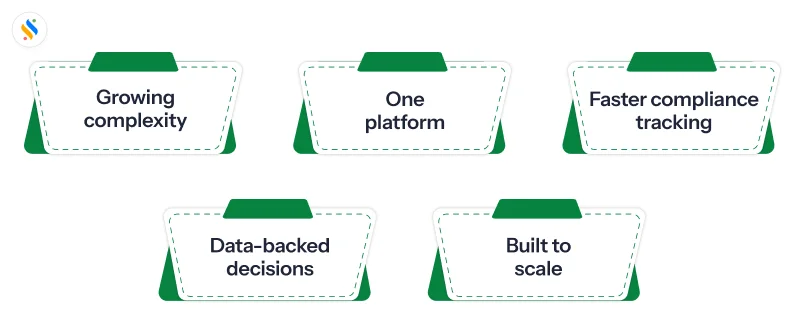
1. Growing complexity, shrinking bandwidth:
Manual pay processes worked when teams were small, and pay structures were simple. But what happens when the headcount grows, pay bands multiply, compliance rules change, and performance-linked incentives get harder to track? That’s why there is a need for a smart solution that can streamline the entire process.
2. One source instead of scattered spreadsheets:
When data related to salary and benefits gets stored on one platform instead of different spreadsheets, HR spends less time reconciling numbers and fixing errors.
3. Faster & more accurate compliance tracking:
Having a compensation management tool is essential because labour laws are not rigid; they keep evolving. The tools here track these changes in real-time.
4. Data-backed decision-making:
Instead of relying on gut instinct during appraisal season, the right system gives HR real benchmarking data, budget forecasts, and pay equity insights – so raises and bonuses are backed by numbers, not guesswork.
5. Built to scale with the business:
As a company adds locations, roles, or pay structures, manual processes buckle first. A proper system scales alongside headcount without needing a bigger HR team just to keep up.
Super Payroll: The modern solution for compensation management
Imagine you have a small business and your workforce strength is between 50-100. Now, you are not wrong if you choose to manage the compensation of your staff through spreadsheets. But what would happen the moment the business starts to scale and headcount increases? This is where the limitations of spreadsheets become visible!
Plus, spreadsheets are extremely error-prone. Your team has to take out extra time to ensure that there won’t be any errors. Isn’t that tedious? That’s why businesses choose a smart, long-term solution – automation. There are so many compensation management tools out there, but there is a reason why Super Payroll stands out! An essential module of Superworks, this is software that has taken so many businesses in India away from spreadsheets and made their compensation management process efficient.
No matter what the business size is or what the industry is, Super Payroll is serving every company and making payroll processing and compliance management efficient.
Conclusion
That’s it for this blog! By now, we are pretty sure that you must have understood the benefits of compensation management. Compensation is one of the biggest motivating factors for the workforce. It compels them to give their absolute best, which is eventually beneficial for any organization. Now, for most organizations, it is simply limited to ensuring that their workforce receives timely and accurate payment. But that is just one aspect of it. The purpose is to put it out there that, through effective compensation management, businesses can attain a lot more. We are in the era of AI, and for effective compensation management, it is necessary to have a compensation management tool in place. Spreadsheets might be effective, but their limitations hit the moment the workforce expands and the business scales. An effective compensation management tool automates and streamlines the entire process. Now, there are several out there that claim to be the best, but there is a reason why businesses trust Super Payroll to manage their workforce’s compensation. Want to understand it better? Book a demo and see it for yourself!










