TL; DR
If you want to track the day-to-day work of your employees, whether they are in the office or remote, you need a monitoring tool. But, before that, you need an employee monitoring policy. It is the written document that tells your team what you track, why you track it, and what happens to that data once it’s collected. Just like everywhere around the world, workplace monitoring in India is governed by some laws. With the DPDP Act now active in India, “we’ll figure it out later” is a liability. This guide breaks down what a strong employee monitoring policy actually contains, walks through real-world policy examples for three different kinds of teams, flags the mistakes that get policies challenged, and shows you how to roll one out without triggering a trust crisis on your floor.
Imagine your employee, almost by accident, finds out that his screen activity is getting recorded, and the data has been logged for months.
Nobody told him about this, and you, as a manager, didn’t present any written document. No explanation, nothing. Within weeks, other employees also started to have similar experiences. By the end of the month, a sizeable number of employees submitted their resignations and started to look for another company.
Now, would you blame them? Absolutely no! After all, they aren’t at fault here. It is the company. But scenarios like these are common in the workplace, where the company keeps their workforce in the dark regarding workplace monitoring.
The result? Breach of privacy and trust, and ultimately, employees quitting!
Hence, it is paramount to have a structured and effective employee monitoring policy in place. While there is a boom in the adoption of employee monitoring tools in the workplace, companies still find it difficult to have an effective policy.
This blog focuses on closing the gap by helping you create an effective employee monitoring policy.
What exactly is an employee monitoring policy?
An employee monitoring policy is a formal, written document that defines the rules of engagement for workplace surveillance. It spells out which activities are tracked, the tools used to track them, the business reason behind the tracking, who gets access to the collected data, and how long that data is retained.
It’s worth separating this from informal monitoring habits. A manager occasionally glancing at a shared dashboard isn’t a policy. A policy is a standing, documented commitment that applies consistently, gets communicated to every employee before monitoring begins, and gets reviewed on a schedule rather than left to gather dust. Without that documentation, monitoring is just surveillance with no accountability attached to it, and that’s the version that tends to end up in front of a labour court or, increasingly, the Data Protection Board of India.
Why your business needs one right now, not “eventually”?
A few years ago, “we should probably write a monitoring policy” sat comfortably on the someday list for most HR teams. That’s changed. Three things shifted the urgency:
The DPDP Act is no longer theoretical:
India’s Digital Personal Data Protection Act, 2023, along with its operating Rules notified in November 2025, has moved from “upcoming law” to “law with a clock running.” Organisations get an 18-month phased runway, with full compliance required by May 2027, but several obligations, including the Data Protection Board’s oversight, are already active. Employee data is treated no differently from customer data under this framework, and non-compliance penalties can run as high as ₹250 crore for a single violation.
Hybrid and remote work erased the old boundaries:
When work happened entirely inside an office, on office hardware, during office hours, the lines were simple. Once people started working from spare bedrooms on a mix of company laptops and personal phones, “what counts as monitorable” stopped being obvious — and policies written for an office-only world stopped covering half the actual risk.
Employees are asking better questions:
Today’s workforce – especially younger hires – is far more privacy-literate than the workforce of five years ago. “Is this being recorded?” and “Who sees this?” are now standard questions, not paranoid ones. A business that can’t answer them with a written policy looks like it has something to hide, even when it doesn’t.
The legal backbone: What Indian law actually says about monitoring
This is the part most employee monitoring policy templates skim past, and it’s exactly where companies get into trouble. Here’s the real legal landscape, in plain terms.
There’s no single “employee monitoring law” in India. Unlike some Western jurisdictions, India doesn’t have one dedicated statute that lays out exactly what employers can and can’t monitor. Instead, the legal basis is stitched together from several sources:
- The Information Technology Act, 2000, particularly Section 43A, which requires organisations handling sensitive personal data to maintain “reasonable security practices.” Legal commentators also point to provisions around traffic data and computer resource monitoring as part of the basis employers rely on when monitoring activity on company-owned systems – though this is interpretive, not a direct grant of blanket surveillance rights.
- The IT (Reasonable Security Practices and Sensitive Personal Data) Rules, 2011 (“SPDI Rules”), which require informed consent before collecting sensitive personal data and mandate that employees be told what’s being collected and why.
- The Digital Personal Data Protection Act, 2023, which classifies your company as a “Data Fiduciary” and every monitored employee as a “Data Principal.” It introduces a useful but narrow exemption: data processing for “legitimate uses” tied to the employment relationship (payroll, attendance, statutory compliance) doesn’t always require fresh consent. But monitoring that goes beyond the standard scope of the job — screen recording, granular activity tracking, location tracking outside work hours — sits in a greyer zone where transparency and a documented, proportionate purpose matter a lot more.
- Article 21 of the Constitution, where the Supreme Court’s landmark judgment established privacy as a fundamental right. Courts have since made clear that this right isn’t absolute and can be reasonably restricted — but only through a documented, proportionate, and transparent process. A monitoring policy is, in effect, how a business demonstrates that it meets that bar.
Monitoring itself isn’t illegal in India. Undisclosed, disproportionate, or undocumented monitoring is what gets challenged, whether through an internal grievance, a labour dispute, or a complaint to the Data Protection Board.
A well-drafted employee monitoring policy is the single document that protects you on all three fronts simultaneously.
(Note: this section is for general awareness and isn’t a substitute for advice from your legal counsel, particularly given how fast the DPDP compliance timeline is)
It’s time to take policy on paper to policy in action!
Back your employee monitoring policy with a tool that is built on transparency and accountability.
What should actually be in your employee monitoring policy?
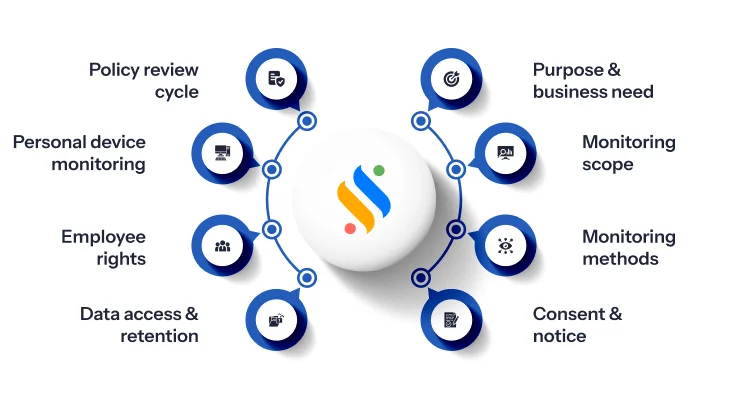
Skip the generic checklists. Here’s how the strongest employee monitoring policies are actually structured, grouped by what each section is doing for you.
1. Purpose and legitimate business reason:
Name the specific reasons monitoring exists: productivity visibility, data security, regulatory record-keeping, or client SLA compliance. Vague language like “to ensure efficiency” invites scrutiny. Specific language, such as “to track active work hours for billing accuracy on client projects,” holds up.
2. Scope:
List the exact activities, devices, and time windows covered. Just as important: state explicitly what’s excluded – personal devices unless enrolled, communications outside work hours, non-work applications. The exclusions often matter more legally than the inclusions.
3. Methods and tools:
Name the categories of tools in use – screen capture, activity/idle-time tracking, attendance systems, network monitoring — without needing to expose every technical detail of how they work.
4. Consent and notice:
Document how and when employees are informed – onboarding documentation, a signed acknowledgement, and an internal policy portal. Under the DPDP framework, “we told them once during onboarding two years ago” is a weak position; renewed, accessible notice is the safer one.
5. Data handling, access, and retention:
Define who can access monitoring data (typically HR and direct managers only – not the whole org), how it’s stored and secured, and how long it’s kept before deletion. Open-ended retention (“we keep it indefinitely”) is one of the most common policy weaknesses.
6. Employee rights and grievance redressal:
State how an employee can ask what’s been collected about them and raise a concern. Even a simple two-line escalation path here significantly strengthens the policy’s credibility.
7. Personal device and remote-work provisions:
For hybrid teams, this is non-negotiable. Be explicit about whether personal devices are ever monitored, and if so, only with separate, specific consent limited strictly to work applications.
8. Review cycle:
State that the policy is reviewed periodically (annually is common) and that employees will be notified of material changes, not just silently updated.
Common mistakes that get monitoring policies challenged
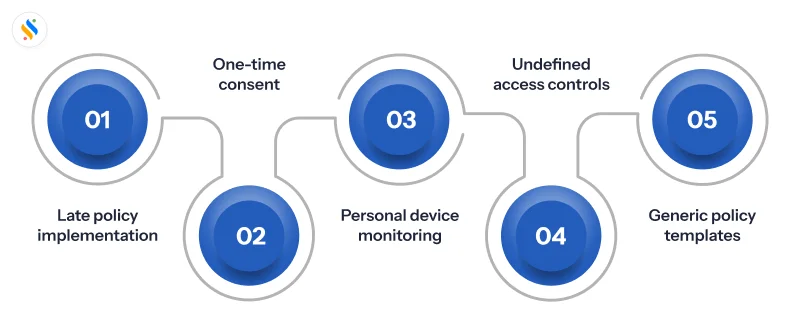
Writing the policy after the monitoring has already started:
Retroactive policies look exactly like what they are – damage control – and rarely hold up if questioned.
Treating consent as a one-time checkbox:
A signature buried in a joining-day stack of forms, never referenced again, is a thin defence years later.
Monitoring personal devices without separate, specific consent:
This is one of the fastest ways to turn a routine monitoring program into a legal dispute.
No defined access hierarchy:
If monitoring data is visible to anyone who asks, you don’t have a policy — you have a leak waiting to happen.
Copy-pasting a generic policy without adapting the scope:
A policy written for an office-only call centre doesn’t fit a hybrid field-sales team, and employees notice when a policy clearly wasn’t written for their actual job.
Tips for rolling out the policy without breaking trust
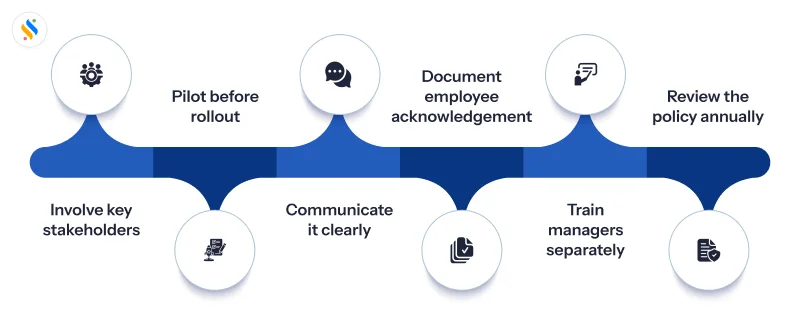
1. Draft with HR, IT, and legal counsel together:
Don’t write this in isolation. HR sees the people-risk, IT knows what’s technically being captured, and legal counsel knows where the DPDP and IT Act lines actually sit. Each function catches a blind spot that the others miss. A policy drafted by just one of them usually shows it.
2. Pilot the language with a small employee group first:
Before a company-wide rollout, test the draft on a small, representative group. Confusing clauses – the ones that sound fine to HR but raise eyebrows on the floor — surface fast this way, and it’s far cheaper to fix at this stage than after a full rollout.
3. Communicate it as a standalone moment:
Don’t bury the policy as one more clause inside a 40-page employee handbook. A short town hall, a dedicated email, or a five-minute walkthrough during onboarding signals that this matters – and gives employees a real chance to ask questions instead of skimming past it.
4. Collect documented acknowledgement:
Get a timestamped, retrievable record that each employee has seen and acknowledged the policy. A digital sign-off through your HRMS works well here, since it’s easy to produce later if the policy is ever questioned.
5. Train managers specifically:
Most monitoring controversies don’t start with the policy — they start with a manager misusing or over-interpreting their access to monitoring data. A short, separate training session for managers on what they can see and what they’re allowed to do with it closes this gap.
6. Review the policy annually:
Treat any new monitoring tool or newly tracked data point as an automatic trigger for a policy update – not something to patch in quietly later. An annual review cadence keeps the document honest about what’s actually happening on the ground.
Put your employee monitoring policy into practice!
A policy on paper is only half the job. It needs monitoring infrastructure that’s actually built to respect the boundaries you’ve written down. That’s where purpose-built employee monitoring software earns its place: role-based access controls, configurable tracking windows, and exportable activity logs make it far easier to operate within a policy instead of constantly working around it.
Super Track, a module of Superworks, is built around exactly this kind of structured, accountable tracking. Work-hour-based activity logs, access limited to authorised roles, and real-time, accurate reporting that maps cleanly onto the kind of clauses outlined above. It’s the tool that makes the policy enforceable in practice rather than aspirational on paper. But don’t take our words. Start your free trial and see the difference for yourself.










