Employee Monitoring Explained: Pros & Cons for Better Team Management
Employee monitoring software pros & cons
8 min read
December 4, 2025
What if,
Your manager announces that the management has made a decision to implement workforce monitoring.
Now, try this experiment and carefully notice your peers.
Over 50% of them will have either a concerning or skeptical facial expression. Why?
There is a reason for it, and it’s something you should know!
Over the years, employee monitoring has gotten a bit of a bad reputation among the workforce.
“It’s a tool of surveillance, it will take away our freedom, the management has lost trust in us.” All this chatter is pretty common. And to some extent, they are not wrong at all.
But employee monitoring isn’t the hero or villain. It’s all about how you use it.
In this blog, we will explore employee monitoring pros and cons in detail, so that you can form an informed decision on implementing it in your workspace or not.
What businesses can achieve with employee monitoring software?
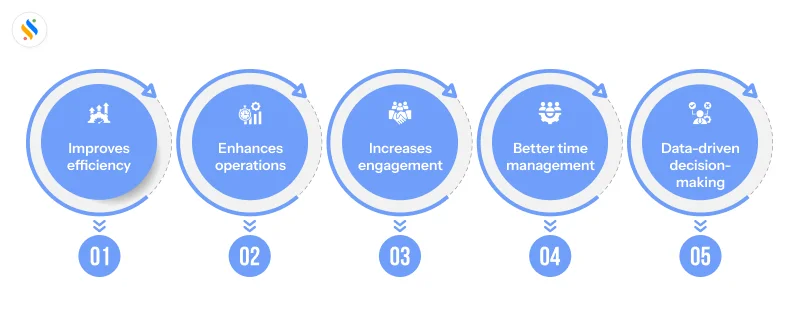
Enhances the efficiency of the workforce:
Ask any HR professional, and they’ll say employee monitoring has helped them improve productivity. It is because it clears blind spots so you can see real productivity and, in turn, gain valuable insights to make better decisions.
Improves the overall operation:
An ideal scenario of a business is where you manage to utilize your resources efficiently and generate promising output. At the same time, optimize the workforce performance. Employee monitoring helps you achieve exactly that.
Make employees more engaged:
It enhances engagement, too. Real-time performance data helps managers guide employees better, celebrate wins, and fix issues early, making employees feel valued.
Time management gets better:
Modern workloads make time management challenging. Employee monitoring shows where time goes, helping identify inefficiencies and improve focus.
Data-driven decision-making:
With monitoring, leaders get clear, real-time insights rather than assumptions. They can spot productivity trends, workload gaps, and bottlenecks, helping them optimise team performance.
Pros of employee monitoring
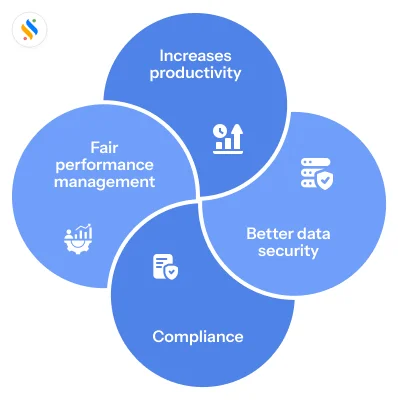
Effective solution to increase employee productivity:
Employee monitoring software plays a key role in boosting the productivity of the workforce. One of the things that is challenging for managers is having no visibility into their team’s work. The result? No real-time insights based on which managers can allocate tasks. This is dangerous as it leads to burnout in employees.
All this changes when businesses have employee monitoring. Managers have productivity reports in real-time, making it easy to evaluate the most productive, least productive, and most idle employees.
Data security gets enhanced:
Cybersecurity has become a serious concern for businesses of all sizes. The rise of AI is also fueling more phishing, ransomware, and social engineering attacks.
On the other hand, threats can be internal too. Employees may, intentionally or unintentionally, expose sensitive information, mishandle it, or fall victim to a malicious link that increases the possibilities of data breaches.
That’s why employee monitoring becomes essential. One of its key features is file tracking, which helps you monitor file transfers, sharing, and access, and flags any abnormal activities.
Helps businesses adhere to compliance:
Ever dared to run a business without complying with the laws and regulations? Good luck if you manage to do that! The truth is that every business – whether it is big or small – must comply with the laws that authorities make.
On top of that, these laws and regulations keep changing. Missing even a small detail can cost businesses heavy penalties. The scariest thing is that if you try to manage compliance manually, chances are that errors will get on increasing, and you’ll surely end up paying hefty prices.
You can save your business with employee monitoring. All you have to do is store all the documents in the tool, and it automatically tracks access and updates. This makes auditing easy and keeps the business compliant-ready.
Effective in fair performance evaluation:
One of the most heartbreaking moments for any employee is when their hard work goes unnoticed, or worse, the performance evaluation is totally biased. This has often been the major drawback of the traditional way of performance evaluation.
This not only affects the confidence of the employee, but it also creates disengagement and makes the workforce distrustful of the leadership, resulting in the overall productivity being affected. To mitigate this issue, you need employee monitoring solutions that help you make unbiased decisions. When the performance evaluation is fair, it leads to enhanced job satisfaction and reduced employee turnover.
Say goodbye to guesswork and hi to clarity!
Get visibility on your team’s productivity for smart decision-making.
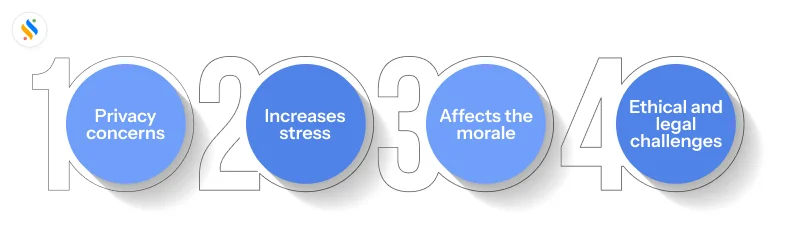
Nobody likes the invasion of privacy, and employees in the workplace are also the same. When employees start to feel that there is a workforce monitoring software that monitors every activity, they will look at it as a privacy intrusion.
This feeling becomes even stronger when employees are kept in the dark. Employees begin to feel anxious and are constantly under pressure. Overall, this will impact their morale, trust, and performance.
It increases stress on the employees:
One of the drawbacks of employee monitoring in the workplace is that it gives rise to “performative productivity,” meaning that employees believe that they have to come across as “always busy.” Instead of focusing on working efficiently, they feel that they need to increase productivity levels on the monitoring dashboards.
This creates unnecessary stress on the employees, as they now have to prove that they have been productive all day. When productivity gets measured through activities like keystrokes and mouse movements, and overlooks activities like brainstorming, anxiety is bound to increase.
Affects the employees’ morale:
How would you feel if you came to know that your every activity is being monitored all the time? You will be uncomfortable, obviously. This is what employee monitoring in the workplace does to employees. It creates a sense of fear that employees’ every movement is being watched. This stuns the capabilities of the workforce.
A belief starts to come that their organisation has very little trust in their workforce. This can steadily start to affect their morale and can also lead to disengagement from their work.
Ethical and legal issues:
Another major con of employee monitoring software is that, in some places, it is heavily restricted under data protection laws. Companies become obligated to follow the rules set by the authorities. Failing to comply can lead to heavy penalties and serious legal consequences.
Then there are ethical challenges, too. Employees often consider it a violation of their privacy, making the adoption of it even more difficult.
How can you bring employee monitoring to your workplace?
After evaluating the employee monitoring pros & cons, it’s time to look at how you can bring it to your workplace.
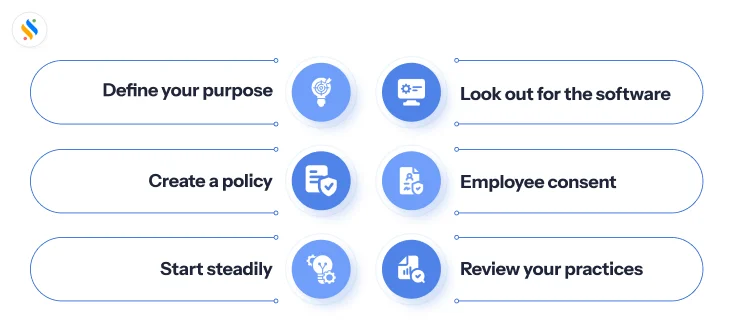
Start by defining your purpose:
The very first step starts with the clarity of why you want an employee monitoring tool in your workplace. Define your goals and objectives. Are you looking,
To track productivity?
Measure the workforce performance?
To manage projects efficiently?
Look for the right tool in the market:
The next step is to look for that “right” monitoring software. Most of the monitoring tools have some common features, such as:
Activity tracking
App and website usage reports
Productivity analysis
Idle time monitoring
Screenshots capturing
keystroke tracking
Create a monitoring policy:
Now, it’s time to create a comprehensive monitoring policy. This is important because it will inform employees of the purpose of workplace monitoring in the first place. Apart from that, it will remove every sort of doubt and bring clarity. And when employees are clear, they won’t look at it as a surveillance tool.
Take employee consent, if required:
If the law around your region clearly mentions that you need to take the consent of the employee before monitoring, then it’s best that you do it. The benefit is that employees will also feel informed and respected. Not obtaining it can land your company in serious legal consequences.
Start at a steady pace:
Once the software is integrated, start to monitor small activities such as tracking login/logout times, attendance, or productive hours, so your employees can gradually adjust to the new system.
Review your monitoring practices:
Set a time, i.e., every few weeks or months, to review your monitoring practices. Take team feedback, reassess the data you track, ensure the tools work well, and confirm your policies meet legal standards.
Wrapping Up
It entirely depends on you whether you want to implement employee monitoring in your workplace. If you don’t, then it’s fine. But, if you do choose to adopt monitoring, you need to understand that it can be a big difference-maker in the overall productivity and performance of your workforce. However, it has its own challenges too, and the employee monitoring pros & cons that we discussed here show that when done thoughtfully, monitoring can bring clarity and efficiency in your organisation. If you also want to make it happen, Super Track from Superworks, the best HRMS & payroll software in India, is the perfect solution you need. With real-time insights, easy setup, and seamless integration, Super Track makes it simple for you to bring smart workforce monitoring into your workplace. Get your free
FAQs
What is workforce monitoring?
It’s the systematic tracking of employee work activities to gain insights that boost productivity, support compliance, enhance security, and optimize team performance.
What can I track with employee monitoring software?
With employee monitoring, you can do keystroke logging, mouse movements, app usage, time tracking, file transferring, and attendance. Apart from this, you can also do internet usage tracking.
Is employee monitoring software bad for businesses?
It entirely depends on how you use it. It is helpful in boosting employee performance if you use it with complete transparency and a clear purpose. Without consent and clarity, it can even lead to serious employee privacy concerns and decreased job satisfaction.
Is Super Track the best tool for monitoring in the workplace?
Yes. It’s one of the most reliable, versatile monitoring tools that offers real-time visibility, detailed reports, data-driven insights, and smart insights, helping managers make informed decisions without micromanaging.
Written By :
Alpesh Vaghasiya
The founder & CEO of Superworks, I'm on a mission to help small and medium-sized companies to grow to the next level of accomplishments.With a distinctive knowledge of authentic strategies and team-leading skills, my mission has always been to grow businesses digitally The core mission of Superworks is Connecting people, Optimizing the process, Enhancing performance.
Superworks is providing the best insights, resources, and knowledge regarding HRMS, Payroll, and other relevant topics. You can get the
optimum knowledge to solve your business-related issues by checking our blogs.