Problems with the traditional approach of tracking performance
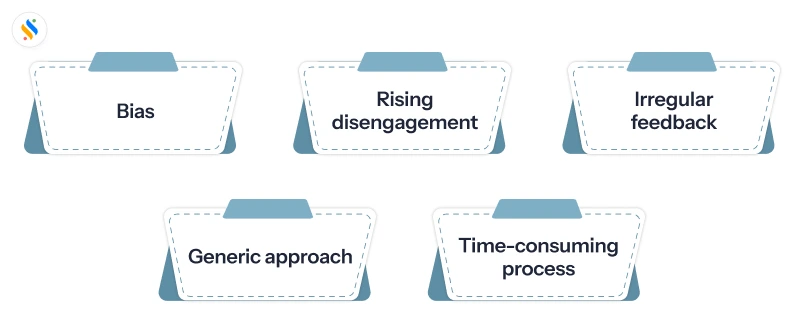
The issue of bias:
Biases in the workplace are the enemy of employees. And, the sad part? It is pretty common in the with the traditional performance management system. Not to mention, there is no real-time data, and the whole evaluation can be based on favouritism. No wonder this is the most common issue in the workplace, even today.
Increases disengagement:
Since we touched upon bias, it is also the reason that employees lose motivation. They may feel their loyalty to the company is not valued. Over time, this can lead to disengagement, missed deadlines, and doing only the minimum required.
Inconsistency in providing feedback:
Teams don’t grow because of yearly performance reviews. They grow when you actually talk to them and provide regular feedback on where they need improvement. Constructive feedback is essential. However, in a traditional method, this is extremely irregular. Now, if this is the scenario, how do you expect from your time to give their best?
One-size-fits-all practice:
Because it lacks any form of smart or advanced approach, the traditional method of performance evaluation is a generic way. It simply follows the set way of evaluation for everyone. Whether it is one employee or an entire department, the employee performance metrics remain the same for everyone. The result? Well, you can guess that on your own.
The process is time-consuming:
The whole process operates in two ways: paper-based and outdated tools. So, imagine having to do a performance evaluation of 100 employees; the process would prove to be extremely tedious. HRs put a great deal of their time either calling every employee to their cabin for 1×1 meetings or looking for tools that can do it for 100 employees or more.
Employee performance tracker: Explained
An employee performance tracker is advanced software or a tool that monitors and evaluates an employee’s performance. This helps managers in identifying the areas of growth and improvement, so that they can make informed decisions.
Employee performance tracker key functions
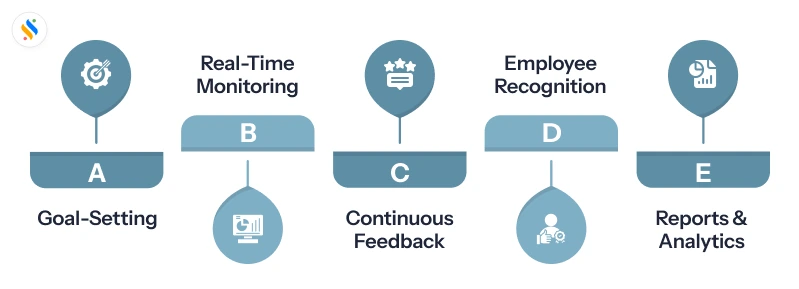
Goal-setting:
Things become pretty easy to do when there is clarity on what to do, who will do it, and how. The same is the case with an employee performance tracker. In my experience, when goals are clear, teams get charged and focus on achieving them.
Employee performance tracker offers you goal-setting frameworks that help you set goals that are specific, measurable, attainable, reliable, and time-bound. In addition to this, it helps you in tracking goals and ensuring that they meet your organisational objectives.
Real-time performance monitoring:
What would you do if you didn’t know,
Who is performing which tasks?
Where is it heading?
How much time is your employee spending on one task?
Simple, you’ll keep on guessing. Thankfully, you don’t have to do that because an employee performance tracker helps you with that, as it provides productivity monitoring insights in real-time. So that you don’t keep guessing about your employee’s performance.
Feedback to employees:
Ongoing feedback is the need of the hour in the workplace. Those days are behind us when managers used to have interactions with their teams quarterly or yearly. When you expect your team to give their best every day, how do you think yearly feedback will work? When you have real-time visibility, you can have regular check-ins with your team.
Employee recognition:
If you don’t reward your sincere and hardworking employee, do you think they will work at their optimum level? I know I won’t! But don’t go with my word; ask your workforce too, will they?
Now, you can save yourself from making things from bad to worse with an employee performance tracker. It shows,
Your top-performing employee
Your least performing employee
And the idle ones too
This way, you can reward the right ones and assist the ones that are lagging. Also, this makes employees feel valued.
Reporting & analytics:
This is, honestly, the best part of having an employee performance tracker, and in my opinion, a time-saving option, too. When you have an employee monitoring software that also measures employees’ performance with automated reporting, you don’t have to wait long for performance reports.
Just a few clicks and you can have the report with analytics of every employee and department. To make things easy for you even further, you can have a dashboard that tracks everything.
Methods of monitoring employee performance:
Let’s take a look:
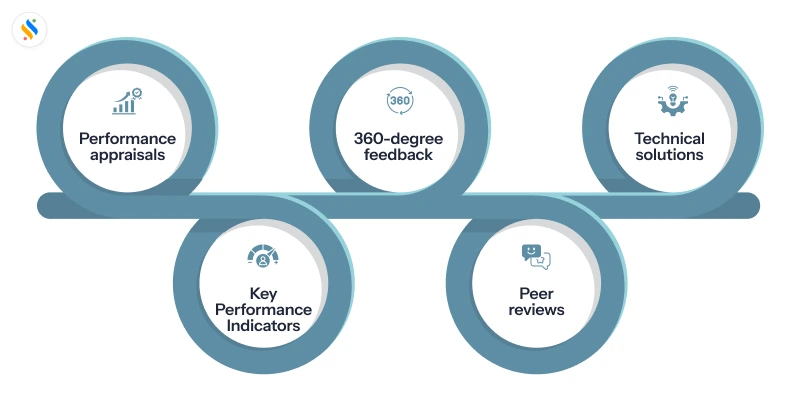
Performance appraisals:
Performance appraisals are yearly or quarterly meetings where you sit down with the employee and go, “Okay, what did we actually do this year?” The idea is to look back at goals, behaviour, and outcomes and just talk it out honestly.
Key Performance Indicators (KPIs):
KPIs are basically the scoreboard. Numbers, ratios, deadlines – all that tells you whether someone is moving in the right direction. They’re super useful for keeping conversations grounded.
360-degree feedback:
This one is interesting because you’re not just listening to the manager anymore; you’re getting opinions from literally everyone around the employee. Peers, subordinates, sometimes even customers.
Peer reviews:
Peer reviews are like a lighter version of 360-degree feedback. You ask teammates who actually work with the person daily. Usually, they’re the ones who know who’s pulling weight, who’s quietly solving fires, who’s ghosting work. The feedback tends to be more specific and practical because peers see the day-to-day reality.
Technical solutions:
Then there are digital solutions, such as monitoring software, that track activity logs, project timelines, attendance patterns, and even app usage. It removes guesswork and helps in spotting trends, bottlenecks, and dips before they become real problems.
Why is an employee performance tracker important?
Here’s why:
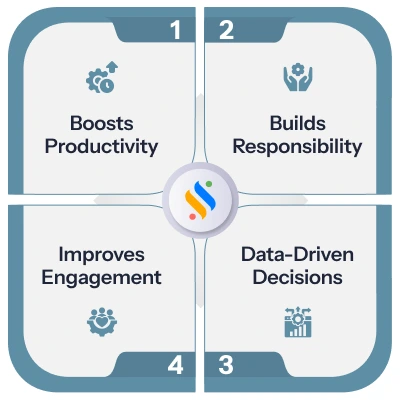
Increases your team’s productivity:
In most companies, managers are unable to gauge the strengths and weaknesses of their employees. They can till the number of employees is small…and they can’t when it is big. However, this won’t be a problem with an employee performance tracking system. Why?
Because it provides real-time data on the employee productivity and performance of your team. This makes it easy for you to assess the areas that are affecting their growth, so that you can make informed decisions.
Makes the employees more responsible:
The moment your employees start to know that their work is being monitored, they start to take ownership of their work. Now, they can’t just ignore any task, because they know that the “big brother” is watching them.
You don’t have to nag them and ask about deadlines. The dashboard will clearly tell the tasks they have and the time that they are spending on them. No micromanaging. 100% responsible workforce guaranteed.
Data-backed decision-making:
When you implement an employee performance tracker in your company, you can rest assured that you will get accurate data. You stop saying that, “I feel like this person is doing good.” Instead, it becomes, “ I know this person is doing well because his performance evaluation data says it.”
The data and reports on job performance you get make it easy for you to manage people and resources with a much smoother workflow.
Enhances the team’s engagement:
You know, when you give constructive feedback on it, you are basically increasing their employee engagement.
You make your employees feel that they and their work are getting valued, which leads to increased motivation, job satisfaction, and a stronger commitment to contributing to the organizational success of your business.
Stop wasting time in manual tracking!
Automate performance management for better workflow.
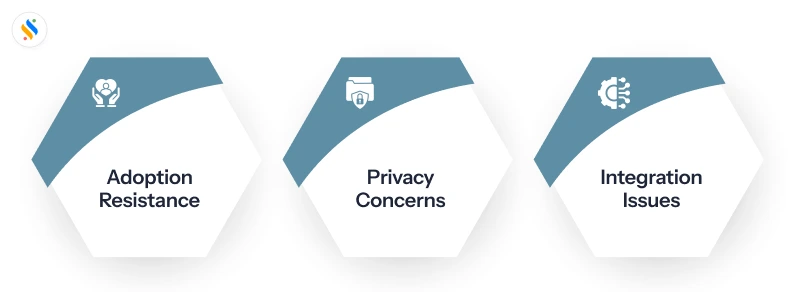
Here’s a truth that we all know – change is everything, but forget one thing about it – it is difficult to accept. Most often, employees feel uneasy or get skeptical about being monitored.
Their concern? This will increase micromanagement. Just the thought of it can make your team anxious and less confident about their work.
Privacy violations:
To make matters worse, employees also consider it a tool of privacy violations. When they feel that even their personal messages and activities are being monitored, they start to worry about their privacy.
This even creates distrust toward management. Even if the monitoring is only meant for work-related tasks, the fear of being “watched” all the time can stick.
Complex integration issues:
Sometimes getting a performance tracker to actually work with all your existing tools is a headache. Glitches and syncing issues often disrupt workflows and hinder operational efficiency, frustrating everyone.
How to track employee performance in the workplace?
So that you can have a seamless experience of employee performance monitoring:
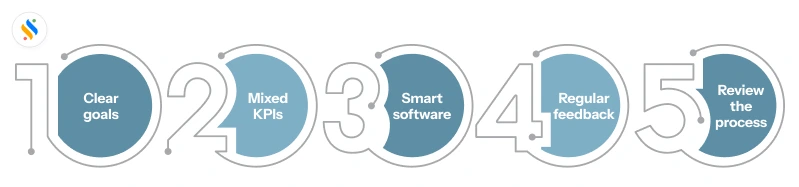
Establish clear goals:
Honestly, tracking performance becomes way easier when everyone knows exactly what they’re supposed to do. If goals are vague, then both you and the employee will remain confused. Keep your goals specific, measurable, achievable, relevant, and time-bound. So that reviewing becomes easy for you and your team has absolute clarity.
Use different KPIs for better results:
One KPI is never enough because people work differently and jobs are not the same. That’s why you need to keep mixing up your KPIs, like quality of work, speed, consistency, teamwork, etc. This way, you’re going beyond a one-size-fits-all approach, and you can have accurate results.
Advanced software can be helpful:
Let’s be real, doing performance monitoring manually is a headache. That’s where monitoring software actually helps. It automates all the manual tasks, centralizes all the data, shows trends, and gives you dashboards so you don’t have to dig through spreadsheets.
Provide continuous feedback:
A lot of managers wait for yearly reviews, but by that time, half the problems become old news. Instead, giving small bits of constructive feedback regularly works way better. It doesn’t have to be formal; even a quick “hey, this looks good” or “try changing this part” helps employees stay on track.
Keep reviewing your performance practices:
Even your tracking method needs tracking. Sometimes the KPIs you set earlier stop working, or the software you use is outdated, or maybe the team’s work style has changed. It’s good to check once in a while whether your performance process is still working the way you expected it.
Tips to keep in mind when looking for an employee performance tracker
So that you can have the best employee performance tracking software for your business:
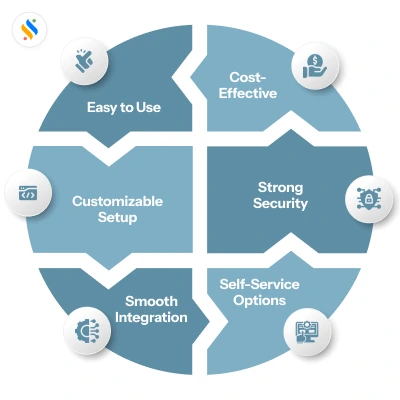
Easy-to-use:
Honestly, I don’t think that you’d use the tool if the tracker is difficult to use. No matter the size of your business, you want something simple to set up and easy for your team to understand without spending hours on training.
Easy to customize:
You want a tracker that can be tweaked to fit your business. Being able to adjust dashboards, reports, and settings to match your team’s needs makes it actually useful.
Smooth integration:
No one wants a tool that doesn’t sync with other existing tools. Smooth integration makes everything flow better, and it’s way less stressful for both managers and employees.
Self-service features:
Giving employees some control over their own data or reports is a game-changer. When they can check their progress or update details themselves, it reduces your workload.
Data security:
You can’t ignore security. All that business info is sensitive, and if it leaks or gets misused, it’s a big problem. The tracker should have strong protections in place. Otherwise, trust fades.
Cost-effective:
Finally, it shouldn’t burn a hole in your pocket. Some trackers look fancy but cost way too much for what they actually do. You want a tool that gives value for your money without breaking your bank.
Conclusion
If there’s one thing I’ve learned, it’s that tracking individual employees’ performance isn’t just about numbers or dashboards—it’s about actually helping your people grow. And yes, employee performance trackers aren’t perfect. But if you want to take a smarter approach and skip the messiness, Superworks can help you do that really well. Superworks is one of the best HRMS & payroll software in India, and it comes with everything you need to measure performance smartly. Book a demo for efficient performance management!
FAQs
What are the key metrics I should use to measure my employees' performance?
It’s a mix of numbers and just watching how they actually work, because numbers alone don’t tell the full story. If you wanna actually know how your employees are doing, there are a bunch of things to look at. Like, are they finishing their tasks on time, are they hitting their goals, and is the work even any good? Then there’s stuff like how much they actually help the team, whether they show up on time, and if they’re learning new things or coming up with ideas.
To what extent are employee performance tracking tools effective?
Employee performance tracking tools can be pretty effective, but it’s not like they’re some magic fix. They help you see who’s doing what, spot bottlenecks, track goals, and give real-time feedback instead of waiting for yearly reviews. That said, their effectiveness really depends on how you use them to get actionable insights. If managers just stare at dashboards and don’t actually act on the data, it doesn’t help much.
Is it hard to set up an employee performance tracker?
It depends. Some are super easy to install, and you’re ready in minutes. Others can be a headache with integrations and dashboards. Honestly, Super Track is the best performance measuring tool that easily integrates with your existing tools.
Written By :
Alpesh Vaghasiya
The founder & CEO of Superworks, I'm on a mission to help small and medium-sized companies to grow to the next level of accomplishments.With a distinctive knowledge of authentic strategies and team-leading skills, my mission has always been to grow businesses digitally The core mission of Superworks is Connecting people, Optimizing the process, Enhancing performance.
Superworks is providing the best insights, resources, and knowledge regarding HRMS, Payroll, and other relevant topics. You can get the
optimum knowledge to solve your business-related issues by checking our blogs.