ESIC 2025: Reforms that are Transforming India’s Social Security!
SPREE 2025 scheme
9 min read
December 26, 2025
What a transformative year it has been for India!
On 21st November, the Indian government released the new labour codes 2025, which have played a major role in building a more transparent and efficient framework for employees and employers. Recently, the government has released new ESIC updates.
The new ESIC circular 2025 highlights how employers, HR professionals, and employees can interact and avail social security benefits.
So, without waiting further, let’s get started and understand how it would affect the employees and the employers.
ESI is a mandatory social security scheme where employers contribute 3.25%, and employees contribute 0.75% of wages. Employers deposit the total monthly amount with ESIC to provide medical, maternity, and disability benefits to workers and their families.
SPREE 2025:
The Scheme for Promotion of Registration of Employers and Employees (SPREE 2025). SPREE 2025 is a one-time initiative that allows unregistered employers and their employees to enrol in the ESI scheme without past penalties or inspections.
Benefits to employers:
Employers can register without being liable for unpaid ESIC contributions, interest, or penalties for periods before July 1, 2025.
ESIC will not conduct inspections or demand past records for the period before the new registration date.
Registering in SPREE 2025 will grant full immunity from legal prosecution related to earlier non-registration.
It’s a one-time registration process and can be completed via the ESIC Portal, Shram Suvidha Portal, or the MCA Portal.
By regularising compliance, employers can avoid the risk of future audits uncovering past defaults.
Benefit to employees:
Avail the social security benefits under the ESI Act from the date of registration.
Primary, Secondary, and Tertiary medical benefits for self and family.
Cash benefits for sickness, maternity, injury, or death during the course of employment.
Reservation of seats in ESIC mental/dental colleges under the ward of the IP scheme.
How to register?
Step 1:
To register, visit the ESIC Portal. You can also do it with other government portals, such as the Shram Suvidha Portal and the MCA Portal. Go to the Employer login option. It will redirect you to the ESIC registration portal. Now, click on Sign Up.
Step 2:
Enter details such as business name, employer’s name, state, region, email ID, and phone number. This information is essential for your ESIC registration. Therefore, it must be accurate.
Step 3:
Add details of all eligible employees, including:
Name
Aadhaar number
Date of joining
Monthly wages
Family details for benefit coverage
Enter wage details very carefully, as they directly impact contribution calculations and future compliance.
Step 4:
Once verification is complete, you will receive an ESIC registration code. With this code, you can start making contributions, and employees can access ESIC benefits.
ESIC Amnesty Scheme 2025:
ESIC has introduced an Amnesty Scheme 2025. Under this scheme, employers can resolve old ESI disputes (up to March 31, 2025) by settling dues, interest, and damages to clear litigation, especially for coverage issues and pending cases.
Types of disputes covered:
Coverage disputes:
Applies to,
Closed units older than five years.
Units closed within the last five years.
Active businesses that are still functioning.
Contribution disputes:
If an employer disagrees with the contribution assessment, they must:
Approach the court for permission to settle out of court.
Provide accurate records such as salary sheets, EPFO data, or IT filings.
If no records are available, contribute a minimum of 30% of assessed dues.
Also, give a written letter stating that they will regularly comply with the provisions of the ESI Act in the future.
Criminal cases:
For insured persons involved in false declarations:
Resolution terms:
Refund the full excess amount received.
Provide a written commitment to refrain from future false declarations.
No interest will be recovered on the refunded amount.
Forgery and criminal conspiracy-related cases are not included.
Prosecution cases:
Cases filed against insured persons for providing false declarations can be withdrawn only if,
They pay all due contributions and associated interest.
In the absence of direct records, fallback options like:
Previous wage data
Form-01 submissions
Survey reports
Minimum wage standards of the state are acceptable to determine dues
If dues and interest are already settled without protest, the case will be withdrawn automatically.
No additional penalties or damages will be claimed.
Key features:
Unregistered employers and employees can join within a 6-month window without worrying about any retrospective action.
Employers registering under the scheme are not liable to pay contributions, interest, or penalties for periods before their registration.
Registered establishments will be free from inspections or demands for records relating to any period before their coverage under SPREE 2025.
Employees who register under the scheme, along with their families, will immediately receive benefits including medical care, sickness allowance, maternity support, and disability coverage.
The scheme is available to factories and establishments with 10 or more employees in areas where ESI is implemented.
Key benefits:
Employers who clear their pending contributions along with applicable interest may receive a full or substantial relief.
A structured out-of-court resolution mechanism is being introduced to settle ongoing disputes related to contributions, coverage, and similar matters.
The scheme covers court and prosecution cases filed on or before March 31, 2025, and even extends to employers who have already availed benefits under earlier amnesty schemes.
In cases where the dispute relates only to damages, employers can close the matter by paying just 10% of the calculated damages, as long as the principal contribution and interest have already been paid.
The Social Security Code, 2020, merges existing laws like the ESI Act (1948), which aims to simplify and expand worker coverage across India, including gig and platform workers.
ESIC under Social Security Code 2020:
New definition of wages:
The definition of “wages” has changed and now includes only:
Basic pay,
Dearness allowance, and
Retaining allowance (if any)
Other components like bonus, employer contributions to PF, house accommodation, etc., are excluded from wage calculation.
This change may increase the number of employees covered under ESIC benefits.
50% Rule:
If an establishment has more than 20 employees, at least 50% of the employees earning up to the wage limit must be enrolled for ESIC benefits.
For smaller establishments, voluntary registration may apply, but the 50% threshold ensures meaningful coverage.
If allowances (like HRA or conveyance) exceed 50% of the total pay, the excess is added back to the “wages.”
New family and dependent definitions:
ESIC has issued clarifications expanding who qualifies as a dependent and family:
Dependants include widowers and grandparents in addition to previous categories.
For female employees, father‑in‑law and mother‑in‑law are now recognised as part of “family” for medical benefits.
Expanded coverage:
Mandatory coverage now applies to establishments in hazardous or life-threatening sectors, even if they employ only one person.
For the first time, gig workers (e.g., delivery partners, freelancers) are eligible for medical and disability benefits.
Establishments with fewer than 10 employees can now opt in voluntarily.
Infrastructure & services expansions:
ESI cards are now being linked with the Ayushman Bharat Digital Health Account (ABHA), making the digital health ID portable across any ESIC hospital in India.
Aadhaar verification for medical or cash benefits isn’t mandatory anymore; beneficiaries may use alternate IDs like PAN, Passport, or Driving license.
The long-term impact of ESIC 2025
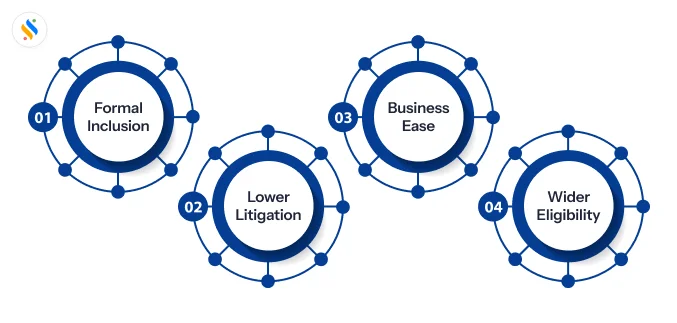
Expanded formal workforce:
It will bring millions of informal workers into the formal social security system, giving them healthcare, maternity, and disability benefits for better financial security.
Reduced litigation and improved compliance:
The Amnesty Scheme is designed to resolve around 27,000 pending court cases as of March 2025. By offering employers a cost-effective way to settle long-standing disputes and waiving damages/interest in eligible cases, ESIC aims to foster a culture of “Less Litigation – More Compliance”. This reduces the burden on the judicial system and encourages employers to adhere to regulations proactively in the future.
Enhanced “Ease of Doing Business”:
By simplifying registration processes through online portals and offering legal immunity from past non-compliance during the SPREE scheme period, ESIC is making compliance less daunting for employers, particularly MSMEs and startups. This is expected to improve the overall business environment in India.
Wage definition and broader eligibility:
The operationalisation of the Code on Social Security, 2020, with a uniform definition of “wages”, will bring many previously excluded, mid-level employees into the ESI net. This ensures that a greater number of employees receive benefits based on a more inclusive calculation of their earnings.
Actions HRs and employers can take
It is high time for HRs and employers to promptly act on these changes. Here’s how to do it:
Review wage components:
“Wages” now primarily include basic pay, dearness allowance, and retaining allowance.
Apply the 50% rule:
If the sum of excluded allowances (e.g., HRA, bonus, conveyance) exceeds 50% of the total remuneration, the excess amount must be added back to the “wages” for ESIC deduction purposes.
Recalculate contributions:
For employees currently earning up to the ₹21,000, ensure the revised wage base is used to calculate the contribution, i.e., 0.75% for the employees and 3.25% for the employer.
Register gig and platform workers:
Employers must prepare to bring gig, platform, and unorganised sector workers under the social security net.
Update Form-1 Declarations:
HR must allow employees to add newly eligible dependents, including grandparents, widowers, and parents-in-law (specifically for female employees).
Link your Aadhaar:
Ensure all new registrations and existing records are linked with Aadhaar to facilitate auto-verification.
Register under SPREE 2025 & ESIC Amnesty 2025:
SPREE 2025 is active until December 31, 2025.
ESIC Amnesty 2025 is active from October 1, 2025, to September 30, 2026.
Start issuing formal letters:
It is now mandatory to provide appointment letters specifying job details and social security entitlements to all workers.
Free annual health checkups:
Employers must provide free annual health check-ups for employees above 40 years of age.
Single portal filing:
HRs and employers must shift to a unified compliance system by filing registrations and returns through the Shram Suvidha Portal or the ESIC Portal.
Conclusion:
The new ESIC 2025 updates by the Government of India are an important step in making the social security system more inclusive, transparent, and streamlined.
The reforms that we discussed here can make organisations not only secure the welfare of their employees but also minimise legal risks and contribute to a stronger, more formalised workforce across the country.
And with our payroll software, compliance with ESIC 2025 becomes effortless. So, book a demo, grow your business, and keep your workforce secure.
FAQs
What is ESIC?
ESIC (Employees' State Insurance Corporation) is an Indian social security body by the Government of India that administers the ESI Scheme, providing health insurance and financial benefits like sickness, maternity, and disability coverage for organized sector workers and their families.
What are the benefits that fall under ESIC?
ESIC provides comprehensive social security benefits, including
Medical care
Maternity benefits
Disability benefits
Dependants' benefit, and
Unemployment allowance.
How to calculate ESI contribution?
To calculate ESI contribution, you apply fixed percentages to an employee's gross monthly wages: the employee pays 0.75%, and the employer pays 3.25%, totaling 4%. Gross wages include basic pay, allowances (DA, HRA, CCA, etc.), and incentives, but exclude annual bonuses or gratuity. However, you can also use advanced tools like the ESI calculator that can help you with the accurate calculation of ESI contribution.
What is SPREE 2025?
The full form of SPREE 2025 is the Scheme for Promotion of Registration of Employers and Employees. It is active from July 1 to December 31, 2025. The scheme is a one-time initiative by ESIC that offers unregistered employers and workers the opportunity to come under the ESI scheme without facing past penalties or inspections.
What is ESIC Amnesty 2025?
The ESIC Amnesty Scheme 2025 is a one-time initiative launched by the ESIC. Running from 1st Oct., 2025, to 30th Sept., 2026, the scheme aims to clear long-pending disputes, reduce litigation, and improve compliance. It offers employers financial relief to settle issues related to damages, interest, and coverage disputes through out-of-court settlements.
Written By :
Alpesh Vaghasiya
The founder & CEO of Superworks, I'm on a mission to help small and medium-sized companies to grow to the next level of accomplishments.With a distinctive knowledge of authentic strategies and team-leading skills, my mission has always been to grow businesses digitally The core mission of Superworks is Connecting people, Optimizing the process, Enhancing performance.
Superworks is providing the best insights, resources, and knowledge regarding HRMS, Payroll, and other relevant topics. You can get the
optimum knowledge to solve your business-related issues by checking our blogs.