TL; DR
A payroll service in India is not just about calculating salaries or filing deadlines for statutory compliance like PF, ESI, PT, LWF, and TDS. It is a matter of efficiency and accuracy. You can use payroll software, hire an outsourced payroll firm, or combine both. The right choice can help you save your HR and payroll team’s time. This blog covers all that in great detail.
Payroll looks simple until the 15th of the month arrives!
Salaries must be accurate, PF and ESI must be filed, TDS must be deposited, PT changes from state to state, and LWF rules keep evolving. One wrong figure and your team notices before you do.
Now, getting all of this right can be extremely challenging, especially with spreadsheets. That is why there is more demand for payroll services in India. A good service takes over the monthly cycle, keeps your filings on time, and gives employees clean payslips. The hard part is choosing.
Some payroll providers in India do the work for you. Others give you software and let your HR team run it. This guide covers everything about payroll service in India.
Payroll service in India: Explained!
A payroll service in India is an arrangement, run by a firm, by software, or by both, that calculates and manages employee pay, applies statutory deductions, pays salaries, and files the required compliance returns.
Mostly, payroll service in India are offered in two ways: One is payroll software, where businesses get an automation tool to handle payroll processing and compliance. The other is outsourcing services, where a third-party vendor entirely handles everything.
Core components of payroll management services in India
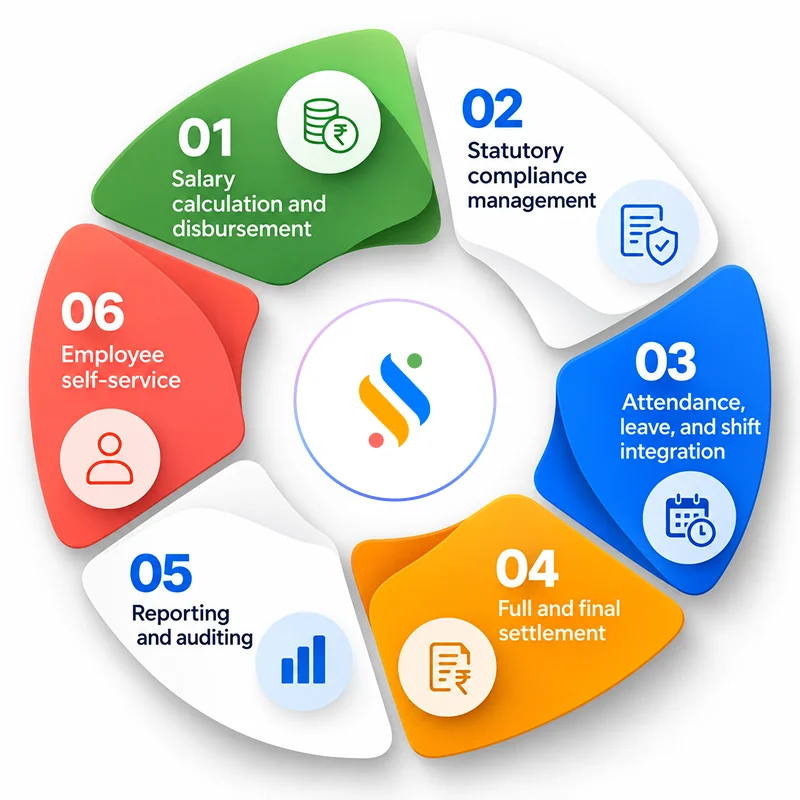
1. Salary calculations and disbursement:
Payroll services calculate each employee’s gross and net salary based on their attendance, leave, overtime, bonuses, reimbursements, and deductions. Once payroll is approved, the system can generate data and maintain a record of it.
2. Statutory compliance management:
Payroll services calculate and manage applicable statutory deductions such as PF, ESI, Professional Tax, LWF, and TDS. They also support the preparation of challans, returns, and compliance reports within the required timelines.
3. Attendance, leave, and shift integrations:
Payroll works with attendance, leave, and shift data to calculate payable days, loss of pay, overtime, and shift-based earnings accurately. Integrating them directly with payroll reduces manual data entry and prevents discrepancies.
4. Full & Final settlement:
When an employee leaves his/her organization, payroll services calculate the final payable amount by considering unpaid salary, leave encashment, incentives, etc. This creates a structured exit process.
5. Reporting & auditing:
Payroll services generate reports related to salaries, statutory compliance, department-wise payroll, etc. This will help your HR and payroll team reconcile payroll, identify discrepancies, and maintain an audit-ready trail.
6. Employee self-service:
Employee self-service gives employees direct access to payroll information. They can view or download payslips, access tax documents, review salary details, and manage relevant payroll requests.
Types of payroll service providers in India
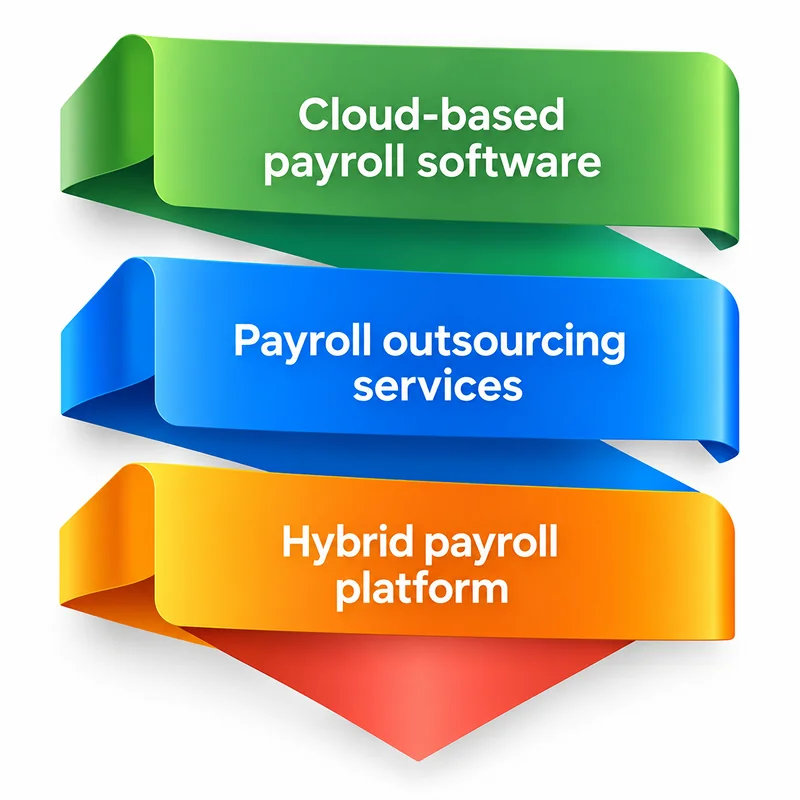
1. Cloud-based payroll software:
The HR team runs payroll inside an online tool. The software calculates salaries, applies PF, ESI, PT, LWF, TDS, generates payslips, and Form 16. You can fix a change on the same day, but someone on your team must own the monthly run.
2. Payroll outsourcing services:
A payroll firm runs the full cycle for you. Each month, you send inputs such as attendance, onboarding/offboarding, and salary changes before the cutoff date. The firm calculates pay, files returns, and shares payslips.
3. Hybrid platform:
Payroll runs on software, while an external expert handles filings, audits, or complex cases. Some providers bundle this as software plus a managed service. Your team keeps daily control, and the expert covers the risky work, such as multi-state professional tax or labour code queries. It costs more than software alone but less than full outsourcing.
Take the complexities out of your payroll cycle with the smart solution!
Manage payroll, compliance, employee payslips, and more without any manual work
How do the new labour codes change payroll services for businesses?
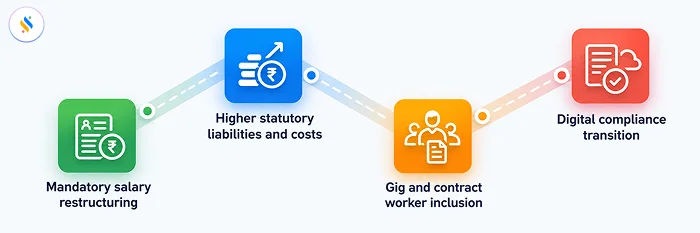
1. Mandatory restructuring of the workforce’s salary:
Under the Code on Wages, basic pay, DA (Dearness Allowance), and retaining allowance must make up at least 50% of total remuneration. If HRA and other allowances go above 50%, the excess is added back to the wage base. Companies that keep basic pay at 30-40% of CTC must rebuild their salary structures. Your payroll provider should let you edit structures and preview the impact before the next run.
2. Escalated statutory liabilities & costs:
A higher wage base means a higher PF and gratuity base. Employer contributions rise, and take-home pay can fall for employees. Overtime and in-kind benefits such as food coupons also count toward the 50% computation, according to the Ministry.
3. Inclusion of gig and contract workers:
The Code on Social Security extends coverage to gig and platform workers, and the codes bring contract workforces into clearer view. Businesses that use contract staff or freelancers need accurate records for them too. Your payroll setup should track them separately and keep accurate reports.
4. Moving towards digital compliance:
The codes push employers toward digital records, online filings, and system-based inspections. Documents stored in physical registers and spreadsheets will get lost easily. Look for a provider that maintains an audit trail, generates compliance reports instantly, and updates when state rules change.
Mistakes most Indian businesses make when choosing a payroll service provider
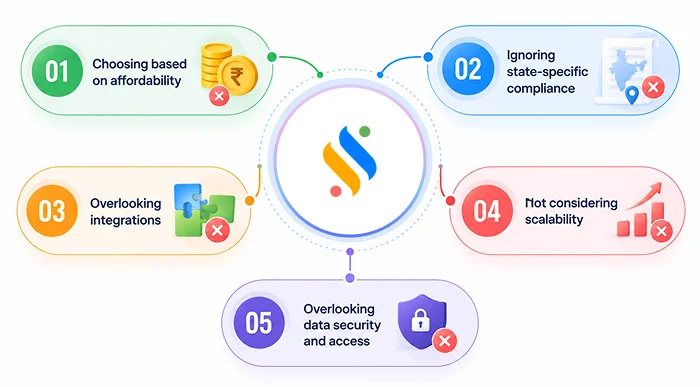
1. Choosing a provider simply because of affordability:
The affordability often leaves out key compliance operations like filings, off-cycle runs, year-end tax work, or setup fees. You then pay extra later, or your team does the missing work by hand.
2. Ignoring state-specific compliance:
PT slabs and LWF rules differ from state to state. A provider that is strong in Gujarat may be weak in Karnataka. A wrong deduction affects every employee in that state and can lead to notices and penalties.
3. Overlooking integrations:
If attendance, leave, and reimbursements sit in separate tools, someone must copy that data into payroll every month, and that is where most errors start.
4. Not considering scalability:
A tool that suits 40 employees may struggle at 100. On top of this, switching providers mid-growth is costly and disruptive.
5. Overlooking data security & access:
Payroll data includes salaries, bank details, and PAN numbers. Many businesses never ask who can view it, on either side. Weak access controls raise the risk of leaks, and a leak can damage employee trust.
What to look for when choosing a payroll service provider for your business?
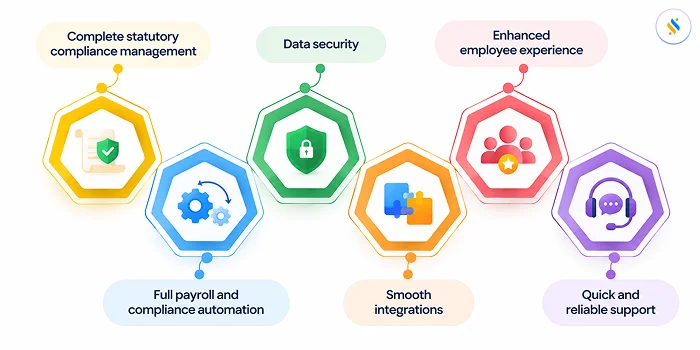
1. Complete statutory compliance management:
Check that the provider covers key statutory compliance – PF, ESI, PT, LWF, and TDS. Apart from this, ensure that you can do proper filings. Ask how quickly they update rules whenever there is a change.
2. Automation of the entire payroll & compliance process:
Having automation shouldn’t be simply about doing salary calculations only. The automation should also handle deductions, challan generation, payslips, Form 16, full and final settlements, and others.
3. Data security:
Apart from salary disbursements, payroll also holds salaries, bank details, and PAN numbers. The bottom line? Security features shouldn’t be optional for you. Look for security features like encryption and role-based access.
4. Smooth integrations:
Most payroll errors start in attendance and leave data. Choose a provider whose payroll connects directly to your HR platform. If you use separate tools, confirm the data syncs both ways and how often.
5. Enhanced employee experience:
Employees should be able to view payslips, download tax documents, submit investment declarations, and check their salary breakup without rushing to HR. A self-service portal cuts the repetitive queries HR goes through often.
6. Quick and reliable support:
Payroll days and compliance deadlines can be stressful, so support must be fast. Look for clear response times, a named contact for your account, and help during the filing window.
Simplify payroll processing and compliance management with Super Payroll!
Running payroll with efficiency and accuracy is no cakewalk. This gets even harder as your team grows. More employees, more offices in different cities and states, and ever-evolving rules – managing all this manually will create errors, and the time that will go into fixing them will be incomprehensible. It is for this reason that businesses invest in the right tool, and that is what Super Payroll is built to do.
A module by Superworks, it is an Indian solution made for Indian businesses. It calculates salaries, applies PF, ESI, professional tax, LWF, and TDS, and generates payslips and Form 16 in just a few clicks. Plus, it is integrated with Super HRMS, so employees’ attendance, leave, and shift data flow directly into payroll. You can also build custom salary structures, manage loans, advances, and bonuses, and settle FnF payments. Employees get self-service access to payslips and tax documents, and HR gets real-time reports and analytics, whenever needed.
Wrapping Up
There you have it, a comprehensive guide on payroll service in India. For any business – irrespective of its size and industry – payroll is the most crucial aspect. It is not something that is limited to employees’ salaries only. A smooth and efficient running payroll indicates that employees are getting paid on time, the pay is accurate, and the company is compliant with the state and central rules.
Now, you can understand the magnitude of it. One mistake here can lead to heavy financial penalties and can even put companies in serious legal trouble. That’s why most businesses in India go for payroll services. We covered it in great length here, starting from what it is to how you can have the right one.
Payroll service in India is all about ensuring that the payroll runs smoothly and businesses remain compliant. If you are also tired of running payroll and managing compliance manually and looking for a solution that can save you time, then check out Super Payroll. Book a demo and bring accuracy to your payroll operations!









