A Guide for HRs and CEOs to Overcome Remote Work Challenges
Challenges of remote working for employers
6 min read
December 9, 2025
Imagine your whole team is spread across cities. Everyone is working exactly the way they work in the office.
The only difference is that everyone is not in the office. They are working remotely.
And the only way to communicate, tools like Zoom!
Now, here’s the question: how’d you manage your team?
If your answer is the way you manage them at the office, then you’re totally mistaken. But you’re not alone, because this is a mistake that most managers and HRs make.
Remote work challenges are totally different from in-office challenges. The systems, visibility, communication flow, accountability, work hours, and even employee well-being – everything changes the moment the office walls disappear.
When leaders fail to adjust quickly, teams often end up battling challenges that slowly drain their productivity.
We believe it’s time to bring those issues to light, and this blog is designed to guide you through understanding and solving remote work challenges effectively.
The interesting thing about the remote working model is that, although being an exceptional one, it has its own set of challenges that managers face.
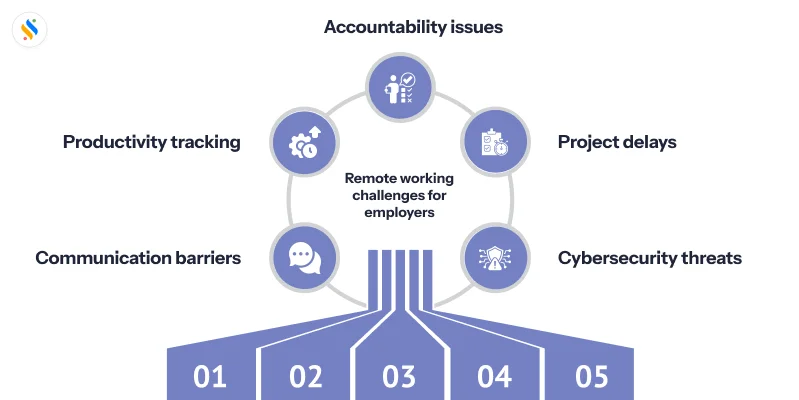
Communication barriers:
Transparent communication often becomes difficult the moment your team starts to work from home. Now, there are reasons for it. Face-to-face interactions are frequent, which increases collaboration. You know how your employees are doing, and you can reach out to your colleague whenever needed. All these form a healthy, productive environment. But when employees start to work from home, all of this changes. Misunderstandings increase, and even simple messages can come across as vague.
Difficult productivity measuring:
One of the biggest skeptisim of remote working is that it makes productivity measuring difficult. This has given birth to the notion that remote workforces aren’t as productive compared to in-house ones. Without a goodemployee monitoring software in place, distractions increase, and supervision becomes difficult. This brings uncertainty, as managers are left with simply guessing on who is the most productive, least productive, and idle.
Employee accountability:
In addition to these, ensuring that the employee remains accountable for their work is another hurdle. Because they aren’t working from the office, it is difficult to track how employees are handling their tasks. While this can also happen in the office setup, chances are that managers can intervene and make an effective decision. But the same can’t be done in remote working. As a result, managers often come to know about this by the end of the day.
Project mismanagement:
Project management is one of the most common remote working challenges. In the traditional office setup, project management is smooth – from task allocation to task progress tracking, everything happens in real-time. Apart from these, managers can quickly resolve project-related problems that the team faces. Unfortunately, this natural coordination is often missing from the remote working style. When task updation gets delayed, it becomes difficult to track how much time is going behind a task. This can also lead to missed deadlines.
Cybersecurity risks:
Cybersecurity risks are one of the biggest challenges of remote working for employers. The security infrastructure goes away the moment you start working from home. A remote workforce works from shared data networks and home Wifi that increases the possibilities of data breaches.
Challenges of remote working for employees
If you think that it is only managers who face remote work challenges, then you’re wrong. Because the challenges affect the employees, too.
Work-life balance becomes a struggle:
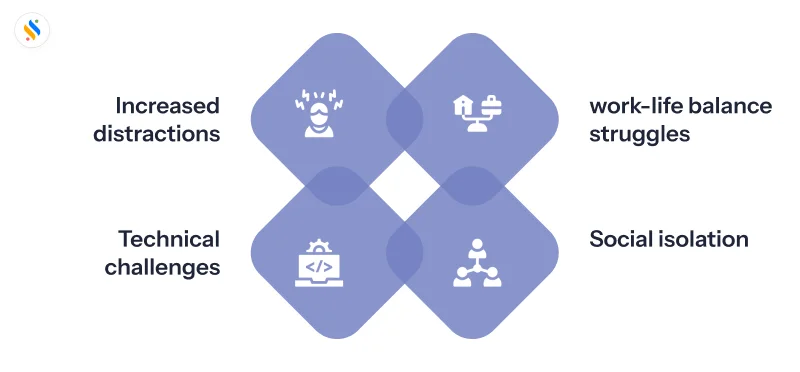
Yes! This is also the reality of the remote working model. Employees often believe that because physical space is now absent, they have much more control over their work. The problem starts with blurred work life boundaries. Personal obligations and family interruptions affect the focus. Also, some employees end up working longer hours because they’re not in the office anymore.
Increasing isolation:
When you spend most of your days at home, your social interactions start to fade. The quick chats, casual conversations, inclusive work environment, and simple moments of connection you don’t get at home. Instead, everything happens through a screen. Over time, this lack of real, human interaction makes you feel increasingly disconnected – and eventually, isolated.
Technical challenges:
One of the biggest fears of the workforce that works from home is internet outage. The biggest benefit of working from the office is that there is an IT team whose job is to take prompt action on such hiccups. This facility isn’t available for remote working. Employees have to troubleshoot all the technical issues on their own, and not doing it will interrupt important meetings and delay tasks.
Increased distractions:
Working from home also brings multiple distractions that are often absent when working in the office. Try this yourself if you are an employee who has kids or is simply married; you’ll notice how easily your focus breaks. A child asking for attention, a quick household task, a conversation with your spouse, or even routine home noises can interrupt your workflow.
How can you overcome remote work challenges for better management?
Transparent communication is key:
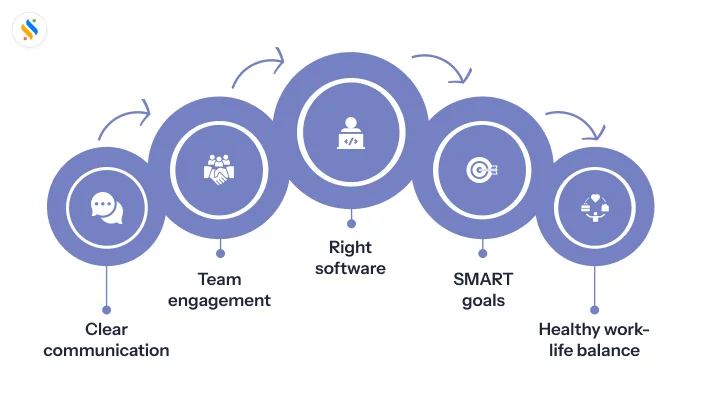
Ensure that effective communication is in place, especially when teams are working from home. Keep all the digital interactions transparent and conduct daily check-ins with your team.
Emphasise team engagement:
Create opportunities for employees to connect personally. Organise virtual team-building events to maintain team cohesion.
Equip with the right software:
Invest in tools like Superworks to streamline workflows, track progress, and centralise all the data, so that any team member can easily access any document anytime.
Don’t measure outcome with hours:
Ensure that your goals are specific, measurable, achievable, relevant, and time-bound. Also, use different KPIs for each role. Instead of tracking how long someone stays online, focus on the quality and impact of their work.
Encourage setting boundaries:
Encourage employees to set their professional boundaries so that they can take care of their physical and mental well-being. Remind your team that it’s okay to disconnect after work and avoid responding to messages late at night, so that they can effectively maintain work-life balance.
Conclusion
The remote working model is here to stay, and with it, its challenges. There is no denying that challenges are equally immense for both employers and employees. However, with a systematic and strategic approach, one can manage effectively and mitigate the challenges associated with it to a great extent. And it becomes easier when you have the right tool. Super Track from Superworks, the best HRMS & payroll software in India, is what you need to make it happen. Get your free trial today and start managing your remote workforce efficiently!
FAQs
What is remote work monitoring?
In layman's terms, it is the way of monitoring and analysing the activities, performance, and behaviour of employees who work from home.
Why is remote work monitoring difficult to manage?
Because visibility naturally drops when employees are not physically present. Managers struggle to measure productivity, track tasks, maintain communication, and ensure accountability. Without a proper workforce tracking tool, everything feels scattered.
What makes Super Track the best tool to manage remote teams?
Super Track stores all the data and centralises it into one place. Whether it is attendance, productivity, project, performance, onboarding, leave, payroll, or compliance, you don't have to juggle through multiple tools for different tasks.
Written By :
Alpesh Vaghasiya
The founder & CEO of Superworks, I'm on a mission to help small and medium-sized companies to grow to the next level of accomplishments.With a distinctive knowledge of authentic strategies and team-leading skills, my mission has always been to grow businesses digitally The core mission of Superworks is Connecting people, Optimizing the process, Enhancing performance.
Superworks is providing the best insights, resources, and knowledge regarding HRMS, Payroll, and other relevant topics. You can get the
optimum knowledge to solve your business-related issues by checking our blogs.