Team Performance Metrics for High-Performing Teams
Tracking performance metrics
6 min read
December 18, 2025
Take a look at your team.
Now, have your thought,
“Is it really performing well…or am I just assuming it?”
It happens a lot. More than a manager even admits.
Some days your team looks super productive.
And some days… it feels like everything is slipping out of control.
Here’s the funny part. You still don’t know why it’s happening!
Are people unclear about what they need to do? Is someone stuck but not saying anything? Or is the workload just uneven?
The truth is, without the right team performance metrics, you’re kinda driving blindly.
Every manager hopes that their team does well, but hope isn’t exactly a strategy. That’s why figuring out what’s holding teams back and how the right metrics can actually help you. This blog aims to do just that.
Just so that you know what is stopping your team from bringing their A game!
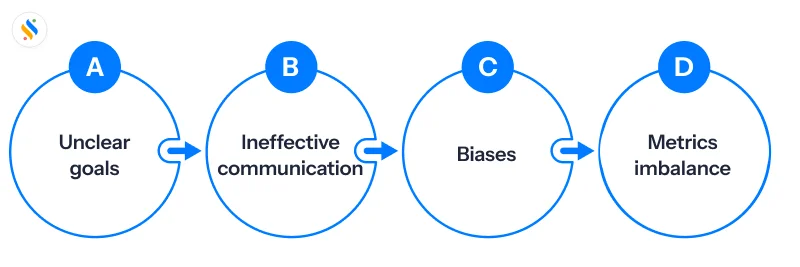
Unclear goals:
A lot of times, the biggest problem is that nobody really knows what they’re working toward. The goals are either too vague… or maybe too big. Sometimes, it is not communicated clearly at all. So people end up doing “something,” other than doing the “right” thing. And when everyone is confused, it becomes almost impossible to measure performance in the first place.
Lack of effective communication:
Then, there is the issue of poor communication…and honestly, I’ve seen that happen a lot! Managers often have a notion that nobody “explains” anything better than they do. Teams often end up believing that “they got it.” But… they didn’t.
Bias:
Suppose you’re a hard-working employee who is passionate about your work and always gives your best. But appraisal comes, and your manager prefers your peer over you for promotion. Shocking! But, do you know why? It is because he “vibes” well with your manager. It can be frustrating. You don’t need an IQ of over 100 to detect bias here.
Imbalance between quantitative and qualitative metrics:
And then there’s this constant confusion about what actually counts as “good performance.” Should you look at numbers only? Or the effort someone puts in? Or how do they help the team? Honestly, most companies end up leaning too much toward the numbers — like how many tasks were completed, how many calls were made, how many hours were logged. But numbers aren’t always true. Someone might be slow because their nature of work might be complicated.
Key team performance metrics:
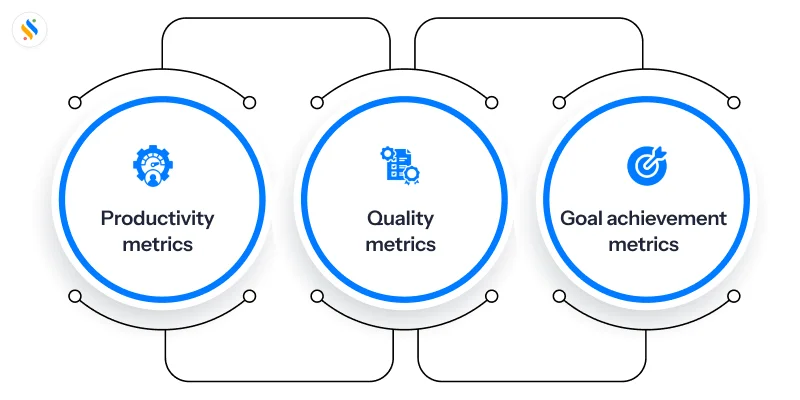
Productivity metrics:
This is one of the most common employee performance metrics. It measures how efficiently a team completes a certain task with the available resources.
Output per team member: The amount of work each member produces
Task completion rate: Percentage of timely task completion.
Project delivery time: Time taken to complete a project compared to the deadline.
Quality metrics:
High productivity matters only when the work meets the quality standards. It assesses the accuracy and excellence of the output.
Error rate: Frequency of mistakes in work.
Customer satisfaction scores: Feedback from stakeholders on the team’s performance.
Goal achievement metrics:
Tracking how effectively a team meets its objectives provides a clear measure of performance.
Key performance indicators: Specific targets for the teams for measuring the team’s performance.
Objectives and key results: Progress toward broader organizational goals.
Importance of measuring the team’s performance
So that you don’t have to keep guessing on who’s working on what tasks, and make informed decisions.
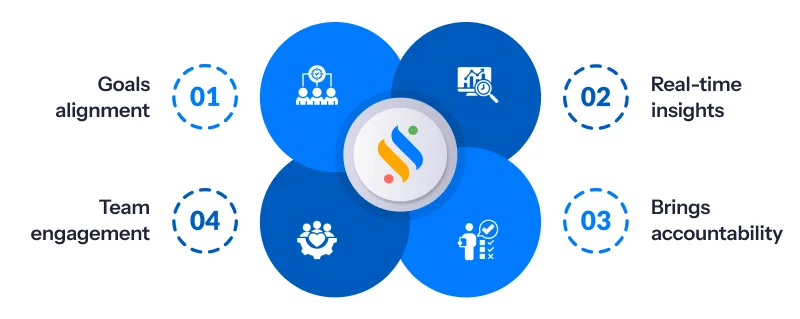
Helpful in making teams aligned with the goals:
Things start to fall in place when your team knows what they’re supposed to be doing. When 10 employees do different tasks and start going in different directions, obviously, things will not go smoothly for you.
Provides key insights in real-time:
What if you suddenly come to know one day that your team isn’t that productive the way you imagine? You won’t like that surprise, do you? However, the moment you have insights into your team’s performance, blind spots go out of the window. You stop assuming and start seeing things as they actually are.
Make teams more accountable:
So when your team knows that they’re actually being monitored, they start to take their work a little more seriously. It’s important because the most common scenarios that happen among teams are that “I thought he was handling this.” This goes away. Everyone knows what is on their plate and by what time they should complete it.
Boosts the team’s engagement:
When people feel seen, they automatically get more connected to their work. It’s that little moment of, “Oh, someone actually noticed what I did.” And honestly, that alone can shift their whole energy. Performance tracking is also about recognising the small wins and those tiny extra efforts.
See how your team’s performing in real-time!
Switch to a tool that actually shows you what’s happening.
Best practices to use the team’s performance metrics effectively:
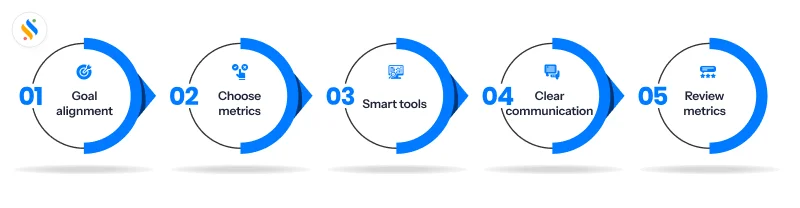
Align your metrics with your goals:
When you’re tracking performance, the first thing is to make sure the metrics actually match what you want to achieve. So start with your main goals and then decide what numbers actually show progress.
Choose the right metrics and KPIs for your team:
Not every team runs the same way, so the KPIs also shouldn’t be copied and pasted from somewhere else. Pick the metrics that are helpful in team performance evaluation.
Opt for the right monitoring tool to track the performance:
Honestly, the tools you pick will either make your life easy or completely chaotic. An employee monitoring software that measures performance gives you real-time data and keeps everything organised.
Ensure clear communication:
Tracking performance can become a dicey thing if you haven’t communicated it with your team. So communicate.
Keep reviewing and updating your team performance metrics:
Metrics aren’t permanent. What worked 6 months ago might not make sense today. So check your team performance metrics on a frequent basis and adjust them when the team’s goals or workflows change. This keeps your performance tracking fresh and relevant.
Tracking your team’s performance shouldn’t be challenging!
So, here we are! The core of this blog is to make you understand that you can’t improve if you can’t measure it! Teams don’t magically become productive just because you “expect” it from them. You need real-time visibility to actually see what’s happening in your team’s day-to-day work. And honestly, you can’t do this manually. That’s why using the right system matters more than anything. Superworks, the best HRMS & payroll software in India, is what you want. It helps you measure performance, track productivity, and understand your team in a way that’s actually useful, all in real time. Book a demo now!
FAQs
What are the team’s performance metrics?
Team performance metrics include quantifiable measures of productivity, efficiency, and quality, such as cycle time and on-time completion rates. They also cover client satisfaction, cost, and goal achievement.
How often should managers evaluate their team’s performance?
Solely relying on annual reviews is widely considered ineffective. Managers should evaluate their team's performance formally at least quarterly, complemented by continuous, informal feedback in regular one-on-one meetings.
How important is it to consider qualitative metrics during team performance evaluation?
It is very important because they provide a holistic view by capturing subjective aspects like teamwork, communication, and innovation that numbers alone miss. Integrating qualitative data with quantitative data allows for a more balanced and comprehensive assessment.
Is Superworks the best team’s performance measuring tool?
Yes. It gives you real-time insights into productivity, work patterns, task progress, and overall team efficiency without any guesswork. Instead of relying on assumptions or manual tracking, the platform helps you see exactly how your team is performing with accurate data and meaningful metrics.
Written By :
Alpesh Vaghasiya
The founder & CEO of Superworks, I'm on a mission to help small and medium-sized companies to grow to the next level of accomplishments.With a distinctive knowledge of authentic strategies and team-leading skills, my mission has always been to grow businesses digitally The core mission of Superworks is Connecting people, Optimizing the process, Enhancing performance.
Superworks is providing the best insights, resources, and knowledge regarding HRMS, Payroll, and other relevant topics. You can get the
optimum knowledge to solve your business-related issues by checking our blogs.