Union Budget 2026: Decoding India’s Steps for the Future
Union Budget of India
9 min read
February 4, 2026
The Union Budget 2026, presented on 1st February 2026 by the Finance Minister of India, lays out the government’s plan for how India will earn, spend, and invest money in the coming year. This year’s budget focuses on keeping growth strong while spending wisely. At the same time, it continues to support social welfare and essential public services. This blog will give you a complete overview of the Union Budget 2026.
₹40,000 crore allocated through the Electronics Components Manufacturing Scheme to expand beyond chip fabrication into semiconductor equipment, materials, and full-stack Indian intellectual property. The initiative includes industry-led research centers and a dedicated skilled workforce development program.
Biopharma SHAKTI
A five-year ₹10,000 crore initiative (BioPharma Strategy for Health Advancement through Knowledge, Technology & Innovation) to position India as a global biopharma manufacturing hub. The program establishes three new National Institutes of Pharmaceutical Education and Research (NIPERs), upgrades seven existing ones, creates 1,000 accredited clinical trial sites, and strengthens the Central Drugs Standard Control Organisation with a dedicated scientific review cadre.
Critical minerals & rare earths
Development of rare earth corridors across four states (Odisha, Kerala, Tamil Nadu, and Andhra Pradesh) with a comprehensive scheme covering research, mining, processing, and manufacturing. Customs duty exemptions on capital goods for processing critical minerals.
Other sectors
Textiles: Integrated program with five components, including National Fibre Scheme, Textile Expansion & Employment Scheme, and Mega Textile Parks.
Chemical parks: Three dedicated parks to expand domestic production.
Container manufacturing: ₹10,000 crore scheme.
Construction equipment: Manufacturing scheme for tunnel-boring machines, metro equipment, and high-altitude road machinery.
Sports goods: ₹500 crore for manufacturing and R&D.
Carbon capture: ₹20,000 crore over five years for CCUS (Carbon Capture, Utilization, and Storage) technology.
Infrastructure Development
High-Speed rail & transport
Seven high-speed rail corridors announced: Mumbai–Pune, Pune–Hyderabad, Hyderabad–Bengaluru, Hyderabad–Chennai, Chennai–Bengaluru, Delhi–Varanasi, and Varanasi–Siliguri. A new dedicated freight corridor connecting Dankuni (West Bengal) to Surat (Gujarat) will link mineral-rich regions with industrial centers and ports.
National waterways
Operationalization of 20 new National Waterways over five years, with special focus on National Waterway-5 (Mahanadi river system), backed by ₹13,000 crore investment. Target: Increase share of inland waterways and coastal shipping from 6% to 12% by 2047. Ship repair ecosystems are planned for Varanasi and Patna.
City economic regions
Focus on cities with populations over 500,000, prioritizing Tier-2 and Tier-3 cities as new economic growth hubs. ₹5,000 crore allocated per City Economic Region over five years for environmentally sustainable infrastructure and passenger systems.
MSME & Enterprise Support
SME Growth Fund: ₹10,000 crore to support job-creating enterprises and enable scaling
Self-Reliant India Fund: Additional ₹4,000 crore for micro-enterprise risk capital.
TReDS platform: Mandatory adoption for all central PSE purchases from MSMEs, integrated with GeM, backed by a credit guarantee.
Corporate Mitras: Professional assistance program in Tier-II and Tier-III towns with modular courses by ICAI, ICSI, and ICMAI.
Income Tax & Direct Tax Reforms
New Income Tax Act 2025
Effective April 1, 2026, the new Income Tax Act replaces 60-year-old legislation with simplified rules and redesigned forms for easier compliance.
No Change in Tax Slabs
Tax rates remain unchanged under both old and new regimes. Under the new regime, income up to ₹12 lakh remains effectively tax-free due to a ₹60,000 rebate, with slabs ranging from 5% (₹4-8 lakh) to 30% (above ₹24 lakh).
Extended Filing Deadlines
Effective March 1, 2026:
ITR-1 & ITR-2 (salaried): July 31 (unchanged)
Non-audit business & trusts: August 31 (extended from July 31)
Audit cases: November 30
Revised returns: March 31 (extended from December 31)
TCS & TDS changes
TCS on LRS reduced to 2% for education, medical, and overseas tour packages
TCS on sellers rationalized to 2% for alcoholic liquor, scrap, and minerals
Lower tax deduction certificates: Centralized automated process through CDSL/NSDL
STT on F&O increased from 0.02% to 0.05% (effective April 1, 2026)
Special Schemes
Share buyback: Now taxed as capital gains for all shareholders
FAST-DS 2026: One-time 6-month window for disclosure of foreign assets/income by small taxpayers
Cryptocurrency: New penalty provisions for non-reporting or inaccurate reporting
Healthcare Initiatives
5 regional hubs with integrated healthcare complexes, AYUSH centres, and Medical Value Tourism Facilitation Centers
3 new AIIMS, 3 new All India Institutes of Ayurveda, NIMHANS-2 in North India
Training of 1.5 lakh multi-skilled caregivers.
Education & Skill Development
5 townships near industrial corridors with multiple universities and research institutions
One girls’ hostel per district for STEM higher education
New National Institute of Design in the eastern region, IIT for Creative Technologies in Mumbai
AVGC (Animation, Visual Effects, Gaming and Comics) labs: Content Creator Labs in 15,000 schools and 500 colleges
High-value crops: Support for coconut, cashew, cocoa, sandalwood
Fish exports: Catch by Indian vessels in EEZ/High Seas made duty-free
Lakhpati Didi: Target of 3 crore women entrepreneurs
The government has proposed the launch of SHE Marts, a community-owned retail store run and managed by women through local self-help groups and community federations.
Digital Infrastructure & Technology
Cloud services: Tax holiday until 2047 for foreign cloud providers serving global customers through India-based data centres
Continued support for the AI Mission and the National Quantum Mission
Education-technology integration across multiple sectors
Trade Facilitation & Customs
Digital clearance: Seamless cargo clearance system by the end of FY; food/drugs/plant/animal system by April 2026
Advance rulings: Validity extended from 3 to 5 years
AEO status: Approval time reduced to 15-30 days with a duty deferral facility
Courier exports: Complete removal of the ₹10 lakh per consignment cap
Duty exemptions on life-saving drugs, cancer medicines, and critical minerals processing equipment
Regional Development Focus
Eastern India: Rare earth corridors, Dankuni-Surat freight corridor, National Waterway-5 (₹13,000 crore), Regional Centres of Excellence in Kolkata and Dibrugarh
North-East: Enhanced tourism infrastructure, mountain trains, heritage site development
Poll-bound states: Significant allocations for West Bengal, Tamil Nadu, Kerala, and Assam, covering freight corridors, high-speed rail, rare earth corridors, and tourism.
What does the Union Budget 2026 have for the IT sector?
The ambition to create India’s digital economy and take the country to the global stage was on full display yesterday. During her announcement of the Union Budget 2026, the Finance Minister prioritised AI, the data centre economy, and manufacturing, laying the groundwork for growth across the startup ecosystem.
The budget also committed to easing compliance, encouraging innovation, and strengthening India’s appeal to global investors and talent.
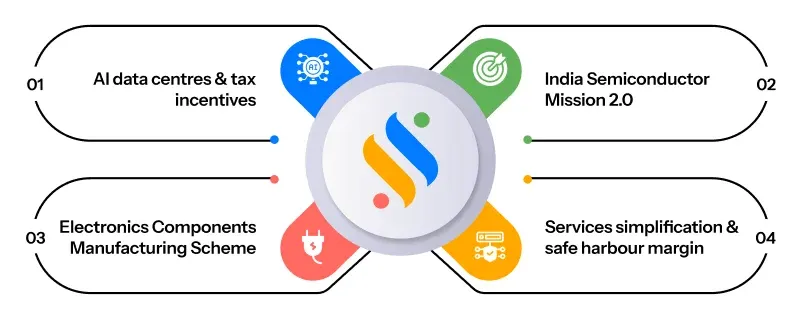
Push for AI data centres and tax incentives till 2047
Highlighting the focus on digital infrastructure, the Union Minister for Electronics and Information Technology, Railways and Information & Broadcasting said that AI data centres play a critical role in the infrastructure layer of the AI architecture. He noted that investments of around USD 70 billion are already underway in India, with announcements of further investments of around USD 90 billion.
The government budget also proposed a tax holiday till 2047 for foreign companies providing cloud services to customers globally using data centre services from India. Such companies will provide services to Indian customers through an Indian reseller entity. A safe harbour of 15% on cost has also been proposed where the data centre service provider in India is a related entity. The long-term policy framework will position India among the leading global destinations for AI and cloud infrastructure.
India Semiconductor Mission (ISM) 2.0
The launch of India Semiconductor Mission (ISM) 2.0 was also announced in the budget. This will be built upon the strong foundation created under ISM 1.0, which established a completely new and foundational semiconductor industry in India. ISM 2.0 will focus on designing and manufacturing semiconductor equipment in India, manufacturing of materials used in semiconductor production, creation of a large design ecosystem, and further strengthening of talent development initiatives. A provision of Rs. 1,000 crore has been made for ISM 2.0.
In the Union Budget 2026, the announcement of increasing the Electronics Components Manufacturing Scheme (ECMS) from about Rs. 22,000 crore to Rs. 40,000 crore also happened.
Services simplification and safe harbour provisions
IT services remain India’s largest exported service sector, with exports exceeding USD 220 billion. To provide tax certainty and support industry growth, the Budget proposes new safe harbour provisions for IT and IT-enabled services with higher thresholds and competitive margins.
All IT services, including software development services, IT-enabled services, knowledge process outsourcing and contract R&D services, have been proposed to be grouped under a single category of Information Technology Services, with a common safe harbour margin of 15.5%.
A Safe Harbour Margin is a fixed profit margin set by tax authorities. If a business meets this margin, the tax department accepts its transfer pricing without further checks.
It removes guesswork from pricing calculations and helps companies avoid lengthy disputes, making compliance faster, clearer, and more predictable.
The threshold for availing safe harbour has been proposed to be increased substantially from Rs. 300 crore to Rs. 2,000 crore, with approvals through an automated, rule-based process.
What has remained unchanged in the Union Budget 2026?
Even though the Finance Minister of India made some promising announcements yesterday in the Union Budget 2026, some things will stay the same. One of these is the tax rates. Here are the tax slab 2026.
Income up to ₹4 lakh – Nil
₹4-8 lakh – 5%
₹8-12 lakh – 10%
₹12-16 lakh – 15%
₹16-20 lakh – 20%
₹20-₹24 lakh – 25%
Above ₹24 lakh – 30%, plus applicable cess.
With a standard deduction of ₹75,000 and a rebate for incomes up to ₹12 lakh, salaried individuals earning up to ₹12 lakh will not have to pay any income tax under the new tax regime.
Key Takeaways
The Union Budget 2026 reinforces India’s growth-first approach with strong investments in all the key areas. While the tax slab remains unchanged, the 2026 Budget of India opens new growth avenues that will act as foundation for a stronger, future-ready India.
FAQs
How is the Union Budget 2026 different from the previous ones?
The Union Budget 2026-27, presented on February 1, 2026, focuses on transforming India into a "Viksit Bharat" by 2047 through record capital expenditure, structural tax reforms, and a push for high-tech manufacturing.
How does the Union Budget 2026 benefit businesses and MSMEs?
The Union Budget 2026 helps MSMEs by improving access to structured funding. The goal is to support business expansion, long-term investments, and better financial stability. The allocated funds will mainly go to MSMEs with strong growth, proven business models, or those operating in key sectors.
What would be the role of a technology like payroll software?
In the Union Budget 2026, payroll software serves as a critical bridge between the government's major tax reforms and their practical execution by businesses. It automates tax compliance, streamlines EPFO, and reduces manual errors.
Written By :
Alpesh Vaghasiya
The founder & CEO of Superworks, I'm on a mission to help small and medium-sized companies to grow to the next level of accomplishments.With a distinctive knowledge of authentic strategies and team-leading skills, my mission has always been to grow businesses digitally The core mission of Superworks is Connecting people, Optimizing the process, Enhancing performance.
Superworks is providing the best insights, resources, and knowledge regarding HRMS, Payroll, and other relevant topics. You can get the
optimum knowledge to solve your business-related issues by checking our blogs.