TL; DR
Cloud-based HRM software stores HR data on secure remote servers and costs significantly less than on-premise over 5 years when hardware, IT, and maintenance costs are factored in. Before signing with any vendor, verify Indian data residency, full statutory compliance (PF, ESIC, PT, TDS), DPDP Act compliance, and ISO 27001/SOC 2 certifications.
The 7 must-have features are mobile ESS, automated payroll, geo-fenced attendance, real-time analytics, tool integrations, and automatic compliance updates. This guide walks you through everything you need to evaluate before committing to a cloud HRMS.
Businesses in India, no matter whether they are a startup, a mid-sized company, or a thriving enterprise, whenever someone talks to them about switching from on-premise HRMS software to cloud-based HRMS, the immediate question vendors face is, “Will our workforce data remain safe?”
And to be honest, that’s a very valid question. This is because there has been a misconception surrounding cloud-based HRMS software. From outsourcing data to being extremely pricey, the list is endless.
So, how about breaking them? And that’s why we have prepared this article. It will explain what cloud HRMS software is, the cost comparison with on-premise, what security and compliance requirements to verify, and which features to prioritize before you sign anything.
What is Cloud-Based HRM Software?
Cloud-Based HRM software is an online platform that stores and manages employee data on secure, remote servers rather than on a company’s system. Unlike on-premise systems, where your data lives on servers you own and manage, a cloud HRMS stores and processes your HR data on the vendor’s infrastructure.
Cloud HRMS vs On-Premise HRMS: TCO breakdown
The total cost of ownership (TCO) over five years will break the perception that subscription-based pricing is more expensive than on-premise HRMS.
| Cost Component | Cloud HRMS | On-Premise HRMS |
|---|
| License / subscription | ₹80–₹150/emp/mo | ₹5–₹15 lakhs upfront |
| Hardware infrastructure | None | ₹5–₹20 lakhs (servers, storage) |
| IT team for maintenance | None | ₹8–₹15 lakhs/year (1 FTE minimum) |
| Software updates | Included | ₹1–₹3 lakhs per major version |
| Data backup and recovery | Included | ₹50,000–₹2 lakhs/year |
| Implementation | ₹50,000–₹1.5 lakhs | ₹3–₹10 lakhs |
| Compliance updates | Automatic | Manual — at additional cost |
| Estimated 5-year TCO | ₹6–₹10 lakhs | ₹55–₹1,10,000 lakhs |
Security and compliance:
No business will ever say that data security is not a top priority. That’s why, before signing up with your vendor, it is important for you to understand what security-related compliance is required.
What the DPDP Act requires from your HRMS vendor:
India’s DPDP Act directly affects how HRMS platforms store and process employee data. Key requirements include:
- Consent from employees before collecting and storing personal data, including Aadhaar, PAN, bank account details, and other details.
- Data residency, meaning whether the servers will be located in India or in another country.
- Data access rights and this is essential because when employees leave, they should be given access to their personal data.
- Data breach notification, so that businesses can take prompt action whenever it hits their systems.
- Purpose limitation, and this is equally important to ensure that their data won’t be used for any other purposes.
Security certifications include,
- ISO 27001
- SOC 2 Type II
- VAPT
- Indian residency
7 features every cloud HRMS must have
When evaluating HRMS Tools for your business, understanding the key features that drive efficiency and compliance is essential.
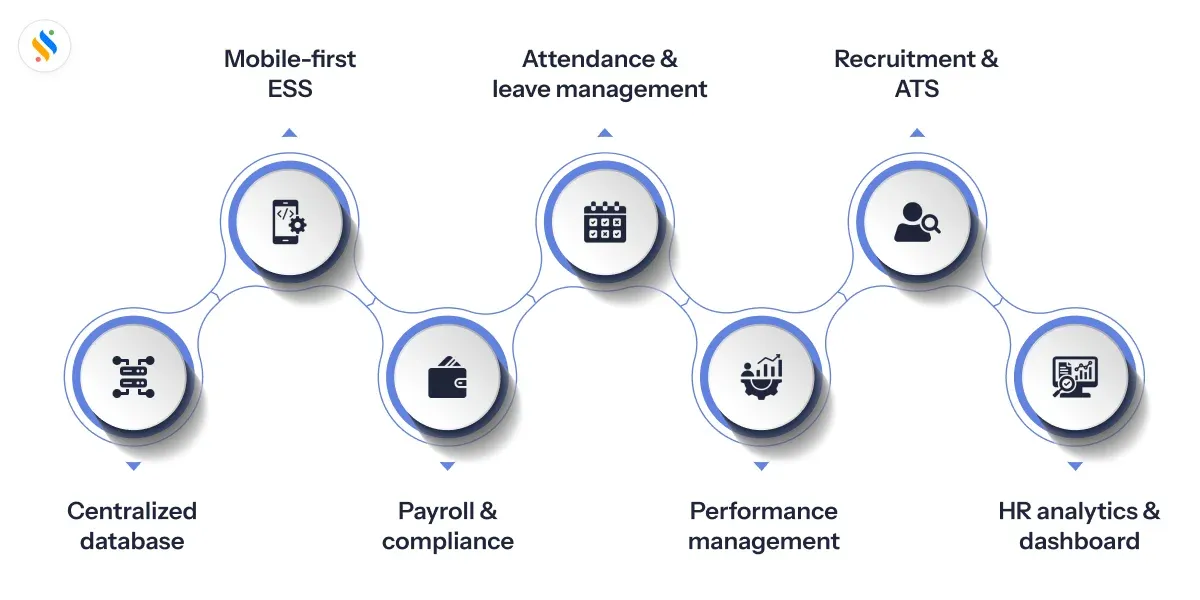
Not every cloud HRMS platform offers the same depth of functionality. Here are the 7 features that separate a cloud HRMS from a basic digitization tool:
Centralized database:
A centralized database is the backbone of a cloud HRMS because it keeps every employee record in one live system instead of spreading it across spreadsheets, shared folders, and disconnected tools. That means HR, payroll, and managers all work from the same updated information for attendance, leave, salary, documents, and compliance, with no duplicate entry or version mismatch. For Indian businesses, this also makes audits, payroll processing, and statutory reporting far more reliable because the data stays consistent across every module.
Mobile-first ESS:
The idea of a cloud-based HRM software is that it should be easy to access and responsive in nature, too. From office staff to floor workers, every employee should be able to perform basic tasks such as viewing/downloading payslips, applying for leave, clocking in and out, and raising HR queries from their smartphone. The app must work across all Android and iOS devices.
Automated payroll with Indian statutory compliance:
This is non-negotiable for Indian businesses. The software must handle PF, ESIC, PT, TDS, and GST on reimbursements, and generate ECR files, ESIC challans, Form 16, and Form 24Q, all from the same platform, without the need to integrate a third-party payroll software. Cloud delivery means statutory rule updates happen automatically. This means that your payroll should be updated automatically as per compliance rules.
Attendance & leave management:
A modern cloud-based HRM software should make attendance and leave management effortless, accurate, and accessible for employees. They should be able to mark attendance not only from the web, but also from mobile devices. At the same time, biometric solutions like facial recognition, punching, and fingerprinting should work smoothly. As far as attendance for field employees is concerned, geo-fencing and live location tracking become equally important to ensure employees can only mark attendance from authorized locations. A reliable cloud HRMS should also make leave management efficient.
Looking for the right cloud-based HRM software for your business?
Superworks handles payroll, attendance, compliance and more, all from one platform.
Performance management:
A cloud HRMS should help organizations move beyond yearly appraisals and build a continuous performance culture. Managers should be able to set goals, track KRAs and KPIs, conduct regular reviews, and provide real-time feedback, all from a dashboard. At the same time, employees should have complete visibility into their performance progress, achievements, and appraisal cycles. This is important because it will help HR and managers identify top performers, close productivity gaps, and make data-driven workforce decisions.
Recruitment & ATS:
In the modern corporate ecosystem, if hiring of candidates is still getting done through emails and spreadsheets, then this is a huge wastage of resources. That’s why a modern cloud HRMS with a built-in applicant tracking system (ATS) should streamline the entire recruitment process, from job posting and resume screening to interview scheduling and offer rollouts. Recruiters should be able to track candidate status in real time, collaborate with hiring managers, and maintain a centralized talent database from one platform. More importantly, once a candidate is hired, their information should automatically flow into the cloud HRMS software for seamless onboarding, document collection, and employee record creation.
Real-time HR analytics and dashboards:
One of the core advantages of cloud HRMS over on-premise is real-time data visibility. Your HR dashboards should update instantly as attendance, leave, and payroll data changes — not at the end of the day or after a manual export. Attrition trends, absenteeism patterns, and payroll cost variances should be visible without generating a report.
7-question framework that helps you choose a cloud-based HRM software in India
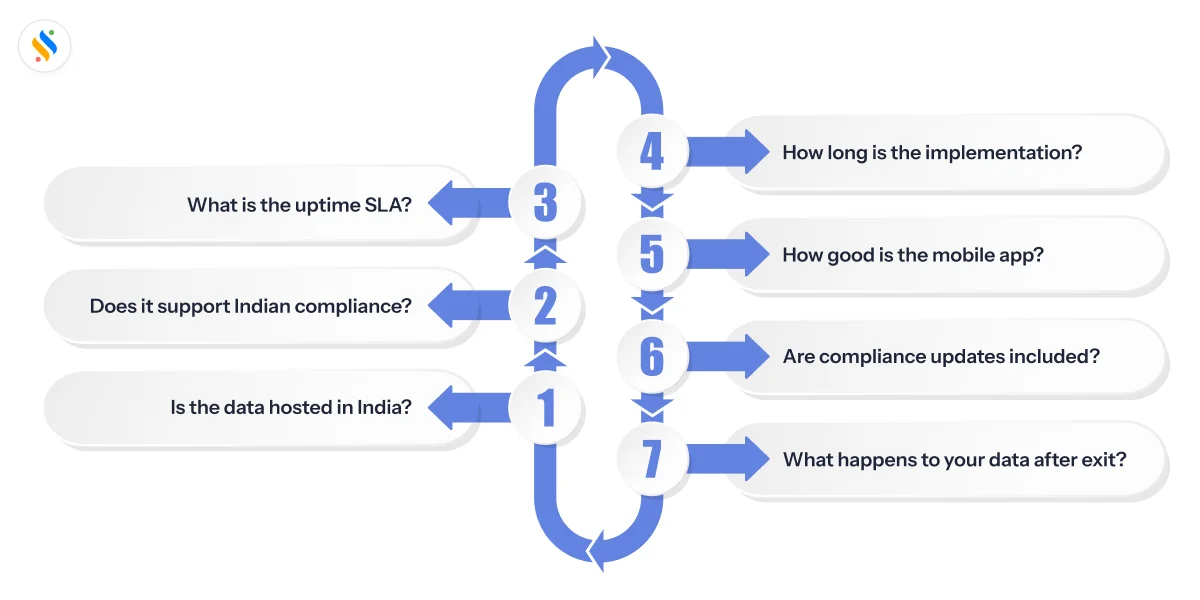
Before committing to any cloud-based HRMS solution, run through these seven questions:
Is the data hosted in India?
DPDP Act compliance requires Indian-based data residency for most employee data categories. If the vendor’s servers are outside India, verify that the jurisdiction is on the government’s approved list. Do get it mentioned in your contract.
Does it handle all India statutory requirements?
PF, ESIC, PT, TDS, GST, and other compliance must all be handled within the platform, not through a third-party payroll integration. Ask for a live payroll demo before signing.
What is the actual uptime SLA, and what are the penalties?
“We have 99.9% uptime.” Now, this sounds reassuring from the marketing standpoint. But, even a 10-minute delay during a payroll day can severely hamper the entire payroll processing. The best solution here? Ask the vendor to define downtime calculation methodology, escalation timelines, support response commitments, and financial penalties for SLA breaches directly in the contract.
How long does implementation actually take?
Implementation is essential. The longer it takes, the more it can impact your operations. Ask your vendor for the timeline for implementation, and if it takes any longer, ask them the reason for it. Also, ensure that you get the best support team at your disposal. So that if any problem comes up, it gets promptly responded to and resolved as quickly as possible.
What does the mobile app experience look like for employees?
Ask the vendor to show you the ESS on an Android or iOS device during the demo. Test applying for leave, payslip download, and attendance punch-in. If any of these are clunky, slow, or desktop-dependent, your employee adoption will be low.
How are compliance updates delivered and at what cost?
Some cloud HRMS vendors charge for statutory compliance updates, treating them as professional services rather than part of the subscription. This is a red flag. Compliance updates must be included in the standard subscription with no additional cost.
What happens to your data if you leave?
Get a clear answer mentioned in the contract on data export format, export timeline, and data deletion confirmation after you exit. A software that makes data portability difficult is clearly not a winning software.
Best Cloud-Based HRMS Solutions in India
Choosing the right cloud-based HR software can be tricky, especially when everyone simply claims to be the best in the market. At the same time, it is important to understand that it’s the set of features that separates the best ones from the others. That’s why we have prepared a features comparison list of some of India’s best cloud-based HR software.
For businesses looking to transition to cloud-based HR management, adopting a reliable Core HRMS can simplify operations, ensure compliance, and provide a scalable foundation for your entire HR ecosystem.
Before you finalize a vendor, it’s worth comparing more options side by side. Explore our detailed list of the Top HRMS software in india to see which platform best matches your business requirements.
Conclusion
Cloud-based HRM software is the reality of Indian businesses. Its affordability, compliance automation, and responsiveness have made it the default choice for businesses across every industry of every size.
But what separates the right cloud HRMS from the wrong one is not the feature list. It is data residency, statutory compliance depth, security certifications, and the quality of the mobile experience your employees will actually use every day.
And one wrong move here can be expensive, not just in terms of money, but one has to face compliance penalties, employee frustration, and HR spending hours fixing what should have been handled automatically.
The good news is that you can make the right call now, because you know what to look for, what questions to ask, what certifications to verify, and what red flags to walk away from.
And if you are looking for a platform that clears every item on this list, you should definitely check out the best HRMS software in India. Super HRMS is a made-in-India HR software, compliant from day one, and designed for businesses that cannot afford to get key HR tasks like payroll or compliance wrong.
Book a demo and see how it works for your business!









