At a glance
The payroll process in India isn’t just about calculations and deductions. This blog deep dive gives you a walkthrough of 12 essential payroll process steps, from setting salary policies and locking attendance to calculating deductions, processing payments, and filing statutory returns. You will also learn about the latest 2025–26 Labour Code changes, statutory compliance requirements, important due dates, and how the payroll cycle changes as your business grows from 10 to 500 employees.
If you are also a working employee in India, you might also look forward to the day when the notification says that your salary is credited to your account. But do you actually know how this entire process works?
A good number of employees which includes HR, finance, and payroll ensure that the entire process runs smoothly.
It is extremely critical because a missed leave approval, an outdated salary structure, or an incorrect PF deduction can turn a routine payroll run into hours of corrections and compliance headaches.
Now, most organisations in India still choose spreadsheets for payroll running, which is an extremely risky process because there is a room for errors in this. And a lot of time will go into fixing this.
So, what exactly is the payroll process in India? This blog deep dives into it. The blog also breaks down the 12 payroll process steps, explains the latest compliance changes and due dates, and gives you a practical monthly checklist to make payroll processing more accurate.
What changed in Indian payroll in recent times?
| Changes | In effect from |
|---|
| The four Labour Codes replaced the old Acts. PF and ESI now sit under the Code on Social Security, 2020 | 21st November 2025 (Central Rules notified 8 May 2026) |
| Monthly wages must be paid before the 7th of the next month; dues on resignation, dismissal or retrenchment within 2 working days | 21st November 2025 |
| The 50% wage rule: if excluded allowances exceed 50% of total pay, the excess counts as wages | 21st November 2025 |
| EPF wage ceiling raised from ₹15,000 to ₹25,000 a month | 17th September 2026 |
| Income-tax Act, 2025 replaced the 1961 Act: salary TDS moves from Section 192 to Section 392, Form 24Q becomes Form 138, Form 16 becomes Form 130 | 1st April 2026 |
| Karnataka PT is ₹300 in February (₹2,500 a year); Maharashtra LWF is ₹25 employee + ₹75 employer each half-year | 1st April 2025 / 2024 |
Payroll process steps at a glance
| Stage | Steps | Owners | Typical timing (salary paid on the 1st) |
|---|
| Pre-payroll | 1. Set or review pay policies | HR + finance head | Once; review every April |
| 2. Collect the month’s inputs | HR, managers, finance | 20th–25th |
| 3. Lock attendance and leave | HR, with manager approvals | 25th–26th |
| 4. Validate employee data | Payroll executive | 26th |
| Calculation | 5. Calculate gross pay | Payroll executive | 27th |
| 6. Apply statutory deductions | Payroll executive | 27th |
| 7. Apply other deductions | Payroll executive | 27th |
| 8. Review and approve | Finance head or founder | 28th–29th |
| Post-payroll | 9. Pay salaries | Finance | Last working day or the 1st |
| 10. Issue payslips | HR | Payment day |
| 11. Deposit dues, save challans | Finance | 7th–15th of next month |
| 12. File returns, update registers | Payroll + finance | Monthly, quarterly, yearly |
Stage 1: Pre-payroll (policies, inputs and the attendance lock)
Most payroll errors start here, so this is the stage worth slowing down for.
Step 1: Fix the policies once, then review them every April
Write down these five things:
1. Pay schedule:
Pay period, attendance cut-off, payment date, and whether a day’s pay is based on calendar days or a fixed number of working days.
2. Salary structure:
Basic, HRA, special allowance, employer PF and the rule behind each. Under the new code, allowances kept outside “wages” can’t exceed 50% of total pay. Anything above that is added back for PF, gratuity and bonus.
3. Attendance and leave rules:
Week-offs, holidays, late marks, half days, paid and unpaid leave, and whether unused leave lapses or gets encashed.
4. Registrations:
EPF once you have 20 employees, ESIC from 10 employees in notified areas, professional tax and Labour Welfare Fund in each state where you employ people, and a TAN for TDS.
5. Approvals:
Who adds a bonus, who approves leave, who signs off the register and who releases payment. The person who prepares payroll should not be the one who approves it.
Step 2: Collect the month’s inputs
Consider anything arriving later will go into next month as an arrear.
| Input | Comes from |
|---|
| Joiners and exits | HR |
| Revisions and arrears | HR, managers |
| Attendance and loss of pay | Attendance system |
| Overtime, shift allowances | Managers |
| Incentives and bonus | Sales, managers |
| Loans and advances | Finance |
| Reimbursements | Employees, with bills |
| Tax declarations | Employees |
Step 3: Lock attendance and leave
This one step prevents more wrong salaries than any other control. Before you calculate anything:
- Ask managers to approve or reject every pending leave, regularisation and overtime request.
- Freeze the attendance register. Changes after the lock are handled as next month’s arrear or recovery, not as a re-run.
- Count paid days through a formula: present days + paid leave + week-offs + holidays − loss-of-pay days.
Step 4: Validate the data
Every employee needs a bank account and IFSC, PAN, UAN (where PF applies), a salary structure, and a joining date. Then look for red flags like duplicate records, people who have left but are still active, and anyone showing zero paid days.
Stage 2: Payroll processing (gross, deductions and net pay)
Step 5: Calculate gross pay
Gross pay is everything earned before deductions. For each monthly component:
Earned amount = Monthly component × Paid days ÷ Days in the month
Add the month’s variable components, and you have gross.
Step 6: Apply statutory deductions
| Deductions | Rate | When it applies |
|---|
| EPF | 12% employee + 12% employer on PF wages (Basic + DA). Of the employer’s 12%, 8.33% goes to the pension scheme (EPS), capped at the wage ceiling of ₹25,000 from 17 September 2026 | 20 or more employees. PF is mandatory up to the ceiling; many employers contribute on full Basic |
| ESIC | 0.75% employee + 3.25% employer on gross wages | Employees earning ₹21,000 a month or less (₹25,000 for persons with disability). Eligibility is fixed for each contribution period, April–September and October–March |
| PT | State slab, maximum ₹2,500 a year. Maharashtra: ₹200 a month, ₹300 in February (women earning up to ₹25,000 are exempt). Gujarat: ₹200 a month from ₹12,000. Karnataka: ₹200 a month from ₹25,000, ₹300 in February | Only in states that levy it. Delhi, Haryana and Uttar Pradesh do not |
| LWF | Small fixed sums. Maharashtra ₹25 + ₹75 per half-year; Karnataka ₹50 + ₹100 a year; Haryana 0.2% of wages, employee share capped at ₹35 a month, employer pays double | Only in states with an LWF law |
| TDS | Deducted monthly on projected annual income, under the regime the employee picks | Section 392 of the Income-tax Act, 2025 for salary paid from 1 April 2026 (Section 192 of the 1961 Act before that) |
Step 7: Apply other deductions
Loan EMIs, salary advances, notice-period recovery, and fines. Each needs the employee’s written consent or a signed policy. The Code on Wages caps total deductions in a wage period at 50% of wages.
Step 8: Calculate net pay and review the register
Net pay = Gross − statutory deductions − other deductions
Put every employee’s figures into one payroll register and check it before sending it to the bank:
- Compare each person’s net pay with last month. Any change above 10% without an input behind it needs an explanation.
- Reconcile headcount (last month + joiners − exits) and compare compliance totals with last month.
- Get a second signature from top management.
Let’s understand this with an example
Priya’s monthly salary is ₹50,000: Basic ₹25,000, HRA ₹10,000, special allowance ₹15,000. April has 30 days. She took 3 days of unpaid leave, so she has 27 paid days.
| Line | Calculation | Amount |
|---|
| Basic | 25,000 × 27 ÷ 30 | ₹22,500 |
| HRA | 10,000 × 27 ÷ 30 | ₹9,000 |
| Special allowance | 15,000 × 27 ÷ 30 | ₹13,500 |
| Gross earned | | ₹45,000 |
| EPF, employee share | 12% of ₹22,500 (below the ₹25,000 ceiling) | ₹2,700 |
| ESIC | Gross is above ₹21,000 | Not applicable |
| Professional tax | Maharashtra, April | ₹200 |
| TDS | ₹6 lakh a year is below the ₹12 lakh rebate limit under the new regime | ₹0 |
| Net pay | 45,000 − 2,700 − 200 | ₹42,100 |
| Employer PF (cost, not a deduction) | ₹1,874 to EPS (8.33%) + ₹826 to EPF | ₹2,700 |
Had she taken no unpaid leave, her net pay would have been ₹46,800 (₹50,000 − ₹3,000 PF − ₹200 PT). That ₹4,700 gap is exactly what goes wrong when a leave request is approved after payroll has run. Multiply it across 200 employees and a few late approvals, and you get a month of corrections, recoveries, and unhappy staff.
Still running payroll on Excel and spreadsheets?
Move beyond manual entries with automated salary calculations, payroll verification and compliance reports.
Stage 3: Post-payroll (payment, payslips, challans, and returns)
Post-payroll is where money moves, and compliance proof gets created.
Step 9: Pay salaries
Most Indian companies upload a bulk payment file in their bank’s format. If you pay a few workers in cash, keep a signed cash register. The Code on Wages requires monthly wages to be paid before the 7th of the following month, though most employees expect money on the last working day or the 1st.
Step 10: Issue payslips
Wage slips are mandatory. Each one should show earnings, deductions, paid days, and net pay. Send them either through a password-protected PDF by email or ensure that your system offers self-service.
Step 11: Deposit statutory dues and save the challans
Every payment generates a challan, which is your receipt. File them month by month and match each one against what payroll deducted. Late TDS carries interest of 1.5% a month, and late PF or ESIC draws 12% a year interest.
Step 12: File returns, update registers and post the journal
1. Returns:
PF ECR every month with the payment; ESIC contributions every month; PT returns as your state requires; Form 138 every quarter for salary TDS; Form 130 to each employee by 15th June.
2. Registers:
Wages, wage slips, deductions and fines, advances, overtime, leave and the EPF register. Labour inspectors ask for these.
3. Accounts:
Post the payroll journal, so the books agree with the register.
Statutory calendar: Due dates for the payroll process in India
| Item | Frequency | Due date |
|---|
| Salary payment | Monthly | Before the 7th of the next month |
| TDS deposit | Monthly | 7th of the next month; 30 April for March |
| EPF contribution + ECR | Monthly | 15th of the next month |
| ESIC contribution | Monthly | 15th of the next month |
| Form 138 (salary TDS return, formerly 24Q) | Quarterly | 31 July, 31 October, 31 January, 31 May |
| Form 130 to employees (formerly Form 16) | Yearly | 15 June |
| Professional tax | Monthly or yearly | Varies by state |
| LWF | By state | Maharashtra: June and December deductions, paid by 15 July and 15 January. Karnataka: yearly, by 15 January. Haryana: monthly |
| Statutory bonus | Yearly | Within 8 months of the accounting year’s close (Section 39, Code on Wages) |
| Full and final settlement | On exit | Within 2 working days of the last day (Section 17(2), Code on Wages) |
EPFO sometimes extends a due date by circular, so check the portal for any updates frequently.
The payroll process for 10, 100 and 500 employees
| 10 employees | 100 employees | 500 employees |
|---|
| Who runs payroll | Founder | One HR or payroll executive | A payroll team of 2–4 with maker-checker roles |
| PF | Not mandatory below 20 (voluntary cover is allowed) | Mandatory | Mandatory, often with several establishment codes |
| ESIC | From 10 employees, for anyone earning up to ₹21,000 | Mandatory where eligible | Across every location |
| PT and LWF | Usually one state | One or two states | Several states, each with its own slabs and dates |
| What usually goes wrong | A missed registration or due date | Late leave approvals causing wrong pay | Multi-state rules and unauthorised changes |
| The control that helps most | A calendar and this checklist | Attendance lock plus a second reviewer | Role-based access, audit trail, challan matching |
“We’re too small for compliance” is the trap at 10 people: PT applies from the first employee in states that levy it. Somewhere around 100 employees, attendance becomes the biggest source of errors, and Excel stops keeping up. That’s why it is best to opt for payroll software.
When is the right time to move payroll off Excel?
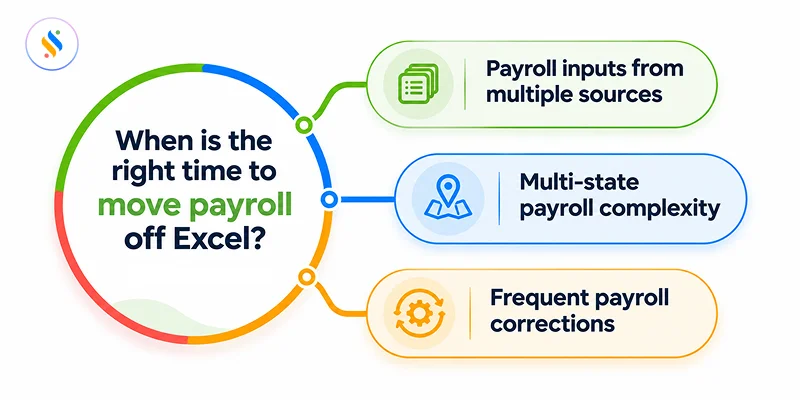
Spreadsheets work until they don’t. Three signs it’s time:
Inputs arrive from more than three places:
Attendance, leave, reimbursements, loans and incentives all live in different files, and someone copies them in by hand every month.
You run payroll in more than one state:
Each state brings its own PT slabs and LWF rules, and they change. Karnataka changed its February PT in 2025; Haryana revised its LWF cap in January 2026.
Corrections have become routine:
If last month’s arrears and recoveries take longer than the payroll itself, the process, not the person, is the problem.
How does Super Payroll run this process?
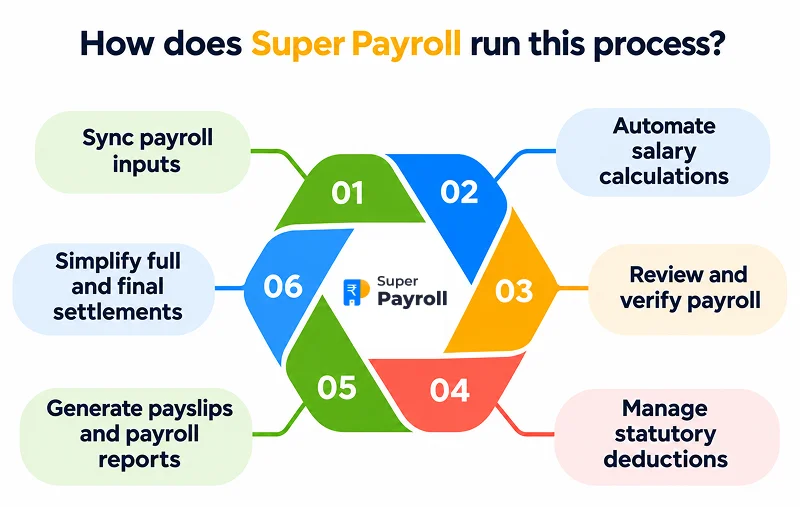
Super Payroll, a key module of Superworks, turns the 12 steps into one guided monthly run.
Super Payroll is integrated with Super HRMS to sync employee records, attendance, and leave data automatically. It also supports OT and shift adjustments, reducing the need to enter the same information into multiple spreadsheets.
Calculate salaries automatically:
Create salary structures and calculate earnings based on attendance, paid days, overtime, bonuses, and other salary components automatically. This makes processing easy.
Review and verify payroll:
Before processing salaries, payroll teams can review every detail and calculation. Super Payroll supports payroll verification and locking, helping teams check the figures before finalising.
Manage statutory deductions:
Super Payroll calculates statutory deductions based on configured payroll rules. It also provides compliance reports to help teams review deductions and maintain payroll records.
Generate payslips and payroll reports:
Create payslips with a clear breakdown of earnings, then share them with employees. Employees can also access them on their own. Payroll reports and analytics also help teams review salary costs and other figures.
Simplified full-and-final settlements:
When an employee exits, Super Payroll helps manage pending salary, leave encashment, gratuity, claims, and deductions.
Monthly payroll processing checklist
Pre-payroll
- Joiners added with salary structure, bank details, PAN and UAN.
- Exits marked with the last working day; F&F started so it can be paid within 2 working days.
- Revisions, arrears and bonuses entered with approval.
- Every pending leave, attendance and overtime request approved or rejected.
- Attendance locked and paid days computed.
- Loans, advances, reimbursements and recoveries confirmed.
- Data related to bank, PAN, UAN, etc. checked.
Calculation by the 29th
- Gross pay pro-rated correctly.
- PF (at the ₹25,000 ceiling), ESIC, PT, LWF and TDS applied to every eligible employee.
- Other deductions backed by consent or policy, and under 50% of wages.
- Register compared with last month, with every variance explained.
- Headcount and statutory totals reconciled with second sign-off.
Post-payroll by the 15th of next month
- Salary paid before the 7th, with date recorded.
- Payslips sent to every employee.
- TDS deposited by the 7th.
- PF and ESIC deposited, ECR filed, by the 15th.
- PT and LWF paid as per the state calendar.
- Challans saved and matched with deductions.
- Registers updated; payroll journal posted.
- Quarterly: Form 138 filed. Yearly: Form 130 issued by 15 June.
Final thoughts
The payroll process in India hasn’t become harder to understand in 2026, but it has become less forgiving. Wages are due before the 7th, exits are settled in two working days, the PF base has grown, and every tax form has a new number. Start with one change, fix an attendance lock date, and run your next payroll against the checklist we have presented in this blog. Then note which steps took the longest. Those are the ones to automate first. And if you are looking for software that can make the entire payroll process easy for you, then check out Super Payroll. We have already talked about it at length in this blog, so just book a demo and take a first step toward stress-free payroll running.


