What are the most effective types of flexible work schedules that can improve your team’s productivity and job satisfaction?
Questions of this kind are all over the internet, because such kind of flexible work arrangements are quite famous nowadays. And for that reason, numerous HR, project, and operations managers are seeking such kind of solutions as more employees are pushing them for flexible working conditions.
So, is there any good news on that front? Are there any time-saving tips? Well, there isn’t just one type of flexible schedule that can work for everyone—there are multiple options to fit different jobs, companies, and personal needs.
Through this blog, we are gonna help you break down 10 types of flexible work schedules that can help you make your workplace more productive & your team happier. Moreover, we’ll cover how each one works, who it fits best, and how it helps employees meet deadlines, manage personal matters, and reduce stress.
And not just that, once you have read the blog, you are also gonna find needed answers to common questions about scheduling, legal issues & productivity tools. And once you have understood the very benefits of flexible work, you will have a clear idea of which flexible work arrangements are suitable for you to ensure a better work life balance and that too while keeping your team on track. So, let’s see…
What is a Flexible Work Schedule?
A flexible work schedule is a fine work arrangement that is completely free from a fixed 9-to-5 routine, allowing employees to decide or adjust their work hours accordingly. Such a kind of flexible schedule allows employees to choose when they have to start and end their day. And as long as they complete their tasks on time, that will be just fine.
Some flexible work schedules also come with finer options like remote work, compressed workweeks, or job sharing. And for that reason, flexible work schedules keep aiming to help employees manage,
- Their family responsibilities,
- Reduce overtime hours, and
- Balance their personal lives with job demands.
Employers that are offering various types of workplace flexibility can easily ensure job satisfaction, reduce turnover & boost productivity. However, let us list out all the points that can benefit employers with flexible work arrangements.
- Employees may create their own schedules
- Focus is on tasks completed, not time spent
- Often used to support work-life balance and reduce scheduling conflicts
- Can include part-time work, four-day workweek, or even phased retirement
Many employers now prefer flexible schedules because they help them access a wider pool of talent, especially those who need workplace flexibility due to child care or other personal matters. And it’s applicable for both part-time and full-time employees. So, let’s discover all 10 types of work schedules, one by one…
Wondering how others are making it work?
They have the right tool – get it now!
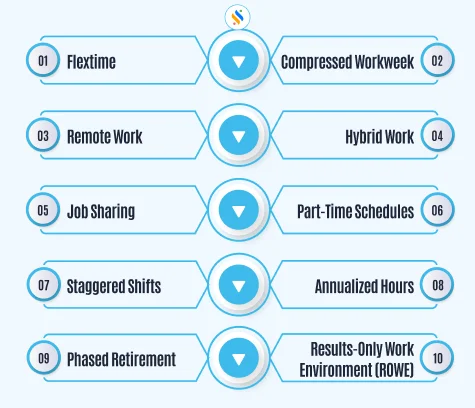
10 Types of Flexible Work Schedules
1. Flextime
Flextime always lets employees choose their preferred work hours within a set range. And it will be completely ok, as long as they are present during core business hours, for example, the meeting hours from 10 a.m. to 3 p.m. Such a kind of flexible schedule is very common in teams that require some overlap for meetings or collaboration, but still want freedom.
For example, a developer might enjoy the work flexibility and work from 7 a.m. to 3 p.m. So they can align with a personal routine more easily. While on the other hand, a designer can start at 11 a.m. and ends at 7 p.m. Both meet during core hours and finish their tasks on time.
Benefits
Improves job satisfaction, supports family responsibilities, and reduces scheduling conflicts.
Best for
Teams that need daily interaction but don’t require a strict 9-to-5.
2. Compressed Workweek
This schedule squeezes a full 40-hour week into fewer days. Common formats include the five-day workweek (8 hours/day) or the four-day workweek (10 hours/day). Such a kind of format keeps allowing employees to get longer weekends while still doing a full-time job. Companies offering such a solution reduces burnout, and often see fewer sick days and higher morale.
Benefits
Extra days off, more personal time, potential savings on overtime pay, and commutes.
Best for
Teams that can handle longer workdays in exchange for a shorter week.
3. Remote Work
Remote work gives employees the freedom to work remotely full-time or part-time with much less stress. Just like the compressed work week, this flexible working setup is also quite common during the pandemic and even after all these years it still remained popular even today.
Workers can log in from home, or some café, or anywhere else where there’s internet access. They simply can avoid traffic, focus on deep work, and tailor their environment to their tasks.
Benefits
Higher productivity, better work-life balance, and cost savings for both employers and employees.
Best for
Roles that require independent work, like writing, design, and coding.
4. Hybrid Work
A hybrid work model splits time between remote and on-site office work. Some companies have fixed days in the office, while others let the team enjoy flexible hours and let them decide. Such a kind of flexible work arrangement keeps offering the best of both worlds: face-to-face collaboration and private time to focus.
Benefits
Builds stronger team relationships while giving freedom to handle personal lives.
Best for
Roles where collaboration matters but doesn’t have to happen daily.
5. Job Sharing
Job sharing here involves two part-time employees sharing the same duties of one full-time job. They literally keep splitting work hours and often communicate to stay aligned on their shared tasks.
From one of those 2 employees might work Mondays to Wednesdays, while the other can work Thursdays to Fridays. They ensure full coverage without burning out.
Benefits
Better work-life balance, avoids overtime hours, and helps employees with caregiving or other priorities.
Best for
Jobs that require continuous presence, like executive assistants or customer service.
6. Part-Time Schedules
Part-time roles require much fewer working hours, like 35–40 hours per week, when compared to full-time employees. Henceforth, such schedules are to help employees stay engaged in their careers while balancing other commitments outside their professional lives.
For instance, a project manager could work 3 days a week but still lead a small team. With clear priorities and good project management software, part time work can still drive results.
Benefits
Keeps people in the workforce, helps employers with staffing, and supports those with other responsibilities.
Best for
Roles that don’t require a constant presence.
7. Staggered Shifts
With a Shift roster, staggered shifts allow various team members to start and finish their work at different times. Like one person may work from 6 a.m. to 2 p.m., while another may start from 2 p.m. and end at 10 p.m. With such a kind of flexible work arrangements, a company can save money, and cover more hours of the day by reducing the crowding in the office.
Benefits
Extends service hours, reduces rush hour traffic, and supports personal matters.
Best for
Customer service, IT support, and production teams.
8. Annualized Hours
Employees work a set number of hours per year rather than a fixed weekly schedule. For example, they might work more in busy months and less during quiet periods.
This flex schedule provides freedom and aligns employees working time with business needs. Tracking tools like time tracking methods help ensure hours are used wisely.
Benefits
Gives employees control and helps employers manage peak workloads.
Best for
Industries with seasonal demands, like education or tourism.
9. Phased Retirement
This setup helps senior employees slowly reduce their work hours before full retirement. Instead of leaving suddenly, they may go from full-time to part-time over several months or years.
This allows a smoother transition and helps transfer knowledge to new hires.
Benefits
Retains valuable talent, eases change, and supports personal lives.
Best for
Experienced roles in leadership, consulting, or training.
10. Results-Only Work Environment (ROWE)
In a ROWE model, employees are basically judged by their results—and not by their location or number of hours worked. And the best thing about it is that employees can choose when, where, and how to work. The focus is on what they complete. This removes micromanagement and puts trust front and center.
Benefits
Encourages accountability, boosts job satisfaction, and helps employees remain productive on their own terms.
Best for
Self-driven teams where output matters more than presence.
Super Project: Streamlining Flexible Work Schedules
As per various types of flexible work arrangements listed above, you can easily choose the most suitable one, but in order to manage them properly, you are gonna need a tool. A robust tool like Super Project by Superworks that can manage tasks, track progress, and ensure accountability! So, let’s have a detailed inspection of it’s comprehensive features, which can help you maintain your work schedule better.
Key Features of Super Project
- Centralized Dashboard: Provides an overview of all projects, enabling managers to monitor progress and allocate resources efficiently.
- Time Tracking: Facilitates monitoring of work hours, ensuring that employees adhere to their flexible schedules while maintaining productivity.
- Task Management: Allows for assigning tasks, setting deadlines, and tracking completion, which is essential for teams with flexible work arrangements.
- Resource Allocation: Ensures optimal utilization of team members, aligning with the goals of workplace flexibility.
- Real-Time Collaboration: Supports communication among team members, crucial for maintaining cohesion in remote work settings.
- Comprehensive Reporting: Generates insights into project performance, aiding in decision-making and continuous improvement.
By integrating Super Project into your operations, you can effectively manage flexible work schedules, enhance job satisfaction, and promote a better work-life balance among your employees.
Conclusion
Building a workplace where flexible work schedules can thrive can never be about keeping everyone happy; rather, it’s about giving people the space and the right tools to do their best work. And from job sharing to remote work, the flexibility you offer can literally help you shape the way your team members approach their day, manage their tasks, and handle their day-to-day personal matters.
However, flexibility without structure can easily backfire, because how will you ensure productivity? That’s why successful teams pair flexible working models with high-end systems that can keep projects on track and help employees working in sync—even if they’re not in the same room or on the same schedule.
That’s where smart tools, like Super Project, come in.
When your team starts using this highly efficient project management software for their daily workflow, they start to organize priorities, track work hours, and keep communication open. With the help of such tool, flexibility becomes a strength, not a struggle.
So, if you’re thinking of stepping into a new work schedule model, don’t just change the calendar—change how you are running projects up until now.
Let your team own their time—let your team own a Super Tool—and let them deliver results you can count on.






