Managing multiple shifts is a headache, and all HRs in the world will agree to this! Because deciding how many people will belong to which shift, which time they will come and leave, their leave, and any special updates can’t be done if you don’t have a shift roster!
Companies with multiple shifts and a varied number of hours in their work schedules can relate to this much more than those that don’t! For companies that rely heavily on shift work, managing shift rosters is a critical aspect and the crucial reason behind running a successful business!
In the true sense, shift management without the roster is time-consuming and a daunting task, and without that, you can not ensure your operations keep running smoothly! And that need of having a staff duty roster applies to everything from a manufacturing unit to a healthcare facility!
Hence, here, today, we are going to talk about every detail regarding the shift duty roster and guide you through these aspects.
- About the shift roster meaning & why it is so crucial?
- The importance of shift rosters!
- How to create them? And then we will share,
- 7 ultimate shift rosters that can help you boost your business!
So, let’s start understanding every aspect of the employee roster to supercharge business, right away! Furthermore, we will also tell you about the best HRMS & payroll software in India that can provide the best Shift management!
Why is unstructured shift scheduling a risk for your business?
Here are the following risks of unstructured shift scheduling:
Productivity takes a nosedive:
Without proper planning, the wrong number of employees end up working at the wrong time. This can affect their productivity.
Burnout becomes inevitable:
When some employees are repeatedly assigned back-to-back shifts while others are underutilised, burnout is only a matter of time.
Employee turnover:
So what do you think is going to happen if you keep assigning shifts to a burned-out employee? Naturally, they will quit. The sad part is that it is pretty frequent in shift scheduling. As a result of this, employees start to feel unjust and decide to move on, resulting in a risk of turnover.
Risk of compliance:
Ignoring labor laws around working hours, rest periods, and overtime can result in legal penalties and reputational damage.
Shift Roster: Explained!
A shift roster is a structured plan that assigns employees to specific work times, days, and locations to ensure continuous business operations. It prevents overstaffing/understaffing, reduces overtime costs, and manages fatigue by scheduling shifts.
Importance of shift roster
For managers,
- It provides a clear framework for operations, ensuring no gaps during transition periods or unexpected absences.
- Businesses can minimize overstaffing and reduce unnecessary overtime expenses by aligning staffing levels with actual demand.
For employees,
- Advance notice of shifts allows employees to plan their personal lives, reducing stress and improving work-life balance.
- Ensures fair workload distribution and adequate rest between shifts, which lowers fatigue-related health risks.
- Companies offering stable and predictable schedules often see higher retention rates.
Types of Shift Rosters
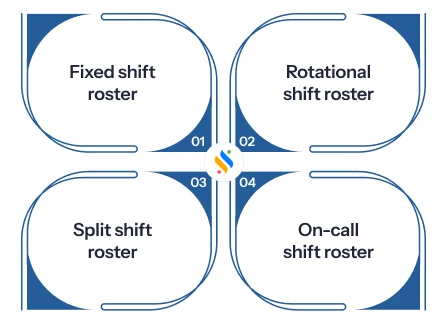
Fixed shift roster:
Fixed shift rostering is basically what me and most of the workforce around the world are assigned. The hours, days, everything is fixed. Changes in it are a case of exception. For example, an employee always works from 9 AM to 5 PM, five days a week.
Rotational shift roster:
Rotational shift rostering is all about designing specific shifts and assigning them to employees. Depending on companies to companies, this can either be an alternative or can be set to a specific period. For example, an employee may work the morning shift one week, the afternoon shift the next, and the night shift after that.
Split shift roster:
Split means breaking things into two parts. In the exact same way, it divides working hours into two separate segments. This totally varies and depends on the shift scheduling policies of companies. An example of such a shift can be that an employee works from 7 AM to 11 AM, takes a break and goes home, returns to work, and completes the shift from 4 PM to 8 PM.
On-call shift roster:
As the name suggests, when the required employee is unavailable to fill the shift, all you have to do is call an employee who can effectively fill that position. Think of it as your backup team. Whenever an emergency situation arises, you just have to make a call to your standby team.
How to make a shift roster for your business?
- Identify your operating hours and the minimum staff required for each shift.
- Collect staff leave requests and preferred working times before starting.
- Place the right employees into specific slots based on their skills.
- Check for overwork, mandatory break times, and local labour law limits.
- Total the scheduled hours to ensure you stay within your weekly labour costs.
- Send the final schedule at least a week in advance so staff can plan.
Shift scheduling software is of great help. It handles every kind of rotating shift and can greatly simplify the whole scheduling process. They automate numerous tasks involving creating shift rosters. This will be a time-saver for you and minimzes any possibilities of errors.
7 Ultimate Shift Roster Tips
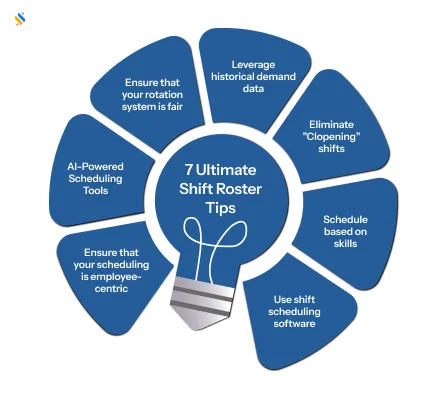
After disclosing all the details of an employee roster [including how to make it], now let’s start exploring those 7 crucial tips!
1. Ensure that your scheduling is employee-centric
Ensure that your entire scheduling operations are employee-centric, so that you prioritize the needs and preferences of your employees.
2. AI-Powered Scheduling Tools
AI-powered scheduling tools are becoming more and more popular day by day! And soon you will find them the crucial part of the HR operations because organisations are accepting this measure as their roster management at a large scale. As for shift management, what can these AI tools do to manage them properly? So, basically, these tools utilize their algorithms to optimize shift schedules of work, which would be completely based on three crucial factors;
- Employee availability,
- Employee skills, and
- Specific business needs.
Still building shift rosters manually? It’s time to go beyond that!
Save time, reduce errors, and schedule smartly with Superworks.
3. Ensure that your rotation system is fair:
One of the complaints that is often registered against shift scheduling is that it is often biased. Managers put the employees who are close to them on more comfortable shifts. And in some cases, harsh shifts are also assigned, just as a way to punish someone. All this creates a very negative environment. Therefore, its important to ensure that the rotation remains fair.
4. Leverage historical demand data:
Having some real-time data can do wonders for you. Pull out some past shift scheduling data and start analyzing them. It will help you identify peak hours and quiet periods. This way, you can create a list of employees/workers that works best in their respective shifts. Apart from this, you
5. Eliminate “Clopening” shifts:
Unless you are running a retail business, a hospitality business, or in a similar sort of business, it is best to avoid clopening shifts. The biggest risk of such shifts is that it drains the employees’ energy and exhaust them entirely. I mean, you don’t want a workforce that is totally burned out, do you? Therefore, it is best to provide a buffer shift of at least 8-10 hours.
6. Schedule based on skills:
One of the biggest issues is that managers look at shift rostering as only a slot-filling thing. It is actually more than that. You, as a manager, must ensure that the right employee/worker is assigned the right task and the right shift. Otherwise, the whole thing will go haywire. The best way is to provide cross-training to staff. This way, your operations won’t be halted.
7. Use shift scheduling software
Moving away from spreadsheets and automating the entire shift scheduling process saves a lot of managers’ time. Shift roster software automatically flags overtime risks, ensures that you are compliant with labor laws, and provides real-time insights, so that you can make informed decisions.
Conclusion
If you are a manager or an HR and you are managing a workforce that primarily works in shifts, then you don’t need me or any outsider to tell you how difficult it is. In the workspace, managing such teams can be difficult, and it double folds the moment you do it manually.
And if you want a solution that can make things even better for you, then I’d suggest there is only one: Super HRMS! Considered by over 500 businesses as the best HRMS software, it’s a comprehensive business management solution that automates and streamlines the entire employee lifecycle, from hiring to retiring. And its shift scheduling feature makes the whole process seamless for you! So, stop thinking too much! Book Super HRMS demo now!










