TL; DR
Core HRMS is the foundation of any HR system. It covers employee data, org hierarchy, documents, leave management, and basic reporting. Nothing more. An HRMS builds on top of it by adding payroll, attendance, performance, and recruitment. HCM goes further with strategic modules like succession planning and workforce analytics. For Indian SMBs with under 50 employees with simple HR operations, core HR is enough. Once you’re processing payroll in-house, managing compliance (PF, ESIC, PT, TDS), or running structured performance cycles, you need a full HRMS. This guide walks you through the 5 core HR modules, a decision framework for when to upgrade, and how Super HRMS covers core HR today while scaling into full HRMS as your business grows.
If you’ve started doing an online search for an innovative HR software, you’ve probably noticed the alphabet soup: HRMS, HCM, hrms vs hris, and core HR. Now, this is often done on purpose. Vendors use these terms loosely, and this confuses buyers, who end up buying software that perhaps they didn’t need in the first place.
Before you commit to a platform or sign a yearly contract, understand what core HRMS actually is, what it does, and where it ends.
We have curated this guide for HR leaders at Indian SMBs. It includes what core HR covers, the five modules that define it, when it’s enough on its own, and when you need to step up to a full HRMS.
Core HRMS vs full HRMS vs HCM: what’s the actual difference?
The three terms get used interchangeably, but they describe systems of different scope.
Core HRMS is the foundation. It’s the system that holds your employee database, organizational structure, documents, leave records, and basic reporting. Think of it as the source of truth for “who works here, what’s their role, and what’s their status.” Nothing more.
HRMS sits one layer above. It includes everything in core HR, plus payroll, attendance, performance management, recruitment, and often expense and asset tracking. An HRMS software is what most growing companies in India actually need — it handles the operational side of HR end-to-end.
HCM is the broadest of the three. It includes everything an HRMS does, plus strategic modules like succession planning, workforce analytics, learning management, and compensation planning. HCM platforms are typically built for enterprises with 500+ employees and dedicated HR business partners.
Here’s how they stack up:
| Capabilities | Core HRMS | HRMS | HCM |
|---|
| Employee database | ✓ | ✓ | ✓ |
| Org chart & hierarchy | ✓ | ✓ | ✓ |
| Document management | ✓ | ✓ | ✓ |
| Leave management | ✓ | ✓ | ✓ |
| Basic reporting | ✓ | ✓ | ✓ |
| Payroll (with PF, ESI, PT, TDS) | ✗ | ✓ | ✓ |
| Attendance & shifts | ✗ | ✓ | ✓ |
| Performance management | ✗ | ✓ | ✓ |
| Recruitment / ATS | ✗ | ✓ | ✓ |
| Learning & development | ✗ | Partial | ✓ |
| Workforce analytics | ✗ | Partial | ✓ |
| Succession planning | ✗ | ✗ | ✓ |
| Compensation planning | ✗ | ✗ | ✓ |
If you’re under 50 employees and your HR team is one or two people, core HRMS might cover you. If you’re between 50 and 500 employees and running payroll in India, you almost certainly need a full HRMS. HCM becomes relevant when HR shifts from operational to strategic — usually past 500 headcount.
The 5 essential core HR modules
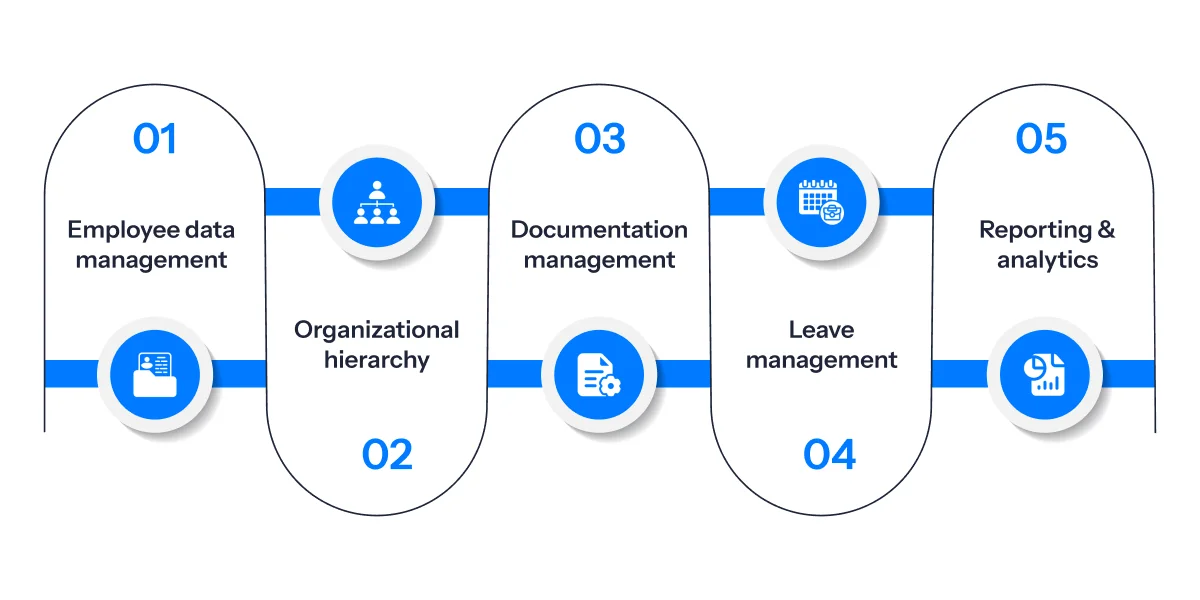
One of the most interesting things about HR software is that no matter who the vendor is or what the system is, core HRMS software features remain the same. The depth varies, but the categories don’t. Let’s take a look at each core HR module and understand it in detail:
1. Employee data management:
As the name implies, it contains the entire database of employees. It includes details like name, contact details, employment status, joining date, department, designation, manager, salary band, and statutory IDs (PAN, Aadhaar, UAN, ESI number). Good core HR software lets employees update their personal details, access company policies & documents, apply for leave, and view/download salary slips by themselves through self-service. This cuts down the back-and-forth with HR. It should also support custom fields so you can capture anything specific to your business, from blood group to emergency contacts.
2. Organizational hierarchy:
This is basically a reporting structure. Imagine a new candidate joins your organization, they should know who he/she is going to report to, which department they sit in, etc. This module powers approval workflows downstream. For instance, if anyone applies for leave, the leave requests flow to the right manager, expense approvals follow the chain, and access controls inherit from the hierarchy. A visual org chart inside the system also helps employees understand the company structure quickly, making collaboration, communication, and role clarity much easier across teams.
3. Documentation management:
Offer letters, contract-related documents, ID proofs, education certificates, appraisal letters, F&F-related documents – earlier, these documents used to get stored in the physical format and that too in file cabinets. The documentation management module stores all the essential HR documents in digital formats, it gets centralized, controls access, and also allows HR to create their own documents from templates. The best implementations support e-signatures and version control, so you’re not chasing PDFs over email.
4. Leave management:
Leave policies, balances, applications, approvals, and holiday calendars. This is one of the most-used modules because every employee interacts with it. Core HR leave functions should handle multiple leave types (casual, sick, earned, maternity, paternity, comp-off), accrual rules, carry-forward and encashment logic, and approval workflows. For Indian companies, it also needs to handle location-specific holidays since holidays vary by state.
5. Reporting & analytics:
Reporting and analytics turn core HRMS data into actionable insights. Instead of manually compiling spreadsheets, HR teams should be able to generate real-time attendance reports, leave, employee turnover, headcount, payroll, and workforce trends directly from the system. A good core HR software should also offer customizable dashboards, department-wise filtering, and export-ready reports for audits and compliance.
These five modules together represent the core HR functions every system in this category is judged on. Vendors differentiate on UX, configurability, and how cleanly the modules talk to each other — not on which modules they include.
A solution that is built for growing Indian SMBs!
Manage your people, processes, and HR workflows from one platform before complexity catches up.
When is core HRMS enough (and when do you need more)?
This is one of the most pertinent questions, because most buyers get it wrong here. It’s because they either end up paying for an cloud based HRM software is when all they just need is core HR, or end up paying for core HRMS when they actually need an HRMS.
Here’s how you can have the best one for your business:
Core HRMS is enough,
- When your workforce is small.
- When you’re processing payroll either manually or facing challenges in doing it accurately.
- Tracking attendance through spreadsheets.
- You do formal performance reviews via Google Forms.
- You’re not actively hiring.
You need a full HRMS when
- You’re processing payroll in-house and need to automate hr compliance software, i.e., PF, ESI, PT, and TDS.
- You’re hiring actively and spending time on resume parsing.
- You run performance reviews on a structured cycle.
- You have shift workers, field staff, or multiple office locations needing attendance tracking.
- Your team is struggling to reconcile HR-to-payroll data.
Here’s the thing – core HRMS works well for Indian SMBs with relatively simple HR operations. But as the businesses began to scale, having a full HRMS became a necessity.
Best core HRMS for Indian SMBs
The Indian market has a healthy mix of homegrown and global tools. Here’s a list of some of the most prominent Indian-based HR software.
| Software | Best for | Strengths |
|---|
| Super HRMS | SMBs wanting core HR with a path to full HRMS + payroll | India-first compliance, modular pricing, scales into payroll and attendance without switching platforms |
| GreyThr | Compliance-heavy SMBs | Strong statutory engine, established market presence |
| Keka | Mid-market with HR + performance focus | Slick interface, good performance module |
| Zoho People | Existing Zoho ecosystem users | Cheap, integrates with Zoho stack |
| HROne | Mid-market with broader HCM ambition | Wide module coverage |
| FactoHR | Payroll-heavy buyers | Solid payroll engine |
What makes Super HRMS the best solution for core HR processing?
Super HRMS is one of the best solutions for core HR processing for every industry and every business size in India . It centralizes all the employees’ data, automates it, and makes the entire workflow efficient which has types of hrms software, enabling HR to shift from administrative tasks to more strategic tasks.
Here’s what it has for you:
Core HR (foundation):
- Employee data and self-service.
- Org hierarchy and team structure.
- Document management with templates and e-signatures.
- Leave management with India-specific holiday calendars.
- Standardized HR reports and dashboard.
HRMS extensions (turn on when ready):
- Integration with Super Payroll.
- Attendance with geo-fencing, biometric integration, and shift management.
- Performance reviews with goals, feedback, and review cycles.
- Recruitment and onboarding workflows.
- Expense management
- Asset management.
Conclusion
The USP of a core HR system is that it brings everything to one platform. Whether it is employees’ data, documents, leave, attendance, or workforce reports, one doesn’t have to keep jumping from one tool to another.
This means that if you have an audit today, you don’t have to spend time looking here and there for your attendance data. Everything is centralized, safely stored, and only the authorized employee can access it whenever needed.
This is great because it saves money, as you don’t have to pay for different tools. All you need is just one platform.
But growing Indian SMBs aren’t asking “what does core HR do?”. All they want to know is “what happens when I outgrow it?”
The answer is its efficiency, whether it is payroll, attendance, performance, or recruitment; everything gets better. Picking a platform that handles the basics today and grows with you tomorrow is usually the best path.
And Super HRMS, a product by Superworks, is designed around this progression. Along with core HR, it allows organisations to perform every essential HR operation, like payroll and compliance, from one platform. So, no need to go for third-party integration or outdated tools. Only one platform is all you need. If you also want to make your HR operations efficient, book a demo now.










