TL; DR
Employee monitoring tools are a permanent fixture of how businesses operate today. The latest employee monitoring statistics show that roughly 3 in 4 employers now track remote or hybrid staff in some form, AI adoption for monitoring is growing fastest across all categories, and employee sentiment remains split. Most workers don’t reject monitoring outright, but they do reject monitoring that isn’t disclosed. In India, the DPDP Act, 2023, has turned monitoring from a purely managerial choice into a compliance question, with 2026 marked as the critical year for employers to align their practices before the law’s full enforcement deadline. This blog breaks down what’s actually happening in workplace monitoring this year.
It’s the middle of 2026, and workplace monitoring isn’t a debate about whether companies will track employees anymore; it’s a question of how, how much, and whether employees were told about it.
Hybrid and remote work didn’t fade away the way some predicted; they settled into the default operating model for a large share of knowledge workers. That shift forced employers to find new ways to answer one simple question: is work actually getting done? The answer, for most organizations, has been employee monitoring software.
But the numbers behind this shift tell a more layered story than “everyone is watching everyone.” Let’s get into the employee monitoring statistics that actually matter for leaders making decisions in 2026.
Why is employee monitoring still climbing in 2026?
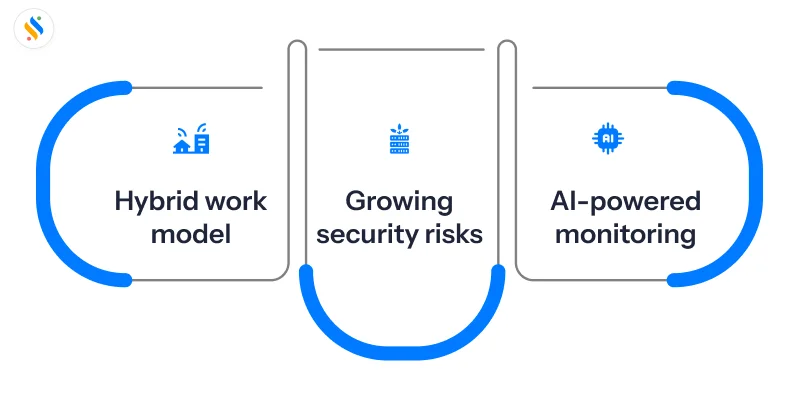
Three forces are keeping monitoring adoption on an upward curve this year.
Hybrid work is permanent, not temporary:
Organizations that adopted monitoring tools to manage remote teams during the pandemic didn’t roll them back once offices reopened. A large share of employers that deployed tracking software during 2020–2021 have kept it in place permanently, treating it as core infrastructure rather than a crisis response.
Security risk has grown alongside flexibility:
Distributed teams, more personal devices, and a wider attack surface mean insider threats and data leakage are now boardroom concerns, not just IT ones.
AI has made monitoring far more capable:
What used to be a simple time-tracking log is now a system that can flag unusual file transfers, detect burnout patterns, and generate productivity summaries automatically.
Key employee monitoring statistics of 2026
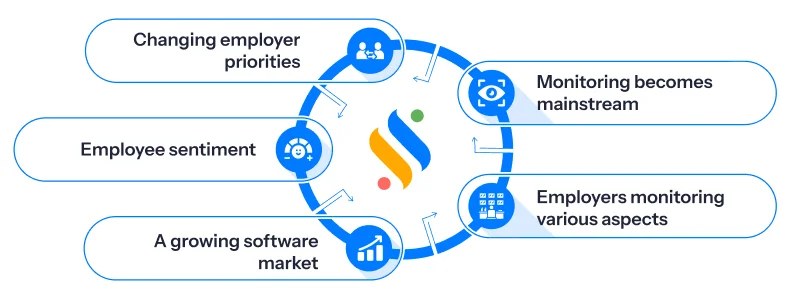
Adoption is now the norm, not the exception:
78% of U.S. employers report using some form of online employee monitoring tool. About 75% also monitor employees physically present in the office, using tools like video surveillance and biometric access controls.
What employers are actually tracking?
Monitoring today goes well beyond clocking in and out. The most common categories include:
Web and application activity:
A majority of employers now save browsing logs and monitor which apps and websites employees use during work hours, primarily to manage compliance and reduce time spent on non-work activity.
Real-time and screenshot-based tracking:
Real-time screen tracking and periodic screenshot capture remain widely used, especially among companies managing remote teams where physical oversight isn’t possible.
Insider threat and data protection:
With data breaches and IP leaks a growing concern, monitoring tools increasingly flag unusual file transfers, unauthorized access attempts, and other indicators of insider risk – an area Gartner expects formal programs around to expand significantly through the back half of the decade.
AI-driven productivity scoring:
AI is an innovation that is impacting each industry around the world. Currently, the scenario is that in order to sustain, businesses have to adopt AI. This also applies to employee monitoring software. Vendors are offering AI-powered features that are making the market more lucrative.
The market is growing, but not slowing down on innovation:
The global employee monitoring software market is expected to grow to $1,784.70 million by 2034. The growth is also propelled by the fact that companies are demanding more innovation in the product. Features like AI-powered analytics, platform integrations, and mobile/field-team tracking have grown sharply.
Employee sentiment:
This is where the employee monitoring statistics get more tricky. This is perhaps the most common problem that employees experience – they weren’t informed about workplace monitoring. This is considered a breach of trust and intrusion of privacy, leading to employees quitting the organization.
Employer behaviour is shifting too:
Nearly 46% of employers have increased their use of monitoring software over the past year, and a meaningful share of remote and hybrid employees report their company isn’t using any tracking software at all, suggesting adoption still has room to grow even as it becomes mainstream.
Legal and privacy considerations of employee monitoring in 2026
Workplace monitoring laws have tightened almost everywhere, and 2026 has been a particularly active year for compliance requirements.
United States:
Monitoring remains legal nationwide under the Electronic Communications Privacy Act, but a growing number of states now require employers to give employees written notice before monitoring begins.
European Union:
GDPR continues to permit monitoring under the “legitimate interest” basis, but typically requires a documented Data Protection Impact Assessment before deployment, along with clear employee notice.
India:
This is where the compliance picture has changed the most. Employee monitoring sits at the intersection of the Information Technology Act, 2000 and the DPDP Act, 2023. The Supreme Court established privacy as a fundamental right under Article 21. But one that can be reasonably restricted when monitoring is lawful, proportionate, and properly disclosed. Non-compliance carries real financial weight. The Data Protection Board of India can impose penalties of up to ₹250 crore for failing to implement reasonable security safeguards.
Good monitoring is built on trust and transparency
Balance productivity, privacy, and trust with transparent employee monitoring.
2026 outlook: where employee monitoring is heading next
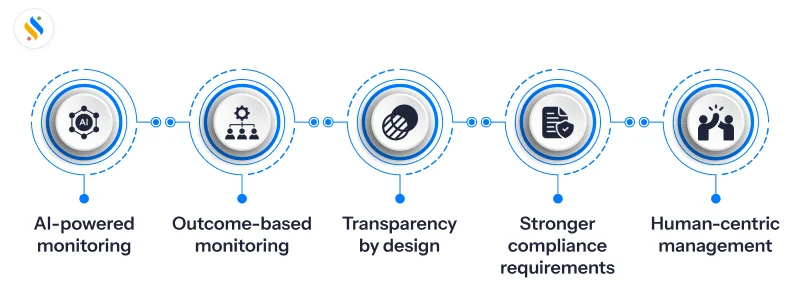
AI-powered monitoring becomes standard, not premium:
As AI features move from differentiators to default capabilities, expect monitoring platforms to lean further into pattern detection, burnout flags, and automated reporting – while facing more scrutiny over how those AI judgments are made.
Outcome-based monitoring gains ground over activity-based monitoring:
Tracking what got done – goals met, deliverables shipped – is increasingly preferred over tracking how busy someone looked, particularly as employees push back on metrics like keystrokes or idle time that don’t reflect real output.
Transparency becomes a competitive feature, not a compliance afterthought:
Tools that give employees visibility into their own data, rather than treating monitoring data as manager-only, are seeing stronger adoption and lower internal resistance.
India’s compliance window narrows:
With the DPDP Act’s full enforcement deadline approaching in 2027, more Indian employers will formalize monitoring policies, appoint accountable data fiduciaries, and move away from informal or undocumented tracking practices during 2026.
Human-centric skills keep gaining weight alongside monitoring data:
As monitoring tools keep getting more capable at monitoring employees’ work, organizations are placing more emphasis on the skills a dashboard can’t measure. This means that human traits like communication, judgment, collaboration, and the ability to support a peer are increasingly gaining weight.
What makes Super Track the right fit for ethical employee monitoring in the workplace?
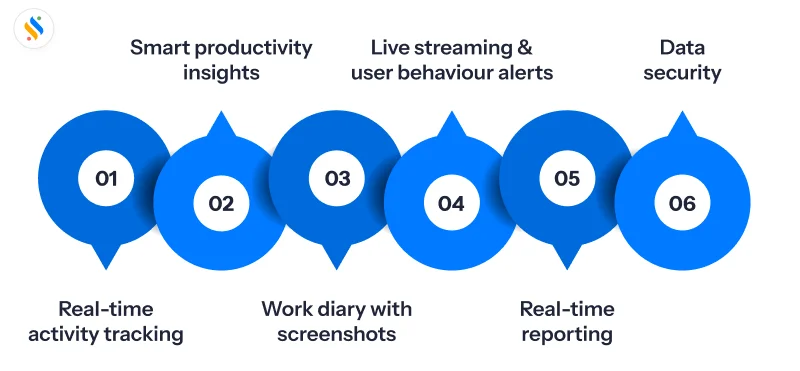
Super Track is built around the same principle the latest employee monitoring statistics point to: monitoring works when it’s transparent, purposeful, and compliant by design; not when it’s invasive.
Its core capabilities include:
Real-time activity tracking:
Managers get visibility into work patterns as they happen, without resorting to covert surveillance. Activity data is collected and presented in a way employees can also see, keeping the process consistent with a disclosed-monitoring approach rather than silent background tracking.
Smart productivity insights:
Instead of reducing performance to raw activity counts, Super Track surfaces workload imbalances, bottlenecks, and patterns across teams. This gives managers context for decisions — like redistributing work or flagging early signs of burnout — rather than just a tally of hours logged.
Work diary with screenshot capturing:
Screenshot capture runs on clearly disclosed policies that employees are made aware of upfront, not as a silent, background process. This keeps the feature aligned with the transparency standard that current employee monitoring statistics show drives higher acceptance.
Live streaming and user behaviour alerts:
Super Track offers live screen streaming and user behaviour alerts to give managers immediate visibility when it matters most. Managers can view an employee’s screen in real time to understand ongoing work. On the other hand, the software also flags policy violations, unusual activity, and other high-risk behaviours as they occur.
Real-time automated reporting:
Reports generate automatically from monitoring and attendance data, cutting down the manual work HR and people-ops teams would otherwise spend compiling and cross-checking records.
Built around India’s data protection requirements:
Super Track’s monitoring approach is designed to align with the DPDP Act’s purpose-limitation and disclosure principles from the outset, helping Indian HR teams stay compliant without having to retrofit consent and notice mechanisms after deployment.
Conclusion
The employee monitoring statistics for 2026 point to one consistent theme: monitoring isn’t going away, but the way companies monitor is under far more scrutiny than it was a few years ago.
Whether it’s adoption in the workplace, vendors offering AI, or the regulatory framework keeps on evolving, this blog is a testament to the fact that businesses treat monitoring tools as an effective solution to measure the team’s productivity, rather than considering it as a surveillance tool.
And while there is still a pushback from some employees regarding adoption of employee monitoring software, it has and will prove to be a game-changing solution for enhancing workplace efficiency.
Now, since we have touched upon the topic of a game-changing solution, businesses in India often look for a tool that is not only employee-friendly but also makes their employees accountable. Super Track can easily be considered the most trusted employee monitoring software out there.
From workforce tracking and employee productivity tracking to real-time performance reports, you get all the features you need to track the day-to-day work of your employees, whether they work from the office or from home.
Plus, it integrates easily with other Superworks’ modules like Super HRMS, Super Payroll, and Super Project, scalable and extremely budget-friendly.
So, want to have it in your workplace? Just start your free trial today and witness it doing wonders for your business.










