An all-in-one business management solution for all your business needs!
Book a free demo to know more!
-
Built to scale with your business.
-
AI-powered solution to automate workflow.
-
Cost-effective for growing businesses.







An all-in-one business management solution for all your business needs!
Book a free demo to know more!

HR Software for Mid-Sized Businesses That Are Ready to Scale
Looking for the best HR software for mid-sized businesses? Automate attendance, leave, shifts, and more with Super HRMS. Explore the guide.
TL; DR
For most companies, the most effective solution to manage the workforce, the entire employee lifecycle, payroll, and compliance is spreadsheets. While it is good if the business is at the startup level and the workforce is below 100. But the moment the business scales, the workforce expands, and the business doesn’t remain a startup, managing everything through spreadsheets becomes difficult. Mistakes in tracking attendance, leave, payroll, and compliance deductions become common. Hence, it becomes essential for a business to look for HR software for mid-sized businesses. If you are a founder whose business is scaling and looking for HR software, this guide contains all the essential insights you need to have for a software.
Your company is growing, right? Well, that’s good news!
But do you know that as your company grows, your HR operations also get more complex?
Many mid-sized companies manage workforce and HR operations through spreadsheets. This is a common practice. However, this becomes ineffective the moment your headcount starts to go from 150 to 300.
Attendance tracking gets harder, pending leave approvals pile up, and HR spends more time fixing errors.
That’s where every startup founder should start to look for HR software for mid-sized businesses. Having an effective solution like this saves HR and employees time and also makes the entire operation extremely efficient and smooth. The right HRMS software for mid-size companies brings everyday processes into one place without adding complexities.
But not every HR software is built for medium businesses. In this guide, we’ll get a complete overview of HR software for mid-sized businesses in India and how to choose an HRMS software for your growing business.
Signs that a startup needs to look for HR software for mid-sized businesses
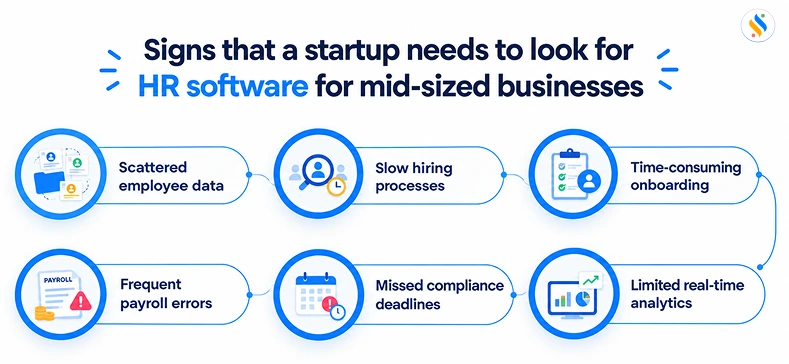
1. When data is spread everywhere:
Attendance data is in one tool, leave data in another, payroll in another. Nothing is integrated. As a result, HR spends more time cross-checking numbers.
2. Hiring slows down:
Every department hires on its own timeline, with postings, approvals, and candidate data scattered everywhere. Plus, hiring offers take longer to go out.
3. Onboarding becomes time-consuming:
New candidates often wait days for laptops, access, and paperwork. What should have been done in an hour takes a week.
4. Payroll errors become frequent:
Manual calculations and mismatched attendance and leave data, if they go unnoticed, will be detected by employees, which affects their trust in the organization.
5. Missing compliance deadlines become common:
The risk of missing deadlines increases when PF, ESI, TDS, and PT filings get pulled together at the last minute.
6. Lack of real-time analytics for better decision-making:
Reports and analytics related to headcount, attrition, and attendance trends are stored in different platforms rather than a single one.
What exactly is HR software for mid-sized businesses?
HR software for mid-sized businesses is software that is built to manage the workforce and HR operations of a business with a workforce between 500-1000. The purpose is to automate and centralize the entire employee lifecycle and make HR operations efficient.
What are the key features of HR software for mid-sized businesses?
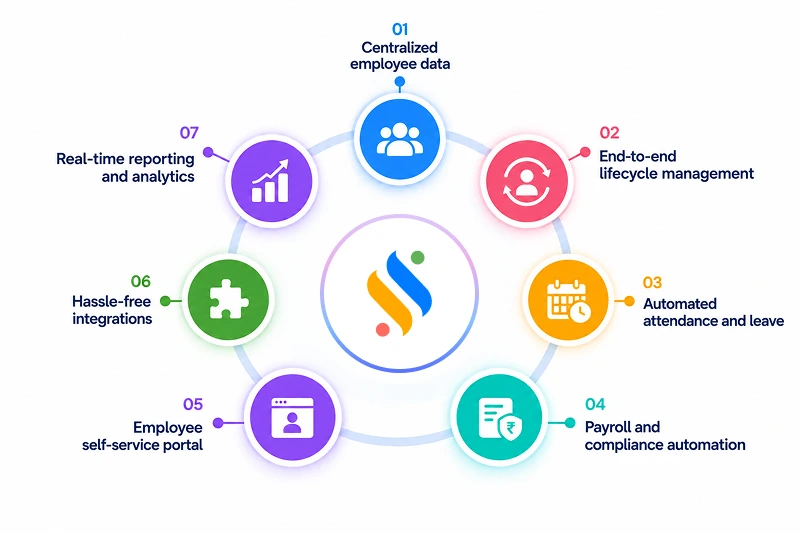
1. Centralized employee database:
Every employee’s data – personal details, documents, employment history, and compensation— lives in one place instead of scattered across spreadsheets and tools. HR managers can pull any document instantly from one platform.
2. End-to-end employee lifecycle management:
From onboarding to the final settlement, every stage of an employee’s lifecycle runs through a single connected platform. This way, managers get automated task lists, new candidates have visibility, and there is no back-and-forth.
3. Automated attendance management & leave management:
Attendance gets tracked automatically, and it can be integrated with biometric devices, mobile check-ins, or web punches, with shift schedules and multiple work locations handled. Leave requests, approvals, and balances update in real time on a shared calendar. Because attendance and leave data feed directly into payroll, there’s no separate need to reconcile data.
4. Payroll processing & compliance management:
Payroll pulls directly from attendance and leave data, calculates statutory deductions automatically, and generates payslips automatically. PF, ESI, and PT contributions are computed based on current rules, and filing calendars are tracked so nothing slips past a deadline.
5. Employee self-service portal:
Employees can apply for leave, check their payslips, download tax documents, update personal details, and raise requests directly through a portal- without the need for HR. This results in cutting down repetitive queries that HR often gets.
6. Hassle-free integrations:
Attendance, leave, payroll, onboarding, and performance data all flow directly between modules. A leave approval reflects in payroll automatically, and attendance records feed straight into compliance calculations. Because when everything runs on a single system, there’s no mismatch in data.
7. Real-time reporting & analytics:
Headcount trends, attrition rates, attendance patterns, and compliance status -every metric should be visible on a live dashboard in real time. Users should be able to generate reports and analytics on departments and locations by filtering.
Business is scaling, workforce is growing, and still using spreadsheets?
Replace scattered spreadsheets with an HR system that is built to keep up with a growing workforce

Why should mid-sized businesses be mindful of compliance?
Just like every business operating in India, compliance matters equally to mid-sized businesses. The compliance load for mid-sized businesses is different from that of startups. Professional tax (PT) slabs vary by state; PF and ESI thresholds and contribution rules apply differently depending on headcount and location, and companies operating across multiple states have to track separate filing calendars for each one. Add in the newer labour codes, and manual compliance tracking becomes risky.
This is one area where HR software for mid-size businesses earns its cost quickly. That said, PT slabs, PF and ESI rates, and labour code provisions change periodically, so always verify current figures against the official government portals.
How to choose the right HRMS software for a growing business?
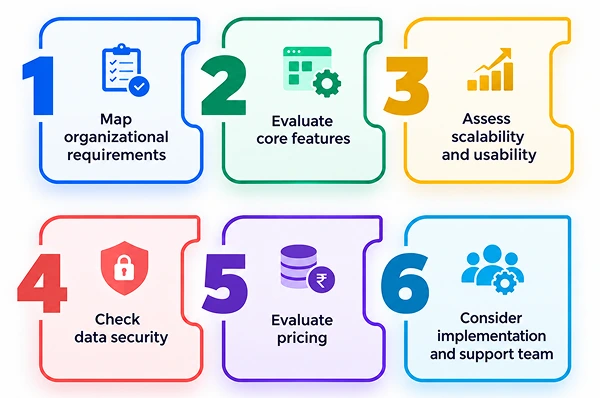
With most platforms offering a similar feature checklist, the real differences show up in how they hold up as headcount grows and business scales. Here are some things that you should be aware of when choosing HRMS software:
1. Map out your organizational requirements:
Before paying for the platform, get clarity on your existing workflow. Do you want to automate payroll, compliance, or leave? List out organizational needs. And if you have departments, you need to be aware of their requirements.
2. Evaluate core features:
Check that attendance, leave, payroll, shift, and reporting are built into the platform. Look past the feature checklist and ask how the modules actually work together.
3. Assess the platform’s scalability & usage:
A platform that works well at 100 employees should work equally well when employee count goes to 400. Test how easily it handles it. Plus, the ease of usability increases the possibilities of adoption by employees. If the employees have to take extra time to learn about the platform, then it is no good.
4. Check for data security:
HR platforms hold sensitive employee data. That’s why it is important to be thorough about the security features like encryption and access control. And in case of any problem, how data backup will work in case of a data breach.
5. Evaluate the platform’s pricing:
Look beyond the headline price per employee and check what’s actually included at that tier versus what triggers an upsell. Pricing that scales predictably with headcount is easier to plan around than pricing that jumps once you cross a feature threshold or user count. Also factor in implementation costs and any add-on fees for modules you’ll need later.
6. Consider implementation, onboarding, & support team:
A platform is only as good as the team that helps with implementation. Ask the vendor how long it typically takes, how data migration will be handled, and how the support system will work out.
Super HRMS: The most recommended HRMS solution for mid-sized businesses in India
Super HRMS by Superworks is built for scaling businesses like yours. Its features- core HR, attendance management, leave management, onboarding-offboarding, shift scheduling, employee engagement, helpdesk, expense & reimbursements, and reporting & analytics- you can manage from one platform. This way, data moves between them automatically instead of requiring spreadsheets.
It’s employee self-service ensures that employees can pull off certain HR tasks like view/download payslips, updating their personal details, managing their attendance, applying for leave, and accessing company policies easily without the need for HR.
Plus, the platform is integrated with Super Payroll, so all the workforce’s data flows directly into the payroll platform, without the need for a single spreadsheet. And you can manage your team’s payroll cycle and business compliance easily.
So, if your business is scaling and you need HR software for Mid-Sized Businesses that doesn’t force you to switch to another platform every few years, Super HRMS is your platform. Book a demo now!
Conclusion
By now, you must have realised that spreadsheets are clearly not the right tool to manage the workforce when the business is growing. They are good only till the business is in its early stage. The moment it starts to grow and the workforce expands, it becomes ineffective. This is where HR software for mid-sized companies becomes essential. And through this blog, we have aimed to explain exactly that.
So, if your business is in a growth phase, then it’s time to switch to HR software. And if you are looking for a platform that not only offers an exceptional set of features but is also affordable, has faster onboarding and implementation, and has the best support team, then Super HRMS is for you.
Table Of Content
Recent Things
Grow your business. Not your HR workload!
Super HRMS automates HR processes and helps you manage your growing workforce effortlessly.
- All-in-one
- Customizable
- Scalable
- Cost-effective


