An all-in-one business management solution for all your business needs!
Book a free demo to know more!
-
Built to scale with your business.
-
AI-powered solution to automate workflow.
-
Cost-effective for growing businesses.
- Winter 2026G2 Best
Support - Winter 2026G2 High
Performer - Winter 2026G2 Easiest
Setup - Winter 2026G2 Easiest
Admin





An all-in-one business management solution for all your business needs!
Book a free demo to know more!
- Winter 2026G2 Best
Support - Winter 2026G2 High
Performer - Winter 2026G2 Easiest
Setup - Winter 2026G2 Easiest
Admin

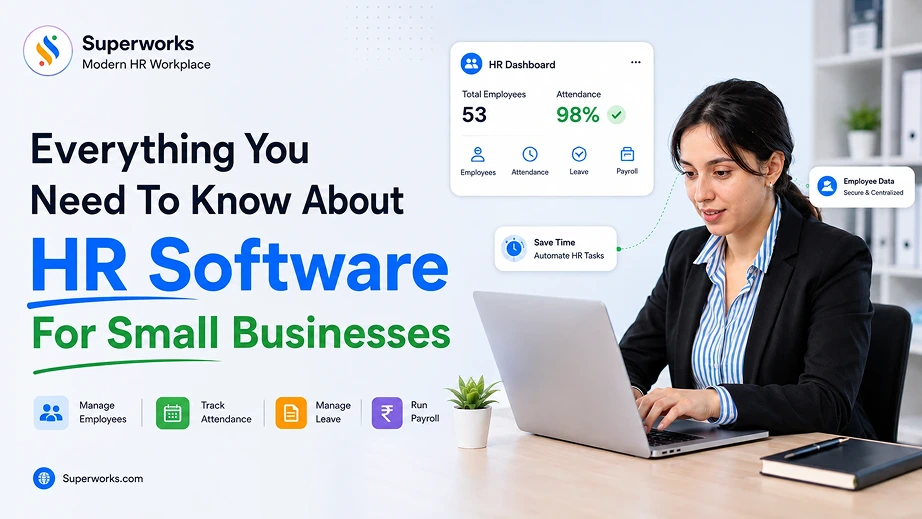
Everything You Need To Know About HR Software For Small Businesses
Looking for HR software for small businesses? Manage core HR, attendance, leave, shifts, documentation, & more with Super HRMS. Book a demo
TL; DR
HR software for small businesses automates and centralizes all the essential HR functions – attendance, leave, shifts, payroll & compliance, performance, projects, engagement, reporting & analytics – and brings them on one platform. Small businesses work on an extremely tight budget. As a result, they heavily rely on spreadsheets to manage their operations. The problem is that performing operations through them is extremely time-consuming and, especially, it becomes ineffective the moment the headcount starts to increase. This is where HRMS software becomes a smart solution to go for. If you are an HR manager, C-level executive, or a founder who didn’t use HR software for your small business, this is your guide.
If you look at the way most small businesses manage their workforce, you will realize that they simply rely on two solutions – either spreadsheets or scattered tools. Now, if you have a small unit, let’s say ~50 employees, managing the workforce this way can be a safe bet. But what would happen the moment your headcount starts to increase and business starts to expand? These solutions will break!
Now, this is something that HR managers, C-level executives, and startup founders understand very well. And they have started to look for HRMS software for small businesses. This is an effective solution because it takes the business away from spreadsheets and automates the entire HR operations.
While the benefits of having it for small businesses are extremely impressive, there remains hesitation among certain startup founders who believe that it is either extremely expensive or only for mid-sized and large enterprises. As a result, there remains hesitation in going for it.
This guide cuts through the noise and gives you in-depth details on HR software for small businesses.
HR software for small businesses: An overview!
Just like any HR software, HR software for small businesses is a smart solution that automates, centralizes, and streamlines the essential HR operations. This includes core HR, onboarding & offboarding, attendance, leave, shifts, engagement, project management, performance management, reporting & analytics, payroll & compliance, etc. Doing all these things manually through spreadsheets is not only tedious and time-consuming, but is also error-prone.
HR software eliminates all this and makes the process efficient. The keyword that is worth paying attention to is “small businesses”. This is because every HR software caters to different organizational requirements, and because of that, the set of features is also different. What might be essential for a startup may not be important for a mid-sized business or an enterprise-level business. Hence, it is important for small businesses to be cognizant of their requirements.
Signs that it’s time to switch to HR tools
If you are a startup founder and you are also facing these issues, it’s time for you to start Googling “HR software for startups”.
1. Payroll takes longer every single month:
If your HR and payroll team processes payroll through spreadsheets, and it takes an entire day, that’s not a productivity problem; it’s an operational problem. Doing payroll processing through spreadsheets is extremely ineffective. Plus, it doesn’t scale, either. Every new hire adds another row, which means another possible case of calculation errors in payroll.
2. You keep missing the compliance deadlines:
Just because you are a startup right now, it doesn’t mean that you are immune to the penalties. PF, TDS, ESIC, and PT are the essential components of statutory compliance and missing a deadline or an important document during the audit will put your startup in serious legal problems.
3. Employees keep rushing to HR for basic tasks:
No employee enjoys the idea of rushing to the HR cabin every time for tasks that they can do on their own. HRs also don’t get entertained by that. Basic HR tasks such as checking attendance, applying for leave, view/download payslips, accessing company policies, or updating personal information – these are things that don’t require assistance from HR.
4. Zero visibility on the attendance & shifts of employees:
When your employees enter their clock in/out and breaks in a register, or they get updates about their shifts on WhatsApp or email trails, chances are that you actually have zero visibility into who is coming and leaving on time or who is actually on their shifts.
5. Your workforce decisions are completely based on your gut feelings:
For any business, whether it is a startup or a large enterprise, decisions related to headcount, attrition, leave trends, engagement, and department-wise budgets are some of the most important decisions. Making decisions on these without real-time data and analytics can harm the growth of a business in the long term. As a result, most startup founders rely on their gut feelings for decision-making.
Don’t let a growing headcount turn HR into chaos!
Replace scattered tools and spreadsheets with one smart HRMS

Benefits of HRMS software for small businesses
1. Time-saving solution:
Automating payroll, attendance, and leave tracking removes the manual work that generally eats up a great deal of your team’s time.
2. Reduction in errors:
Doing workforce management, even payroll, through spreadsheets is extremely risky. HR software automatically calculates everything and ensures that everyone receives their remuneration fairly and transparently.
3. Keeps the business compliant:
Automated statutory calculations and deadline tracking reduce the chance of a missed filing turning into a penalty. This matters more for small businesses, where compliance fines can hit harder.
4. Improved employee experience:
Instant payslip generation, instant leave approvals, and self-service access -this shows that, even if the business is small, employees can perform certain tasks by themselves.
5. Reliable data for better decision-making:
Once workforce data lives in one system instead of scattered spreadsheets, patterns become visible — rising overtime costs, attrition in a specific team, leave clustering around certain months. None of that is visible when the data is stored in five different locations.
Key features to look for in HR Software for small businesses
As we said above, every HR software caters to specific organizational needs. Hence, to assume that all software is the same is wrong. However, there are a few features that a startup founder should look for in HR software for small companies.
1. Core HR automation:
At the heart of any HR software for small businesses is core HR automation. The platform not only safely stores employees’ records but also manages the entire employee lifecycle from hiring to retiring. Whether it is the onboarding of a new candidate, offboarding of an existing employee, or managing the documentation of employees, all needs to be done in minutes.
2. Payroll & statutory compliance:
Payroll and statutory compliance are important. Period. Now, HR software that offers to automate these can be extremely beneficial for your HR team and your business. That’s because it will save their time, and the automation will ensure that your business remains compliant and audit-ready. Hence, you should look for features like automation of salary calculations, payslip generation, statutory compliance, etc. Compliance is extremely important, especially in India. Rules and rates are ever-evolving and vary by state, so if the software is unable to auto-update the rate accordingly, then that HR software is not worth it.
3. Attendance & leave management:
If an HR software accurately tracks employees’ clock-in/out and breaks in real-time without a single use of a spreadsheet, then it’s good. However, if it is able to integrate with biometric systems and offers attendance features like geo-fencing, selfies, facial recognition, and others, then that is your solution. The same applies to leave management too.
4. Employee self-service:
A portal where employees check their own leave balance, view/download payslips, and update personal details cuts down repetitive requests to HR. It empowers employees to pull off certain HR tasks on their own, without depending on HR.
5. Scalability:
The HRMS software for small business you pick today should still hold up when your business expands and headcount grows. This is important because if that is not the case, you have to keep switching systems every few years. Plus, one cannot ignore the time that goes into data migration. That’s why prioritize a platform that is scalable in nature and doesn’t outgrow your business growth.
6. Reporting & analytics:
You don’t need enterprise-grade business intelligence at this stage. You need clear, ready-made reports on attendance, payroll costs, and leave trends — the kind you can read easily and that help you make informed decisions based on them.
7. Ease of use & transparent pricing:
If a platform requires you to set up a dedicated team whose sole job is to ensure that it keeps running, it’s not built for you. On top of that, small businesses get the most value from software that’s intuitive from week one, with pricing that’s easy to forecast as your team grows.
Simplify the HR operations of your small business with Super HRMS!
Running a business is not easy, even if it is just a startup. From keeping track of attendance and leave to ensuring no compliance deadline gets missed, it takes a village to keep ensuring that the startup away from all kinds of problems and ensure that operations run smoothly.
However, all this gets thrown out the window when a startup founder refuses to let spreadsheets and scattered tools go, knowing that the headcount is increasing and the business is expanding.
This resistance to opting for a better solution often puts even healthy startups into a struggling position. That’s why it is high time for startups to look for HR software that simplifies workforce management.
And if you are a founder who is looking for HR software in the market that is extremely affordable, check out Super HRMS by Superworks. This software has changed the way startups manage their workforce.
Conclusion
When it comes to managing the workforce of a startup, the challenges are different from those of mid-sized businesses and large enterprises. There are budget constraints, and along with that, the resources are limited too. In such a scenario, it is no surprise that to manage the workforce efficiently and to ensure that HR operations run smoothly, startup founders choose spreadsheets.
While it is a good idea for the short term, it is clearly not for the long term. And this blog addresses exactly that. Once the business and the workforce expand, it’s best to switch to a smarter solution.
So many HR software for small businesses on the market that claims to be the best. But very few are living up to the expectations of the founders. Even if they do, they don’t scale with the business. Plus, the pricing issue also persists there.
That’s why so many startups in India trust Super HRMS for their HR operations. Book a demo to see why it is the most trusted and recommended HR software!
Table Of Content
Recent Things
