
TL; DR
This blog breaks down labour law compliance in India in a structured and practical way, helping HR teams understand key central and state regulations, major labour codes, and other legal requirements. It also explains how modern HRMS software simplifies compliance management by reducing manual effort and improving accuracy across payroll, attendance, and reporting. Whether you are building a labour law compliance checklist for the first time or auditing your existing HR processes, this guide covers everything you need to stay compliant with the latest labour laws and avoid the consequences of non-compliance.
One can’t define Indian labour law compliance by a single rulebook. It is built through multiple layers of central and state laws. For HR teams, this makes compliance less about memorizing laws and more about managing constant change across payroll, attendance, employee benefits, and statutory filings.
What makes it even more challenging is the overlap between different authorities and the frequency of updates across states and industries. And because of that, businesses often find themselves in non-compliance with the latest labour laws. A structure that looks straightforward on paper often becomes complex in execution, especially for organizations operating across multiple locations.
This blog breaks down that complexity in a structured way, so that you and your business stay compliant, no matter how many new laws and reforms get introduced.
The structure of labour laws in India
India’s labour law framework is one of the most detailed and layered regulatory systems in the world. It governs everything from wages and social security to industrial disputes, employee welfare, and working conditions. The intent is to ensure that there is a safe working environment for employees.
What makes Indian labour law compliance particularly complex is that the framework is not controlled by a single authority or one unified legislation. Instead, it operates through a combination of:
- Central labour laws,
- State-specific labour laws,
- Industry-specific regulations,
- And the newly introduced labour codes.
For HR teams and employers, understanding this structure is the first step toward achieving proper labour law compliance.
labour falls under the Concurrent List, meaning both the Central and State Governments have the authority to create labour-related laws. This dual structure is one of the defining characteristics of Indian labour law compliance.
This creates a two-layer system:
Central labour laws:
These are enacted by the Government of India and apply across the country. They usually govern:
- EPF
- ESI
- Bonus
- Gratuity
- Industrial relations
- Social security
- Wage regulation
State labour laws:
State governments frame rules for:
- Shops & Establishments
- labour welfare fund
- Professional tax
- Local holidays and leave rules
- Employment registrations
- State-specific working conditions
Before the four labour codes consolidated the framework, India’s labour landscape included over 40 central laws, from the Factories Act, 1948, which governs manufacturing and industrial workplaces, to the Prevention of Sexual Harassment (POSH) Act, 2013, which mandates safe and dignified working conditions for women. Understanding this broader ecosystem is important even today, because many of these laws continue to operate alongside the new codes until full implementation at the state level.
Presenting 4 labour codes
Post-independence, India’s labour law framework grew organically. And this remained for decades. Each new problem prompted a new law: wages had their own act, industrial disputes had another, factory safety yet another. But over time, the system became extremely complex for businesses to follow.
However, the historical structural transformation in India’s labour law came on November 21, 2025, when the Government of India replaced 29 and merged 44 existing labour laws into four key codes.
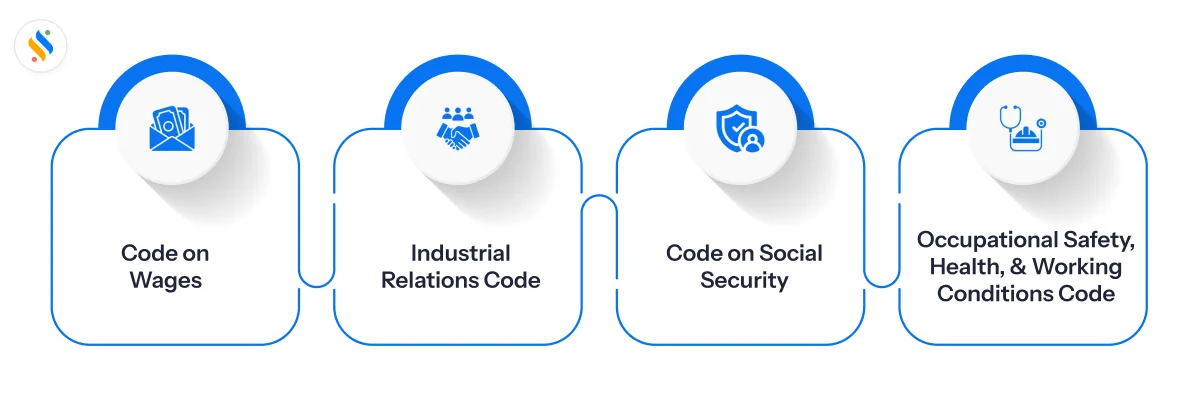
These four codes are:
- The Code on Wages, 2019.
- The Industrial Relations Code, 2020.
- The Social Security Code, 2020.
- The Occupational Safety, Health, and Working Conditions Code, 2020.
The goal? To improve worker welfare, modernize India’s labour ecosystem, and bring the nation’s regulatory framework into compliance with international norms. Together, these four codes form the new foundation of labour law compliance in India, and every HR team needs to understand what each one demands.
Here is what each pillar covers:
Code on Wages, 2019:
This code simplifies wage structures, ensuring timely payments and establishing a legal right to minimum wages for all workers. It introduces the concept of a National Floor Wage, a nationally mandated baseline below which no state can set its minimum wage. Under the Code on Wages, basic pay plus dearness allowance must be at least 50% of total remuneration; a rule that directly impacts salary structuring, PF contributions, and gratuity calculations.
Industrial Relations Code, 2020:
The Industrial Relations Code streamlines industrial relations, promoting effective communication between employers and employees. One of its most debated provisions, the Industrial Relations Code raises the threshold for retrenchment permission from 100 to 300 workers, giving medium-sized manufacturers significantly more flexibility without requiring government consent for workforce adjustments. It also aims for faster and more predictable dispute resolution through reformed Industrial Tribunals.
Social Security Code, 2020:
The code consolidates multiple laws into one framework, ensuring universal protection and extending coverage to organised, unorganised, gig, and platform workers with digitisation and portability at its core. It modernises benefit schemes like the Employee State Insurance Corporation (ESIC) and the Employee Provident Fund (EPF), promotes ease of doing business through simplified compliance, and unifies diverse labour laws to expand worker benefits.
Crucially, app-based delivery workers, cab drivers, and other gig economy participants are recognized as a formal category eligible for welfare fund benefits. Fixed-term employees are now entitled to pro-rata gratuity from day one of service, ending a long-standing gap in coverage.
Occupational Safety, Health and Working Conditions Code, 2020:
The Occupational Safety, Health and Working Conditions Code unifies 13 labour laws into a comprehensive framework for workplace safety, health, and welfare. Among its key reforms: an Inspector-cum-Facilitator system, shifting enforcement towards guidance, awareness and compliance support rather than punitive action; a single registration, single license and single return across safety and working-conditions requirements, replacing multiple overlapping filings; and a National OSH Board to set harmonized safety and health standards across sectors.
8 Important Central labour Laws Shaping HR Compliance in India
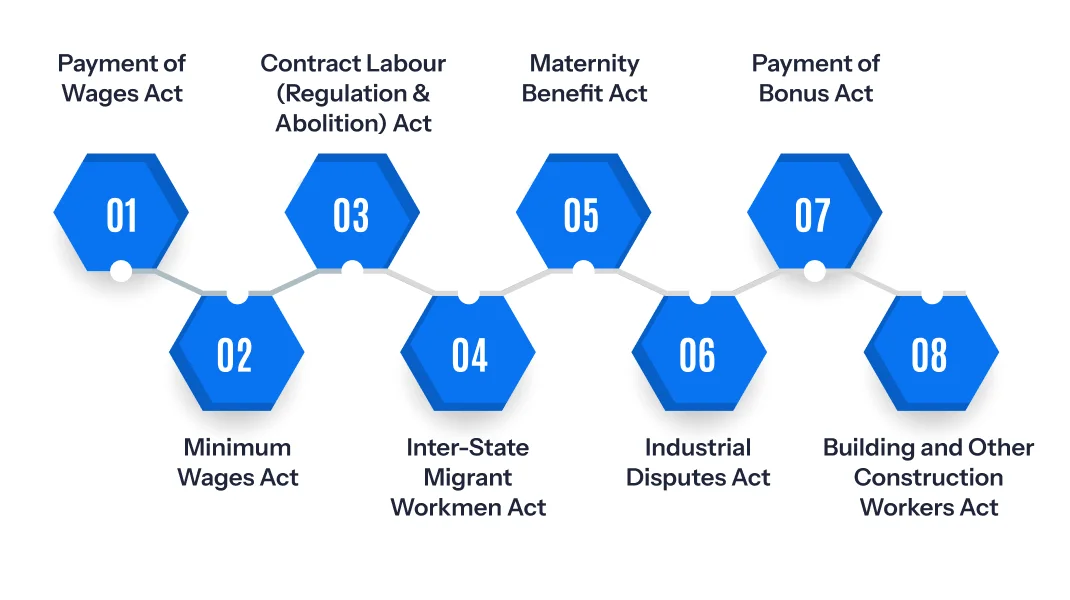
Even before the introduction of the 4 labour codes, a handful of central labour laws formed the backbone of labour law compliance in India. These acts shaped how organizations handled wages, industrial relations, employee welfare, social security, and workplace rights. Here are the eight most important central labour acts every HR professional should understand.
Payment of Wages Act, 1936:
The Payment of Wages Act, 1936, was one of India’s earliest labour laws focused on protecting workers from delayed or unauthorized wage deductions. Before this Act, employers often delayed salary payments or imposed arbitrary deductions without legal accountability. The law was introduced to standardize wage payment practices, protect employees from exploitation, and ensure that fair wages are given to employees.
The main objective of the act?
- Timely payment of wages.
- Authorized deductions.
- Wage periods.
- Payment methods.
- Employer accountability.
Key provisions
Under the traditional framework:
- Wages had to be paid within prescribed timelines.
- Unauthorized deductions were prohibited.
- Employers were required to maintain wage records.
- Employees could file claims against delayed payments.
Historically, the Act applied to employees below certain wage ceilings, though these limits changed over time through amendments.
Why is this law important for HR?
The Payment of Wages Act directly affects:
- Payroll processing.
- Salary disbursement timelines.
- Deduction management.
- Payroll audits.
- Employee grievance handling.
Even today, delayed salary payments are one of the most common triggers for labour complaints in India.
Current status
The Act has now been subsumed under the Code on Wages, 2019.
Minimum Wages Act, 1948:
The Minimum Wages Act, 1948, was introduced to ensure that workers receive a legally protected minimum level of compensation for their labour. The law empowers both the Central and State Governments to prescribe minimum wages for scheduled employments.
Why is this act important?
India does not follow a single national minimum wage structure. This act segregates based on:
- State.
- Industry.
- Skill category.
- Nature of work.
- Geographic classification.
Employees are commonly classified as:
- Unskilled.
- Semi-skilled.
- Skilled.
- Highly skilled.
What are the HR team’s responsibilities here?
- Track state-wise minimum wage notifications.
- Ensure salary structures remain compliant.
- Calculate overtime correctly.
- Maintain wage registers.
- Prevent underpayment risks.
Failure to comply with minimum wage laws can lead to:
- Legal penalties.
- labour disputes.
- Compliance notices.
- Reputational damage.
Current status
The Minimum Wages Act has been integrated into the Code on Wages, 2019.
Contract labour (Regulation & Abolition) Act, 1970:
The Contract labour Act, commonly called the CLRA Act, regulates the employment of contract workers in India.
The Act was introduced to:
- Prevent exploitation of contract labour.
- Improve working conditions.
- Define the responsibilities of contractors and principal employers.
Applicability:
The Act generally applies to:
- Establishments employing 20 or more contract workers.
- Contractors employing 20 or more workers.
Key compliance requirements:
- Principal employers must obtain registration,
- Contractors must obtain labour licenses,
- Welfare facilities must be provided,
- Wage payments must be monitored,
- Working conditions must meet prescribed standards.
The law also places liability on the principal employer if contractors fail to meet wage or welfare obligations.
Why HR teams must understand CLRA:
This law is especially important for organizations using:
- Third-party staffing.
- Security personnel.
- Housekeeping staff.
- Contract technicians.
- Temporary labour.
HR teams must monitor:
- Vendor compliance documentation.
- Contractor documentation.
- Attendance records.
- Wage payments.
- labour license validity.
Improper contractor management can expose organizations to serious compliance and litigation risks.
Current status
The CLRA Act is proposed to be subsumed under the Occupational Safety, Health and Working Conditions Code, 2020.
Inter-State Migrant Workmen Act, 1979:
The Inter-State Migrant Workmen (Regulation of Employment and Conditions of Service) Act, 1979, was enacted to protect migrant workers recruited from one state and employed in another. The law became necessary because migrant workers were often subjected to:
- Poor living conditions.
- Wage exploitation.
- Unsafe work environments.
- Lack of legal protection.
Key objectives:
The Act regulates:
- Recruitment of interstate migrant workers,
- Wage protection,
- Accommodation standards,
- Journey allowances,
- Medical facilities,
- Working conditions.
Employer obligations:
Employers engaging interstate migrant workers are required to:
- Register establishments.
- Maintain records.
- Ensure equal wage protection.
- Provide displacement and travel allowances.
- Maintain suitable working conditions.
Why does this law matter?
The act is particularly relevant for:
- Construction companies.
- Manufacturing units.
- Infrastructure projects.
- Logistics operations.
- Large industrial contractors.
The COVID-19 pandemic brought renewed attention to migrant labour compliance and worker welfare across India.
Current status
The law is now intended to operate under the Occupational Safety, Health and Working Conditions Code, 2020 framework.
Maternity Benefit Act, 1961:
The Maternity Benefit Act protects the employment rights of women employees during pregnancy and maternity leave. The law ensures that women are not forced to choose between childbirth and continued employment.
Key provisions:
Under the amended law:
- Eligible women employees can receive up to 26 weeks of paid maternity leave for the first two children.
- Certain provisions also apply to adoptive and commissioning mothers.
To qualify, an employee must generally have worked at least 80 days in the preceding 12 months before the expected delivery date.
Additional employer responsibilities:
Depending on employee strength and applicability, employers may also need to:
- Provide crèche facilities.
- Allow nursing breaks.
- Protect employees from dismissal during maternity leave.
Why HR teams must understand this act?
It directly affects:
- Leave management.
- Payroll continuity.
- Workforce planning.
- Gender inclusion initiatives.
- Employee retention strategies.
Maternity-related obligations are a direct labour law compliance responsibility, not just an HR policy choice.
Industrial Disputes Act, 1947:
The Industrial Disputes Act was introduced to maintain industrial peace and establish formal systems for dispute resolution between employers and workers.
What does the act govern?
The law regulates:
- Strikes.
- Lockouts.
- Retrenchment.
- Layoffs.
- Employee termination.
- Collective bargaining.
- Industrial dispute resolution.
Key mechanisms
The act established:
- labour courts.
- Industrial tribunals.
- Conciliation officers.
- Arbitration procedures.
Why is this law important for HR?
The Act significantly impacts:
- Termination procedures.
- Disciplinary actions.
- Workforce restructuring.
- Union negotiations.
- Separation compliance.
In larger establishments, retrenchment and closure often require compliance with notice and compensation rules. Termination and restructuring procedures are high-risk areas where labour law compliance failures most visibly result in litigation.
Current status:
The Industrial Disputes Act has been consolidated under the Industrial Relations Code, 2020.
Payment of Bonus Act, 1965:
The Payment of Bonus Act regulates statutory bonus payments for eligible employees. The law was introduced to ensure that employees share in the financial success of establishments.
Applicability:
The Act generally applies to establishments employing:
Key provisions:
Eligible employees are entitled to:
- Minimum bonus payments.
- Subject to salary thresholds and eligibility conditions.
The act prescribes:
- Minimum bonus rates.
- Maximum bonus limits.
- Rules for allocable surplus calculation.
HR compliance responsibilities
HR and payroll teams must:
- Determine employee eligibility.
- Calculate bonus amounts.
- Maintain bonus registers.
- Process timely disbursements.
- Handle bonus-related disputes.
Bonus calculations often become sensitive during audits and employee grievances.
Current status
The Payment of Bonus Act is now intended to operate within the Code on Wages framework.
Building and Other Construction Workers Act, 1996:
The Building and Other Construction Workers (Regulation of Employment and Conditions of Service) Act, 1996, focuses on the welfare and safety of construction workers. Construction work is considered one of the highest-risk employment sectors in India, making this law critically important.
Main objective:
The Act regulates:
- Safety standards.
- Welfare measures.
- Working conditions.
- Health protections.
- Worker registration.
Coverage:
The law generally applies to establishments employing:
- 10 or more construction workers.
Key employer obligations:
Employers may be required to:
- Register establishments,
- Provide welfare facilities,
- Maintain safety measures,
- Ensure protective equipment,
- Contribute to construction cess under applicable rules.
Why does this act matter?
The law is highly relevant for:
- Real estate developers.
- Infrastructure companies.
- EPC contractors.
- Construction project management firms.
Construction-related labour compliance is heavily monitored due to high workplace accident risks.
Current status:
Many provisions of this law are also proposed to be consolidated under the Occupational Safety, Health and Working Conditions Code, 2020.
Reduce the friction in compliance management!
Stay updated on statutory changes without depending on spreadsheets or manual tracking.
State-Level Acts: Shops & Establishments (S&E), Professional Tax (PT), and labour Welfare Fund (LWF)
Central legislation sets the floor for labour law compliance in India, but state-level acts determine a significant portion of day-to-day HR obligations. Three state-administered frameworks, in particular, affect virtually every employer regardless of industry: the Shops & Establishments Act (S&E), Professional Tax (PT), and the Labour Welfare Fund (LWF). Together, they govern working conditions, employer tax contributions, and worker welfare funding across every major business hub in the country.
The Shops & Establishments Act (S&E):
The Shops & Establishments Act is the foundational registration law for any commercial establishment operating in India. It applies to shops, offices, warehouses, hotels, restaurants, entertainment venues, and any space where trade or business is conducted. Businesses operating across multiple states must comply separately in each jurisdiction, as there is no centralised national registration.
At its core, the S&E Act governs:
- Mandatory registration: Required typically within 30 days of commencement of business.
- Working hours: Maximum hours per day and week, spread-over rules, and overtime entitlements.
- Leave entitlements: Earned leave, sick leave, and casual leave norms.
- Wages and payment timelines: Aligning with the Payment of Wages Act at the state level.
- Employee termination: Notice periods and conditions of service.
- Workplace conditions: Lighting, ventilation, cleanliness, and safety requirements.
Even a single employee can trigger registration requirements in many states. This means startups and micro-businesses cannot treat S&E registration as optional. Leave policies in particular vary significantly — what counts as adequate casual leave in Maharashtra may differ from Tamil Nadu’s prescribed minimums, making state-specific rules a genuine operational challenge for multi-location businesses.
Professional Tax (PT):
Professional Tax is a state-level tax on employment income, applicable to both salaried employees and self-employed professionals. The constitutional maximum for annual PT is ₹2,500 per employee. The employer is responsible for deducting PT from employee salaries, remitting it to the state government, and filing periodic returns. No two states have the same PT structure. Each state has its own tax rates, slabs, deductions, and filing procedures. A few important nuances HR teams must track:
- Maharashtra has gender-specific slabs – women earning up to ₹25,000 per month are exempt from PT entirely.
- Karnataka revised its PT slabs with effect from 1 April 2025. The higher deduction of ₹300 applies in February; all other months are ₹200, bringing the annual total to ₹2,500.
- Tamil Nadu deducts professional tax on a half-yearly basis – in August (for April–September) and January (for October–March), not monthly.
- West Bengal employers must pay professional tax by 31st July for the full financial year. Late payment attracts 1% interest per month plus a penalty of up to 50% of the due amount.
One of the most common payroll errors in multi-state organisations is applying the same PT rate across all locations or using outdated slabs.
For instance, applying ₹200 for all 12 months in Maharashtra or Karnataka. So, instead of ₹300 in the designated month results in systematic under-deduction.
Labour Welfare Fund (LWF):
The Labour Welfare Fund is a state-specific statutory contribution – not a Central Government scheme enacted in 16 states and union territories, with each state having its own LWF Act, contribution rates, and filing deadlines. LWF contributions fund social security benefits, housing, education, and recreational facilities for workers.
LWF contributions are fixed amounts per employee (not percentage-based), ranging from ₹6 to ₹120 per period, with both employer and employee contributing – the employer’s share is typically 2–3 times the employee’s share.
Recent amendments that HR teams must act on:
- Maharashtra revised its LWF contribution from ₹12 (employee) / ₹36 (employer) to ₹25 (employee) / ₹75 (employer) per employee per half-year in March 2024.
- Karnataka revised contributions from ₹20/₹40 (half-yearly) to ₹50 (employee) / ₹100 (employer) per year, and reduced its applicability threshold from 50 employees to 10 employees effective January 7, 2026. This means a large number of smaller IT and services companies in Bengaluru that were previously below the threshold now have active LWF obligations.
- West Bengal increased the employer share from ₹6 to ₹30 in January 2024.
State-by-State Summary: Top 10 States
The table below consolidates the key compliance parameters across India’s ten most economically active states. Use this as a quick reference for your labour law compliance planning. But always verify against the latest state notifications before filing, as rates and thresholds are subject to revision.
| State | S&E Act | Registration Validity | PT Applicability | Max Annual PT | LWF Applicability | LWF Contribution (Employee / Employer) | LWF Frequency |
|---|
| Maharashtra | Maharashtra S&E Act, 2017 | Permanent (no renewal) | Yes | ₹2,500 | Yes (5+ employees) | ₹25 / ₹75 per half-year | Half-yearly (Jun & Dec) |
| Karnataka | Karnataka S&E Act, 1961 | 5 years (digital renewal) | Yes | ₹2,500 | Yes (10+ employees) | ₹50 / ₹100 per year | Annual (by Jan 15) |
| Tamil Nadu | Tamil Nadu S&E Act, 1947 | Annual (auto-renewal with declaration) | Yes | ₹2,400 | Yes | ₹20 / ₹40 per year | Annual |
| Delhi | Delhi S&E Act, 1954 | 1–5 years | No PT | — | No LWF | — | — |
| Telangana | Telangana S&E Act, 1988 | Lifetime | Yes | ₹2,500 | Yes | ₹2 / ₹5 per month | Monthly |
| Andhra Pradesh | AP S&E Act, 1988 | Lifetime | Yes | ₹2,400 | Yes (20+ in shops/commercial; all factories) | ₹2 / ₹5 per month | Annual |
| West Bengal | WB S&E Act, 1963 | Annual | Yes | ₹2,500 | Yes | ₹3 / ₹30 per half-year | Half-yearly |
| Gujarat | Gujarat S&E Act, 1948 | Annual | Yes | ₹2,500 | Yes | ₹6 / ₹12 per half-year | Half-yearly |
| Rajasthan | Rajasthan S&E Act, 1958 | 1–5 years | No PT | — | Yes | ₹25 / ₹50 per year | Annual |
| Punjab | Punjab S&E Act, 1958 | Annual (exempt if ≤20 employees) | No PT | — | Yes | Varies | Monthly |
Note: All figures reflect the most recently enacted state amendments as of May 2026. Contribution rates are subject to revision by state governments. Verify before filing.
Compliance calendar: What’s due when?
Knowing which laws apply to your business is only half the battle. The other half – the one where most penalties are actually incurred is knowing exactly when every obligation falls due throughout the year. Indian labour law compliance is not a single annual event; it is a continuous cycle. The following table breaks down the full compliance calendar, so HR and payroll teams have a clear, actionable picture.
| Month | Key Deadline | Act |
|---|
| Every month by the 7th | TDS deposit | Income Tax Act |
| Every month by the 15th | EPF (ECR) + ESI contributions | EPF Act / ESI Act |
| April | Minimum wage revision (1st cycle) | Minimum Wages Act |
| May 12 | ESI half-yearly return (Oct–Mar) | ESI Act |
| May 31 | Form 24Q — Q4 TDS return | Income Tax Act |
| June 15 | Issue Form 16 to all employees | Income Tax Act |
| July 15 | LWF deposit — half-yearly states | State LWF Acts |
| July 31 | Form 24Q — Q1 TDS return | Income Tax Act |
| October | Minimum wage revision (2nd cycle) | Minimum Wages Act |
| October 31 | Form 24Q — Q2 TDS return | Income Tax Act |
| November 12 | ESI half-yearly return (Apr–Sep) | ESI Act |
| November 30 | Statutory Bonus payment + Form D return | Payment of Bonus Act |
| January 15 | LWF deposit — half-yearly & annual statements | State LWF Acts |
| January 31 | Form 24Q — Q3 TDS return | Income Tax Act |
| February 1 | Bonus annual return (Form D) | Payment of Bonus Act |
| March 31 | S&E annual return (select states) | State S&E Acts |
| April 30 | EPF annual return (Forms 3A & 6A) | EPF Act |
Note: All the act’s due dates vary by state. Always verify state-specific deadlines separately.
How does HRMS software automate labour law compliance?
Managing labour law compliance manually sounds manageable, right? Well, it isn’t!
As businesses grow, managing labour law compliance becomes much more complicated.
A company operating from one office may expand into multiple locations and states, but they need to adhere to different state-specific rules. Payroll structures become more complex, contractor management increases, and attendance policies may vary across teams and locations.
As a result, HR teams often end up spending significant time handling compliance tasks and tracking deadlines instead of focusing on employee management.
That is exactly why HRMS software has become essential for modern businesses.
Today, an HRMS does far more than store employee records or process salaries. It helps organizations automate labour law compliance. Here’s how modern HRMS software simplifies labour law compliance in India.
It automatically calculates statutory deductions:
One of the biggest compliance risks in HR processes is incorrect salary deductions. A good HRMS automatically calculates:
- PF contributions.
- ESI deductions.
- Professional Tax.
- Labour Welfare Fund.
- Bonus eligibility.
- Gratuity components.
- TDS deductions.
Instead of manually maintaining spreadsheets or updating formulas every month, the software applies predefined statutory rules directly within payroll processing. For HR teams managing large employee counts, this automation alone saves hours of manual work every payroll cycle.
It applies state-wise compliance rules automatically:
labour compliance in India changes from state to state. Tracking these manually becomes difficult very quickly.
Modern HRMS platforms solve this by applying state-specific compliance rules automatically based on employee location.
So instead of HR teams configuring every compliance detail manually, the system handles the rest. This is especially useful for organizations operating across multiple states.
It automates attendance and OT compliance:
Labour laws regulate:
- Working hours.
- Weekly offs.
- OT.
- Shift duration.
- Break timings.
HRMS software integrates attendance tracking directly with compliance management.
Using:
- Biometric systems.
- Geo-fenced attendance.
- Mobile attendance apps.
- Shift scheduling tools.
The system can automatically:
- Calculate OT.
- Track working hours.
- Monitor shift violations.
- Maintain attendance records for labour law compliance audits.
Sends compliance alerts before deadlines are missed:
One of the most common reasons companies face penalties is surprisingly simple: missed deadlines.
An HRMS helps prevent this through automated reminders. So, instead of depending on manual calendars or email reminders, HR teams receive centralized compliance alerts before due dates arrive.
That means fewer missed filings and better audit preparedness.
Maintains digital compliance records:
During labour inspections, companies are often asked to produce:
- Wage registers,
- Attendance records,
- Leave records,
- Employee documentation,
- Contractor documentation,
- Payroll reports.
Searching for these manually can become chaotic.
An HRMS centralizes compliance records digitally so HR teams can retrieve documents instantly whenever needed. And because everything is digitally stored, organizations reduce dependency on physical paperwork.
It integrates payroll with compliance automatically
Payroll and compliance cannot operate separately anymore. Every salary revision, new joiner, or minimum wage update affects statutory calculations. An HRMS integrates all these systems so payroll remains aligned with compliance rules automatically, enabling the kind of continuous compliance that manual HR processes simply cannot sustain at scale.
For HR leaders evaluating platforms, the right question to ask is not just “does it calculate correctly?” but “does it handle filing returns, generate upload-ready files, maintain record keeping in the prescribed format, and push regulatory updates automatically?” These are the capabilities that distinguish a genuine labour law compliance platform from basic payroll software. If your team is looking for comprehensive labour law compliance services built specifically for the Indian statutory landscape, the ability to automate across all these dimensions is the benchmark.
Conclusion
labour law compliance in India has never been simple. And with evolving labour codes, changing state-level regulations, multi-state operations, and increasing digital scrutiny, it is only becoming more complex.
For HR and compliance teams, compliance best practices today go beyond filing returns or maintaining registers. They include payroll accuracy, employee trust, audit readiness, operational continuity, and overall business risk management. Adherence to the full framework -central acts, state acts, labour codes, and compliance calendars is what separates organizations that stay compliant from those that face avoidable legal penalties and reputational damage.
But the challenge is that most compliance issues do not happen because companies intentionally ignore the law. They happen because:
- Deadlines get missed.
- Wage revisions go unnoticed.
- Record keeping is fragmented across disconnected tools.
- State-specific rules are applied uniformly where they should not be.
- Vendor compliance is assumed rather than verified.
- Or payroll calculations are handled manually across multiple systems.
That is exactly why modern businesses are moving toward automated compliance management.
A good HRMS software helps HR teams follow compliance best practices, simplify statutory compliance, reduce manual dependency, centralize documentation, automate calculations, and ensure compliance with the latest labour laws and reforms. It also supports HR processes end-to-end, so your HR staff can focus on people rather than paperwork, and your compliance team can move from reactive firefighting to structured, continuous compliance.
If your HR team is still managing payroll, compliance tracking, and attendance either through spreadsheets or disconnected tools, this is probably the right time to rethink the process.
Super HRMS by Superworks helps businesses manage payroll, attendance, statutory compliance, employee records, and workforce operations from one centralized platform, designed specifically for Indian businesses and Indian compliance requirements.
Want to know how it works out for your business? Book a quick demo!










