TL; DR
While an HRMS software takes care of your entire employee lifecycle, it is an HCM software that goes one step beyond that. From hiring and onboarding to succession planning, it takes care of everything. The difference between HRMS software and HCM software is simple – HRMS software makes day-to-day HR operations efficient. HCM software is essential for a long-term workforce strategy. In the Indian business context, whether it is an SMB or a growing enterprise, compliance is non-negotiable. That’s why, having an HCM software that takes care of PF, ESI, multi-state PT, LWF, and the four Labour Codes, all from a single platform, is an absolute green flag! This guide in detail talks about HCM software, its core modules, what specific features a business should look for, a comparison between key platforms of Indian businesses, and how Superworks is the right choice for Indian businesses!
For Indian businesses navigating multi-state compliance, high attrition rates, and rapid headcount growth, your decision of choosing an HCM software directly shapes how well your business is ready for long-term impact.
One of the biggest problems is that most HCM software comparisons are written for a global audience. Managers evaluate platforms on feature breadth and G2 ratings without accounting for what Indian HR teams actually deal with every day.
This guide is written specifically for Indian businesses that are planning to have an HCM software. It covers everything. This way, if you are creating a shortlist, trying to make a case internally for upgrading from HRMS, or simply trying to understand what separates a genuine HCM platform from a rebranded HR tool, this is the guide to read first.
What HCM software actually does and how it is different from HRMS software?
Let’s clear this confusion once and for all – both are different from each other. It is true that both of them are used in the same sentence, but they are not the same. The problem is that it is often used interchangeably, resulting in confusion. And in the end, managers end up getting the wrong one for their business.
An HRMS software focuses primarily on operational HR: payroll processing, attendance tracking, leave management, and statutory compliance. It is transactional by design. It processes what has already happened and keeps the paperwork accurate.
HCM software goes further. An HCM system is strategic. It covers the full employee lifecycle, how you attract talent, develop it, retain it, and plan for the roles your organisation will need two years from now. Where HRMS asks, “Did we pay everyone correctly this month?”, HCM tools ask, “Are we building the workforce we need to compete?”
| Functions | HRMS Software | HCM Software |
|---|
| Payroll & Statutory Compliance | Yes | Yes |
| Attendance & Leave Management | Yes | Yes |
| Recruitment & ATS | Limited | Yes |
| Learning & Development | No | Yes |
| Performance Management | Limited | Yes |
| Succession Planning | No | Yes |
| Workforce Analytics | Limited | Yes |
Most Indian mid-size companies start with HRMS and hit a ceiling around 200–300 employees, when spreadsheet-based succession planning and instinct-driven hiring decisions stop scaling. That is typically the inflexion point where a full HCM platform starts paying for itself.
The modules that every HCM platform needs!
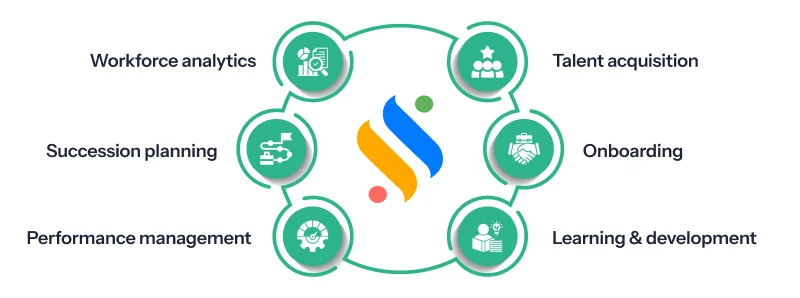
Not all HCM tools are built equally. When evaluating any platform, these six modules separate a genuine HCM system from a rebranded HRMS with a new coat of paint.
1. Talent acquisition:
A proper HCM platform does more than track applications. It integrates job board distribution, AI-assisted candidate scoring, structured interview scheduling, and offer management, all feeding directly into onboarding.
2. Onboarding:
Structured onboarding is one of the highest-return investments a company can make in early retention. Look for digital document collection, role-based task checklists, IT and access provisioning workflows, and 30-60-90 day goal-setting built into the flow. The best HCM software makes the new hire feel prepared, not lost.
3. Learning & development:
An L&D module within your HCM software should connect identified skill gaps, surfaced through performance reviews, to targeted training paths. Strong platforms recommend learning content automatically based on role, level, and performance trend data, rather than relying on employees to self-enrol in whatever is available.
4. Performance management:
Continuous feedback cycles, OKR or KRA tracking, and appraisal automation, all sitting within the same system. This is where HCM software earns its price premium over basic HRMS. When performance data informs promotion decisions, the process feels fair, and the outcomes improve.
5. Succession planning:
Knowing who is ready to step into a critical role and who needs another 12 months of deliberate development requires data that your HCM system already holds, if the modules are connected properly. A succession planning module maps bench strength against org chart vulnerabilities before a resignation forces a reactive decision.
6. Workforce analytics:
Analytics and reports generation are vital to get a 360° view of everything. This includes attrition risk, cost-per-hire, headcount trends by department, and performance distribution across levels. The details provided on these things make your HCM platform a genuine decision-making tool for HR leadership and the C-suite.
Explore how Superworks handles the full employee lifecycle!
One platform brings your entire HR stack under one roof.
HCM software for India: Compliance, regional Pay Scales, and ESOPs
Generic global HCM platforms are built for US or European compliance frameworks and adapted for India as an afterthought, usually through partner integrations or manual configuration layers. If your primary workforce is Indian, that gap has real consequences.
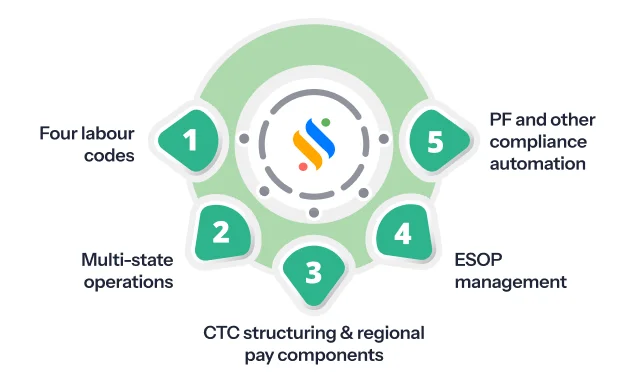
Here is what India-specific HCM software must handle natively:
The four labour codes:
India’s consolidated Labour Codes – the Code on Wages, the Industrial Relations Code, the Code on Social Security, and the Occupational Safety, Health and Working Conditions Code are reshaping the country’s compliance. Your HCM platform should update its compliance engine as state-level rules get notified, not wait for your HR team to track legislative developments and configure changes manually.
Multi-state operations:
In India, every state has its own compliance requirements, which vary from state to state. Imagine a company’s main establishment is in Maharashtra. But they also had offices in Karnataka, Pune, Punjab, Gujarat, and Telangana. In that case, they need to maintain a separate compliance system for each location. Also, need to ensure that they don’t overlap. Now, an HCM software that cannot handle this creates compliance risk at scale.
CTC structuring and regional pay components:
Variable DA components, HRA calculations tied to city classification, LTA policies, and special allowances differ significantly across locations and industry sectors. The right HCM software for India handles CTC structuring at the individual employee level while keeping every statutory deduction accurate without the HR team acting as a reconciliation layer between the system and reality.
ESOP management:
As Indian startups and growth-stage companies scale, ESOP administration has become a core HR function rather than a finance team side project. Look for platforms that track grant letters, manage vesting schedules, handle exercise windows, and integrate with payroll for accurate perquisite tax calculations under Section 17(2) of the Income Tax Act.
PF, ESI, Gratuity, PT, and LWF automation:
Non-negotiable. Any HCM platform operating in India must automate PF contributions (including international worker coverage), ESI eligibility checks, gratuity provisioning, Professional Tax deductions across states, and LWF contributions, along with ECR-ready reports for EPFO submissions. If a vendor treats any of these as add-ons, that is a red flag.
Best HCM software comparison: Superworks vs Darwinbox vs SAP SuccessFactors vs Workday
| Features | Superworks | Darwinbox | SAP SuccessFactors | Workday |
|---|
| India payroll & compliance | Native | Native | Via localisation pack and partner configuration | Via localisation layer; limited India-native depth |
| Multi-state PT / LWF | Yes | Yes, though slab updates may require a support ticket | Via configuration | Limited |
| Labour Code readiness | Yes | Yes, confirmed across all modules | Requires a configuration project | Not confirmed for India |
| ESOP management | Yes | Yes | Yes | Yes |
| Performance & OKRs | Yes | Yes | Yes | Yes |
| Learning management | Yes | Yes | Yes | Yes |
| Succession planning | Yes | Yes | Yes | Yes |
| Workforce analytics | Yes | Yes | Yes | Yes |
| SMB / mid-market pricing | Affordable, transparent PEPM | Mid-range, custom pricing | Enterprise only | Enterprise only |
| India-based support | Yes | Yes | Limited | No India-based support team |
Superworks pricing structure: What to expect at different team sizes?
While the HCM software pricing in India generally depends on various factors. However, with Superworks, you get transparent, module-based plans that scale with your business. No hidden costs or bloated prices. Just a transparent pricing for businesses of all sizes.
| Plans | Prices | What’s Included? |
|---|
| Startup Plan | ₹80/month (includes 50 employees) | Core HR, employee lifecycle, attendance & leave tracking, and payroll & compensation. |
| Professional Plan | ₹100/month (includes 50 employees) | All Startup Plan features, plus asset tracking and expense management. |
| Premium Plan | ₹135/month (includes 50 employees) | All Professional Plan features, plus employee experience, helpdesk, and performance & OKR. |
| Enterprise Plan | Custom Pricing | Features available as per specific business requirements. |
Conclusion
The job of any good HCM software isn’t just automating HR tasks; it gives organizations the essential infrastructure needed to make better decisions about people faster. For Indian businesses, that means finding a platform where statutory compliance is built in and where every module – from payroll processing and compliance to succession planning is designed around how Indian HR actually works.
The gap between a generic software for HR tasks and HCM software built for Indian compliance is not a minor inconvenience. Multi-state PT, LWF, the four Labour Codes, and two-day full-and-final settlement requirements are non-negotiable obligations. That’s why there is a need for a system that offers everything on one platform, so that one doesn’t need to go for third-party integration.
The rules are simple – if your company is at an early stage, an HRMS software will work out well for you. But when the team begins to grow, a comprehensive HCM software becomes a necessity.
However, switching from one solution won’t be easy, but that is exactly the gap Superworks was built to close. Designed for SMBs and mid-size businesses in India, it centralizes HR operations and brings together core HR, payroll & compliance, performance, asset tracking, internal communication, project management, employee activity tracking, and more on one platform.
So how do you know if it meets your business requirements? Just book a demo!










