TL; DR
HCM software does more than digitise HR. It directly affects your bottom line through lower attrition, faster hiring, accurate payroll, and compliance that doesn’t keep your team up at night. This blog breaks down 10 specific benefits of HCM with real ROI framing, a worked calculation showing how a 150-person company can realistically hit 300%+ returns in Year 1, and a side-by-side look at how SMBs and enterprises measure HCM value differently. If you’re trying to build the business case for HCM, or just want to know what good looks like this is where to start.
Human Capital Management software brings hiring, onboarding, payroll, performance, and workforce planning into one system. But the real case for HCM isn’t just operational; it’s financial. Every benefit of HCM maps back to a number your CFO cares about: cost per hire, attrition rate, hours saved, and compliance penalties avoided.
This blog breaks down the benefits of HCM with the ROI framing you need to make the business case, whether you’re a 50-person SMB or a 5,000-employee enterprise.
Why does measuring HCM ROI actually matter?
Investing in HCM software without a clear ROI framework is like hiring without a resume. You’ll get something, but not what you were looking for!
The business case for HCM sits at the intersection of three cost centres that most companies consistently underestimate:
- People costs: Compensation, benefits, attrition, and rehiring.
- Compliance costs: Penalties, audits, and manual error corrections.
- Productivity costs: Hours spent on admin that could go toward revenue-generating work.
When you quantify each of these, even modest HCM improvements compound quickly.
The advantages of HCM become clearest when you stop treating it as an HR tool and start treating it as a cost-reduction platform.
Benefits of the HCM system that you can’t ignore!
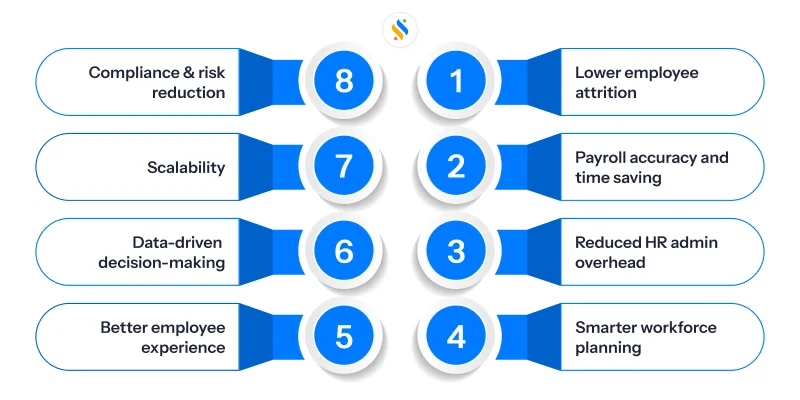
These aren’t soft wins. Each benefit of the HCM system below maps to a measurable business outcome.
1. Lower employee attrition:
Attrition is one of the most expensive workforce problems a company faces. Industry estimates place the cost of replacing an employee at 50–200% of their annual salary, depending on seniority and function. HCM systems address this through structured onboarding, continuous feedback cycles, career development tools, and early warning signals in engagement data, all of which reduce the conditions that push people to leave.
2. Payroll accuracy and time saving:
The biggest con of processing payroll manually is that it is error-prone by design, no matter how careful one is with it. Each payroll error, whether a missed deduction, a miscalculation, or a compliance gap, costs time to fix and can attract penalties. Automated payroll within a human capital management system eliminates most of these errors at the source by applying statutory rules, leave balances, and real-time attendance data automatically.
3. Reduced HR admin overhead:
Most of the HRs spend the majority of their time working on administrative tasks. Now, this is something that modern HRs aren’t signed up for, and if you assess it carefully, all these tasks can be easily automated. The USP of HCM software lies in automating all the administrative tasks. This way, it saves a sizeable amount of HR’s time that is often chewed up in performing manual tasks, and HRs are able to focus on important areas.
4. Smarter workforce planning:
You can only be able to make smarter workforce decisions if you have the data with you. HCM software provides real-time reports and analytics on aspects like headcount, turnover, and hiring. This way, you stop being reactive and start to become more strategic in your decision-making.
5. Better employee experience:
Having an HCM software in the workplace basically means enabling employees to perform basic HR tasks on their own. This includes viewing/downloading payslips, applying for leave, managing attendance, updating personal details, accessing important policies, and generating important forms like Form 16. When employees start to perform these tasks by themselves, their day-to-day experience starts to get better, because now they don’t have to rush to the HR cabins for even the smallest of queries.
6. Data-driven HR decision-making:
In business, certain decisions are often taken based on gut feeling. And while there is absolutely nothing wrong with it, there are certain areas where you need an objective perspective, such as department-wise performance, time-to-hire, and performance distribution. These are the areas where you need data and analytics to make informed decisions. One of the biggest benefits of having an HCM software is that it eliminates “gut instincts” and replace it with analytical data. This way, your decisions are more strategic and less reactive.
7. Scalability without proportional headcount growth:
As companies grow, HR complexity scales faster than headcount. More employees mean more payroll runs, more leave categories, and more compliance variables across locations. HCM systems absorb this complexity without requiring you to hire additional HR staff at the same rate. This is where HCM impact becomes particularly visible for fast-growing companies.
8. Compliance and risk reduction:
Labour law compliance in India involves the Code on Wages, ESIC, PF, professional tax, gratuity, and a growing number of state-level regulations. Manual tracking of these obligations is a liability. The HCM platform has built-in compliance. This means that whether it is a central or state compliance, everything gets taken care of with minimal to no manual intervention, which means that the scope of errors in compliance goes down significantly.
Still fixing payroll errors?
There's a better way to spend that time, and we can show you in 15 minutes.
HCM benefits for SMBs vs Enterprises!
The benefits of HCM are real for both small businesses and large enterprises, but the ROI profile looks meaningfully different.
| Dimension | SMBs | Enterprises |
|---|
| Biggest ROI Driver | Payroll accuracy + compliance | Attrition reduction + workforce planning |
| Primary Pain Point | Running everything manually with a small HR team | Inconsistency across departments or geographies |
| Time to Value | Faster (simpler setup, fewer integrations) | Longer setup, but higher absolute return |
| HCM Value Focus | Cost reduction + time savings | Strategic HR capability at scale |
| Risk Profile | Compliance penalties, payroll errors | Talent gaps, productivity loss across large teams |
How to calculate HCM ROI for your business?
The HCM ROI formula is,
HCM ROI = ROI = ((Total Gains – Total Costs) ÷ Total Costs) x 100
Let’s understand this with an example.
A 150-person manufacturing company in India, running payroll and attendance manually before switching to HCM software.
Step 1: Total gains (Annual)
| Gain Area | How It’s Calculated | Amount |
|---|
| Attrition reduction | 3 fewer exits × ₹2,50,000 avg. replacement cost | ₹7,50,000 |
| HR admin time saved | 10 hrs/week × ₹400/hr × 50 weeks | ₹2,00,000 |
| Payroll error corrections eliminated | 4 errors/month × ₹5,000 avg. correction cost × 12 | ₹2,40,000 |
| Compliance penalty avoidance | Conservative single-penalty estimate | ₹1,00,000 |
| Total Gains | | ₹12,90,000 |
Step 2: Total costs (Annual)
| Cost Area | Amount |
|---|
| HCM Platform Subscription | ₹2,40,000 |
| Implementation + Onboarding (one-time, amortised over Year 1) | ₹60,000 |
| Total Costs | ₹3,00,000 |
Step 3: Apply the formula
ROI = ((Total Gains – Total Costs) ÷ Total Costs) × 100
((₹12,90,000 – ₹3,00,000) ÷ ₹3,00,000) × 100
=(₹9,90,000 ÷ ₹3,00,000) × 100
= 330%
These are illustrative figures. Your actual numbers depend on current attrition rates, payroll complexity, HR admin hours, and compliance exposure. But the structure holds: quantify your current costs, then model what a 10–20% improvement in each looks like. The HCM ROI case usually becomes obvious before you finish the exercise.
Superworks turns HCM benefits into business results! Here’s how
Most HCM platforms promise the same outcomes. Where they differ is in how well they handle the specifics, India’s statutory requirements, the complexity of multi-location payroll, and the reality that most HR teams don’t have a data analyst sitting next to them.
Superworks is built around exactly that gap.
It brings attendance, payroll, leave, performance, and compliance into a single platform — not as bolted-on modules, but as a connected system where data flows without manual intervention. When an employee’s leave is approved, payroll already knows. When attendance data updates, compliance calculations update with it.
Here’s what that looks like in practice:
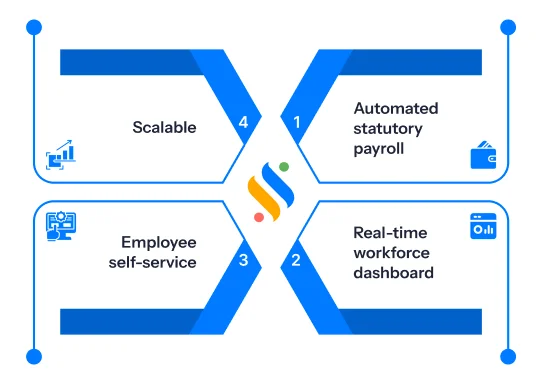
Statutory payroll, handled automatically:
PF, ESIC, professional tax, and Code on Wages calculations apply at the point of processing, not as a post-run checklist.
Real-time workforce dashboards:
Attrition signals, attendance trends, and productivity data are visible without exporting spreadsheets or waiting for monthly reports.
Employee self-service:
Viewing/downloading payslips, applying & managing leave, accessing the company’s policies, and updating personal details are some of the tasks that employees can do on their own.
Scalable across headcount:
Whether you’re at 80 employees or 800, the system absorbs the added complexity without requiring additional HR headcount to manage it.
The result is an HCM platform that doesn’t just reduce admin; it actively contributes to the ROI numbers outlined above.
Conclusion
The numbers in this blog aren’t hypothetical. Attrition costs real money. Payroll errors take real time to fix. Compliance gaps carry real penalties. And every week your HR team spends on admin is a week they’re not spending on the work that actually moves the business forward.
That’s the honest case for HCM, not that it’s a nice-to-have upgrade, but that the status quo has a price tag most companies aren’t actively tracking.
If you’ve read this far, you already know what the benefits of HCM look like on paper. The next step is seeing what they look like inside your own numbers, your headcount, your attrition rate, your current payroll setup.
Superworks is built to make that transition straightforward for Indian businesses from the first payroll run to the first workforce dashboard that actually tells you something useful.
Try Superworks and see the difference a connected HCM system makes. Book a demo now.










