TL; DR
If your HR team is stuck doing admin work instead of business strategy, a human capital management system is what changes that. This guide breaks down the five pillars of HCM, ten ROI-backed key benefits, and how Indian SMBs can evaluate and implement the right HCM solutions without enterprise-sized budgets or timelines.
Till now, you might be running an HR department with 200 employees across two cities, three spreadsheets, and one very overworked HR executive.
But it’s time to say goodbye to it!
A human capital management system is what makes that possible. But before getting into it, let’s understand what’s actually at stake.
Last year, the attrition rate in India’s IT and services sector was reported to be around 14.1%. And while the problem has relatively come down in comparison to past years, the problem persists.
On top of that, compliance penalties for missed PF filings or incorrect gratuity calculations are rising. And founders who built great products are watching those products stall because they can’t hire, retain, or develop the right people fast enough.
This guide breaks down what a human capital management system actually does, why it matters for Indian SMBs specifically, and what to look for when you’re evaluating one.
What is human capital management?
Human Capital Management (HCM) is a comprehensive set of practices and tools used to recruit, manage, develop, and optimize an organization’s workforce.
Unlike traditional HR functions that focus on basic administration, HCM takes a strategic view. It connects hiring decisions to business outcomes. It measures whether your training spend is producing better performers.
HCM vs HRMS vs HRIS: When does each term apply?
These three terms get used interchangeably. They shouldn’t be. Here’s how they actually differ:
| Terms | Full Form | Primary Focus | Best For |
|---|
| HRIS | Human Resource Information System | Data storage and reporting | Companies that need a single source of truth for employee records |
| HRMS | Human Resource Management System | HR operations and process automation | Companies automating payroll, attendance, and compliance workflows |
| HCM | Human Capital Management | Strategic workforce management | Companies connecting HR data to business performance and growth |
Think of it as layers. HRIS is the foundation. It holds employees’ data and records. HRMS software sits on top of that and automates the day-to-day. HCM is the strategic layer that uses all of that to plan talent management, succession, development, and culture, turning HR processes from reactive to proactive. And unlike a standalone human resources management tool, HCM connects every layer to business outcomes.
Your HR team has better things to do than chase approvals!
See how Superworks takes the admin off their plate.
The 5 pillars of human capital management
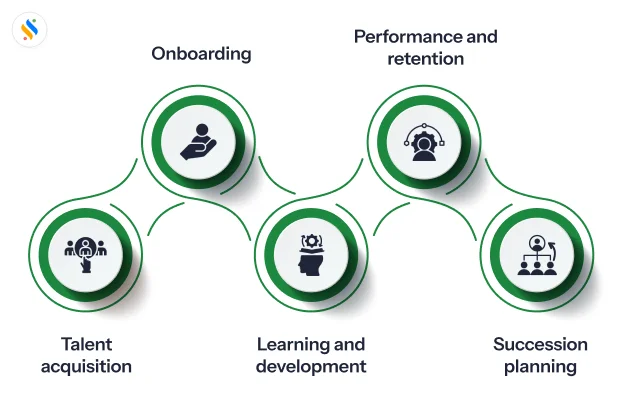
HCM isn’t one thing. It’s five interconnected functions that, when managed well, compound into a competitive advantage.
1. Talent acquisition:
In the Indian talent market, where a single role can attract 500+ applications and whether the candidate will get selected based on how well the JD is written, talent acquisition is both a science and a craft.
And human capital management helps you find and hire the right people. Good acquisition means you know which candidate and role can drive revenue, where your best hires came from, how long it takes to hire for each position, and what your offer acceptance rate looks like, something that can easily be understood with HCM.
2. Onboarding:
The period between offer acceptance and the first 90 days on the job is where most companies lose people quietly. Research shows that employees who go through a structured onboarding program are 69% more likely to stay for three years. In India, where lateral hiring is expensive and notice periods are long, getting this right matters.
Most onboarding failures aren’t about culture fit; they’re about chaos. The system isn’t ready, it’s been weeks, and the documents are still getting collected, and no one told the new joiner what they have to do in the first 30 days.
A structured HCM-driven onboarding process covers the entire employee lifecycle from day one, so the new joiner hits the ground running instead of spending their first week figuring out who to ask for what.
3. Learning and development:
Most Indian SMBs fund training but can’t measure it. Workshops get attended, certifications get added to LinkedIn, internal sessions get scheduled, and six months later, no one can say whether any of it moved the needle on performance or retention.
With HCM, you can identify skill gaps early, build development plans tied to actual role requirements, and have an honest conversation with employees about where they’re growing and where they’re not.
4. Performance and retention:
Performance management in a spreadsheet is always retroactive. By the time you’ve compiled the appraisal, you’ve already missed months of coaching opportunities, and in many cases, the employee has already started looking elsewhere.
HCM moves performance management from an annual event to a continuous one. It keeps employee engagement high, surfaces employee wellbeing concerns before they escalate, and gives HR professionals the visibility they need to act, keeping employees motivated before disengagement becomes a resignation.
5. Succession planning:
This is the pillar most SMBs skip and the one that hurts the most when a key person leaves without warning. A sudden resignation from a department head shouldn’t send the company into a hiring emergency, but for most SMBs, it does.
At the core of the HCM strategy is workforce planning. This means knowing, before anything goes wrong, which employees are ready to step into senior roles, which positions are single points of failure, and where internal development needs to happen before you’re forced into an expensive external hire.
What are the benefits of an HCM system?
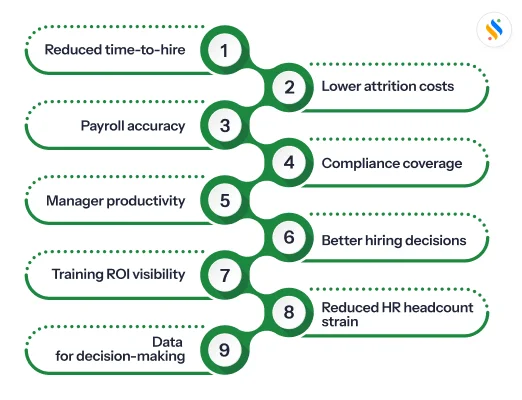
Here are the outcomes that an Indian business can expect from an HCM solution:
1. Reduced time-to-hire:
The hiring process stops being a tedious exercise the moment your entire recruitment workflow comes on one platform. The result is faster closures, fewer dropped candidates, and real-time data available to recruiters for insights, something that WhatsApp threads can’t offer.
2. Lower attrition costs:
Replacing an employee in India is not inexpensive. That’s because the resources that go into the hiring process are exorbitant. A human capital management system helps you spot flight risks early through performance trends, engagement signals, and pulse survey data, so retention becomes a proactive effort rather than a post-resignation regret.
3. Payroll accuracy:
Manual payroll processing is slow, error-prone, and in India, errors in PF, ESI, or TDS don’t just create internal headaches; they create some serious troubles. Automated payroll processing reduces errors significantly and gets done in hours instead of days.
4. Compliance coverage:
In recent times, the government of India took a massive decision to replace and merge existing labour laws into four new labour codes. While there are some Indian states where these codes are yet to be implemented, most of the Indian states have already implemented them. Now, keeping up with all of it manually can eat up a significant amount of HRs’ time. An HCM system automates statutory calculations, generates required documentation, and flags deadlines before they become penalties.
5. Manager productivity:
Every leave approval email, every manual attendance query, every appraisal form chased over WhatsApp is time a manager isn’t spending on their actual work. Self-service portals save the time of not just employees, but managers too.
6. Better hiring decisions:
A well-implemented HCM system tells you which hiring sources produce your best performers, which roles consistently see early attrition, and where your offer-to-acceptance ratio is weakening. That kind of visibility turns hiring from a gut-feel exercise into something you can actually improve.
7. Training ROI visibility:
Most companies fund training and have no idea whether it worked. Linking learning records to performance data changes that. When you can see whether employees who completed a specific program outperformed those who didn’t, your L&D budget stops being a cost line and starts being a lever.
8. Reduced HR headcount strain:
A properly configured HCM system absorbs work that would otherwise require additional HR hires – through automation, employee self-service, and integrated workflows. For a growing SMB where every headcount decision matters, that’s a meaningful operational advantage.
9. Data for decision-making:
This is the benefit that compounds over time. Once your hiring, payroll, performance, and attendance data all sit inside one system, you can answer questions that most Indian SMBs currently can’t. That’s what separates an HCM system from a loose collection of HR tools: not just storing data, but making it useful.
What features should one look for in an HCM software?
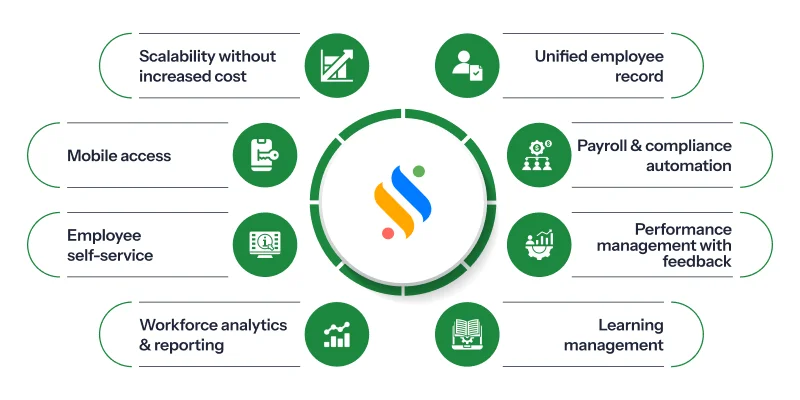
Just because a vendor is selling its platform as an HCM system, it doesn’t guarantee that the platform will live up to its definition. That’s why one should look for these features when going for an HCM software:
1. Unified employee record:
Centralization is the keyword. Everything about an employee – his personal data, documents, attendance data, leave data, and payroll should be stored on a single platform.
2. Automation of payroll processing and compliance management:
For India specifically, PF, ESIC, PT, TDS, gratuity, and bonuses are some of the mandatory expectations from businesses. However, when all of the calculation gets done manually, the chances of errors increase, and one small mistake can put a company into serious trouble. That’s why the HCM software should have been effective in keeping the business compliant.
3. Performance management with continuous feedback:
Apart from just annual appraisals, the HCM software should also offer goal-setting like OKRs or KRAs, manager check-in tools, peer feedback, and performance history that travels with the employee across roles.
4. Learning management:
In these evolving times, having a workforce that is skilled and future-ready makes a business a winner. And that’s why having a built-in learning management system can enable managers to create courses and provide certification, which can be a difference-maker.
5. Workforce analytics and reporting:
While it is good to have HCM software or human capital management system that takes care of everything, it is essential to know whether it provides any real-time data. If the platform doesn’t instantly provide any report or analytics on headcount trends, attrition analysis, cost-per-hire, or absenteeism patterns, then there is no point in having that software for the business.
6. Employee self-service:
Applying for leave, accessing important documents, viewing/downloading payslip, and updating profiles are some of the basic HR functions that don’t require the involvement of HRs. The HCM software and human capital management system should offer employee self-service so that it saves employees an HRs time.
7. Mobile access:
India’s workforce is increasingly mobile-first. Field sales, distributed teams, and remote employees need HR access from their phones, and therefore, the HCM software should be responsive in nature.
8. Scalability without increasing cost:
For SMBs, this one matters a lot! Some enterprise HCM platforms are priced per module. This means the cost doubles every time you add a feature. Therefore, look for transparent pricing that scales with headcount, not with feature unlocks.
How Superworks delivers HCM for SMBs and mid-market companies?
Most HCM platforms are built for enterprises, but very few take care of the SMBs.
Superworks is among the handful of platforms that not only serve big enterprises, but also serve the small and mid-sized businesses of India.
The most amazing thing about Superworks is that it scales effortlessly. This way, founders don’t have to get stressed about migrating to other tools simply because their workforce has increased.
Here’s how the platform maps to the five pillars:
| HCM Pillar | Superworks Capabilities |
|---|
| Talent Acquisition | Recruitment module with ATS, job board posting, and interview scheduling. |
| Onboarding | Digital document collection, task checklists, and structured first-90-days workflows. |
| Learning and Development | Training tracking, certification management, and L&D spend reporting. |
| Performance and Retention | KRA-based goal setting, continuous feedback, 360° reviews, and pulse surveys. |
By now, you must have understood the importance of staying compliant, not just with central government rules but with state government rules too.
That’s why Indian SMBs and MSMEs trust Superworks for their compliance management. Its product, Super Payroll, not only makes payroll processing swift but also ensures that your business remains compliant with Indian compliance. PT, TDS, ESIC, EPF, everything gets taken care of from the dashboard.
Conclusion
If you evaluate the current Indian SMB scene, you will realize that they don’t have a people problem. The problem lies in their system. Too many disconnected tools, manual work that isn’t going to stop anytime, and an HR team spending time managing administrative tasks rather than people.
A human capital management system is a solution here. It clears the operational noise so the people running HR can actually do their job, and also gives an approach where people become the key asset of the organization, aligning them with your organizational goals.
Now, finding an efficient human capital management system is the solution which seems like a cakewalk, right? Well…it isn’t! And while you may have your requirement checklist with you, choosing the right one won’t be that easy. However, there is one solution…one that has been trusted by every SMB in India!
Superworks is a business management solution that automates, centralizes, and streamlines the entire HR operation. Whether it is attendance, leave, shift, performance, payroll, or compliance, it takes care of everything and enables HRs to focus on strategic tasks rather than administrative tasks. And the best part? When your workforce grows from 50 employees to 100 employees, it scales with you effortlessly. This way, you don’t have to go through the headache of migrating to another tool every 2-3 years.
So, if you are looking for a platform that makes your HR operations efficient without the need to break the bank? Book a Superworks demo today!










