Payroll automation is all about making the complete payroll processing operation efficient. When a business chooses payroll automation, it means that they have made a decision to stop using spreadsheets for their payroll and compliance. The biggest benefit of automating payroll is that it reduces processing time and errors and keeps your business audit-ready. This blog will take a deep dive and talk about the automation of payroll in detail.
If there is one organizational operation that is extremely important and sensitive but is equally stressful, it has to be payroll processing and compliance management. Even today, most businesses in India choose spreadsheets for payroll processing and compliance.
The problem is that with spreadsheets, HRs have to go through the same process again and again – pull attendance, leave, and shift data, calculate salaries, adjust for leaves and reimbursements, deduct taxes, and process payments. All this needs to be done before hitting the deadline. And keep rechecking everything to ensure that there are no errors.
On top of this, the more the headcount grows, the more time the process will take.
It is because of all these reasons that businesses go for payroll automation. This blog breaks down everything related to the automation of payroll. If you’re considering automating payroll in your organization, this blog will help you understand what “automation” actually means.
Manual payroll vs. Automated payroll
The difference will show how automation of payroll outperforms manual ways of payroll processing.
Factors
Manual Payroll
Automated Payroll
Processing time
Calculations take days before every payroll cycle.
Calculations get done in minutes.
Error rate
High. One wrong formula will eventually increase the rework.
Low, since the whole thing is automated.
Compliance management
Someone has to track PF, ESI, PT, and TDS changes and update them.
Rate and rule changes are done automatically.
Data source
Attendance and leave data are re-entered or re-uploaded from separate sheets.
Data flows directly from the HR software, which is often integrated with the payroll system.
Scalability
Gets harder as headcount grows. More employees means more hours on payroll processing.
Scales effortlessly, even if the headcount goes from 100 to 250.
Audit trail
Scattered across spreadsheets, emails, and approval chains.
Logged automatically. Everything is traceable.
Employee experience
Payslip and tax queries go through HR, which often gets delayed.
Employees can view/download payslips, generate Form 16, manage attendance, and check leave balances themselves.
Data security
Sensitive salary data spread across spreadsheets and email threads, with limited access control.
Centralized on one platform with role-based access and audit logs showing who viewed or changed data.
Payroll automation: An overview
As the name implies, payroll automation is the process of adopting technology to handle the organization’s end-to-end payroll cycle. Instead of doing payroll processing and compliance manually through spreadsheets, payroll software automates and centralizes the entire process.
Whether it is salary calculations, statutory deductions, tax management, loan management, payslip generation, Form 16 generation, or advance management, everything gets done without the need for a spreadsheet.
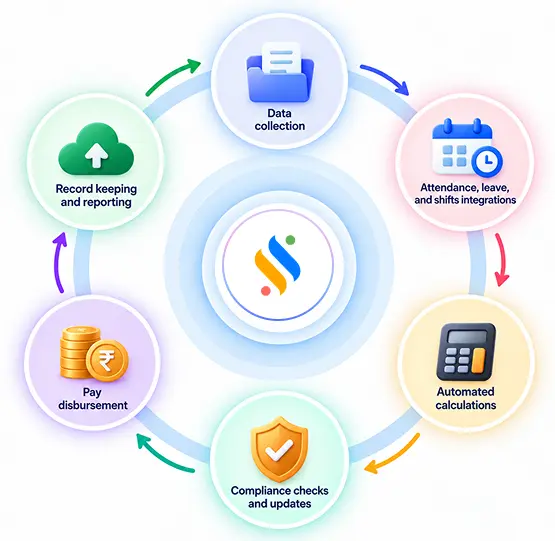
How does payroll automation actually work?
Step 1: Data collection:
The system pulls together employee data needed for payroll — salary structure, tax declarations, bank details, and any changes since the last cycle. Having this centralized in one place means the software isn’t starting from scratch, or from scattered spreadsheets, every month.
Step 2: Attendance, leave, and shift integrations:
Attendance, leave, and shift records flow directly into payroll from the same platform. This removes the manual load or the tedious task of cross-checking everything.
Step 3: Automated calculations:
The software computes gross pay, overtime, deductions, and net pay for every employee in one run, applying your pay rules and statutory formulas consistently. What would take a payroll executive hours to calculate manually happens in minutes, with the same logic applied to every employee.
Step 4: Compliance checks and updates:
Before finalizing payroll, the system checks calculations against current statutory rules — PF, ESI, professional tax, TDS — and flags any updates that affect this cycle. This catches compliance issues before disbursal rather than during a filing deadline, though it’s still worth confirming final rates against official government portals.
Step 5: Pay disbursement:
Once payroll is reviewed and approved, salaries are paid out directly to employee bank accounts, and payslips are generated and made available at the same time. There’s no separate manual step to initiate transfers or distribute payslips individually.
Step 6: Record keeping and reporting:
Every payroll run is logged automatically, creating an audit trail of calculations, approvals, and disbursals that’s ready to reference for filings or internal reviews. Reports on payroll costs and trends are generated from this same data, without manual compilation at month-end.
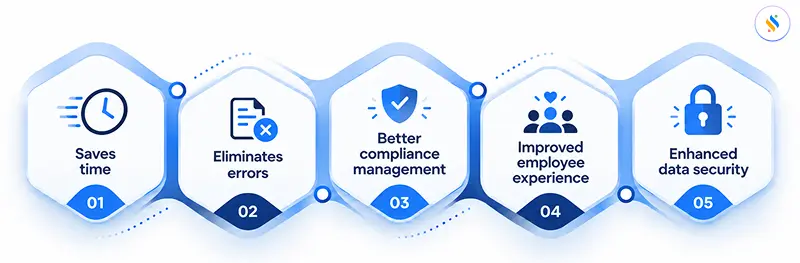
What are the benefits of payroll automation?
1. Saves time:
Calculations that used to take days can now be completed in minutes, since the software handles everything automatically and ensures that each payroll cycle runs smoothly. That frees up HR teams to focus on tasks that actually matter.
2. Eliminates errors:
Rule-based calculations remove the manual re-entry that causes most payroll errors. But with automation of payroll, the same rules will be consistently applied, and errors that earlier would have gone unnoticed will be detected early.
3. Better compliance management:
Automated payroll software flags statutory rate and rule changes as they happen, ensuring that the business remains compliant. This reduces the risk of missed deadlines.
4. Improved employee experience:
Employees get faster, more accurate payslips and can access their own payroll information through a self-service portal. This builds employees’ trust and cuts down on the back-and-forth that is frequent in the manual process.
5. Enhanced data security:
By centralizing payroll data, all the workforce’s information will be stored on a single platform, rather than being stored in cabinets or emails – something that is particularly risky when sensitive information like bank account details is involved. Automation enables role-based access and encryption, so only the right employee will be able to access the details.
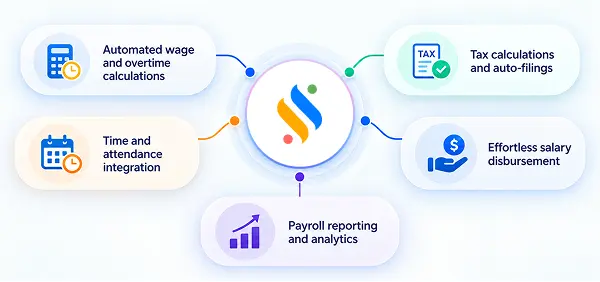
Key features of payroll automation
1. Automated calculation of wages and overtime:
The software automatically calculates gross pay, overtime, and shift differentials based on hours logged. This removes the manual calculations that cause most payroll errors.
2. Tax calculations and auto-filings:
Statutory deductions are calculated each cycle automatically, and the software prepares filings in the required format.
3. Integration of time and attendance:
Attendance, leave, and shift data flow directly into payroll from the same platform. This keeps payroll numbers aligned with what’s actually recorded.
4. Effortless disbursement:
Once payroll is approved, salaries are disbursed directly to employee bank accounts without manual processing for each individual. Payslips are generated and become available to employees at the same time.
5. Reporting & analytics:
Automated payroll software generates reports on payroll and compliance easily. Payroll costs, compliance status, trends across departments or locations – all this can be generated in just a few clicks. This gives HRs, C-level executives, and founders real-time visibility into the business’s existing payroll process and structure.
Ditch spreadsheets and stop fixing payroll errors every month!
Automate salary calculations, statutory deductions, taxes, loans, disbursements and more easily
Payroll automation, compliance, and payroll software in India
Running a business in India has its own set of challenges. And one of them is ensuring that the business remains compliant with state and central rules and regulations. Statutory compliance has four components: PF(Provident Fund), ESI (Employee State Insurance), PT (Professional Tax), and TDS (Tax Deducted at Source).
Rules and regulations in these four components keep changing. In addition to this, PT is a state-levied tax, and because of that, it is not applicable to every state in India. Now, managing all this through spreadsheets can be extremely risky if managing them gets done through spreadsheets.
To avoid any kind of penalties, HR and business founders usually go for payroll software. One of the best things about having this solution is that it automates and centralizes the entire payroll cycle. This way, HR teams don’t have to keep cross-checking data every time, and there will be a reduction in errors.
It is also beneficial in saving teams’ time because, thanks to the built-in employee self-service portal, employees can easily perform basic tasks on their own, such as view/download payslips, Form 16 generation, etc.
Plus, it also stays updated with the ever-evolving changes, so you don’t need to stress about missing any updates. And on top of that, it also ensures that you don’t miss any deadlines.
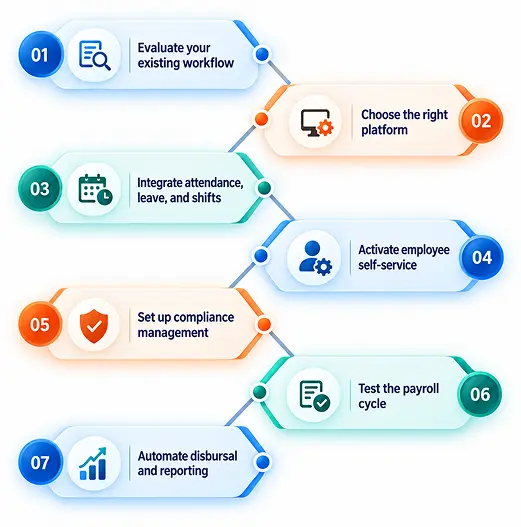
Steps to automate payroll processing
Before you start googling about who gives the best payroll service in India, you need to consider certain things in order to automate the payroll process in your organization.
1. Evaluate your existing workflow:
Assess how payroll is currently processed. Is the data transfer happening manually? Who is doing it and approving it? And most importantly, where are errors happening that are causing delays? Doing such an evaluation will tell you exactly what needs fixing, so that you can make smart decisions regarding adding new software.
2. Get the right platform:
Every software has different capabilities, and hence, they fulfill different business requirements. That’s why don’t choose a platform based on fancy features or the lowest prices. Instead, get the one that meets your organizational requirements. Look for software that handles statutory compliance easily and scales with your headcount.
3. Integrate attendance, leave, and shift tracking:
Payroll accuracy depends on attendance, leave, and shift data feeding directly into the calculation. When this data lives on the same platform as payroll, hours worked and leave taken update automatically.
4. Activate employee self-service portal:
Once the automation begins, enable an employee self-service portal that will allow employees to view/download payslips, generate compliance documents, Form 16, etc., all by themselves. This cuts down repetitive work and saves employees time.
5. Set up state and central compliance management:
If your business has operations in multiple states, then you need the statutory rules that apply to your business. Getting this right at the get-go can save businesses from heavy penalties.
6. Test and run payroll cycle:
Before going live, run a trial payroll cycle using real employee data. Compare the output against your last manually processed cycle to confirm the numbers match.
7. Automate the disbursal cycle and reporting:
Once testing confirms accuracy, switch on automated disbursal, so salaries pay out directly to employee bank accounts each cycle. Plus, payroll reports and compliance records are generated automatically, giving HR teams a clear view of payroll expenses, deductions, and statutory contributions.
Conclusion
By now, you must have understood how payroll automation can change the way you process payroll in your business. When a business decides to choose automation over spreadsheets for payroll processing and compliance management, it is an assurance that there will be minimal errors and complete efficiency, something that is impossible to achieve with spreadsheets. On top of that, it saves the time of HR. All this enables business leaders in India to consider automation of payroll.
Now, when there are many payroll service providers out there, getting the right one will not be easy. That’s why you should consider many factors when getting it. But if you haven’t used any payroll platform in the past and are looking for the best payroll software in India, then you should check out Super Payroll by Superworks.
Built to take care of the entire payroll cycle and compliance management for Indian businesses, it is a platform that is built for businesses of all sizes and every industry. Super Payroll automates and centralizes the entire process without a single manual intervention. The platform is affordable, has swift implementation & onboarding, and has a support team that ensures smooth payroll processing every time. Book a demo and change the way payroll is processed.
The founder & CEO of Superworks, I'm on a mission to help small and medium-sized companies to grow to the next level of accomplishments.With a distinctive knowledge of authentic strategies and team-leading skills, my mission has always been to grow businesses digitally The core mission of Superworks is Connecting people, Optimizing the process, Enhancing performance.
Superworks is providing the best insights, resources, and knowledge regarding HRMS, Payroll, and other relevant topics. You can get the
optimum knowledge to solve your business-related issues by checking our blogs.