
The main reason why most teams face difficulty at work is poor communication. As you must have heard, ” Communication is the key. It can make or break your business”. Thus, if you fail to communicate effectively, it leads to missed deadlines, unwanted confusion, and decreased team performance. When you don’t have communication solutions to rely on, you risk your productivity, customer satisfaction, and even hard-earned revenue.
Just imagine you are planning a project, and your team is unclear about the details or does not have proper details. It will ultimately result in misinterpretation, delay, and missed deadlines. So, effective communication must be your topmost priority. But where there is a will, there is a way. Will here is to solve the problem and way here are the effective business communication solutions.
Thus, today, in this blog, we will show you the causes of poor communication. Also, we will explore ways, or what we call communication solutions, that will help you improve performance and build better relationships with teams and stakeholders.
Common Causes of Poor Communication in the Workplace
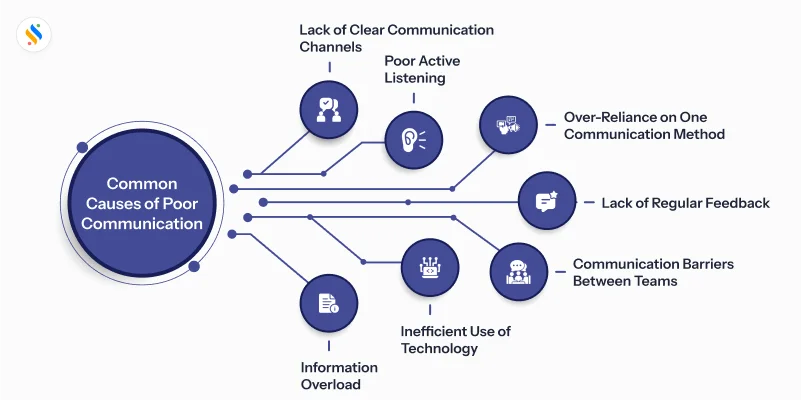
Communication issues are not just a result of one incident or conversation. It’s indeed a volcano that has misunderstandings, missing information, and lack of the right tools. Thus, below we have listed the most common reasons that you must avoid for better communication.
1. Lack of Clear Communication Channels
If businesses fail to define clear communication channels, employees get puzzled about where and how they should share crucial updates for business. As a result, some prefer email, some go for calls, and others use a messaging app. This creates inconsistency and leads to an unstructured system, lost messages, and delays the decision making.
Solution: Companies must prefer a single platform where team members can share updates, get access to required information, and maintain open communication.
2. Poor Active Listening
The conversation is more than just talking. It’s about how good you are at understanding. When your employees are not active listeners, they miss important detail,s which leads to mistakes, repeated conversations, and frustration.
Solution: Encourage employees to give their full attention at times of meetings and discussions. You can even organize training sessions on effective communication and non-verbal cues to help your team learn active listening.
3. Over-Reliance on One Communication Method
Some businesses depend largely on emails or text messages, due to which they face delayed responses and misinterpretations. A business must have different types of communication methods—like face-to-face meetings, calls, and collaboration tools for different situations.
Solution: You can use a mix of vertical communication (from leadership to employees) and horizontal communication (between teams) to make sure everyone is on the same page.
4. Lack of Regular Feedback
When employees don’t get feedback regularly, they can’t figure out if they’re on the right track or not. Lack of mutual understanding can create organizational goal misalignment and lead to inefficiency.
Solution: Managers must provide concise messaging and timely feedback to employees to improve team performance and make sure they are clear.
5. Communication Barriers Between Teams
Due to communication issues between departments, projects suffer. When there are internal communication issues between teams and external communication problems with external stakeholders, the projects slow down, and customer satisfaction is affected.
Solution: You can set up business communication solutions that connect teams in different locations and time zones, ensuring reliable connectivity.
6. Inefficient Use of Technology
When you don’t use the right technology for communication, your messages can get scattered, and you might face inefficient collaboration. Some companies don’t have interactive voice response (IVR) systems or real-time communication solutions integrated.
Solution: Invest in business communication tools that are important for your business, like video conferencing, instant messaging, and real-time tracking, to keep your teams connected.
7. Information Overload
When you send too many messages without structure, your employees can get overwhelmed. If communication is not easily accessible, employees might miss important updates.
Solution: Keep a practice of organizing information using various types of communication tools and strategies, making sure important messages are easy to find.
Struggling with poor communication in your business?
Fix communication issues with the right communication solutions and help your team improve performance, simplify workflows, and boost customer satisfaction.
10 Best Communication Solutions for Workplace Efficiency
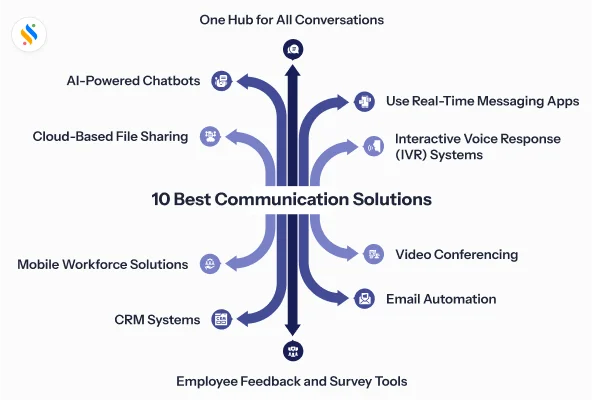
Now that you know the major reasons for poor communication, let’s discuss practical solutions that can help improve collaboration, decision-making, and workplace efficiency. These communication solutions keep the whole team aligned, decrease misunderstandings, and work together to achieve company goals.
1. One Hub for All Conversations
Many companies face communication issues as messages are scattered across emails, chats, and calls. A unified communication platform helps solve this by bringing all required communication channels into one system and making communication seamless.
Why It Works:
- Has all email, chat, video, and calls in one single platform
- Never miss deadlines as everything remains centralized
- Collaboration between remote and in-office teams improve
Example: A marketing team working across multiple locations uses Slack to coordinate campaigns, share updates instantly, and store files in one place, ensuring smooth internal communication.
2. Use Real-Time Messaging Apps
Emails often make communication slow, as responses are delayed. Whereas text messages and real-time messaging apps provide immediate connectivity and make it easier for teams to communicate.
Why It Works:
- Makes response quicker and decreases the number of missed deadlines
- You can use real-time communication for urgent cases
- Make sure you follow concise messaging, avoiding long email chains
Example: A customer service team can integrate real-time communication using chat tools like Super Chat to address customer concerns quickly and boost customer satisfaction.
3. Interactive Voice Response (IVR) Systems
Handling each and every customer call manually is not possible for the support teams. So utilize Interactive Voice Response (IVR) that automates call routing and works as a communication solution, making sure that callers reach the right department without any delay.
Why It Works:
- It decreases the human workload by automating responses
- Takes care that calls are directed efficiently, which improves response time
- Improved customer satisfaction by providing quick resolutions
Example: A telecom company incorporates IVR so that their customers can review their balance or report issues without waiting for a live agent. This works as one of the external communication solutions for business and improves results.
4. Video Conferencing
As remote work is becoming the new trend, face-to-face meetings aren’t always feasible. Video conferencing tools fill this gap and help teams engage in interactive conversations and pick up on non-verbal cues.
Why It Works:
- By doing so, you can strengthen your organizational goals and keep everyone aligned
- Build stronger relationships between remote employees
- decrease the travel costs while maintaining effective meetings
Example: A tech startup has employees who work in different time zones. So the authority schedules weekly Zoom meetings to keep everyone aligned. This fosters collaboration and helps to keep remote workers engaged.
5. Email Automation
Manually sending emails is another headache that eats up valuable time. With email automation, you can skip mundane tasks and ease reminders, notifications, and customer outreach.
Why It Works:
- Automates repetitive tasks and improves overall efficiency
- Reduces errors made by humans in communication
- Helps with external communication that includes customer support and marketing
Example: An e-commerce company sets up automated email sequences to inform customers about order updates and special promotions. As a result, it uplifts customer satisfaction and business results.
6. Employee Feedback and Survey Tools
Poor communication is an end result of common mistakes. Unclear expectations and a lack of feedback are major contributors. By using survey tools, businesses can understand employee concerns and address them proactively.
Why It Works:
- Encourages open communication and exercises transparency
- Helps track team performance and identify communication gaps
- Makes mutual understanding between managers and employees stronger
Example: A company makes use of Google Forms for quarterly employee feedback, which allows it to improve business communication solutions based on team insights.
7. CRM Systems
Customer communication must be organized, accessible, and trackable. CRM (Customer Relationship Management) systems centralize all these interactions and take care of consistency.
Why It Works:
- Manages customer data and makes business results better
- Helps teams keep track of previous interactions for personalized support
- Reduces confusion by keeping all messages centralized in one system
Example: A real estate firm makes use of CRM software to analyze potential buyers’ preferences and follow up based on past interactions, improving external communication.
8. Mobile Workforce Solutions
Businesses that have field service teams require ways to connect with their teams. Field force management software uses real-time tracking and helps managers connect with their remote teams without any issues.
Why It Works:
- Maintains reliable connectivity with mobile teams
- Decrease errors by providing real-time communication
- Allows route planning for better scheduling
Example: A delivery service makes use of route planning software to monitor drivers’ locations, optimize routes, and improve customer satisfaction. You can even use a field force system that has a route planning feature.
9. Cloud-Based File Sharing
Employees waste their valuable time while looking for documents. Cloud storage solutions like Google Drive and Dropbox make information easily accessible and prevent files from getting lost.
Why It Works:
- Ensures that the latest version of documents is always available
- Gives real-time file edit access and improves collaboration
- Reduces time spent looking for important documents
Example: An HR team stores company policies in hrms & payroll software, allowing employees to get access to it anytime and improve internal communication.
10. AI-Powered Chatbots
Modern businesses require 24/7 communication solutions. What can AI chatbots do? It can provide quick answers, reduce wait times, and make sure calls are managed efficiently.
Why It Works:
- Provides concise messaging and quick responses
- Decreased workload on human agents
- Supports both internal communication (employee inquiries) and external communication (customer support)
Example: A retail company incorporates an AI chatbot to handle common customer queries and allow human agents to focus on complex issues and improve customer satisfaction.
Wrapping Up
That’s all for this blog! Here, we saw how poor communication can result in missed deadlines, unclear expectations, and reduced team performance, but the right communication solutions can fix that. Whether it’s using real-time tracking, interactive voice response (IVR), or field force management software, businesses must invest in communication solutions that enhance both internal and external communication.
From concise messaging to using business communication solutions, improving collaboration and maintaining strong relationships should be a priority. By streamlining communication channels, encouraging regular feedback, and using the right tools, companies can drive better business results and boost customer satisfaction. Planning to build a more efficient workplace? Start by applying these strategies today!










