
Overtime, today is considered the big corporate evil that is haunting millions and millions of employees. And for that reason, you have seen so many articles, blogs, interviews, and discussions on the international level on “How can we reduce overtime with a better Overtime management plan?”
Whereas, on the other side, you may find many company’s management worldwide seeing it as a necessary evil that is fueling growth for both the companies and the employees as well! So, what do you feel about it? Is it really necessary? Let’s talk about it!
Many businesses today are struggling with their employee overtime management, overtime hours, and that too without hurting productivity. While working extra hours can help businesses meet their deadlines, too much overtime can easily lead to employee burnout, much higher labor costs & even decreased productivity.
So, the question that comes to mind would be, “How do you devise an overtime management plan to reduce overtime without sacrificing efficiency?” Because it’s highly possible to manage employee overtime quite effectively by simply improving their
- Employee scheduling,
- Optimizing resource allocation, and
- Using smart workforce management strategies.
Henceforth, through the medium of this blog, we are gonna help you learn 9 proven ways to devise an effective overtime management plan to reduce overtime, and that too while maintaining operational efficiency. And once you have implemented these steps, you can easily cut down on excessive overtime, just like you have corrected lateness at work with workforce management tips in the previous blog!
So, let’s get started!
Key Takeaways
- Overtime isn’t always a sign of productivity—sometimes, it indicates inefficiencies.
- Smart employee scheduling can prevent unnecessary overtime.
- Cross-training employees helps distribute workloads more evenly.
- Flexible work schedules can improve work-life balance.
- Using automation and technology reduces repetitive tasks and saves time
What is an Overtime Management Plan?
An overtime management plan always requires a strategic approach, because only with that can they reduce overtime. Simply telling employees to “work less” isn’t enough. Instead, businesses need to identify the root causes of excessive overtime and apply smart solutions.
Here are some common reasons why overtime hours pile up:
- Poor employee scheduling: Not enough workers are available during peak hours.
- Inefficient task delegation: Work isn’t distributed evenly, leading to overworked employees.
- Last-minute work demands: Deadlines creep up, forcing teams to work overtime.
- Lack of cross-training employees: Employees can’t step in for others when needed.
- Demand outweighs labor: Businesses don’t have enough qualified employees to handle the workload.
Once companies have started to tackle these issues, they can simply control overtime management for employees, and that too without compromising employee productivity. So, let’s get answers for reducing employee overtime hours with 9 proven ways!
Overtime Management Plan: 9 Proven Ways To Avoid Burnout
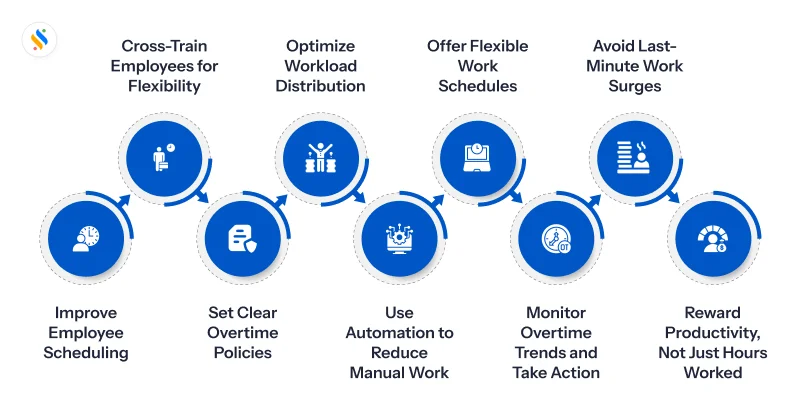
If you’re seeking an efficient overtime management plan without compromising productivity, you need a clear-cut strategy that can help you achieve it. So, let’s have a look at the 9 effective ways to manage overtime in the workplace while keeping employees engaged & maintaining operational efficiency.
1. Improve Employee Scheduling
One of the biggest reasons for overtime is scheduling employees poorly. Because when management in the company fails to plan their shifts efficiently, their employees continue to end up working overtime to fill in the gaps.
Solution
To deal with poor scheduling of employees, companies can start using employee scheduling software. So, they can start quickly filling vacant shifts & ensure they have enough workers even the peak hours. Tools like Superworks, ShiftBase, When I Work, or Connecteam are considered better options here to automate scheduling and reduce unnecessary overtime.
Benefits
- Prevents understaffing issues.
- Reduces overtime costs by optimizing work hours.
- Ensures a balanced workload.
2. Cross-Train Employees for Flexibility
Relying on a small group of employees to handle all the critical tasks can simply lead to an endless overtime cycle, that simply is difficult to end! Moreover, if those employees [on which companies have put critical responsibilities] are absent, then other employees will have to face maximum work hours to cover for them.
Solution
Do a session of cross-training, so your employees can take on multiple roles, ensuring smoother operations and that too without excessive overtime.
Benefits
- Reduces dependence on a few employees.
- Prevents employee burnout caused by overwork.
- Improves employee morale and job satisfaction.
3. Set Clear Overtime Policies
Employees often work in between busy periods and experience too much overtime, and sometimes that too without any extra pay. The Reason behind that is not having any potential official overtime policy in place. Because if there’s no limit to employee hours, then no access management system, or no task delegation, and overtime can quickly spiral out of control.
Solution
Create an official overtime policy that outlines:
- When overtime pay kicks in (after a certain number of hours).
- Who needs to approve extra hours before they are worked.
- How to control overtime by redistributing workloads.
Benefits
- Helps in managing overtime in the workplace effectively.
- Ensures fair overtime distribution.
- Reduces unnecessary labor costs.
4. Optimize Workload Distribution
Some employees work extended work hours while others have lighter workloads. This imbalance results in excessive overtime for some while others stay underutilized.
Solution
Task delegation and better resource allocation help balance workloads across teams. Field force management software can help track who’s doing what and adjust workloads accordingly.
Benefits
- Prevents decreased productivity from overworked employees.
- Reduces stress and improves employee well-being.
- Helps in avoiding unnecessary overtime.
5. Use Automation to Reduce Manual Work
Repetitive tasks in your field activity log keep taking up a lot of time. So, as an employee, if you keep spending too much time on manual work, you probably may end up needing many more overtime hours to complete critical tasks.
Solution
In such cases, you should start automating your routine processes with AI tools, chatbots, or automated workflows. With such solutions, you can simply free up much more time, and that too during regular working hours.
Benefits
- Reduces overtime and health costs related to overwork.
- Improves efficiency and reduces labor costs.
- Allows employees to focus on high-priority work instead of repetitive tasks.
Your team deserves better work-life balance.
Get a better scheduling software for them!
6. Offer Flexible Work Schedules
Rigid 9-to-5 schedules can never treat overtime, rather such schedules keep leading to work overtime situations when employees struggle to complete tasks within fixed hours.
Solution
To solve problems with work schedules, and to ensure proper overtime management, companies should introduce flexible work schedules. Schedules where employees can start early or finish late and that too based on workload. Compressed workweeks of such kind can also help reduce labor costs by maximizing efficiency.
Benefits
- Improves work-life balance and reduces employee burnout.
- Enhances employee satisfaction by giving them control over their work hours.
- Helps in reducing employee overtime hours.
7. Monitor Overtime Trends and Take Action
If you don’t track overtime hours employees work and simply keep paying employees, you won’t know if your overtime reduction action plan is working or not.
Solution
Regularly analyze overtime data using employee scheduling tools, and keep working on distributed work. Because that is how you can simply track patterns and adjust schedules accordingly.
Benefits
- Helps in controlling overtime hours before they become a problem.
- Allows you to make a better overtime management plan and reduce overtime costs proactively.
- Provides insights into whether overtime rules need adjustments.
8. Avoid Last-Minute Work Surges
When team projects aren’t planned properly, whether it’s about work time or just some labor budget, teams literally have to rush in between deadlines. This is where overtime begins, and employee health continues to deteriorate, because here even the high performance team may face last-minute deadlines that will keep forcing them to work overtime.
Solution
Set realistic deadlines can easily help in avoiding unnecessary overtime because this way you can ensure proper resource allocation ahead of time. Encourage managers to plan workloads in a way that avoids peak stress periods.
Benefits
- Prevents employee overtime hours from piling up unexpectedly.
- Helps maintain a healthy work-life balance.
- Reduces stress and improves employee engagement.
9. Reward Productivity, Not Just Hours Worked
Some employees work more overtime because they believe it shows dedication. This can lead to an endless overtime cycle where employees feel pressured to work overtime hours to prove themselves.
Solution
Shift the focus from extra hours to actual productivity. Recognize and reward employees who complete tasks efficiently within regular working hours.
Benefits
- Encourages smart work instead of long hours.
- Boosts employee morale and job satisfaction.
- Supports a healthy work-life balance.
Wrap Up,
Here, all the companies should understand one thing: to reduce overtime, they need an overtime management plan, and without it, they just can’t cut costs. Henceforth, you should focus on maintaining operational efficiency and ensuring that all of your employees are staying productive.
But you just can’t do that efficiently if you keep strangling your workspace with manual procedures. Introduce your workspace to seamless automation and better workforce efficiency with highly efficient platforms like Superworks!
Automation tools like Superworks’s field force management software can help you with proper employee scheduling, seamless workflow tracking, on-time payroll, assurance in employee engagement, and many more. So, leave your troubles of employee scheduling to automation, and start improving your workflow now!










