
When, as an HR manager or as a CEO, you look at your workforce and try to ensure a better distributed workforce management, you are bound to reap some great benefits. But at the same time, it comes with its own set of challenges, that can be quite tough to tackle.
But what are the benefits of distributed workforce model? Or what are those dire challenges that companies are facing when they try to establish a distributed work environment? We’re are gonna talk about those crucial aspects today!
A Business owner in today’s modern world, with the help of expert workforce management tips, has learned to embrace this modern solution of distributed workforce management. Because with the help of this, they can easily access a wide range of global workforce with much ease.
With this modern solution, they can access a global talent pool and ensure their work-life balance by reducing their dependence on a central office. To be honest, many remote employees are working from multiple locations, and more companies in the world need some mind-blowing strategies to ensure seamless communication & collaboration.
But that question that keeps all the HR Managers and the CEOs away from the solution is “HOW!” That “how” is gonna get answered today! Because here, through the medium of this blog, we are gonna help all the CEOs and the HR Managers understand, what this distributed work really means, and how companies can manage their distributed teams effectively.
Moreover, we are also gonna cover top 5 unique ways to improve your workforce’s productivity and that too while keeping their team members engaged.
Key Takeaways
- What does distributed work mean?
- How do you manage a distributed workforce?
- 5 key strategies to enhance remote and distributed work.
- How to maintain company culture in a distributed workplace.
- Best distributed workforce management solution for companies.
- FAQs on managing remote teams.
What is Distributed Workforce Management?
Distributed workforce management directly refers to a setup where all the team members are operating from various locations around the world instead of one single central office. It’s quite completely the opposite of a traditional office setting, which you may find in minor or major cities, a united system that is located in a single place.
But the thing is such a single place is limited to the local presence only, whereas, the modern distributed work model comes with a global presence. And such global presence allows companies to access much wider talent pool.
This model allows businesses to hire from a global talent pool, so all such companies can get access to numerous specialized skills across multiple time zones. So, let’s get to know some of the key aspects of a distributed workforce!
Key Aspects of Distributed Workforce Management
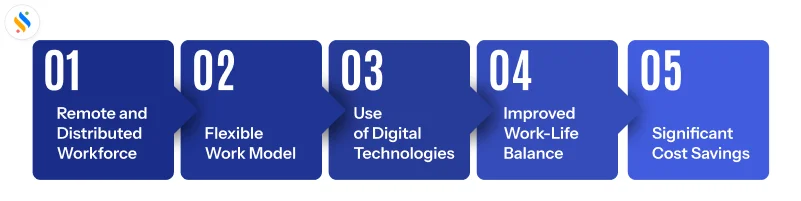
Remote and Distributed Workforce
Employees today are working from different physical locations, which are located outside a traditional office setting; hence, the term is called distributed workforce. Such a setting includes;
- Satellite offices,
- Co-working spaces, or
- Even their homes.
Flexible Work Model
Unlike the physical workplace, distributed teams throughout the world can easily work asynchronously across various time zones. Such models where one or more employees are working remotely ensures a seamles collaboration without the need for everyone to be in the same physical location.
Use of Digital Technologies
Distributed workers who rely on digital communication tools such as mobile tools software can always enjoy better communication channels. With the help of such video conferencing platforms & collaboration tools can always stay connected.
Improved Work-Life Balance
Once you have eliminated the need for physical office space, you can understand what a distributed workforce means. This modern workplace can help employees experience improved work life balance, which can easily lead to much higher employee satisfaction.
Significant Cost Savings
Companies can save lots and lots of money on maintaining a central office location too while keep benefiting from increased productivity and diverse perspectives.
Distributed Workforce Management Best Practices
Distributed workforce management for the entire organization is highly crucial, because that is when team members can keep working remotely or from the office. However, this management requires a well-structured approach to ensure seamless communication, productivity & a strong company culture.
Unlike a traditional office environment that mostly depends on paper-based processes, a distributed workplace depends on crucial aspects such as right mix of distributed workforce tools. Other than that, they would be also needing better leadership strategies & project management tools so they can keep remote employees aligned with company goals.
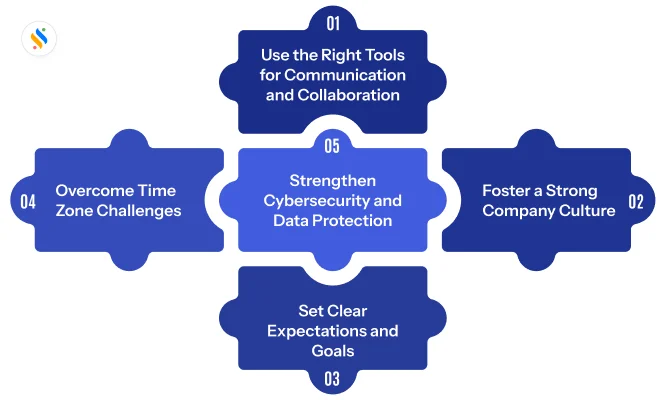
So, let’s have a look at the 5 best practices for distributed workforce management…
1. Use the Right Tools for Communication and Collaboration
A distributed work paradigm means relying on technology to keep team members connected. Businesses here other than valuable insights would also be needing video conferencing platforms, digital communication tools & collaboration tools just so they can ensure seamless collaboration among employees across multiple time zones.
Recommended Tools
- Slack or Microsoft Teams – Instant messaging for quick updates.
- Zoom or Google Meet – For virtual meetings and team check-ins.
- Trello or Asana – Project management tools for task tracking.
- Google Drive or Notion – For document sharing and knowledge management.
2. Foster a Strong Company Culture
Without a central office location, businesses have another job to ensure, and it’s about keep strengthening the company culture. Here, all those business owner must have to take some extra steps to build a strong company culture that keep making employees feel connected despite different physical locations.
How to Build Culture in a Distributed Workforce?
- Firstly, they have to organize virtual company events and ensure some of the best team-building activities.
- Teams have to celebrate their milestones and recognize achievements publicly.
- Create shared traditions, such as virtual coffee breaks or game nights.
- Encourage feedback and open dialogue to maintain inclusivity.
3. Set Clear Expectations and Goals
In a distributed environment, companies should have to understand that clarity is the key. Henceforth, managers should set clear goals, deadlines, and performance expectations for high performing teams to ensure everyone is on the same page.
Best Practices
- Use KPIs to measure performance.
- Have regular one-on-one check-ins.
- Align everyone on company goals to maintain productivity.
4. Overcome Time Zone Challenges
With employees working from diverse locations situated throughout the world, teams have to manage time zone differences because it’s one of the crucial things in distributed workforce management. So, instead of just forcing everyone into the same schedule, you should leverage asynchronous communication to allow flexibility.
How to Manage Time Zones Effectively?
- Use world clocks (e.g., World Time Buddy) to schedule meetings.
- Rotate meeting times so no single region is always inconvenienced.
- Record meetings for those who cannot attend live.
5. Strengthen Cybersecurity and Data Protection
A remote and distributed workforce must have strong security measures to to ensure field worker safety and to protect sensitive company data. Especially for those employees work outside a physical office.
Cybersecurity Best Practices
- Implement VPNs for secure access.
- Use multi-factor authentication for all accounts.
- Conduct regular security training for remote workers.
Don’t let your team face any kind of slow down.
Manage your team better with Superworks!
Superworks: Best Workforce Management Solution
Managing a distributed workforce is not only about communication, rather, it requires seamless coordination to track employee productivity & ensure engagement. Superworks keeps simplifying their workforce management by providing a centralized platform where businesses can;
- Tracking their project timelines,
- Monitor productivity, and
- Ensure alignment across multiple locations.
Unlike various traditional tools, Superworks can always adapt to the distributed work model. This adaptation can keep helping managers oversee teams across various time zones, and that too without disrupting workflows.
Furthermore, it keeps fostering a strong company culture by ensuring that employees keep feeling connected no matter where they work. With Superworks, businesses can easily manage their workforce efficiently while maintaining flexibility and productivity.
Parting Thoughts,
Managing a distributed workforce can be quite challenging, but with the right approach, every business owner can easily maximize their employee productivity with ease. So, whether your company is operating with remote workers, some distributed employees, or a combination of both, you need such amazing software to make a difference.
With Superworks’ field force management software, your business can easily streamline your workforce model with a single, all-in-one platform. To know more details, you can always connect with our experts for better understanding.
Why Superworks?
- Seamless collaboration across multiple locations and time zones.
- Integrated project management tools to keep teams aligned.
- Enhanced work-life balance with flexible scheduling features.
- Built-in security measures to protect remote and distributed workforce data.
- Scalable solutions for growing teams, whether in a central office or across different locations.
The shift from a traditional office to a distributed work model requires modern technology that simplifies operations while improving employee satisfaction. With Superworks, businesses don’t just manage a distributed workplace – they optimize it.










