TL; DR
What is HCM? The full form of HCM is Human Capital Management. It is a strategic approach that views the company’s workforce as an important asset rather than as an expense. Unlike traditional HR systems that focus mainly on administrative tasks, HCM involves practices to attract, develop, optimize, and retain employees to achieve organizational goals. This guide thoroughly explains human capital management, its meaning, core functions, how it differs from HRMS and HRIS, and why modern businesses rely on HCM solutions and tools to build high-performing teams.
Whether you’re an HR manager, an MSME founder, or a C-level executive of a thriving business in India, chances are that you might have heard the term HCM.
Now, when someone asks what is HCM, most often than not, it gets used interchangeably with HRMS and HRIS, and this is where all the confusion begins.
But what does it actually mean, and more importantly, what does it mean for your business?
This guide explains what HCM is in detail.
So, let’s jump right in!
HCM definition & what does HCM stand for?
HCM’s full form is Human Capital Management.
As per the HCM definition, it is a strategic approach that sees employees as a company’s greatest asset, not just a business expense. It brings hiring, development, performance, retention, succession management, and workforce insights under one strategy to align individual and business goals, help people perform at their best, and drive business growth.
What HCM means in practice: 5 core functions
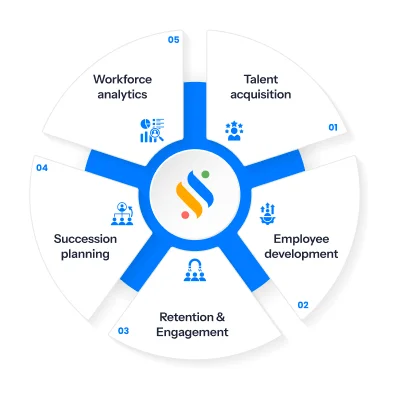
When you understand what human capital management is, you will realize that it has five interconnected functions, and everyone of them operates as part of a larger system.
1. Talent acquisition:
The most interesting aspect about HCM is that it begins even before a person joins your organization. Structured job architecture, employer branding, sourcing strategies, and candidate experience all fall under talent management — marking the very start of the talent lifecycle. For Indian MSMEs competing with larger organizations for skilled talent, this is often the first place HCM thinking creates a measurable advantage.
2. Employee development:
One of the most fascinating aspects of HCM is that here, learning and growth are considered a part of business investments. This includes structured onboarding, skills gap mapping, leadership pipelines, and continuous learning programmes. Development under HCM is tied to performance goals and business outcomes.
3. Retention and engagement:
India’s attrition rate was 16.2% in 2025. Human capital management addresses this systematically. Career pathing, workforce rewards, compensation benchmarking, performance management, and culture-building are all connected to deliver a personalized employee experience — not a collection of separate initiatives. When done right, this approach helps increase workforce productivity across the entire workforce, not just top performers.
4. Succession planning:
Imagine your key employee resigns out of nowhere. Do you have a strategy in place for the next step? HCM works toward ensuring that you have one to address this crisis. Succession planning identifies high-potential employees early and prepares them progressively, reducing organizational risk and leadership gaps.
5. Workforce analytics:
This is where modern features of hr software and HCM separates itself most clearly from traditional HR practice. Which teams carry the highest attrition risk, where productivity gaps are forming, and how your compensation stacks up against market benchmarks? Predictive analytics within an HCM system provides this data as actionable insights, enabling more intelligent workforce decisions at every level of the organization.
See HCM in action!
Explore how modern organizations got a measurable advantage with Human Capital Management.
HCM vs HRMS vs HRIS: Understand the difference
| HCM | HRMS | HRIS |
|---|
| Full Form | Human Capital Management | Human Resource Management System | Human Resource Information System |
| Primary Focus | Strategic workforce planning | Operational HR, payroll, and compliance | Employee data and records management |
| Scope | Full employee lifecycle, business-aligned | HR processes, payroll, attendance, compliance | HR data storage, workflows, basic reporting |
| Best Used By | Organizations aligning people strategy with business growth | Mid-to-large organizations managing complex HR operations | Organizations building structured HR data infrastructure |
| Typical Users | CHROs, HR leaders, founders, C-suite | HR teams, payroll managers, compliance officers | HR admins, data managers |
| Analytics Depth | Predictive, strategic | Operational reporting | Basic records and reports |
The best way to understand them? HRIS manages data . HRMS software manages processes. HCM manages strategy.
For most growing Indian organizations, whether a 60-employee startup or a 150-employee firm, the path moves in sequence.
You start with HRIS to bring structure to employee records. You move to HRMS as HR functions become more complex.
You reach HCM when people’s decisions are connected to business outcomes, and your HR departments are contributing to strategic HR planning — not just day-to-day operations.
Where does HCM fit in the HR systems landscape? Read our detailed guide on human capital management.
Why HCM matters in 2026?
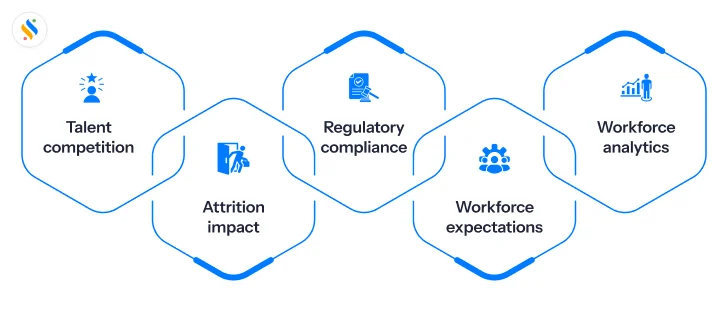
Human capital management has been a subject of discussion among founders and managers, but the current scenario shows that it has moved from aspiration to operational necessity, particularly for Indian organizations.
The talent market is not getting easier:
Across sectors, skilled talent is scarce, mobile, and better informed about their market value. HCM provides a structured, proactive response: building pipelines before vacancies appear, and developing internal talent before you’re forced to look outside.
Attrition has a real cost, and it’s calculable:
Studies consistently show that replacing a mid-level employee costs anywhere between 50% to 200% of their annual salary, when you factor in time-to-hire, onboarding, and the productivity curve for new joiners. HCM reduces this figure by treating retention as a system, not a crisis response.
India’s compliance landscape is evolving:
The consolidation of labour laws into four Labour Codes, once fully notified and enforced, will increase the compliance responsibility on employers of all sizes. HR compliance — from accurate payroll to PF, ESI, TDS, and Gratuity obligations — must be embedded into people processes rather than managed separately. HCM, implemented through the right platform, ensures exactly that.
Your workforce expects more than a salary:
India’s large millennial and Gen Z workforce, which now constitutes the majority of the formal working population, expects career growth, transparent communication, and meaningful work. HCM builds the operational infrastructure to meet those expectations at scale, before they translate into attrition.
Data is now a boardroom expectation:
The shift from “HR as admin” to “HR as strategy partner” depends entirely on the ability to bring workforce data into business planning. Human capital management, supported by the right analytics tools, is what makes that shift possible. For MSME founders who have managed people informally through growth, this is the clearest upgrade path.
What to look for in an HCM software?
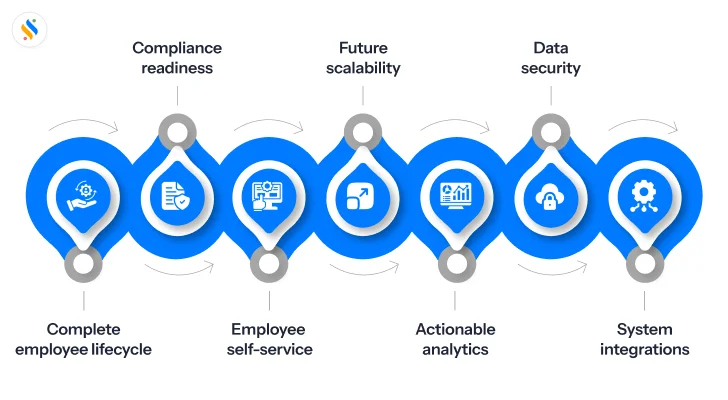
HCM as a strategy requires the right infrastructure to execute. Modern HCM software brings all five core HCM processes into integrated HCM systems, replacing routine tasks and manual processes with a unified platform for workforce management across the full employee lifecycle.
End-to-end lifecycle coverage:
Just because HCM covers the entire employee lifecycle, it does not mean that you should go for it blindly. When going for the platform, do check whether it handles the entire employee lifecycle, or just looks after the fragments of it?
Indian compliance readiness:
Some of the basic compliance requirements are PT, PF, ESI, TDS, accurate payroll processing, compliance and fraud detection, Gratuity, Shop & Establishment Act compliance, and alignment with upcoming Labour Code requirements. These are non-negotiables for any human capital management system operating in India.
Employee self-service:
A strong HCM platform should also offer employee self-service capabilities, giving employees direct access to payslips, leave requests, performance reviews, and personal data. This reduces the administrative load on HR teams and significantly improves the overall experience.
Scalability:
If the system collapses the moment your workforce starts to grow, then there is no point in having it! So, ask yourself one simple question: would you go for a system that will compel you to migrate to another system the moment your business adds 50 new employees?
Actionable analytics:
Basic reports are no longer sufficient. Look for attrition risk indicators, workforce planning dashboards, and benchmarking capabilities that help you optimize workforce management on an ongoing basis.
Data security:
When managing sensitive employee information across the talent lifecycle, data security is non-negotiable. Ensure the platform you choose meets industry standards for encryption, access controls, and audit trails.
Integration depth:
How effectively does it connect with your existing systems? The right HCM solutions don’t add administrative complexity; they replace manual processes with clarity and efficiency.
For a full breakdown, explore our guide to HCM software.