
TL; DR
A payroll report is a summarized document that captures everything related to the wages of the workforce. This includes wages, taxes, deductions, and statutory contributions, among others. Businesses use payroll reports for various purposes, such as compliance filing, budgeting, auditing, and tracking labour costs.
The traditional way of creating payroll reports has always been spreadsheets, but with changing times, businesses have opted to generate them through payroll software. This guide covers all the key aspects of a payroll report and how having one can help HRs, C-level executives, and founders in order to make better payroll decisions.
Ask three people on your team what a “payroll report” is, and you’ll probably get three different answers. For someone in finance, it’s a way to understand the P&L line. For someone in the compliance department, it is proof that the business is compliant. And for someone in HR, it’s a way to understand the salary structure of an existing workforce as well as the new candidate. Now, none of them is wrong, and that’s the problem.
Payroll reporting isn’t one document; it’s a family of reports, each built for a different question, and most businesses only discover which ones they actually need after a missed filing deadline.
Now, you can imagine the gravity of the situation without a payroll report. Yet, most businesses ignore it or don’t know about it. This blog is an attempt to go deep into payroll reporting and how it can make your business efficient.
What is a payroll report?
A payroll report is a structured summary of everything that happened during a pay cycle. This can be for a single employee and for an entire department too. The report includes gross wages, deductions, statutory contributions, net pay, employer costs, etc.
The best thing about having a payroll report is that it takes away the tiresome job of getting data from multiple spreadsheets.
Why do payroll reports matter for growing businesses in India?
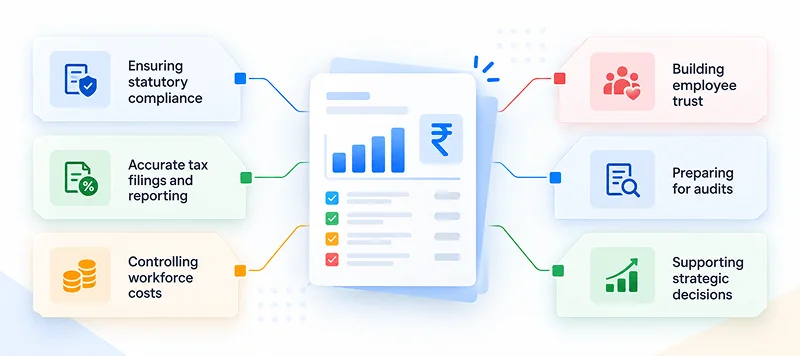
Payroll reports and analytics turn raw salary data into organized records that help Indian businesses make informed payroll decisions. Apart from this, as the headcount starts to grow, manual ways of creating reports fail. Here is why best payroll reports matter for growing businesses in India:
1. Ensuring statutory compliance in India:
Indian payroll compliance isn’t optional. PF, ESI, PT, and TDS all come with their own filing windows, and the rules shift by state and by employee count threshold. Payroll reports flag exactly what’s owed, to which authority, and by when, so nothing slips through during a busy growth phase.
2. Accurate tax filings & reporting:
A single miscalculated deduction can throw off an employee’s Form 16 or your quarterly TDS return, and fixing it after the fact means correction filings, not just a quick edit. Payroll reports catch these errors at the source, before they turn into a compliance headache months later.
3. Control workforce costs:
As headcount scales, payroll quietly becomes the biggest line on the P&L. Regular reporting shows exactly where the money is going – by department, by role, by location- so top management can spot cost creep early instead of discovering it at year-end.
4. Building the team’s trust:
Nothing diminishes employee confidence faster than a pay discrepancy in their payslips. Clear, accurate payroll reports mean HR can answer “why is my salary different this month?” with a specific reason.
5. Preparing for the audit:
Whether it’s a statutory audit, a funding round, or investor due diligence, someone will eventually ask for clean payroll records going back several quarters. Businesses that generate reports as a matter of routine can pull that history in minutes; businesses that don’t end up reconstructing it under deadline pressure.
6. Making strategic decisions:
Payroll data isn’t just for effect that is required solely for the sake of statutory compliance. It’s a planning input. Trends in OT, costs related to attrition, and department-wise spending help leadership in making better decisions.
Types of payroll reports every business needs
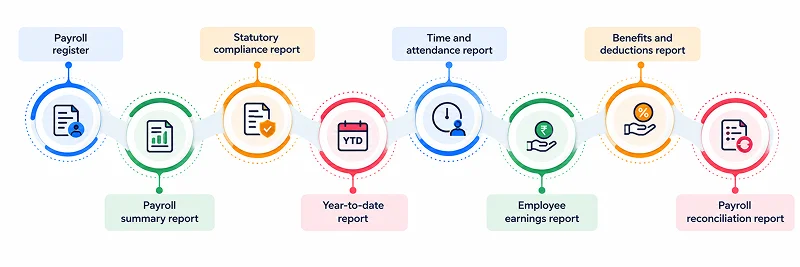
Every business needs a core set of payroll reports to track labour costs, manage cash flow, and maintain legal compliance. Here are a few types of reports:
1. Payroll register:
The master record of every pay run – a line-by-line log of gross pay, deductions, and net pay for each employee, for each cycle. It’s the source document everything else gets built from, and the first thing an auditor will ask to see.
2. Payroll summary report:
A rolled-up view of total payroll cost across the organization for a given period – no employee-level detail, just the top-line numbers finance and leadership actually check first when closing the books each month.
3. Statutory compliance report:
A breakdown of everything owed to the government – PF, ESI, professional tax, and TDS – formatted to match each authority’s filing requirements. This is the report that keeps a growing business away from penalties.
4. Year-to-Date (YTD) report:
A running total of earnings, deductions, and contributions from the start of the financial year to the current date. Useful for annual tax planning, Form 16 prep, and spotting whether cumulative numbers are tracking against budget.
5. Time and attendance report:
This covers hours worked, leave taken, and OTs logged to actual pay adjustments. The report is especially critical for organizations with more hourly or shift-based teams.
6. Employee earnings report:
Basically a payroll payslip, it is a detailed breakdown of what one employee earned – base pay, allowances, bonuses, and overtime – over a specific period. This is the report HR pulls first when an employee has a specific pay question.
7. Benefits and deductions report:
A record of everything subtracted from or added to gross pay beyond statutory deductions – insurance premiums, loan recoveries, reimbursements, and voluntary contributions – kept separate so they’re easy to audit or adjust.
8. Payroll reconciliation report:
A side-by-side comparison of what was budgeted or approved against what was actually paid out, used to catch discrepancies before they compound across multiple pay cycles.
Simplify your payroll reporting!
Automate payroll reports, stay on top of compliance, and get accurate payroll insights
Statutory compliance essentials for payroll reports in India
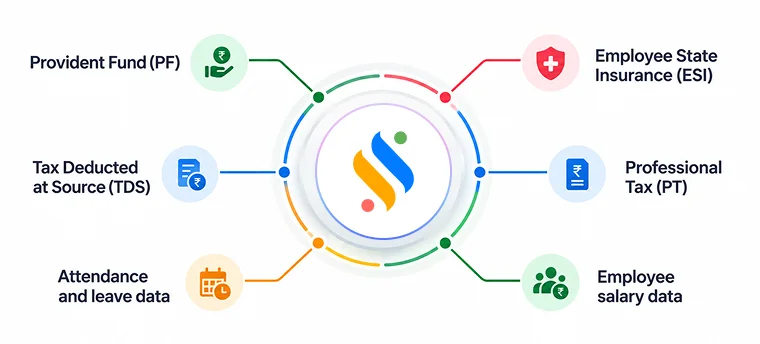
Statutory payroll compliance in India requires companies to accurately compute deductions, submit real-time digital filings, and maintain exhaustive audit-ready records across both central and state governments respectively.
1. Provident Fund (PF):
Mandatory once a business crosses 20 employees, PF requires monthly contributions from both employer and employee, filed via ECR on the EPFO portal. Payroll reports need to track contribution rates, wage ceilings, and filing deadlines accurately. A mismatch here is one of the most common sources of compliance notices.
2. Employee State Insurance (ESI):
In most Indian states, it is applicable once headcount reaches or exceeds 10 employees. ESI covers medical and disability benefits and requires monthly employer-employee contributions filed through the ESIC portal. Payroll reports need to flag which employees fall under the applicable wage threshold, since eligibility can shift as salaries change.
3. Tax Deducted at Source (TDS):
Employers are required to deduct tax on salaries and file it quarterly via Form 24Q, with Form 16 issued to employees at the end of the year. Payroll reports need to reflect accurate slab-wise calculations for each employee, since errors here surface directly in an employee’s personal tax filing.
4. Professional Tax (PT):
A state-level tax with rates, slabs, and even applicability varying by location — what’s owed in Maharashtra won’t match what’s owed in Karnataka. Payroll reports for multi-state teams need to handle this variation automatically, rather than applying a single flat rule across the board.
5. Attendance and leave data:
Statutory calculations like PF, ESI, and leave encashment all depend on accurate attendance records — days worked, leave taken, and unpaid absences. Payroll reports need this data synced correctly, since even small attendance gaps can throw off a filing.
6. Employee’s salary data:
The base layer everything else is calculated from – basic pay, allowances, and salary structure changes over time. Payroll reports need this data to stay current and audit-ready, since statutory contributions and tax filings are only as accurate as the salary figures feeding into them.
How to generate a payroll report online?
Earlier, the standard way to create a payroll report was spreadsheets. The biggest problem with that has been that the process has been not only time-consuming but also error-prone. One mistake in tracking attendance and leave data used to require the HR and payroll team to cross-verify everything again and again. Even a minor error, if go unnoticed, could lead to heavy penalties.
For this reason, HRs, C-level executives, and founders in India started to opt for payroll software. This made the process of generating online payroll reports easy. Here’s how one can generate reports.
1. Log in to your software:
Go to your software portal and enter your credentials to log in. If your organization uses role-based access, make sure you have the permission.
2. Navigate to the reporting section:
Most payroll platforms have a dedicated “Reports” or “Analytics” tab separate from the pay run workflow. This is where every report type lives, ready to be pulled without touching live payroll data.
3. Select the type of report:
Choose the report that matches who’s asking – a summary for finance, a statutory breakdown for compliance filing, or an employee-wise report for resolving a pay query.
4. Select a date range:
Narrow the report to the period that matters. This keeps the output relevant instead of dumping every transaction the system has ever recorded.
5. Apply filters:
Refine further by department, location, employee group, or specific compliance category. Filters turn a company-wide report into exactly the slice a department head or auditor needs.
6. Run the report and export it:
Generate the report and export it. You can do it in PDF format as well as Excel. A good payroll system produces this in just a few clicks without the need for any manual recalculation.
Conclusion
There you have it – a comprehensive guide on payroll reports. Payroll reports are a critical component of efficient payroll management. It helps businesses keep salary data organized, monitor workforce costs, simplify compliance, and make informed payroll decisions.
The general way to approach payroll reporting has often been spreadsheets. Now there are several loopholes to it that we have discussed in this blog, but what makes it ineffective is the moment when headcount in an organization begins to grow.
That’s why businesses are switching to payroll software. Having it can make a world of difference because it will automate and centralize the process of payroll report generation. Now, if you are looking for such software for your business, then you can go for Super Payroll by Superworks. It’s a smart payroll software that has transformed the way Indian businesses create payroll reports.
Book a demo now and see how it can make payroll report generation easy while making your business compliant!









