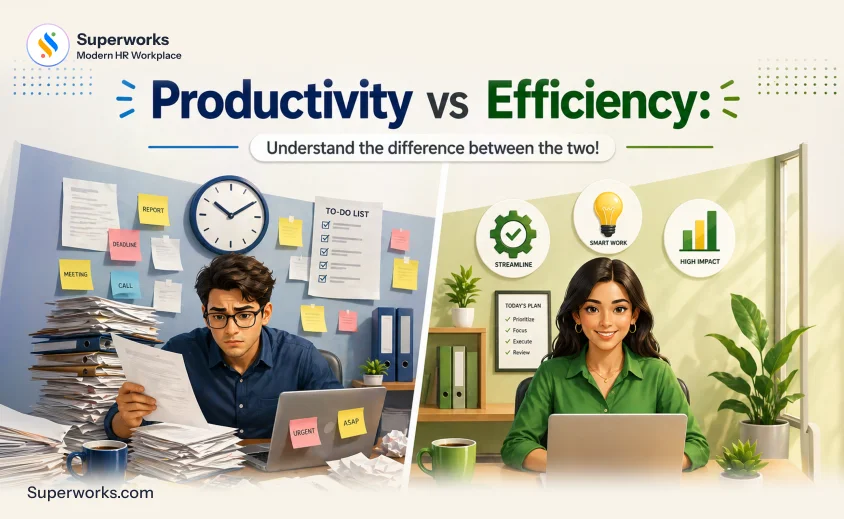
Productivity and efficiency.
Oxford dictionary defines productivity as
The rate at which a worker produces goods, and the amount produced, is compared with the amount of resources needed to produce them.
While it defines efficiency as
The quality of doing something well, achieving maximum results with minimum waste of time, money, or energy.
Now, if you are also among those people who use these two words in a sentence, then you are not alone.
But…the problem is that you’re wrong!
Why?
It is because when we talk about the difference between productivity and efficiency, we only talk about two very different ideas that often get stuck together.
You can be productive without being efficient and vice versa.
But things began to change for you the moment you understood the difference, and while there is employee monitoring software available, it is essential to understand the difference between the two, and this blog aims to do just that.
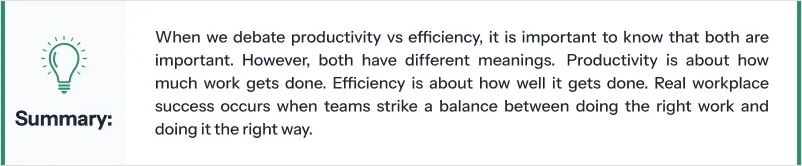
Productivity: An overview
Productivity isn’t just time spent. It’s about getting meaningful work done that drives real progress.
How to measure productivity in the workplace?
Below is the productivity formula:
Output / Input = Productivity
What are the productivity-related challenges businesses face?
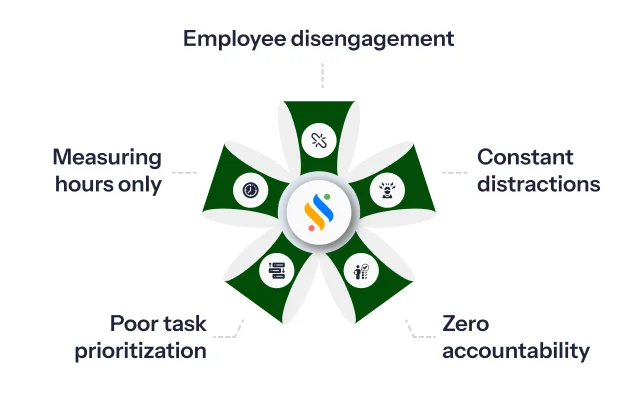
Employee disengagement:
A workplace without recognition or meaningful connection slowly drains productivity. Employees continue showing up, but their energy and focus start to go down.
Constant distractions:
Notifications, emails, Slack messages, random calls, quick “can you check this” requests… they break focus all day long. Even brief distractions disrupt deep work.
Lack of accountability:
If no one owns tasks clearly, things move more slowly than they should. Everyone’s busy, yet nothing really gets done.
Poor task prioritization:
Employees often gravitate toward tasks that feel comfortable, even if they don’t add much value. As a result of this, high-priority work that demands your undivided focus keeps getting delayed.
Measuring hours instead of outcomes:
Many businesses still measure effort by hours logged instead of outcomes achieved. This pushes people to work longer; eventually, productivity drops instead of getting improved.
Busy doesn’t always mean productive!
Turn effort into outcomes by cutting time-wasters.
Efficiency: An overview
This is the second part of the difference between productivity and efficiency. Efficiency refers to getting more done with the same resources with minimal to zero wastage.
How to measure efficiency in the workplace?
Below is the efficiency formula to calculate efficiency:
Efficiency = (Output / Input) x 100%.
But keep in mind that a formula like this can’t really tell you if the work’s good.
What are the efficiency-related challenges businesses face?
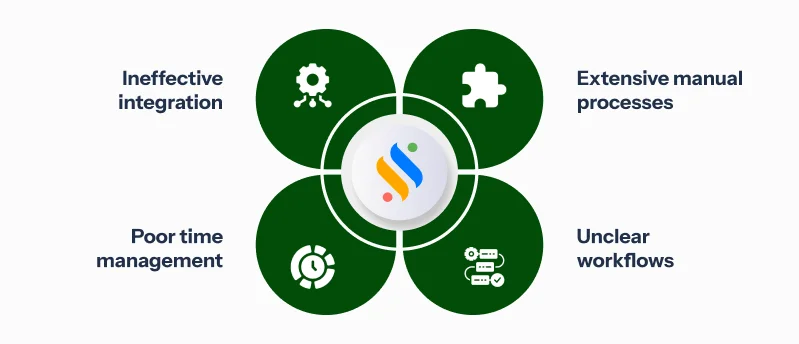
Too many manual processes:
Many teams still juggle spreadsheets, endless email threads, and multiple approval loops to get everyday tasks done. Now, this might appear to be a time-saving solution, but it slows down your productivity and efficiency levels.
Unclear workflows:
In some cases, a process technically exists, but no one fully understands how it flows from start to finish. The result? Missed timelines and efforts that lead nowhere.
Poor time management:
Endless meetings keep employees tied up, managers juggle too many priorities, and important tasks keep getting delayed. Time flies, but no one can pinpoint where it actually went.
Too many tools, not enough integration:
Companies often adopt new tools to fix specific problems. But sometimes, they only end up juggling multiple platforms that operate in silos.
Strategies to improve productivity and efficiency
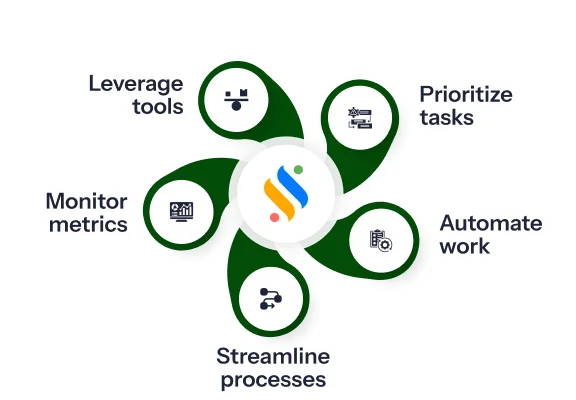
Focus on what actually matters
Not every task on your to-do list will move the needle. While some will truly take your time, others….are just there. Now, your role is to figure out which tasks are high priority. Which are on medium, and which are on low priority? This way you can able to deliver the desired results.
Automate your boring work
A lot of time disappears into small, repetitive tasks that don’t really add much value. Filling forms. Sending the same updates. Copy-pasting things between tools. It doesn’t feel like much in the moment, but it adds up fast. This is where automation helps.
Clean up how work actually flows
Most teams have processes that made sense once… but don’t anymore. Extra approvals. Reports no one reads. Meetings that exist mostly because they always have. It helps to step back and look at how work really moves from start to finish.
Check the metrics, but don’t obsess over them
Metrics can be helpful, as long as they’re used the right way. They do provide you with employee productivity reports that give a reality check – what’s improving, what’s stuck, and where to look more closely. But numbers don’t tell the whole story. High output with constant late nights is a warning sign. And rising efficiency with falling results usually means priorities need adjusting.
Use advanced tools smartly
New tools don’t automatically make teams more efficient. In fact, too many tools can do the opposite. Before adding anything new, ensure that it solves your problem.
How does advance tools help in improving workplace productivity and efficiency?
Yes. Implementing these tools does make a difference.
- Reduce manual effort and repetitive tasks.
- Bring clarity to daily work.
- Improve communication and collaboration.
- Quickens your workflows.
- Provide real-time visibility and insights.
- Reduce stress and improve focus
- Minimal waste of resources
Super Track: A tool you need to build an efficient workplace!
When we talk about productivity vs efficiency, both are extremely important. The problem is when you interchange them, and this is where most workplaces get confused. They don’t know which should be measured to increase output: efficiency or productivity. And that’s where Super Track, a product of the best HRMS & payroll software in India,
For businesses in India looking to measure and improve both productivity and efficiency, implementing Employee monitoring software in India gives you real-time insight into how time is being spent, helping teams work smarter — not just harder.
Superworks perfectly fits in. It gives you actual visibility into your team’s work. Apart from that, it also shows you what people actually do during those hours with real‑time activity tracking, dashboards, and reports that tell you where time is being used, wasted, and where bottlenecks are forming. Book a demo and boost the overall productivity!










