
TL; DR
A reimbursement policy is the written rulebook that tells employees which work expenses the company will pay back, how much, and in what timeframe. If the policy is effective, it brings transparency and increases the trust of employees. But without a policy in place, there will be nothing but confusion, and the impact of it will be seen in the employee’s salary. This blog covers everything about reimbursement policy in great detail.
Every HR team eventually gets the same question from a new hire: “I paid for a client dinner out of my own pocket; how do I get that back?” The answer shouldn’t depend on who they ask.
A reimbursement policy exists precisely so it doesn’t. It sets out, in one document, which expenses are eligible, the proof an employee needs to submit, the approval chain, and how quickly the money lands back in their account.
For a growing Indian company, this isn’t paperwork for its own sake; it’s what keeps expense claims consistent, keeps Form 16 and TDS calculations clean, and keeps employees from feeling like getting reimbursed is a favour rather than a right.
This blog covers the entire concept of reimbursement policy – from what it is, how to draft a reimbursement policy, and everything in between.
What is a reimbursement policy, and what exactly does it cover?
To understand what a reimbursement policy is, it is important to understand the meaning of reimbursement.
Reimbursement is the repayment a company makes to an employee for spending his own money. The amount that the company repays is exact, without markup or deduction. However, it only happens after the employee has already spent their own money and has proof.
A reimbursement policy is a formal written document that defines which out-of-pocket business expenses qualify for repayment. In addition to this, it also sets spending limits and outlines the claim submission processes.
Common categories that fall under a reimbursement policy
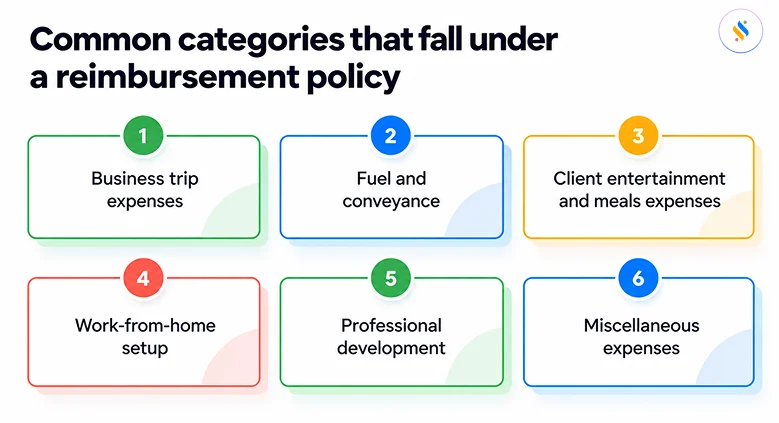
Common categories under an Indian company’s reimbursement policy include:
1. Business trip expenses:
Covers costs employees incur while travelling for work. It can even include going out of the city. A per diem (fixed amount) is given for flights, trains, and hotel stays. At the time of claim, it should be filed with tickets, invoices, etc., along with the purpose.
2. Fuel and conveyance:
Covers local travel such as cab fares, auto or fuel bills for client visits or commuting for other business purposes. Most companies cap this per trip or per month and require either a fuel bill or a logged distance if the employee uses their own vehicle.
3. Client entertainment & meals:
Covers food and hospitality costs during client meetings and business lunches. Policies set a per-head spending cap and require the bill along with the client’s name.
4. Work from home/office setup:
Covers one-time or periodic costs for employees working remotely; a chair, keyboard, monitor, or broadband charges tied to an approved WFH arrangement. Companies set a fixed annual limit per employee and require proof of purchase.
5. Professional development:
Covers fees for courses, certifications, or for attending workshops that are important for the employee’s growth.
6. Miscellaneous purposes:
Covers small, work-related expenses such as bulk stationery purchases, printing costs, courier charges, etc.
Why is the reimbursement policy important?
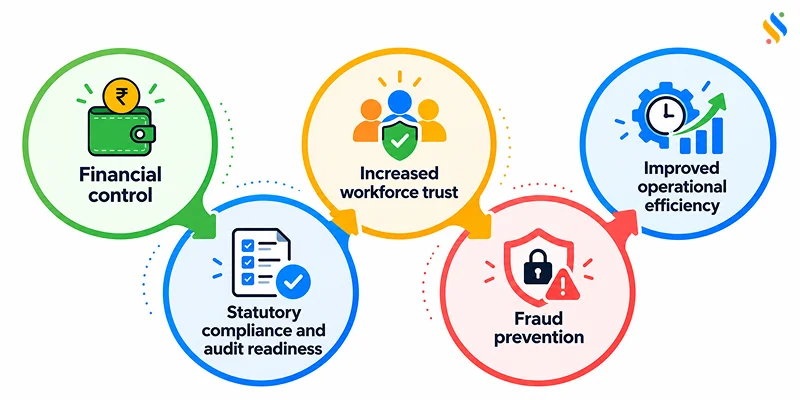
1. Financial control:
A reimbursement policy sets clear spending limits for each expense category. The policy helps finance teams plan budgets clearly, and employees also know exactly how much the company can approve.
Statutory compliance and audit readiness:
A written policy makes it easy to show that every reimbursement is backed by a valid bill and a genuine business reason. This keeps the company’s tax filings clean and avoids penalties.
2. Increased workforce trust:
When employees know exactly what they can claim and when they’ll be paid, they don’t have to chase managers anymore. This builds employee trust.
3. Effective in preventing fraud:
When there are clear rules defined in the policy, it becomes difficult for anyone to submit fake claims. When every claim gets cross-verified thoroughly before the process happens, it will reduce the chance of errors or misuse.
4. Operational efficiency gets better:
With a set process, HR and finance teams spend less time chasing paperwork. Claims move faster, employees get paid on time, and the whole system runs efficiently.
Keep employees’ reimbursements under control!
Manage expense submissions, approvals, and payment records without chasing employees for bills or updates
Step-by-step reimbursement expenses process
Step 1: Legitimate business expense incurred
The employee spends money on a work-related need for business-related purposes.
Step 2: Documentation & receipt collection
This is the important step. Without this, a reimbursement claim cannot move forward. Employees must keep the original bill for every expense they have made, so that they can present it.
Step 3: Expense report submission
The employee submits the claim with the amount, date, category, and a short business reason, attaching the receipt. This should be done within the policy’s set timeframe.
Step 4: Policy verification & approval
The team checks the claim against the reimbursement policy. Any anomaly will be flagged immediately.
Step 5: Payment processing & payout
The amount is paid to the employee once the claim is approved.
Elements included in writing an effective reimbursement letter
An effective reimbursement letter includes:
1. Header:
Include the employee’s name, designation, department, employee ID, date, etc.
2. Subject line:
State the purpose of the reimbursement letter in the first place.
3. Opening:
Your opening sentence should state what the expense was for and why it was incurred.
4. Expense breakdown:
List each expense specifically. If there are multiple items, use a table so the total is easy to check.
5. Supporting proof:
Attach the original receipts for every expense. Also, mention the number of attachments included.
6. Sign-off:
End with a professional and polite note with a closing line, the employee’s signature, and space for the manager’s approval.
Reimbursement letter sample
[Your Name]
[Your Department / Employee ID]
[Your Phone Number / Email]
[Date]
To,
[Manager’s Name or Finance Department]
[Company Name]
[Company Address]
Subject: Request for reimbursement of business expenses
Dear [Manager’s Name or Sir/Madam],
I am writing to request reimbursement of [Total Amount] for expenses incurred while performing official duties for [mention purpose] on [Date of Expense].
The details of the expenses are as follows:
- Date: [Insert Date]
- Description: [Insert brief description, e.g., Travel and client dinner]
- Amount: [Insert Amount]
I have attached the original receipts and supporting documents for your verification. Kindly process this amount at your earliest convenience.
Thank you for your time and assistance.
Sincerely,
[Your Name]
[Your Signature]
Common mistakes companies make when creating a reimbursement policy
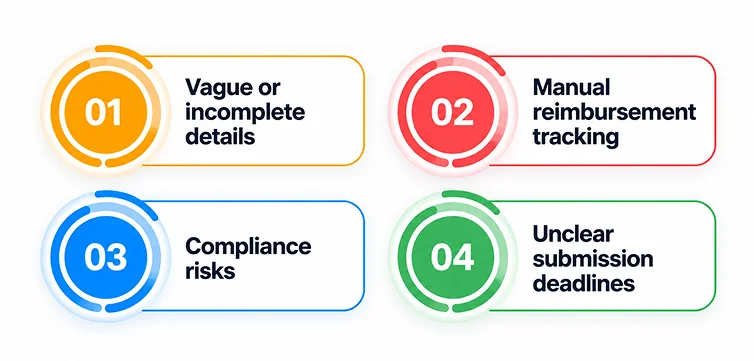
1. Vague or incomplete details:
When a reimbursement policy doesn’t clearly state what’s covered, how much, and what proof will be considered, employees will be left confused. This can also lead to inconsistent approvals.
2. Tracking reimbursement expenses manually:
Managing reimbursement of expenses through spreadsheets makes it easy to lose bills, miss approvals, or pay a claim twice. Instead, running this through payroll software keeps every claim, approval, and payout in one place.
3. Undermining compliance:
Approving claims without valid bills or a genuine reason puts the company at risk. Reimbursements that can’t be justified may also be treated as taxable income for the employee.
4. No clear submission deadlines:
Without a set timeframe for claim processing, reimbursement requests can go unnoticed. This is avoidable with an effective expense reimbursement policy.
Role of payroll software in reimbursement policy: What HR and payroll teams should understand
A reimbursement policy is only as good as the system that runs it. Even a well-written policy fails if claims are still tracked on spreadsheets or chased over email, because HR ends up doing double work – checking bills by hand and then re-entering approved amounts into payroll. The result? No timely repayment.
Connecting reimbursement to an effective payroll system closes this gap. Super Payroll, a key module by Superworks, lets employees submit claims with bills attached, routes them for approval, and adds approved amounts directly to the employee’s payout – all without manual work. This gives HR and payroll teams a single, auditable record of every claim. Book a demo now and save your time from the manual work of reconciling expense slips and receipts.
Conclusion
We hope that by now you must have understood what a reimbursement policy is, why your organization needs to have one, its process, and the common mistakes you should avoid in your reimbursement policy. We have also presented a sample reimbursement letter.
Reimbursement is an essential part of every company because there are certain expenses that employees pay out of their pocket. A clear reimbursement policy for employees lays out everything and establishes some ground rules for how everything is going to roll out – from start to end. This also includes what it covers and what it doesn’t.
All these can become extremely taxing if done manually. But with a payroll solution, everything gets automated and centralized and no manual work. If you want to make your reimbursement management effective, then Super Payroll is for you.