Last summer, Rahul, an operations manager, was facing a nightmare.
Half his field team was stuck in traffic, two deliveries went missing, and no one could explain what happened, just because he and his teams were unaware of the various types of GPS systems and their usage.
So, his phone kept ringing. Customers wanted updates that he didn’t have.
It wasn’t his team’s fault — it was the system.
Or rather, the lack of one.
The operational manager, Rahul, had no real-time tracking, no proper field service reporting, no way to find the exact location of his drivers, and no clear picture of how the day was falling apart.
This is where a global positioning system (GPS) comes in.
With the right global positioning system, you can track vehicles, monitor job sites, and manage deliveries from your desk. You can even track driver behavior, check routes, and fix problems before they hit your customers.
In this post, you’ll learn:
- The 5 best types of GPS systems for field teams
- What types of businesses rely on GPS tracking today
- How to pick the right GPS solution for your field operations
- And answers to real questions that field managers ask every day
- If you want to run your field team without blind spots, keep reading.
5 Types of GPS Systems
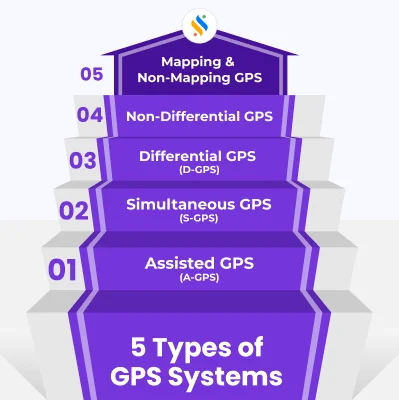
Choosing the right GPS system for your field team isn’t just about tracking — it’s about solving real problems like delays, lost assets, and poor communication.
Here are the 5 best types of GPS systems you should know about:
Field teams don’t all need the same GPS monitoring software. Some GPS works in cities with strong signals. Others go off-road where coverage is weak. That’s why knowing the types of GPS systems matters.
Here are 5 GPS types that field managers should know:
1. Assisted GPS (A-GPS)
A-GPS uses both satellite signals and local network sources like cellular networks or Wi-Fi. It works much faster than standard GPS, which is used in various places like cities, tunnels, or areas with tall buildings.
Field teams, who are using mobile phones or mobile devices, benefit from A-GPS because it can get a lock on location much quickly. Moreover, it also reduces waiting time & keeps team members connected even in poor signal areas.
2. Simultaneous GPS (S-GPS)
S-GPS, which stands for simultaneous GPS, lets a device talk to both the GPS satellites & the cell network at the same time. And just like that, it gives much better voice & data quality while also sending out precise location updates.
This system works well for dispatch services and emergency teams where real-time tracking and voice data matter.
3. Differential GPS (D-GPS)
D-GPS improves the seamless accuracy of the global positioning system, as it keeps using a network of ground stations to correct errors in GPS signals. And that seamlessness allows GPS receivers to get a more accurate position, sometimes within a few inches.
Teams that work in construction, surveying, or asset tracking rely on D-GPS. It’s also useful when mapping utility lines or roads using mapping GPS tools.
4. Non-Differential GPS
This is the basic form of GPS. It uses data from at least four GPS satellites and calculates location based on measured distance and signal transmission time.
It works fine for general GPS applications, like tracking personal vehicles or checking delivery routes. It’s less accurate than D-GPS but still useful for simple tracking.
5. Mapping and Non-Mapping GPS
These are types of GPS devices. Mapping GPS shows routes and maps on the screen. Non-mapping GPS gives coordinates but doesn’t display a map.
Field teams that need to follow routes or find job sites use mapping GPS systems. Non-mapping GPS devices are used when only coordinates matter, like basic vehicle tracking or sensor-based logging.
Each type solves different field challenges.
The best one for you depends on your team’s size, industry, and where you work.
Types of Businesses That Use GPS Trackers
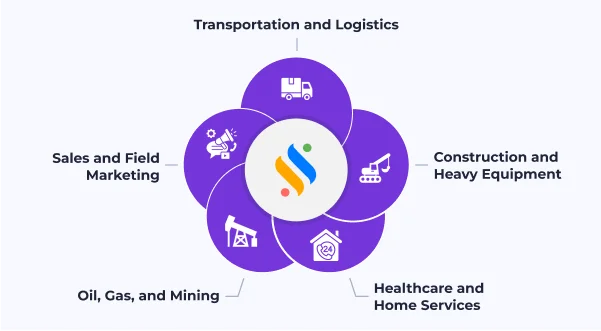
Field teams are the backbone of many industries, and GPS trackers help them stay organized, on time, and accountable. Different businesses use types of GPS systems depending on what they need to track — people, vehicles, or equipment.
Here are the most common industries using GPS devices today:
1. Transportation and Logistics
Companies that handle deliveries, shipments, and dispatch services rely heavily on the global positioning information.
They use vehicle tracking systems and asset tracking to monitor routes, check delivery statuses, and offer real-time tracking to customers.
Tracking helps them improve driver behavior and manage delays faster.
Example: Freight companies, courier services.
2. Construction and Heavy Equipment
Construction managers use GPS systems to keep an eye on expensive machinery and field workers across large sites.
With asset tracking and personal GPS trackers, they can find equipment easily and monitor safety.
Example: Contractors, equipment rental services.
3. Healthcare and Home Services
Healthcare field workers and home service crews use GPS receivers connected to mobile devices to update locations instantly.
Tracking helps ensure workers reach patients or clients safely and on time, so the emergency services can be delivered without any hassle.
Example: Home healthcare, repair services.
4. Oil, Gas, and Mining
In remote areas where cellular networks don’t always work, companies use satellite-based GPS trackers.
They depend on navigation satellite systems and global navigation satellite system coverage to manage crews and equipment across rough terrains.
Example: Offshore rigs, mining sites.
5. Sales and Field Marketing
Sales teams on the road use GPS applications through their mobile phones.
Tracking helps managers optimize schedules and understand which areas are getting more visits.
Example: Pharmaceutical reps, promotional teams.
These GPS tracking and remote sensing aren’t just for trucks anymore. Because from personal vehicles to industrial fleets, this GPS technology is helping businesses of all kinds work smarter. So, in the upcoming section, let’s learn about the various types of GPS systems and which one is the right one for your business.
Make smarter moves out there in the field.
And stay ahead with the ultimate field tracking tool.
Which Type of GPS Tracker is Right for Your Business?
Picking the right GPS system depends on what you need to track, where your team works, and how detailed you want your GPS data to be. Different types of GPS tracking devices offer different strengths.
Here’s how to choose:
1. If You Manage a Fleet of Vehicles
Go with vehicle tracking systems that use GPS sensors and GPS receivers.
- They connect to GPS satellites and give you real-time tracking of your trucks, vans, or service vehicles.
- Features like tracking driver behavior and real-time data reporting are must-haves.
Recommended for
Transportation, delivery services, and field service fleets.
2. If You Handle High-Value Equipment
Choose asset tracking systems built for remote and rugged use.
- These systems use GPS devices to send satellite signals back to your central control.
- Tracking equipment cuts losses, boosts productivity, and reduces downtime.
Recommended for
Construction, heavy machinery, and rental companies.
3. If Your Team Works in Remote Locations
You need satellite-based trackers connected to navigation satellite systems like the Global Positioning System or Global Navigation Satellite System.
- They don’t rely on cellular networks, so you can still monitor your team where phones stop working.
Recommended for
Oil and gas, mining, and emergency response teams.
4. If Your Field Team Relies on Phones
Use mobile app-based GPS tracking through cell phones or mobile devices.
- These apps collect GPS data and combine it with local network sources for smart tracking without extra hardware.
- They even sync with field force management software.
Recommended for
Field sales, light service teams, and marketing teams.
5. If You Need a Budget-Friendly Option
SIM-based GPS systems offer solid tracking with mobile phones using space segment infrastructure and control segment data flows.
They balance cost and accuracy well for urban fieldwork.
Recommended for
Urban courier companies, local service providers.
Expert Tip for Navigation System Seeker,
If you need the highest accuracy for critical missions, then please consider choosing differential GPS (dGPS) or assisted GPS (aGPS). Because these use corrections from ground stations and atomic clocks to improve positioning, navigation & timing.
Wrap Up,
Choosing the right GPS system can feel overwhelming when every option promises better routes, smarter tracking, and real-time updates.
But the truth is, it’s not just about picking the right types of GPS systems — it’s about what you do with the information you get.
Field managers today don’t just track locations.
Rather, with the help of an efficient field force management software, they manage schedules, monitor work quality, optimize routes, and even forecast delays! However, without a seamless integration of various types of GPS systems, it won’t be possible.
That’s why smart businesses pair their GPS solutions with strong field force management tools.
When your GPS devices work hand-in-hand with a full system that manages attendance, job statuses, customer communications, and real-time tracking, your operations shift from “watching” to “controlling.”
If you’re thinking bigger than just dots on a map — if you’re thinking about performance, accountability, and smoother field operations — it might be time to look into platforms built for that next level.
Systems like Super Field Force bring it all together. With this tool, you can simply manage your entire field team, from start to finish, and that too without any hassle. From their attendance to expense management, real-time tracking to entire activity logging, you can do everything without any manual interference.
So, whenever you need such kind of seamless field management, Super Field Force can be the best choice for you!










