“Can a GPS jammer be really capable of blocking GPS signals effectively?” asked a field team member.
“Yes, GPS jammers are fully capable of disrupting GPS satellite signals and affecting the accuracy of tracking systems.” Answered a field team manager.
And this phenomenon can simply lead to some serious risks, especially for field managers & COOs who depend on real time location tracking for their seamless fleet management.
However, about this GPS jammer, there are numerous misconceptions about how they work, their legality, and not to mention their impact.
Through the medium of this blog, we are gonna bust the top myths surrounding GPS jammers. Moreover, we’ll also explain how they can pose some crucial security risks to your field operations. So, stick around to learn how do GPS jammers work. And how, as a field manager or even a COO, you can easily protect your fleet from them.
So, before we can start the depiction of the best GPS jammer, let us clear out what it really is!
What is a GPS Jammer?
GPS jammers are devices that are designed to disrupt GPS satellite signals, and not to mention prevent all the GPS tracking devices from reporting accurately about vehicle locations. These devices do this by sending out radio signals and that too on the same frequency which is used by satellite transmitters orbiting the Earth.
These transmitters are there to provide location, including velocity information, to navigation systems and tracking systems used in vehicles, smartphones, and other electronic devices. When you get a GPS jammer, it starts to transmit jamming signals, and after that, it overwhelms the GPS device by introducing all the signal noise that keeps confusing the receiver.
Since a GPS tracker relies on signals from four or more satellites to know each & every precise location, jamming keeps preventing it from calculating the exact position. This means that both field managers & COOs using field force management software may lose their real-time location updates, and keep affecting the very response time tracking & operational safety.
What is the real use of a GPS Jammer?
A GPS jammer is firstly used to block all the GPS signals, and that makes it quite difficult for tracking all the systems to monitor a vehicle’s location. While some claim these devices are for protecting the privacy of employees, the truth is that their usage often raises serious concerns. Here’s how GPS jammers are typically used:
Avoiding GPS Tracking
Individuals may use a GPS jamming device with relatively low power to prevent fleet managers or employers from tracking their exact vehicle location by using an installed GPS tracker. These kinds keep disrupting employee tracking and reducing accountability.
Theft and Unauthorized Use
Criminals often use these GPS blockers to steal vehicles and that too without being traced. And by blocking these signals directly from satellite transmitters, they keep preventing law enforcement and owners from tracking such stolen assets.
Bypassing Geofence Tracking
Companies using geofence tracking to monitor vehicles entering restricted areas may find these efforts compromised by GPS jamming. This poses security risks for field operations.
Delaying Emergency Services
Some may believe GPS jammers only impact personal tracking, but that’s not the case. Because they can easily interfere even with the emergency services relying on GPS signals for real-time location tracking during critical missions. In many countries, the use of such devices is typically illegal because of various security risks they pose over time.
How Do GPS Jammers Increase Security Risks for Field Teams?
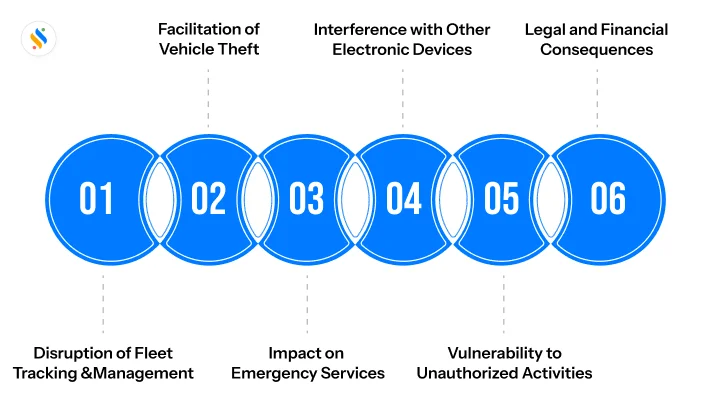
GPS jammers pose significant security risks, especially for field operations that rely heavily on GPS tracking devices and navigation systems. These devices disrupt GPS satellite signals, leading to gaps in monitoring and increased vulnerabilities. Here’s how they impact security:
1. Disruption of Fleet Tracking and Management
Field managers depend on GPS tracking to monitor vehicle locations in real time. When a GPS jammer is used, it can block GPS signals, making the tracker unable to report the vehicle’s location. This can result in:
- Missed deadlines due to delayed deliveries.
- Loss of operational control over field teams.
- Increased response time tracking during emergencies.
2. Facilitation of Vehicle Theft
Thieves can use a GPS jammer to disable installed GPS trackers, preventing the tracker from receiving signals from satellite transmitters orbiting the Earth. This tactic allows them to steal vehicles without being detected. The lack of location data delays the involvement of law enforcement, making recovery difficult.
3. Impact on Emergency Services
Emergency services rely on navigation systems for quick responses. Blocking signals disrupts this process, delaying aid during critical situations. For instance, ambulances and fire services may fail to reach destinations promptly, putting lives at risk.
4. Interference with Other Electronic Devices
GPS jammers emit radio signals on the same frequency as essential satellite transmitters, affecting other electronic devices like mobile phones and communication tools. This interference can disrupt coordination among field teams, increasing operational risks.
5. Vulnerability to Unauthorized Activities
Jammers can help employees hide unauthorized trips or activities, leading to operational inefficiencies. Without accurate real-time location tracking, field managers cannot ensure that vehicles are being used appropriately.
6. Legal and Financial Consequences
In many countries, the use of GPS jammers is typically illegal due to these security risks. Companies caught using them may face severe legal consequences, including fines and penalties, further impacting business operations.
Top 8 Myths About GPS Jammer
Not one but there are numerous misconceptions that keep surrounding GPS jammers, especially when it comes to their legality, effectiveness & impact. So, let’s start breaking down the top 8 myths & reveal the very truth behind them.
Myth 1: GPS jammers are legal to use.
Many companies believe GPS jammers are legal for their personal use. But that’s not it, because, in many countries, they are typically illegal due to the risks they pose to various emergency services, navigation systems & public safety. And companies that are using them are risking facing legal consequences, including hefty fines.
Myth 2: They only affect the user’s device.
A common misunderstanding is that GPS jammers are only there to block the GPS device they’re attached to. But in reality, such devices are there to emit radio signals which can disrupt specific satellite signals and that too for several kilometers.
Such kind of interference can also affect other electronic devices, which include mobile devices & disrupt both emergency & public safety operations.
Myth 3: GPS jammers are expensive and hard to obtain.
The truth? GPS jammers are surprisingly affordable and widely available online. Some are small, like a mini GPS blocking device, making them easy to conceal. This accessibility increases security risks, as employees or unauthorized individuals can easily obtain and use them to hide vehicle locations or bypass employee tracking systems.
Myth 4: Using a jammer makes one completely untraceable.
While GPS jammers can disrupt seamless GPS tracking, because they simply don’t guarantee anonymity. And here, law enforcement agencies can easily deploy some detectors to locate the very source of jamming signals.
The detection of these devices is possible because jamming devices emit microwave signals and signal noise that specialized equipment can identify. So, relying on a jammer to stay hidden? Not a smart move.
Secure your field operations with higher efficiency!
Act Now – and start shielding your operations from GPS jamming!
Myth 5: Jammers don’t impact critical services.
GPS satellite signals are very important for more than just simply vehicle tracking. As they support;
- Emergency services,
- Air traffic control, and
- Maritime navigation.
Disrupting these highly crucial signals can simply delay emergency response times, which can risk many lives. For businesses, such a crucial impact on operations can be severe, as many critical deliveries & field operations may face unexpected delays at a large scale.
Myth 6: They are Effective Tools for Personal Privacy.
Some argue that such jammers are for protecting privacy by simply preventing location tracking. But the truth is much more than that, as the risks that come with such devices can easily outweigh the benefits. These devices can block GPS signals way beyond the intended target, which can affect both the other users and navigation systems.
Myth 7: Detection of GPS jammers is Impossible.
Contrary to popular belief, detecting those infamous GPS jammers is possible, as there are some detectors, which, by the way, are designed specifically for this purpose. Such tools are there to easily,
- Pick up jamming signals,
- Signal noise, and
- Disruptions in satellite transmitters’ normal operations.
For fleet managers, installing such detection systems in their facility brings the certainty that any attempt to disrupt tracking will be quickly identified.
Myth 8: All GPS Jammers Have the Same Capabilities.
The truth is that not all GPS jammers are created equal, and for that reason, their effectiveness depends on crucial factors like power bank capacity, battery size & range. Some can block GPS signals within a short radius, while more powerful models can disrupt signals across several kilometers.
Additionally, the frequency they operate on affects the type of signals they can jam. Understanding these differences helps businesses choose the right tracking systems and protection measures.
Closing Words,
Understanding the truth about GPS jammers is highly crucial for both fleet managers & COOs who are relying on GPS tracking for smooth operations. These devices can bring serious security risks by
- Disrupting GPS satellite signals,
- Affecting vehicle location tracking, and
- Potentially endangering emergency services.
And for that reason, we’ve busted some of the most common myths, from their legality to their actual impact on navigation systems and other electronic devices. Henceforth, we quote the harsh truth which is that GPS jammers carry the potential to cause extensive damage, which includes operational delays & legal consequences.
For companies managing fleets, the key takeaway is to invest in robust GPS monitoring software, utilize detectors, and educate teams about the dangers of jamming signals. These steps not only protect assets but also ensure driver safety and compliance with legal regulations.










