With modern changes in today’s world, the manufacturing industry challenges are being the only thing consistent. Because in this rapidly changing world, such problems of manufacturing industries have become a crucial hurdle not only for some industries but for many industries!
Furthermore, in this troubled situation, field service operations have become the center of these industrial problems. Because there’s a constant struggle with supply chain disruptions, legacy systems, and even a shortage of skilled labor. So, what to do with these manufacturing industry challenges and how they affect operational efficiency are two of the biggest questions, that are yet to be answered!
Because that is what is causing long delays in both production and customer deliveries. So, what should COOs, CEOs, and Field Managers do about it? Or do they even acknowledge these issues, because it will require quite a deep understanding?
Or what’s their plan for staying ahead of these challenges manufacturing industries face? Are they trying some innovative solutions to tackle these challenges? These and many other such questions are there which today we are going to answer in this blog.
So, let’s start breaking down some of the biggest manufacturing industry challenges and explore how we can ensure sustainable operations management to streamline their operations.
What are Manufacturing Industry Challenges?
The manufacturing institute with global companies is evolving rapidly, but still, there are several significant manufacturing industry challenges that keeps hindering growth & efficiency. Henceforth, numerous companies worldwide are struggling with disruptions in their supply chain, outdated legacy systems & labor shortages, and sadly, these factors keep slowing down operations.
One of the biggest manufacturing industry challenges is managing disparate systems that continue to lack integration. And because of that, many inefficiencies are being caused in production lines & delays in inventory management. As manufacturers, if teams want to continue to scale, then they must deal with rising problems like;
- Operational costs,
- Strict regulatory requirements, and
- Data management problems that affect decision-making.
Just like the Ice Age, when many sudden changes have happened at large scale, in this digital age, numerous such changes are being made as we are talking. And because of those ongoing changes in digital transformation journey, many manufacturing organizations are struggling to implement advanced technologies while maintaining their business growth.
Furthermore, there are issues like shop floor inefficiencies, poor production planning & unpredictable demand forecasting that keep hurdling profitability. With all of these, for continuous improvement, manufacturing businesses just have to adapt to sustainable operations management & new eco-friendly trends such as clean technology manufacturing.
Such hurdles are creating problems in the industry, because of which manufacturers to invest in innovative solutions & rethink their operating models to achieve long-term success. So, one after another, let’s read about the top challenge first!
7 Big Manufacturing Industry Challenges
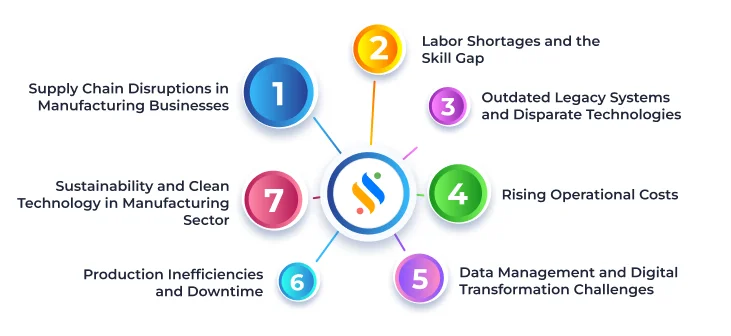
The challenges manufacturing industry face can make a big list, and without any ifs & buts, they are affecting production efficiency, supply chain stability, and even overall business performance. So, let’s take a much deeper look at the 7 of the biggest hurdles and how they are affecting manufacturers worldwide.
1. Supply Chain Disruptions in Manufacturing Businesses
One of the biggest pain points for manufacturing businesses is to ensure supply chain management. Because without it, there can be delays in the delivery of raw materials, which is quite troublesome. Furthermore, there are fluctuating higher costs of transportation & geopolitical tensions that will keep being bottlenecks at multiple levels of the entire manufacturing process.
In addition, the supply chain can also cause disruptions, as it keeps exposing vulnerabilities in just-in-time inventory strategies. Such kind of problems keep adding more difficulty for manufacturers to maintain consistent production.
Impact:
- Delayed production schedules leading to missed deadlines.
- Increased costs due to high transportation fees and material shortages.
- Reduced customer satisfaction as businesses struggle to meet demand.
2. Labor Shortages and the Skill Gap
The manufacturing sector nowadays is experiencing a major workforce crisis, especially in their key areas. The demand for skilled workers is all-time high, but many experienced employees are retiring, and younger talent is very much less inclined to enter the industry.
Moreover, such problems in industry and this lack of sufficient training programs keep widening the skill gap. And that makes it more difficult for manufacturing companies to maintain productivity levels.
Impact:
- Slower production times due to insufficient workforce availability.
- Rising wages and recruitment costs as businesses compete for a shrinking talent pool.
- Difficulty in adopting new technologies due to the lack of trained personnel.
3. Outdated Legacy Systems and Disparate Technologies
Many manufacturing businesses still operate on legacy systems that are outdated and unable to integrate with modern digital technology. These systems create disparate systems within an organization, preventing seamless data flow and efficient shop floor management. As a result, decision-making processes become slow and prone to errors.
Impact:
- Inefficient operations due to a lack of connectivity between different departments.
- Increased downtime as outdated systems struggle to keep up with modern demands.
- Higher maintenance costs to keep old equipment and field sales software running.
4. Rising Operational Costs
The manufacturing industry due to these manufacturing industry challenges are facing growing financial pressures. And due to which prices to purchase raw materials have been increased including the labor & energy consumption. Moreover, strict regulatory requirements keeps adding further costs to production, making it much harder for manufacturers to maintain their profit margins.
Impact:
- Higher production expenses lead to more expensive end products.
- Profit reduction as businesses struggle to balance costs and pricing.
- Reduced investments in innovation due to financial constraints.
5. Data Management and Digital Transformation Challenges
Many manufacturing organizations worldwide are now dealing with data silos & inconsistent data quality across their departments. And due to consistently poor data management practices, they have to face many errors, inefficiencies, and delays in making crucial strategic business decisions.
In addition, some companies are still out there struggling to adopt digital transformation due to the further complexity & cost of overhauling their systems.
Impact:
- Slower response times to market changes and business needs.
- Increased risk of errors due to inaccurate or incomplete real-time data.
- Lack of visibility into production and supply chain operations.
6. Production Inefficiencies and Downtime
Due to unexpected breakdowns, inefficient production planning, and old & outdated production processes manufacturing facilities have to experience costly downtime. And aside from improving productivity, many manufacturers have to face manufacturing industry challenges in maintaining shop floor productivity due to poor coordination between teams & ineffective inventory control systems.
Impact:
- Significant delays in production and order fulfillment.
- Increased maintenance and repair costs for outdated machinery.
- Loss of revenue due to unplanned disruptions in production lines.
7. Sustainability and Clean Technology in Manufacturing Sector
Environmental concerns are yet another one of the most troublesome manufacturing industry challenges that keeps pushing manufacturers to adopt greener manufacturing processes. However, the transition is not that easy.
Furthermore, the compliance with new environmental regulations requires further investments & adopting a clean technology for manufacturing can be very costly. For that reason, companies also have to face pressure from consumers and even the investors to reduce their carbon footprint & implement sustainable operations management.
Impact:
- High upfront costs to switch to sustainable manufacturing environments.
- Operational challenges in balancing sustainability with efficiency.
- Risk of non-compliance penalties if regulations are not met.
You don’t have to tackle manufacturing industry challenges alone!
Try Superworks & end your troubles once and for all!
Trends Shaping the Manufacturing Companies
The manufacturing industry is evolving with rapid technological advancements, sustainability goals, and global shifts. Here are the key trends shaping its future:
1. Digital Transformation & Smart Manufacturing
AI, IoT, and automation are optimizing manufacturing processes, improving operational efficiency, and reducing errors.
2. Sustainable & Clean Technology Manufacturing
Companies are adopting sustainable operations management to meet environmental regulations and reduce energy consumption.
3. AI, Automation & Robotics
AI-driven automation enhances shop floor efficiency, reduces labor costs, and improves data management.
4. Strengthening Supply Chains
With frequent supply chain disruptions, companies focus on real-time data tracking and predictive modeling to improve resilience.
5. Industry 4.0 & Smart Factories
Smart factories use seamless communication and AI-powered analytics to enhance efficiency and reduce downtime.
6. Addressing Labor Shortages & Skill Gaps
The manufacturing sector invests in training programs and automation to bridge the skilled workforce gap.
7. 3D Printing & Additive Manufacturing
On-demand production reduces raw materials dependency and shortens production cycles.
8. ERP & Data-Driven Decision Making
Enterprise resource planning (ERP) systems streamline operations, improve inventory control, and enhance demand forecasting.
9. Cybersecurity in Manufacturing
With increased digital reliance, companies prioritize data protection to prevent cyber threats.
10. Government Incentives & Policy Support
Policies supporting economic growth, electric vehicles, and clean technology manufacturing encourage investment.
Super Field Force: A One-Stop Solution For Manufacturing Industry
The manufacturing industry struggles with supply chain disruptions, legacy systems, and labor shortages, slowing production and increasing costs. Super field force management software, powered by Superworks Field Force Management, provides a complete solution to these manufacturing industry challenges.
- Real-Time Tracking for Supply Chain Efficiency: Live GPS monitoring ensures workforce availability, reducing significant delays in the entire manufacturing process.
- Task Automation to Tackle Labor Shortages: Automated task assignments enhance efficiency, minimizing reliance on skilled workers.
- Modern Integration Over Legacy Systems: Seamless HRMS and payroll integration eliminates interoperability challenges and enhances decision-making.
- Cost Reduction & Smart Resource Allocation: Optimized workforce scheduling improves business growth and lowers operational costs.
- Better Data Management & Reporting: Centralized real-time data insights boost inventory management and production planning.
- Efficient Scheduling to Prevent Downtime: Smart automation keeps shop floor operations running without disruptions.
- Sustainability & Digital Efficiency: Eliminates paper-based reporting, supporting clean technology manufacturing goals.
Why Super Field Force?
- Seamless communication between teams
- Automated workforce management to boost productivity
- HR & Payroll integration for smoother operations
- Smart analytics & reporting for data-driven decisions
- Offline functionality for uninterrupted workflow
Super Field Force is the ultimate workforce solution, streamlining operations and overcoming manufacturing industry challenges.
Parting Thought,
The manufacturing industry with time is evolving, however, manufacturers are still facing significant challenges in their workforce management. Hence, adapting to digital transformation, optimizing production planning & addressing the skill gap are way more than crucial for ensuring long-term success.
Hence, all the companies should implement AI in Field Service Management, because it is quite an amazing solution in this modern world. However, for this AI-based solution, no companies have to look further, because with Super Field Force, they have already met their solution.
Now they can easily reduce their operational costs and amazingly enhance customer satisfaction, a smarter workforce management solution is the key to staying competitive. So, it’s time for manufacturing organizations to embrace innovative solutions & improve operational efficiency.
The future of manufacturing highly depends on streamlined workforce management – so are you ready to take the next step with Super Field Force?










