
Lateness at work is quite a frequent and troublesome problem these days. When HR starts to deal with other employees who are constantly coming late for work, they end up being frustrated, and most of the time, they fail to get the solution.
To be honest, it’s a big problem in India and a much bigger problem throughout the world, for which many HR leaders are providing solutions! This problem of employees being late at their respective workplaces keeps disrupting the entire schedule and can impact productivity of the employees on a massive scale!
Many times, this lateness of some employees even creates resentment among those who keep showing up on time. And for that reason, companies have to have a late coming policy, because without it, your employees are gonna be highly demotivated.
As an HR manager or operational manager, you need solutions dealing with late employees and answers for “How to manage late employees!” Simply warning employees or cutting their pay won’t fix chronic lateness. You need to understand why they’re late and create a system that encourages punctuality.
This guide will walk you through 9 effective strategies to tackle lateness at work. From setting clear policies to using paperless software and route optimisation software to improve time tracking, you’ll find practical ways to handle employee tardiness without unnecessary conflict.
By the end of this blog, we are quite sure that you’ll have everything you are gonna need to ensure punctuality, reduce workplace anxiety & create a culture of accountability.
What is Lateness at Work Called?
When employees keep arriving late for work, they start to disrupt the complete professional settings. It’s not like that for any supervisor; every late-in in the workplace is troublesome, and there can be some occasional delays that can happen due to unforeseen circumstances.
But when this lateness at work becomes chronic (keeps going on for a long time), then there are deep issues that need to be addressed right away. For that reason, to find answers for “how to manage employees who consistently show up late,” HR professionals often categorize this lateness at work into two types:
- Excused Lateness – When an employee informs their respective manager priorly & provides a good valid reason. Valid reasons, such as a medical emergency or unavoidable heavy traffic delays due to some random road construction, can be termed as the excused lateness!
- Unexcused Lateness – When an employee is not often, but keeps coming late quite repeatedly and that too without notifying anyone or giving a justifiable reason.
Most companies, just to find an answer for “how to handle this lateness at work,” have implemented a late coming policy for employees and have to take steps to take when employees are habitually late. Just so they can set clear expectations on punctuality and consequences for repeated delays. However, enforcing these policies fairly while maintaining employee morale is key.
How to Manage Late Employees at Work?
Handling late attendance requires a well-structured yet fair approach because that is a must! Such occasional lateness is somewhat understandable, but when this lateness at work becomes a habit, it starts to affect employee productivity, the morale of staff members, and overall workplace discipline.
Simply punishing employees in telecom field services or some other industry won’t fix the problem or provide a proper answer for “How to deal with late employees!” Because to fix this issue, you will need an efficient strategy that keeps addressing both the employee behavior & its underlying causes.
Henceforth, HR, before asking the question of how to manage late employees, should start the process of betterment by identifying why employees are arriving late for work. Is this lateness at work due to some personal struggles, long commutes, poor time management, or just simply disengagement?
For the next step, teams have to ensure that your late coming policy for employees stays quite clear & well-communicated. This way, employees should know what’s expected of them & understand the consequences of repeated lateness at their own workplace.
At the same time, managers should lead by example—because if the very leadership isn’t punctual and keeps coming late, employees may not take timeliness seriously either. So, here the technology can simply play a key role, because using field force management software or route optimisation software can help track work hours & reduce time lost in transit.
Utilizing modern technology would be especially beneficial for employees working in remote locations or field-based roles. Ultimately, the goal isn’t just to enforce rules—it’s to create a workplace culture where;
- Punctuality is valued,
- Employees feel supported, and
- Everyone understands the importance of being on time.
And for that reason, we have listed out 9 of the most powerful tips that can help teams deal with lateness at work!
9 Powerful Tips to Deal with Lateness at Work
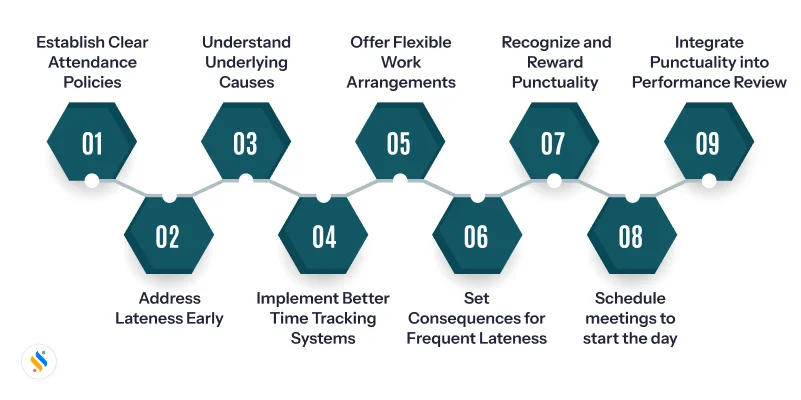
Chronic late attendance can be frustrating for managers and disruptive for teams. Instead of reacting with strict punishments, a proactive approach can help employees improve their punctuality while maintaining a positive work environment. Hence, to help you understand the best practices for managing late employees, we are providing 9 effective strategies to handle lateness and encourage on-time behavior.
1. Establish Clear Attendance Policies
Employees should know exactly what is expected of them when it comes to work hours. A well-defined late coming policy for employees should include:
- Work start times
- The acceptable grace period (if any)
- The process for reporting lateness
- Consequences for repeated tardiness
Make sure employees sign off on these policies so that there’s no confusion later.
2. Address Lateness Early
Ignoring lateness can make it seem acceptable. When an employee starts showing up late for work on a regular basis, address that employee’s late arrival early. Have a one-on-one discussion to understand if it’s a personal issue, a time management problem, poor planning, or a lack of awareness about organization expectations.
3. Understand Underlying Causes
The reason behind the struggle of some employees with lateness is because of personal challenges or some highly unpredictable schedules. Henceforth, instead of just immediately penalizing them, it would be better to take the time and listen to them.
Such a process can easily help you determine if there’s a practical solution or not, to adjust their shift or offer remote work if possible.
4. Implement Better Time Tracking Systems
Using field force management software can help track attendance in real time, especially for field employees. Field sales software and telecom field services teams can benefit from automated check-ins that log work hours accurately. Such a clock-in system always ensures transparency while reducing excuses related to manual time tracking errors.
5. Offer Flexible Work Arrangements
If the reason behind lateness is traffic or some long commute, then consider offering flexible work hours or remote work options. However, it is true that not all jobs allow this, but for roles where productivity isn’t tied to a fixed schedule, it can be done! In the end, flexible schedules can significantly improve punctuality without affecting performance.
6. Set Consequences for Frequent Lateness
If employees continue arriving late despite warnings, there should be a clear consequence and some actionable offense. This could include:
- Verbal or written warnings, eg, a notice for late coming employee
- Loss of incentives or bonuses
- Inclusion of attendance management in performance reviews
- Disciplinary actions if lateness persists
Make sure all actions are documented so employees know the seriousness of repeated tardiness.
7. Recognize and Reward Punctuality
Instead of just penalizing lateness, encourage good behavior by recognizing employees who are consistently on time. This could be through small incentives, public appreciation, or additional perks. Employees respond well to positive reinforcement, which can motivate them to improve their habits.
8. Schedule meetings to start the day
Setting up a quick team check-in or morning huddle can encourage employees to arrive on time. When they know an important meeting happens at the start of the day, they’ll be less likely to come in late.
9. Integrate Punctuality into Performance Review
Being on time should be a factor in employee evaluations. If lateness is a recurring issue, it should reflect in their performance review. Employees who consistently arrive late may need coaching, while those who maintain good attendance should be recognized for their professionalism.
By following these strategies, companies can reduce lateness, improve efficiency, and create a culture of accountability.
Stop chasing after late employees & create a culture of punctuality!
Start using automation & smart scheduling to keep your team on track.
End Lateness at Work with Superworks
Dealing with late attendance doesn’t have to be stressful. With the right tools, policies, and best practices for managing late employees, HR and operations managers can create a system that encourages punctuality while keeping employees motivated.
One of the best ways to manage and track employee attendance is by using Superworks, a comprehensive field force management software. It helps businesses monitor employee work hours, automate attendance tracking, and ensure teams stay on schedule.
Parting Thoughts,
Lateness at work isn’t just about some employees who are running behind schedule—rather it’s a big problem that we just have to consider solving! This major problem of dealing with late employees can easily affect the entire team’s productivity, their workplace morale, and even overall efficiency.
While a late coming policy for employees is highly needed, it also has become the key to solving late attendance issues, which lies in a balanced approach. HR managers and operational managers here should follow these highly crucial steps, which are;
- Focus on understanding the very root cause of lateness,
- Enforcing clear policies to ensure build mutual respect, and
- Using smart tools like field force management software to track attendance effectively.
When they start to follow the given crucial steps, they will be able to create a culture where their employees will take punctuality quite seriously. Once such punctual culture has been established, then HR managers will be able to encourage accountability in terms of field service application, reward punctuality & integrate performance-based incentives!
The ultimate goal is and will be to ensure a work environment where employees are committed to contributing to a process of smooth-running operation. Know more such detailed information & keep boosting your employee management with Superworks!










