TL; DR
HRMS software automates the core of your HR function – payroll, attendance, leave, compliance, and employee records – on one system. For Indian businesses, the non-negotiables are PF, ESI, PT, TDS automation and S&E Act compliance. Most platforms look similar on a features page; the real differences show up in compliance depth, hidden costs, and how well the implementation actually goes. This blog breaks all of it down so you can make the right call.
Managing HR tasks manually has never been a cool idea.
Ask your HR managers – do they enjoy?
Pulling the spreadsheet just to check the employees’ attendance?
Keep cross-verifying sheets by matching two shift spreadsheets?
Or looking for compliance documents in the cabinets at the time of auditing?
Pretty sure the answer will come as NO!!
To address a scenario like this and to make the HR operations efficient came a solution, HRMS software.
But here’s the problem. There are dozens of platforms out there, all making the same promises, “We are the best HRMS software in the market.” And when everyone claims to be the best, figuring out which one actually works for your business won’t be easy.
That’s what this guide is for.
Whether you’re an HR manager trying to justify a software purchase, a founder who just crossed 50 employees and realized things are getting messy, or a C-level executive wondering why payroll errors keep showing up at the worst possible time, you’ll find what you need here.
What HRMS software actually does, how it handles Indian compliance, how pricing really works, and a framework to help you choose without getting misled by lucrative demo offers.
What Is HRMS Software?
Going by the definition, HRMS software is a solution that automates core HR functions, including payroll, attendance, leave management, documentation management, compliance, and others and centralizes them by bringing everything on a single platform. This way, it eliminates manual errors, streamlines the process, and saves time, so that HR professionals can focus on strategic work rather than administrative work.
HR software isn’t just a database of employee records. It’s the operating system for your people function. It takes care of the entire employee lifecycle, meaning the system looks after everything -from the moment someone joins your company to the moment they leave. In addition to this, payroll processing, talent management, employee performance appraisal, employee engagement, compliance, and other tasks.
8 things every HRMS includes:
| Capabilities | What does it do? |
|---|
| Payroll Processing | Calculates salaries, deductions, taxes, and generates payslips. |
| Attendance Management | Tracks working hours via biometric devices, mobile apps, or web punch systems. |
| Leave Management | Applies leave policies, manages approvals, and tracks employee leave balances. |
| Employee Self-Service (ESS) | Lets employees view/download payslips, apply for leave, update personal information, and raise tickets for the help desk. |
| Compliance Management | Handles PF, ESI, PT, TDS calculations, statutory filings, and compliance tracking. |
| Performance Management | Supports goal setting, appraisals, performance reviews, and feedback cycles. |
| Recruitment & Onboarding | Manages ATS workflows, offer letters, document collection, and onboarding tasks. |
| Reports & Analytics | Provides data-driven insights on headcount, attrition, cost-per-hire, productivity, and workforce trends. |
Core HRMS modules: What each one actually does?
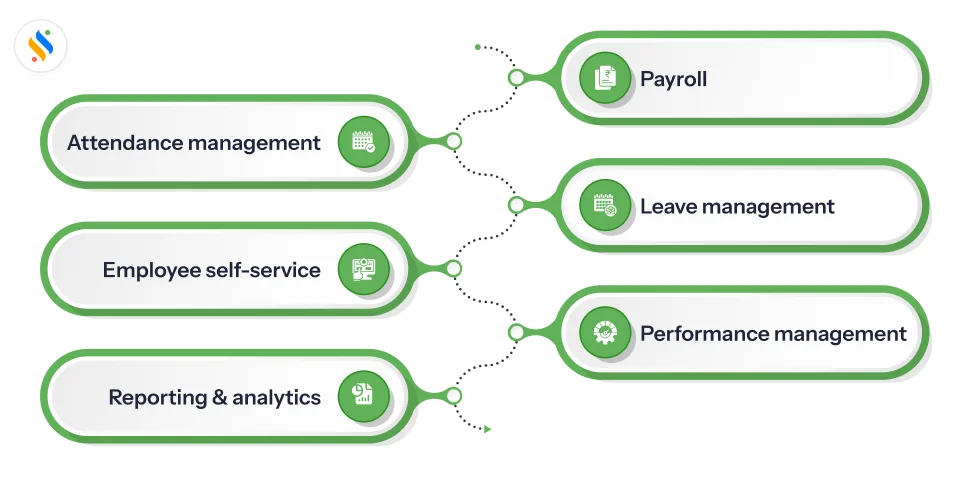
Good HRMS software isn’t a collection of isolated features; it’s a connected system where data flows automatically between modules. Here’s what each module does and why the connection matters.
Payroll:
Payroll is the module where errors are most costly and most common when managed manually. A good payroll module auto-calculates gross pay, statutory and tax deductions, and variable components like overtime, bonuses, and incentives. It generates Form 16, Form 24Q, and payslips without a single manual entry. When it comes to robust payroll software, Superworks’ Super Payroll runs off the same attendance and leave data already in the system, so there’s no separate import, no reconciliation step, and no “someone forgot to update the sheet” conversations.
Attendance management:
Modern attendance management goes beyond biometric punches. Cloud-based HRMS software supports geo-tagged mobile check-ins (critical for field teams, distributed teams, and hybrid workforces), shift scheduling, and real-time tracking dashboards. For Indian businesses with multiple branches or on-site/off-site employees, this is where HRMS pays for itself fastest. The data flows directly into payroll calculations, which happen automatically based on attendance records, not manual inputs.
Attendance management system is the core of any HRMS, capturing check-ins, shifts, and absences automatically. It feeds accurate attendance data straight into payroll.
Leave management:
From the outside, the leave management system of any company might appear to be extremely simple until you’re managing a workforce with 6 leave types, carry-forward policies, sandwich leave rules, and approvals across 3 manager levels. A good leave module enforces all of this automatically, maintains accrual balances, and gives employees visibility into what they have — reducing the “how many leaves do I have left?” messages to HR.
Employee self-service (ESS):
Employee self-service portal is the module that removes the most day-to-day HR burden. Employees can access their payslips, apply for leave, view attendance records, update personal information, and download documents – without emailing HR. For an HR team managing 200+ employees, this alone can save significant hours.
Performance management:
Goal-setting frameworks (OKR or KRA-based), continuous feedback, and structured appraisal cycles, all managed within the same system that has the employee’s complete record. Performance data that feeds directly into compensation reviews removes the subjectivity that makes appraisals frustrating for both managers and employees, leading to higher employee satisfaction, a more productive workplace, and outcomes that are aligned with business goals.
Reports & analytics:
Beyond standard dashboards, modern HRMS platforms are increasingly built on emerging technologies. Predictive analytics capabilities, such as attrition forecasting, workforce demand planning, and performance trend analysis, give HR teams the ability to act on patterns before they become problems, not after.
How do the modules connect?
Here’s the data flow that makes HRMS genuinely powerful:
Attendance data → Payroll
Leave records → Payroll.
ESS approvals → Leave/Attendance (real-time updates)
Performance scores → Compensation reviews
Onboarding data → All modules
When these connections don’t exist, when you’re copy-pasting attendance data into a payroll sheet, that’s where errors, delays, and compliance risks live.
HRMS software vs HRIS vs HCM: Which one do you actually need?
HRMS, HRIS, and HCM – these three terms are often used interchangeably. As a result, managers and founders often get confused. That’s why we thought to clear the confusion once and for all. Here’s the honest difference:
| Comparison Area | HRIS | HRMS | HCM |
|---|
| Full Form | Human Resource Information System | Human Resource Management System | Human Capital Management |
| Core Focus | Data storage and record-keeping | Operational HR automation | Strategic workforce management |
| Typical Features | Employee database, org charts, and HR document management | Payroll, attendance, leave, compliance, ESS, and performance management | All HRMS features plus workforce planning, succession planning, advanced analytics, and learning management |
| Best For | Companies that need organized employee records but still process HR manually | SMBs and mid-market companies automating day-to-day HR operations and repetitive tasks | Large enterprises with complex workforce strategy needs |
| India Context | Often insufficient for compliance requirements | Handles PF, ESI, PT, and statutory filings | Often over-engineered and over-priced for organizations with fewer than 500 employees |
What’s the most honest answer for Indian businesses?
If you have 20–500 employees, you need HRMS software — specifically one built with Indian compliance in mind. HRIS won’t handle your statutory filings. HCM will have more features than you’ll ever use and will cost significantly more.
HRMS software for Indian compliance: What you cannot compromise on?
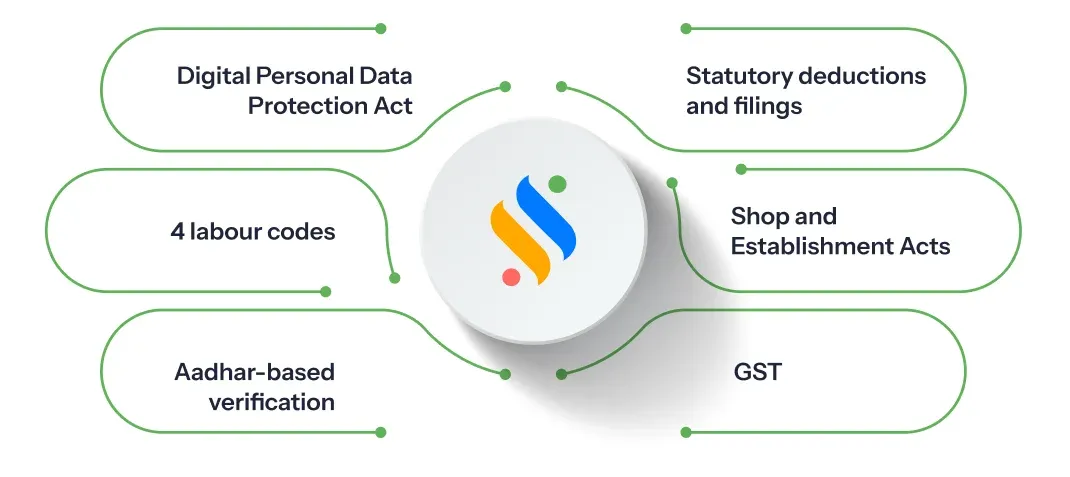
This is the section that matters most for Indian HR managers and founders, and the one that most global HRMS vendors quietly fail on. Indian HR compliance isn’t a checkbox. It’s an ongoing obligation with real penalties. Here’s what your HRMS must handle:
Statutory deductions and filings
Provident fund (PF):
Employer and employee contributions, monthly ECR filing via the EPFO portal, and UAN management. Any HRMS worth using auto-generates the challan and ECR file.
ESI (Employee State Insurance):
Applicable for employees earning up to ₹21,000/month. Monthly contribution (employer 3.25%, employee 0.75%), half-yearly returns, and IP registration. Often missed in manual payroll setups.
Professional tax (PT):
It varies by Indian states, and every state has different slabs and filing frequencies. Your HRMS should have state-wise PT slabs built in and update them when states revise rates.
TDS:
Form 16 generation, Form 24Q generation, and integration with the employee’s declared investments under Section 80C. The HRMS system should handle regime selection at the employee level.
Shops and Establishments Act:
Every state has its own S&E Act, and if your business has offices in multiple states, you’re dealing with multiple sets of rules. An HR solution with built-in S&E Act compliance takes care of every state’s compliance. That means you’re not running a separate compliance calendar for every state.
GST:
GST is a mandatory part of Indian labour law compliance, especially for companies that engage contract workers or process vendor invoices through HR. Your HRMS system should support GST-compliant invoicing and vendor management where applicable.
Aadhaar-based verification:
If there is one document that is of utmost importance in today’s day and age in India, it has to be the Aadhar card. Aadhar verification has become an essential procedure during a new employee’s onboarding. This is mandatory for compliance reasons and to guard the business from any kind of fraud. An HRMS system with an automated Aadhar-based verification procedure not only improves the onboarding workflow but also saves HR time, as they don’t have to chase documents during the onboarding process.
The 4 Labour Codes 2020:
One of the most significant transformations that India, as a nation, witnessed was the merger and replacement of old labour law rules. And the introduction of four labour codes:
- The code on wages, 2019.
- The Industrial Relations Code, 2020.
- The Code on Social Security, 2020.
- The Occupational Safety, Health and Working Conditions Code, 2020.
While the implementation of codes is still “work-in-progress” in some Indian states, most of them have implemented it, and it is now in effect.
This is an important change for HRs that they cannot afford to ignore, especially those who are still operating under the existing laws. The right thing to do here is to get an HRMS system that adheres to the new codes. And how you can do it? Simple, ask your vendor about their roadmap for the latest labour code compliance.
Digital Personal Data Protection Act:
Under the Digital Personal Data Protection Act (DPDP Act) 2023, every employee’s critical information, like Aadhaar numbers, salary details, and health information, is subject to data principal rights. In this regard, HRMS software acts as one of the repositories that safely stores every employee’s personal data.
So, what does this mean practically? It means that your HRMS system must support data localization, have clear data retention and deletion policies, support employee consents, and provide audit logs. When evaluating HRMS vendors, ask for DPDP compliance.
Don’t figure out compliance after a penalty!
See how Superworks handles compliance, including state-wise, before your next payroll run.
HRMS software pricing: How Superworks stands apart?
Pricing in HRMS is rarely as simple as the per-employee-per-month figure on the pricing page. Here’s the full picture.
| Pricing Plans | Pricing Range | What does it get? |
|---|
| Startup | ₹80/employee/month | Essential HR, employee lifecycle management, attendance & leave tracking, payroll, and compensation management. |
| Professional | ₹100/employee/month | All Startup features plus asset tracking and expense management. |
| Premium | ₹135/employee/month | All Professional features plus employee experience tools, helpdesk, performance management, and OKRs. |
| Enterprise | Fully Customizable | Features and modules are tailored according to specific business requirements. |
Hidden costs to watch for:
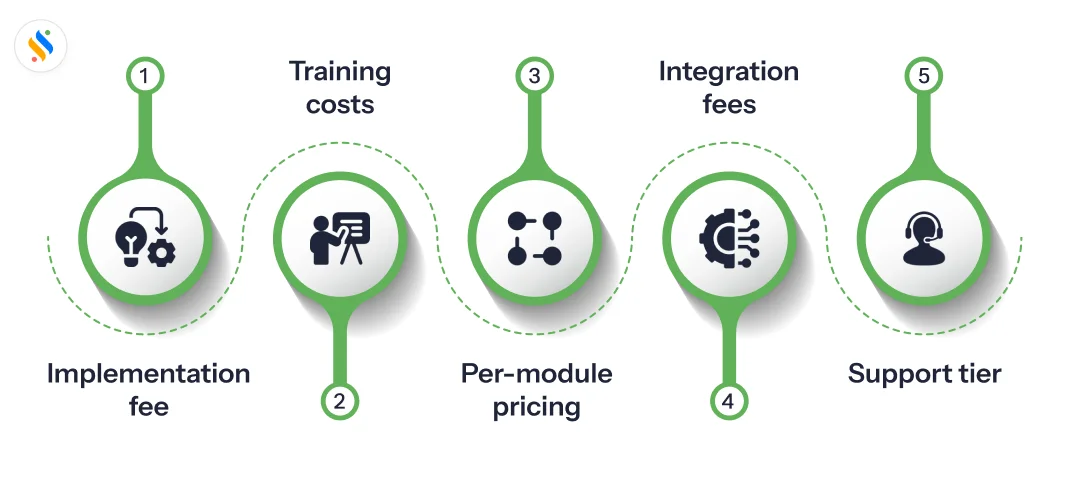
Implementation fee:
Many platforms charge additional prices for setup, data migration, and configuration. Ask upfront whether this is included or billed separately.
Training costs:
Onboarding your HR team and managers isn’t free. Therefore, confirm this before signing any contract because some vendors charge for training sessions, while others offer them as part of the onboarding process.
Per-module pricing:
Some platforms advertise a low base price but charge separately for HR modules such as performance management, recruitment, and advanced analytics. Build the full cost based on the modules you actually need.
Integration fees:
One of the things that managers and founders sometimes ignore is integration fees. If you want your HRMS software to connect your biometric systems, you need to be mindful of the integration costs, because it can raise the total cost.
Support tier:
Most entry-level plans come with email or ticket-based support. If you want phone or dedicated account support, that’s often an upgrade.
Superworks vs. competitors: Features comparison
| Features | Superworks | HROne | greytHR | Keka | Zoho People |
|---|
| Indian Payroll & Compliance (PF, ESI, PT, TDS) | Active | Active | Active | Active | Requires add-on |
| Attendance (Biometric + Mobile) | Active | Active | Active | Active | Active |
| Leave Management | Active | Active | Active | Active | Active |
| Employee Self-Service (ESS) | Active | Active | Active | Active | Active |
| Performance Management | Active | Active | Moderate | Active | Active |
| Shops & Establishment Act | Active | Active | Active | Active | No dedicated feature |
| Labour Codes 2020 | Active | Active | Active | Active | Moderate |
A 7-step framework for choosing the right HRMS software
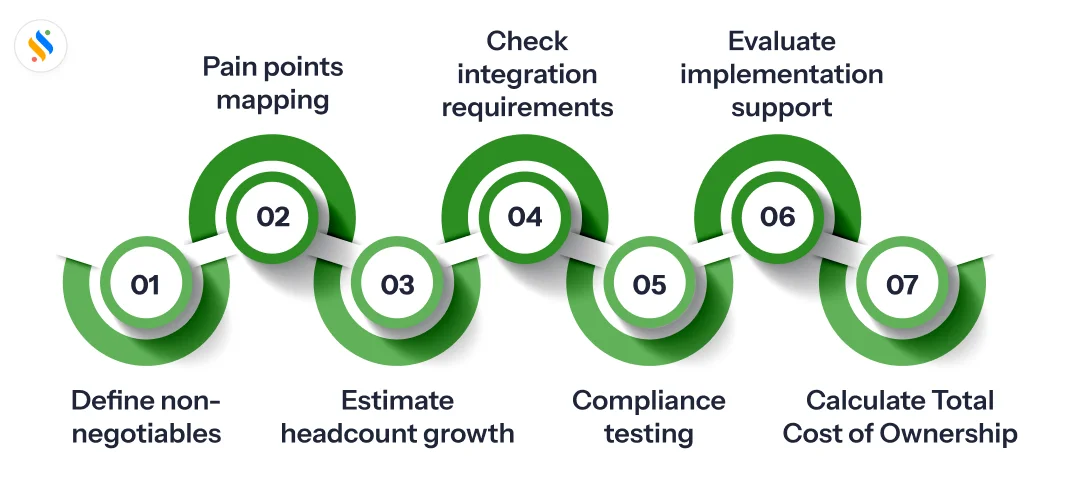
Integrating the wrong solution can not only affect the overall operations, but also can also affect your finances too. That’s why having the right HR software is paramount, and this 7-step framework will help you get the right one:
Step 1: Define your non-negotiables
There are certain things on which no business would like to compromise. If you evaluate the overall scenario of businesses in India, the most important thing is payroll. PF, ESIC, PT, and TDS are the core of Indian compliance. And doing the work on this manually is not only time-consuming, but error-prone, too. That’s why, if an HRMS system doesn’t take care of the payroll processing, it is ineffective, no matter how many lucrative features it offers.
Step 2: Map your current pain points
Where are you losing the most time right now? If it’s month-end payroll, payroll module quality is your priority. If it’s leave management chaos, start there. Your HRMS selection should fix your biggest problem first — not impress you with features you’ll use in year two.
Step 3: Estimate your true headcount growth
More often than not, managers and founders have an HR software for the long term. While it is true that every software should be for the long term, getting the software for the short term can equally be an ideal strategy. That’s because when your current workforce strength is 80 employees and you’re expected to be 200 in the coming times, you don’t know whether the system will support that sort of scalability.
Step 4: Audit your integration requirements
List every tool your HRMS software needs to be integrated with. Confirm native integrations exist, and if they don’t, ask whether APIs are available and whether your team has the capacity to use them.
Step 5: Run a compliance stress test
Ask every vendor the three simple questions:
- Does your software handle multi-state PT compliance?
- What’s your roadmap for the four Labour Codes?
- Is your software compliant with the DPDP Act 2023?
The quality of the answers will tell you a lot about how seriously they take Indian compliance.
Step 6: Evaluate Implementation Support
A platform is only as good as its implementation. Ask for a reference from a company similar to yours in size and industry. Ask how long implementation took, whether there were data migration issues, and whether the support team was responsive. Sales demos show the product at its best; references show it at its most honest.
Step 7: Calculate Total Cost of Ownership (TCO)
Most HRMS software providers have a clean per-employee-per-month number. Not that the numbers aren’t real, but it’s only part of what you’ll actually spend. To get to the true cost, you need to add up everything over a 3-year horizon:
- The annual subscription,
- The one-time implementation and
- Data migration fee.
Conclusion
No matter whether the decision is big or small, if it has anything to do with your business, you put a lot of effort into ensuring that the decision benefits your business. That’s because you understand that one wrong step can lead to major problems. Similarly, when it comes to choosing an HRMS software, you can’t afford to go wrong with it, because the software plays an important role in managing and processing the payroll of your workforce.
In addition to this, it will also play a key role in automating and streamlining the HR operations. Having “the right” HRMS software can make so many things easy for you – from attendance tracking, leave management, and shift scheduling to swift payroll processing, everything gets taken care of. Also, it will keep your business compliant.
And that’s the capability of a good HRMS software: it simply transforms the way you run your HR operations and frees your HR team and managers to focus on strategic tasks instead of administrative tasks. But if it’s not doing anything for your business, perhaps it might not be for you. This blog aims to give every HR manager, C-level executives, and SMB founders in India a detailed insight into how they can have an efficient HRMS software for their business.
But when there are so many HRMS software claims to make the HR operations efficient, choosing the right one can feel a bit tricky. But what if you come to know that actually there is a solution that offers you everything you need for your HR operations, and that too at affordable prices? I am talking about Super HRMS, a product by Superworks! It is one of the best HRMS software in India that is designed for all industries and businesses of all sizes.
From attendance management, leave management and shift management to documentation management, it automates, centralizes, and streamlines HR operations. Its HR chatbot ensures that employees can perform certain functions on their own seamlessly. And not only this! It easily integrates with Super Payroll and takes care of your payroll processing and compliance, so you don’t need to have third-party software!
So, why choose others when everything is available on one platform? Get Super HRMS for your business and make the best decision!










