
TL; DR
On 17th September, 2026, the Ministry of Labour and Employment Gazette Notification S.O. 5109(E) notified the major EPFO update. The wage limit of EPF has been hiked from ₹15,000 to ₹25,000. This is issued under Chapter III of the Code on Social Security, 2020. This is the first revision to the ceiling in over a decade, and it’s expected to bring 51 lakh+ additional employees under mandatory EPF, EPS, and EDLI coverage. For payroll teams, this isn’t just another notification from the government; it means re-identifying eligible employees, splitting September’s payroll and ECR filing, and recalculating CTC structures before the compliance clock runs out.
Every few years, a single line in the Gazette of India quietly resets how payroll is calculated for millions of Indian employees. That moment has come once again. On 17th September, 2026, the Ministry of Labour and Employment dropped a major EPFO update – it has raised the EPF wage limit from ₹15,000 to ₹25,000 per month.
This is monumental because the last time the wage ceiling moved, it moved from ₹65,00 to ₹15,000. That was September 2014.
But for HR and payroll teams in India, this shift will feel disruptive. The reason is that for a very long time, compensation structures, CTC templates, and payroll processing were happening around the old ceiling limit.
This also changes who must be enrolled under EPF, EPS, and EDLI (Employees’ Deposit Linked Insurance), what employees’ take-home pay will be, and what employers owe every month. The government estimates that 51 lakh+ workers will newly come under mandatory coverage as a result.
Now, if your payroll team hasn’t already started mapping things out, this is the time to do it.
In this blog, we’ll take you through this EPF compliance update for 2026 and what your team needs to do now to stay compliant.
What does the notification say exactly?
If you are an HR manager, C-level executive, or a founder in India, pretty sure you must have started hearing rumours about the latest EPFO update. You also might have started reading half-explained LinkedIn articles. But, pretty much, they must be of no avail.
Here’s the complete picture for you:
On 17th September 2026, the Ministry of Labour and Employment published the notification which states that the EPF wage limit has been increased to ₹25,000 per month from the long-standing ₹15,000. Apart from this, Employee PF has increased to ₹3,000 from ₹1800. Employer pension has increased to ₹2083 from ₹1250. And Employer PF has gone from ₹550 to ₹917. The changes are in effect.
Note: Statutory figures in this article are as per the notification. Always visit the EPFO portal and cross-verify before running payroll.
Why ₹25,000 and why now?
The Code on Social Security, 2020 is a consolidation of multiple labour codes. Chapter III of the respective code governs provident fund contributions. Raising the wage ceiling under this chapter directly expands who counts as a “covered employee” for mandatory EPF, EPS, and EDLI purposes. Anyone drawing a monthly wage up to ₹25,000 who wasn’t previously required to be enrolled now falls squarely inside the net.
Old vs new EPF wage limit: What actually changes?
| Component | Rates | Old ceiling (₹15000) | New ceiling (₹25000) | Increase |
|---|
| Employee PF | 12% | ₹1,800 | ₹3,000 | ₹1,200 |
| Employer EPS | 8.33% | ₹1,250 | ₹2,083 | ₹833 |
| Employer EPF | 3.67% | ₹550 | ₹917 | ₹367 |
| EDLI | 0.50% | ₹75 | ₹125 | ₹50 |
| EPF admin charges | 0.50% | ₹75 | ₹125 | ₹50 |
| Employee total | 12% | ₹1,800 | ₹3,000 | ₹1,200 |
| Employer total | 13% | ₹1,950 | ₹3,250 | ₹1,300 |
| Combined | 25% | ₹3,750 | ₹6,250 | ₹2,500 |
The take-home pay change employees will ask about
For employees whose PF is structured as part of their CTC rather than as an employer cost sitting outside it, the higher employee contribution can reduce net in-hand pay by up to ₹1,200 per month. This is the single most common question payroll and HR teams should expect once salary slips reflect the change, so it’s worth getting ahead of it with a clear internal communication.
Your EPF calculations just got bigger. Make payroll simpler!
Calculate contributions accurately and run compliant payroll without the manual effort
Who’s going to be affected by the EPFO update 2026?
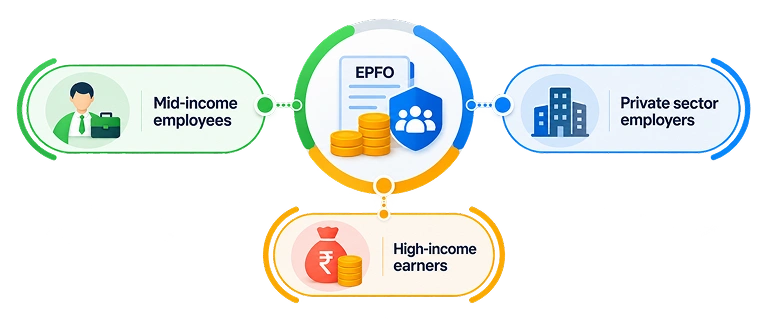
1. Mid-income employees:
This is the group most directly reshaped by the EPFO update 2026. Anyone earning between ₹15,001 and ₹25,000/month now falls under compulsory EPF, EPS, and EDLI enrollment. For many, this means a first-time PF deduction on their payslip, along with the trade-off of higher long-term retirement savings against a modest dip in current take-home pay.
2. Private sector employers:
Every private employer with staff in the newly covered wage band carries the operational weight of this EPFO update. That means auditing payrolls to identify affected employees, enrolling them without delay, absorbing a higher employer-side contribution, and rebuilding CTC structures to reflect the new EPF wage limit. Sectors with a large entry-level or contract workforce will feel this most, since they often have a large number of employees earning just above the old ₹15,000 ceiling.
3. High-income earners:
Employees already earning above ₹25,000/month aren’t newly brought into mandatory coverage by this change – that threshold still governs who must be enrolled. But the revised EPF wage limit resets the reference point employers use for exclusion decisions on future high earners, and existing PF members above the ceiling continue contributing as before.
EPFO update 2026: What should HRs and payroll teams do?
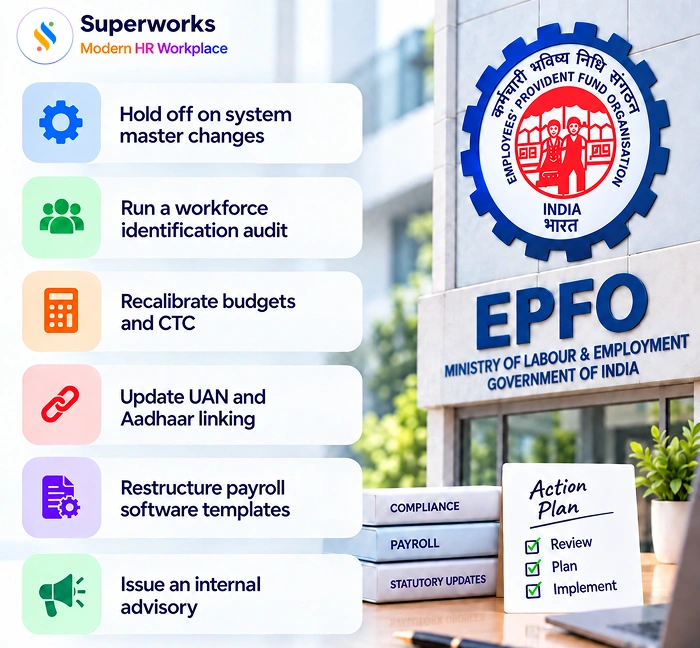
1. Hold off on changing system live masters:
Confirm the effective date and any transitional guidance your compliance advisor flags for this specific EPFO update 2026. Rushing a mid-cycle master change without validating the September split (pre- and post-17 September) risks miscalculating both EPF contributions and gross pay.
2. Run a workforce identification audit:
Pull current payroll data and flag every employee earning between ₹15,001 and ₹25,000/month. The group that shifts from optional to mandatory EPF, EPS, and EDLI coverage under the new wage limit. This audit is the foundation for every other action item on this list.
3. Recalibrate Budgets and Cost-to-Company (CTC):
The higher employer-side contribution — roughly ₹1,200 more per affected employee, combining EPS and PF changes the real cost of employment across every impacted role. Rework CTC breakups and departmental budgets now.
4. Update UAN and Aadhaar linking process:
Newly enrolled employees need a UAN generated or activated, with Aadhaar seeding completed promptly to avoid contribution mismatches. Treat this as a parallel workstream alongside enrollment.
5. Restructure templates in the payroll software:
Salary structure templates, CTC breakup formats, and payslip formulas built around the old ₹15,000 ceiling need to be rebuilt to reflect the new limit. Do this directly within your payroll software. This way, the risk of the same recurring errors will be reduced.
6. Issue an internal advisory in your organization:
If you haven’t informed your workforce and your employees notice a new PF deduction in their payslip, they will ask questions. Hence, it is best to get ahead of it with a short, clear internal note explaining what changed and why. A proactive advisory protects trust far more effectively.
Conclusion
There you have it – an insightful blog on the EPFO update. The new notification revises EPFO wages, Employee – Employer PF, and Employer pension. This is a litmus test for HR and payroll teams. The challenge is to start making identifications about newly covered employees, recalculating contributions, updating CTC structures, managing UAN details – all this before the next payroll cycle.
Now, it is next to impossible to do with spreadsheets, especially for businesses in India that have a 1000+ workforce. That’s why it becomes imperative to have a smart payroll system in place.
Instead of rebuilding calculations every time a compliance rule changes, Super Payroll by Superworks gives your team one place to manage payroll, salary structures, and compliance-related processes. With an all-in-one, customizable, and scalable setup, your team can spend less time fixing payroll calculation errors.
The EPF wage ceiling has changed. Don’t let your payroll process become more complicated. Book a demo now!










