
TL; DR
When someone asks an employee how to calculate CTC from salary, not every employee is able to explain it. CTC is the total amount a company spends on an employee in a year. To calculate CTC, add gross salary, employer PF, gratuity, and any variable pay or other benefits. This guide shows how to calculate CTC from salary, with examples. It also talks about how the math has changed since the introduction of new labour codes and the recent EPF wage hike.
Imagine you are an employee and join a new company. You get selected, and you get your offer letter. The offer letter says that your CTC will be ₹5,00,000 a year. Your first salary credit shows about ₹35,000 a month.
Now, if you are also wondering where the rest went, then don’t worry! That’s because this is something that the majority of the workforce in India experiences.
Most employees try to understand how to calculate CTC from salary. CTC, or cost to company, is the number on the offer letter. It is not your take-home pay. It also includes benefits that perhaps you might see in your payslip or bank account, such as gratuity.
HR teams face the same confusion from the other side. New candidates often find themselves asking why their take-home pay is lower than expected.
This guide explains what CTC in salary means and covers everything in between. By the end, you can calculate CTC from monthly salary or gross salary in a few minutes.
What is CTC in salary?
CTC is Cost to Company. It is the total yearly amount an employer spends to hire and keep one employee. That covers the salary you receive, the benefits the company offers, and any variable pay. So when a company says that your CTC will be ₹5,00,000, that is the company’s cost.
What does CTC structure include?
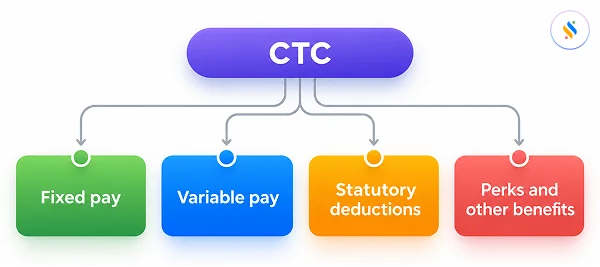
Indian CTC structures include the following:
1. Fixed pay:
As the name implies, this is the fixed pay that you will receive every month. It includes basic salary, HRA, special allowance, and other allowances such as conveyance. Basic is the most important component because PF and gratuity are calculated on it. Under the new labour codes, basic and DA must make up at least 50% of total pay.
2. Variable pay:
This is the part of your pay that depends on results. It includes performance bonuses, sales incentives, commissions, etc. It is not guaranteed and is usually paid quarterly or yearly.
3. Statutory deductions:
These are the payments that the law requires. In it, the employer’s share is part of CTC. Employer PF at 12% of basic, a gratuity of about 4.81%, and ESI at 3.25% if monthly wages are ₹21,000 or less. Employee’s share, such as EPF, PT, and TDS, is deducted from gross salary and is not part of CTC.
4. Perks & other benefits:
These are benefits the company pays for, and they add to CTC without adding to your monthly bank credit. Common examples are group health insurance, meal coupons, reimbursement, employer contribution to the NPS (National Pension System), etc.
CTC vs gross vs net salary: what is the difference?
These three terms look alike but mean different things.
| Term | What it means | Includes employer PF and gratuity? | Formula |
|---|
| CTC | Total yearly cost to the employer | Yes | Gross salary + employer contributions + other benefits |
| Gross salary | Earnings before any deductions | No | Basic + HRA + allowances |
| Net salary | Take-home pay | No | Gross salary − deductions |
Difference between CTC and gross salary
CTC is always equal to or higher than gross salary. Gross salary is what appears as earnings on your payslip.
From gross to net salary
Net salary is gross salary minus deductions. Common deductions are:
- Employee PF at 12% of basic
- Professional tax, set by your state, with a legal cap of ₹2,500 per year
- Employee ESI at 0.75%, if you are covered
- TDS on income tax, based on your tax regime and declarations
Formula to calculate CTC from salary
Here is the basic formula:
CTC = Gross salary + Employer PF + Gratuity + Other employer benefits + Variable pay
Follow these steps:
- List your gross salary: Add basic, HRA, and all allowances for the year.
- Find your basic salary: You need it for PF and gratuity.
- Add employer PF: Multiply basic by 12%.
- Add the gratuity provision: Multiply basic by 4.81%.
- Add other benefits: Include insurance premiums, ESI, and variable pay, if considered.
How to calculate CTC from gross salary
Say your monthly gross salary is ₹50,000 and your basic is ₹25,000.
| Component | Monthly | Annual |
|---|
| Gross salary | ₹50,000 | ₹6,00,000 |
| Employer PF (12% of basic) | ₹3,000 | ₹36,000 |
| Gratuity (4.81% of basic) | ₹1,203 | ₹14,430 |
| CTC | ₹54,203 | ₹6,50,430 |
Note: ESI does not apply here because it only applies when employees’ monthly wages are ₹21,000 or less.
How to calculate CTC from monthly salary
This is the formula to calculate CTC from monthly salary:
Monthly CTC = Monthly gross + (Basic × 12%) + (Basic × 4.81%)
Note: Some employers calculate PF only on the ₹15,000 wage ceiling. In that case, employer PF is ₹1,800 a month, and CTC comes out lower.
From CTC to take-home pay: Working example
Take an annual CTC of ₹9,00,000. Assume basic is 50% of CTC, HRA is 50%, and PF is paid on full basic.
| Component | Annual | Monthly |
|---|
| Basic | ₹4,50,000 | ₹37,500 |
| HRA | ₹2,25,000 | ₹18,750 |
| Special allowance | ₹1,49,355 | ₹12,446 |
| Gross salary | ₹8,24,355 | ₹68,696 |
| Employer PF | ₹54,000 | ₹4,500 |
| Gratuity | ₹21,645 | ₹1,804 |
| CTC | ₹9,00,000 | ₹75,000 |
Now deduct EPF of ₹4,500 and PT of ₹200 from the monthly gross of ₹68,696.
Take-home pay is about ₹63,996 a month before TDS. TDS depends on your tax regime.
This is why a ₹75,000 monthly CTC becomes roughly ₹64,000.
Get every CTC component right at every pay cycle!
Calculate gross salary, PF, gratuity, deductions, and take-home pay easily
How do the newly announced changes impact CTC?
1. New labour codes:
India’s four labour codes came into effect on 21st November, 2025. The Code on Wages, 2019 defines “wages” in one way across all laws.
Wages include basic pay, dearness allowance, and retaining allowance. Wages must be at least 50% of total remuneration. If allowances go above 50%, the excess is added back to wages.
Many companies kept basic at 30% to 40% of CTC. That is no longer enough. A higher basic raises PF and gratuity, which are both calculated on it.
Here is what that means with our ₹9,00,000 example.
At a 30% basic of ₹2,70,000, employer PF is ₹32,400 a year. At a 50% basic of ₹4,50,000, it is ₹54,000. The CTC stays the same, but more of it moves into retirement savings. Monthly take-home falls.
Note: Rules and state-level details are still being settled, so confirm your structure with your compliance team and the Ministry of Labour and Employment portal.
2. New EPF wage hike:
The second change is the EPF wage ceiling hike. The government raised the monthly wage ceiling for mandatory EPF coverage from ₹15,000 to ₹25,000. The new limit applies from 17th September 2026. This is the first revision since 2014.
Two things change for payroll teams and employees:
- More employees are covered: Staff earning ₹15,000 to ₹25,000 a month now fall under mandatory EPF coverage. Reports estimate that over 51 lakh employees benefit.
- PF on the ceiling gets bigger: At 12%, the PF amount on the ceiling goes from ₹1,800 to ₹3,000 a month.
HR teams should review salary structures, update payroll settings, and tell employees how their take-home may change. Confirm the final rules on the EPFO portal.
5 mistakes you should avoid when calculating CTC
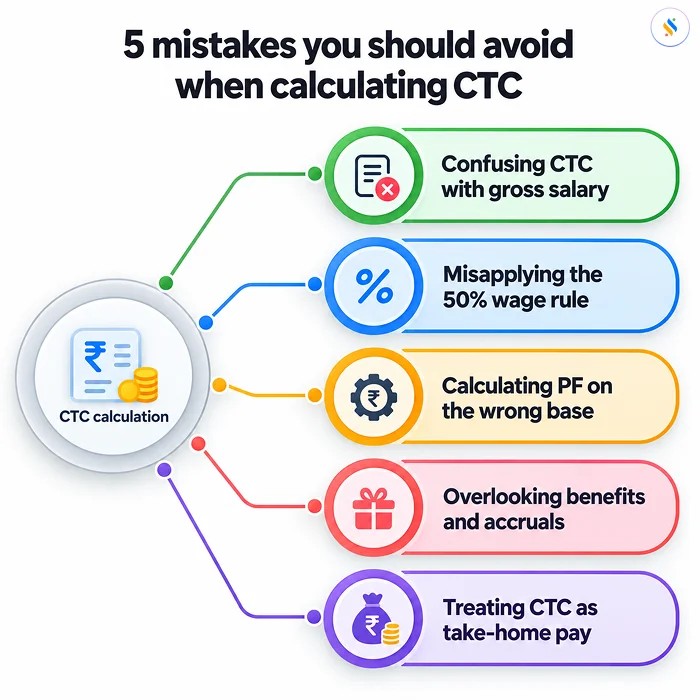
1. Confusing CTC with gross salary:
Gross salary is what appears as earnings on your payslip. CTC also includes employer PF, gratuity, and insurance, which never show up in your monthly pay.
2. Misapplying the 50% wage rule:
Under the Code on Wages, basic pay plus DA must be at least 50% of total remuneration. Many teams check this against gross pay only, or forget that excess allowances are added back to wages. Both errors lead to the wrong PF and gratuity figures.
3. Calculating PF on the wrong base:
PF can be based on full basic or on the EPF wage ceiling, depending on company policy. The ceiling is now ₹25,000. Using the old figure understates monthly PF by ₹1,200 at the ceiling.
4. Not considering benefits and accruals:
CTC includes costs that build up quietly, such as the gratuity provision (about 4.81% of basic), group insurance premiums, and variable pay at target. Leaving them out understates the true cost.
5. Considering it as take-home pay:
CTC is the employer’s total cost. Employee PF, professional tax, TDS, and other applicable deductions reduce gross salary to arrive at net pay.
Why is payroll software essential for effective CTC structuring?
CTC structuring looks simple on paper. In practice, one offer letter touches basic pay, HRA, PF, gratuity, variable pay, and tax. Now repeat that for every new hire and every yearly revision.
Two recent changes made it harder. The 50% wage rule means every salary structure needs a fresh check on basic pay. The new EPF wage ceiling of ₹25,000 changes the PF base for many employees. A spreadsheet will not warn you when a rule moves, and one wrong formula is copied into every row.
However, this can easily be done with payroll software.
Set up the salary structure once, and the software works out everything accurately for the entire workforce. Statutory rules sit inside the system. This way, any major announcement will be taken care of in the system. Apart from this, bonuses and FNF settlement follow the same structure. HR spends less time fixing errors, and employees get a clear breakdown of their earnings.
Conclusion
We hope that this blog will help you build CTC structures efficiently and accurately. Calculating CTC is more than adding up an employee’s salary components. You need to account for multiple components. However, performing so many important calculations on spreadsheets can be extremely risky. That’s why it is best to invest in a smart solution. Super Payroll, a module by Superworks, helps you automate salary calculations, manage PF and other deductions, and maintain accurate CTC structures across your workforce. Instead of relying on spreadsheets and manual formulas, your HR team can manage payroll from one place easily. Book a demo!










