
TL; DR
Choosing between the old vs. new tax regime comes down to one simple question: do your deductions save you more? The new tax regime slabs keep income up to ₹12.75 lakh effectively tax-free after the standard deduction and Section 87A rebate. The old regime tax slab structure rewards taxpayers who claim heavy deductions. This guide breaks down both structures and gives you a framework to help your employees (and yourself) pick the right one before your next payroll cycle.
Every payroll cycle, the same question lands in HR inboxes across India: old regime or new? It sounds like a simple checkbox on a declaration form. Still, for employees, it’s the difference between a heavier monthly TDS deduction and real take-home savings and for HR and finance teams, it’s a compliance decision that has to be right.
The old vs new tax regime debate has only gotten more relevant since the new regime became the default in FY 2023-24, which means anyone who doesn’t actively choose is choosing by inaction.
This guide walks through exactly how the two systems differ for FY 2026-27 and also shows you the practical way to figure out which one is actually right for your business.
The old tax regime and the new tax regime: Explained!
The old tax regime is the traditional structure. Higher slab rates, but a long list of exemptions and deductions that can significantly reduce taxable income for someone who invests and plans well.
The new tax regime, introduced to simplify compliance, flips that trade-off. It offers lower, more compressed slab rates and a higher basic exemption limit, but strips out almost all the deductions the old regime allowed.
Since FY 2023-24, the new regime has been the default tax regime, which means that if an employee doesn’t actively opt for the old regime, payroll will deduct TDS as per the new tax regime slabs by default.
For HR and payroll teams, this default status matters. Every employee who doesn’t submit a regime declaration or the relevant investment proofs gets taxed under the new regime automatically. Chances are that this can catch people off guard.
A clear tax management process can help HR teams track declarations, investment proofs, and TDS calculations more accurately.
Old vs new tax regime: slab rates for FY 2026-27
Below is the comparison of the new tax regime slabs with the old regime tax slabs:
New tax regime slabs (FY 2026-27)
| Taxable Income | Tax rates |
|---|
| Up to ₹4,00,000 | Nil |
| ₹4,00,001 – ₹8,00,000 | 5% |
| ₹8,00,001 – ₹12,00,000 | 10% |
| ₹12,00,001 – ₹16,00,000 | 15% |
| ₹16,00,001 – ₹20,00,000 | 20% |
| ₹20,00,001 – ₹24,00,000 | 25% |
| Above ₹24,00,000 | 30% |
Old tax regime slabs (FY 2026-27)
| Taxable Income | Tax rates |
|---|
| Up to ₹2,50,000 | Nil |
| ₹2,50,001 – ₹5,00,000 | 5% |
| ₹5,00,001 – ₹10,00,000 | 20% |
| Above ₹10,00,000 | 30% |
Deductions under the new tax regime vs. the old tax regime
This is where the real decision gets made. A lower tax rate only helps if it beats what deductions would have saved you elsewhere.
Deductions under the new tax regime
1. Standard Deduction:
Salaried employees and pensioners get a standard deduction under the new tax regime of ₹75,000, deducted automatically from gross salary. No investment proofs or declarations required.
2. Employer’s Contribution to NPS:
Under Section 80CCD(2), an employer’s contribution to an employee’s National Pension System account stays deductible even under the new regime. This will be up to 14% of basic salary for both government and private-sector employees.
3. Agniveer Corpus Fund:
Under Section 80CCH, both the government’s contribution and the individual’s own contribution to the Agniveer Corpus Fund are fully deductible for those enrolled under the Agnipath scheme. This applies specifically to defence personnel.
4. Employment of New Employees:
Businesses filing under Section 80JJAA can still claim a deduction on the additional employee cost incurred when hiring new staff, even under the new tax regime. Since this is a business-level deduction, it matters more for founders.
5. Family Pension Deduction:
Anyone receiving a family pension can deduct the lower of ₹25,000 or one-third of the pension amount received during the year. This is separate from, and in addition to, the standard deduction available on regular salary income.
6. Certain Allowances:
A set of allowances remains exempt under the new regime. This includes transport allowance, conveyance allowance while performing official duties, and daily or tour allowances.
7. Retirement Benefits:
Exemptions on gratuity, leave encashment, and Voluntary Retirement Scheme proceeds continue to apply under the new tax regime, since these are treated as retirement benefit exemptions.
Apart from these, 80C, 80D medical insurance premiums, HRA, and other exemptions are off the table.
Deductions under the old tax regime
1. Section 80C:
This is the most widely used deduction in the old regime. Section 80C allows up to ₹1.5 lakh for investments and payments like EPF, PPF, life insurance premiums, and children’s tuition fees.
2. Section 80D:
This covers health insurance premiums, with a deduction of up to ₹25,000 for self, spouse, and dependent children. An additional ₹25,000 (₹50,000 for parents) for premiums paid on parents’ health cover. Preventive health check-ups up to ₹5,000 are also included.
3. Section 24(b):
This is one of the biggest single deductions available to homeowners, combined with 80C principal repayment. Interest paid on a home loan for a self-occupied property is deductible up to ₹2 lakh per year under this section.
4. Section 80 CCD (1B):
An additional deduction of up to ₹50,000 is available for contributions to the National Pension System (NPS). This makes NPS one of the few instruments that can extend total deductions beyond the standard 80C ceiling.
5. House Rent Allowance:
Under Section 10(13A) of the IT Act, House Rent Allowance helps employees pay for rented housing. It is a partial tax exemption. It reduces taxable salary based on whether the employee lives and works in metro cities like Mumbai, Delhi, or Bengaluru.
6. Standard Deductions:
Salaried employees and pensioners get a flat deduction of ₹50,000 from gross salary, with no proof or documentation needed.
7. Section 80E:
Interest paid on an education loan is fully deductible, with no upper limit on the amount. The deduction is available for up to eight consecutive years, starting from the year repayment begins.
8. Section 80G:
Donations made to eligible charitable institutions and relief funds qualify for a deduction under Section 80G, at either 50% or 100% of the donated amount depending on the fund. Sometimes subject to a cap of 10% of adjusted gross total income. Donations above ₹2,000 must be made through a non-cash mode to qualify.
Let the smart solution do the tax math and save your time!
Automate tax calculations, simplify compliance, and keep every payroll cycle accurate
Common mistakes payroll teams make with tax regime selection
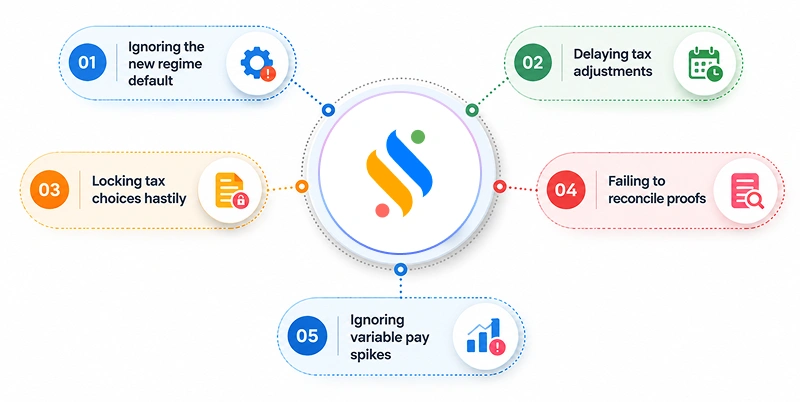
1. Treating the new regime as optional or ignoring defaults:
Some payroll setups still default employees to the old regime out of habit, or process TDS as though a declaration is needed to move into the new regime rather than out of it. Since the new tax regime has been the default since FY 2023-24, any employee who doesn’t submit a declaration must be taxed under it.
2. Leaving tax adjustments for March:
Pushing regime reconciliation and proof verification to the last quarter creates a crunch: employees see unusually large TDS deductions in February and March as payroll corrects an entire year’s shortfall in two pay cycles. Spreading verification across the year avoids both the employee complaints and the error-prone rush.
3. Locking choices hastily:
Collecting a regime declaration once in April and never revisiting it ignores that employees’ circumstances change — a new home loan, a rent increase, or a life event can shift which regime actually saves them money. Teams that don’t build in at least one revision window before the proof-submission deadline end up with employees stuck in a suboptimal regime for the full year.
4. Failing to reconcile declarations vs. proofs:
An employee declaring an intent to invest ₹1.5 lakh under 80C at the start of the year doesn’t guarantee they’ll submit proof of it later. When payroll doesn’t actively reconcile declared intent against actual submitted proofs before the deadline, the gap gets deducted as a lump sum in the final quarter.
5. Ignoring variable pay spikes:
Bonuses, sales commissions, and ESOP exercises can push an employee’s annual income into a higher slab or push them past the threshold for the Section 87A rebate, but many payroll software only recompute projected annual tax at fixed intervals, not when variable pay actually lands. Without recalculating TDS at the point of payout, the shortfall surfaces as a shock during the next cycle instead of being spread out.
Steps to choose a tax regime for the business in India
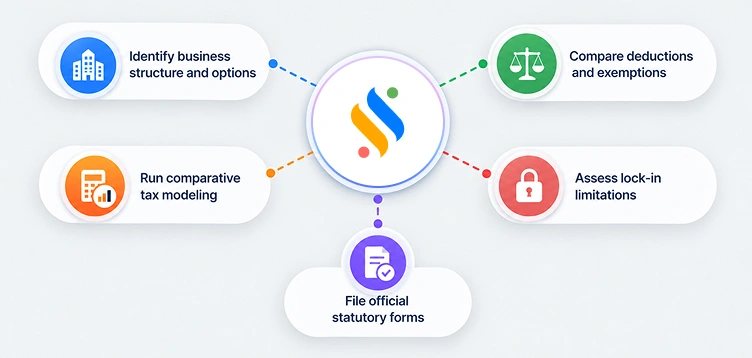
Step 1: Identify your business structure & base options:
The rules differ because of the type of entity. Sole proprietors and professionals filing under ITR-3 or ITR-4 follow the same old-vs-new individual framework as salaried taxpayers, but with stricter switching rules. Partnerships and LLPs are taxed at a flat 30%, so the personal old-vs-new regime choice doesn’t apply to them at all. Knowing which bucket your business falls into determines everything.
Step 2: Compute total deductions vs. exemptions forgone:
List out every deduction, exemption, and incentive currently being claimed and compare that total against what a concessional rate would require giving up. For companies, both 115BAA and 115BAB require forgoing most of these benefits in exchange for the lower flat rate.
Step 3: Run comparative tax modeling:
Model tax liability under each option, not just for the current year but across a realistic 2–3 year projection. A concessional rate that looks marginal currently can become more valuable once exemptions the business currently relies on start phasing out.
Step 4: Assess lock-in limitations:
Every regime choice here comes with restrictions on reversing it. Individuals and HUFs with business income can switch back to the new regime from the old one only once in a lifetime. Section 115BAA, once opted, is irrevocable. Section 115BAB comes with additional eligibility conditions and is equally irrevocable once exercised.
Step 5: Execute via official statutory forms:
Each entity type has its own form and deadline, filed electronically before the income tax return due date under Section 139(1). Individuals and HUFs with business or professional income use Form 10-IEA to opt for the old regime. Companies opting for the concessional rate under Section 115BAA file Form 10-IC, while new manufacturing companies opting under Section 115BAB file Form 10-ID.
Conclusion
That’s all we have in this blog. We hope that by now you have a clearer understanding of the old vs. new tax regime and what each option means for employees, employers, and payroll teams. The right choice ultimately depends on the numbers. For HR and finance teams, the bigger challenge is making sure those choices are calculated correctly, reflected in TDS, and reconciled throughout the financial year. That’s where the right payroll system becomes vital. Super Payroll by Superworks helps businesses simplify payroll and tax management, so your team can spend less time calculating it manually. Book a demo now!










