
TL; DR
The purpose of payroll software for manufacturing units is to go beyond spreadsheets and automate and centralize the entire process, ultimately saving the time of HR and payroll teams. In India, rotating shifts, overtime, contract workers, and state-wise deductions are some of the common components of payroll processing. However, since the arrival of the labour codes and the recent announcement of the PF wage ceiling hike, running payroll will make the process time-consuming, and there will be a lot of errors. For this very reason, manufacturing units in India are getting payroll software. This blog covers the entire spectrum of the solution.
Ask any Indian manufacturing unit HR head the most common challenge they face in their role. While there may be several different answers, one will be the same: running payroll efficiently!
And if you are an HR head of a manufacturing unit in India, you might be very well aware of what I am talking about! Running payroll is by no means easy, especially in an industry where the headcount of the workforce is enormous.
Different attendance for different shifts, overtime sheets come in late, and different policies and structures for contract and permanent staff. On top of this, there is TDS, PF, ESI, PT, and the labour welfare fund – one mistake here and you are looking at heavy and serious financial and legal problems.
That is why manufacturing units are choosing payroll software for their payroll operations. This guide looks at the challenges Indian manufacturing units face and how a smart payroll solution is the need of the hour for them.
Why is payroll for manufacturing in India complex and challenging when done manually?
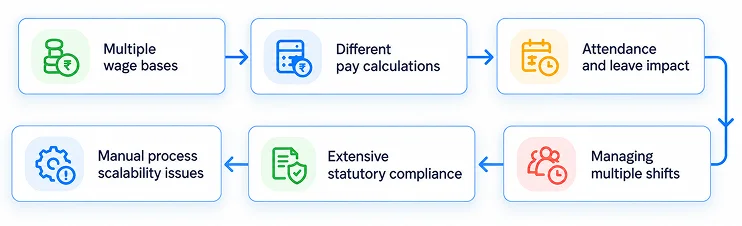
Below are some of the reasons that accurately answer this question.
1. Multiple wage bases:
A factory pays workers in different ways. Some get a monthly salary and some a daily wage. Each requires different calculations, and mixing them can cause serious problems.
2. Different calculations:
Basic pay, DA, shift allowance, overtime, and bonus are all calculated differently. PF, ESI, and gratuity depend on which of these count as wages, so one wrong component throws off the whole payslip.
3. Impact of attendance and leave:
Every late punch, half day, or unpaid leave changes the final pay. When attendance comes in late or in different formats, HR ends up correcting salaries after the payroll is run.
4. Managing multiple shifts:
Rotating and night shifts change every week, and each has its own allowances and overtime rules. Overtime is paid at twice the ordinary rate, so a single wrong entry gets expensive fast.
5. Extensive statutory compliance:
PF, ESI, professional tax, LWF, TDS, and minimum wages must be applied correctly, and the rates differ by state. With the new Labour Codes and the higher PF wage ceiling, these rules are also changing more often.
6. Scalability issues with manual process:
Spreadsheets work for 30 workers but break at 300. As headcount, shifts, and units grow, manual payroll takes longer, hides errors, and leaves no clear audit trail.
What is payroll software for manufacturing?
If you also believe that it is just another payroll software, then allow me to explain how it is different from generic payroll tools. Payroll software for manufacturing is a specialized solution that automates the workforce’s compensation, calculates shifts, and ensures complete labour compliance. It applies statutory deductions and produces payslips, compliance reports and analytics in a few clicks.
Key features of payroll software for manufacturing
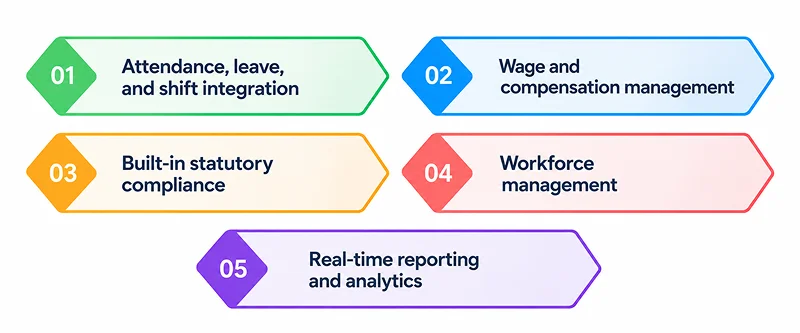
1. Integration of attendance, leave, and shifts:
Attendance, leave, and shift data should flow straight into payroll, with no re-entry. Late punches, half days, and night-shift changes then reach the payslip on their own, and HR stops fixing salaries after the run.
2. Wage and compensation management:
The software should let you build salary structures for different worker types and handle allowances, overtime, bonus, loans, and advances. When wage rules change, you can edit components easily.
3. Built-in statutory compliance:
PF, ESI, PT, LWF, and TDS are calculated automatically, with state-wise settings and reports ready for filing.
4. Workforce management:
Employee records, joining and exit, and full and final settlement stay in one place. Permanent staff, temporary workers, and multiple units can be managed without separate files.
5. Real-time reporting & analytics:
Salary, overtime, and statutory reports are available on demand. Managers can see labour costs by unit or shift, and a clear record of changes makes audits easier.
Benefits of adopting payroll software for manufacturing
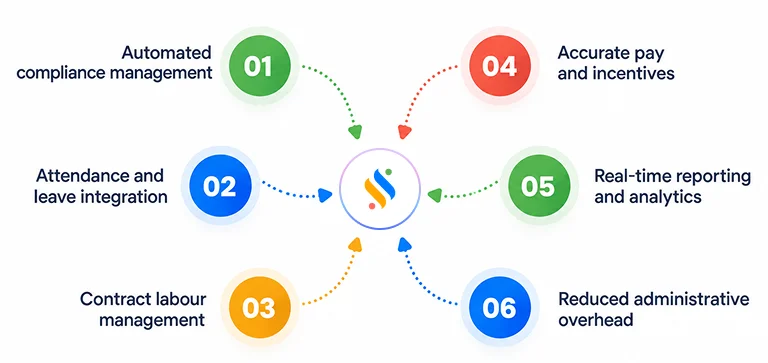
1. Automated compliance management:
The software helps you stay on top of statutory compliance, thanks to its automation capabilities. It reduces manual work and avoids payroll errors.
2. Seamless attendance and leave integration:
Connect attendance, shifts, and leave directly with payroll. Approved attendance data automatically flows into the payroll platform.
3. Effective contract labour management:
Manage contracts and permanent workers from one platform. The software keeps worker records, attendance, wages, and compliance data organized.
4. Accurate pay & incentives:
With automation, you can calculate salaries, overtime, bonuses, and incentives based on actual attendance data, resulting in fair and transparent pay.
5. Real-time reporting & analytics:
Get insights from the workforce’s salary, overtime, attendance, and compliance reports and analytics in real time. HR can use them to make informed workforce decisions.
6. Reduced administrative overhead:
Automating repetitive payroll tasks means HR teams spend less time on administrative work and will be able to focus on more strategic areas.
Run the next payroll cycle of your manufacturing unit without hassle!
Automate payroll and compliance management and save your valuable time
Essential statutory compliance that every Indian manufacturer must get right!
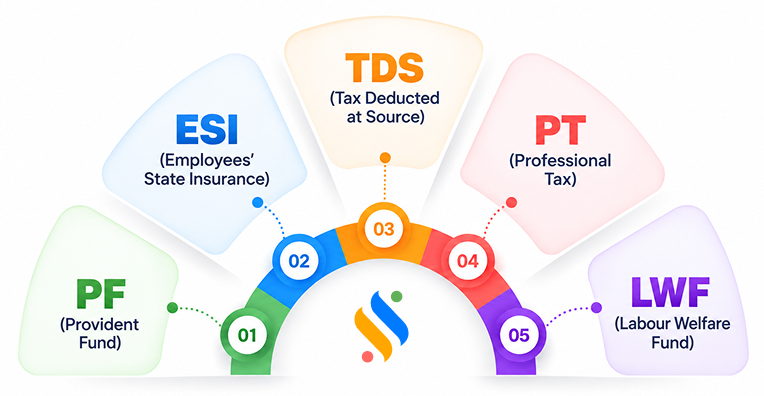
Every Indian manufacturer must follow the compliances mentioned below to avoid heavy fines and legal trouble.
1. PF (Provident Fund):
A retirement savings scheme where the employer and employee each contribute 12% of PF wages every month. The employer must deposit it and file the return on time.
2. ESI (Employees’ State Insurance):
Medical, sickness, and maternity cover for workers earning below the ESIC wage ceiling.
3. TDS (Tax Deducted at Source):
Income tax that employers deduct from salaries, deposit monthly, and report in quarterly returns. Each employee gets a Form 16 at year-end.
4. PT (Professional Tax):
A state-level tax on salaries, with slabs and due dates that differ by state. Plants in more than one state must register and file separately in each.
5. LWF (Labour Welfare Fund):
A small fixed contribution from both employer and employee toward worker welfare. Amounts and due dates vary by state, and late deposits attract penalties.
How does shift calculation take place in payroll processing in India?
You might be wondering why we suddenly started talking about shifts. Allow me to explain. See, a good amount of the workforce in India works in shifts – irrespective of the size of the industry. It may not be the case with every industry, but it is certainly true for the manufacturing industry.
Shift management is the core of the manufacturing industry, and miscalculations are pretty common. If you feed payroll software the wrong data, the results will eventually be wrong. And if this goes unnoticed, the same will be reflected in the employee’s payslips and will create problems during auditing.
Let’s understand this with an example. Assume that a worker has Basic plus DA of ₹15,600 a month. For monthly-paid staff, the daily wage is the monthly wage divided by 26.
- Daily wage: ₹15,600 ÷ 26 = ₹600
- Hourly rate: ₹600 ÷ 8 = ₹75
- Overtime rate at two times: ₹150 an hour
- 10 overtime hours in the month: ₹1,500
Add night-shift allowances, holiday duty, and late-mark rules, and you can see why manufacturing units need a smart payroll solution.
How to choose the best payroll software for manufacturing units in India?
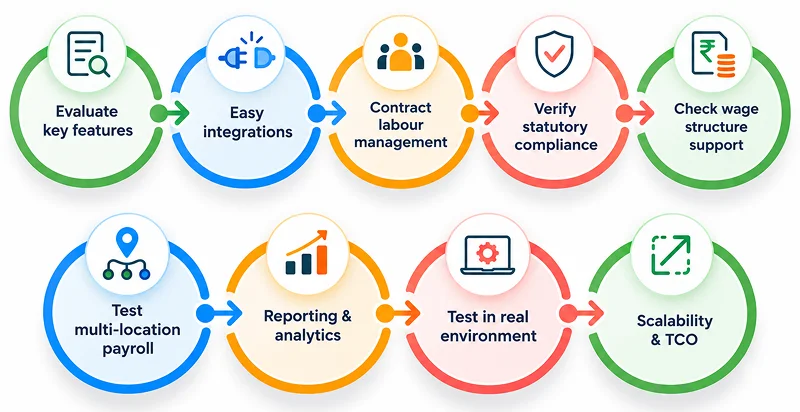
1. Evaluate its key features & capabilities:
Your very first step should be to check whether the software is specifically built for manufacturing needs or a generic payroll tool. We have discussed in the blog the features a payroll software for a manufacturing unit needs to have. While the purpose is definitely to remove manual work, if the features don’t meet your payroll requirements, then it is no good for you.
2. Consider robust and easy integrations:
Your payroll software should easily integrate with biometric devices, HRMS platforms, and other existing tools.
3. Evaluate contract labour management:
If your factory has contract workers, check whether the software can manage their records, attendance, salaries, and compliance. This way, HR would be able to manage permanent and contract workers easily.
4. Verify statutory compliance management:
Make sure the software can handle statutory compliance, i.e., PF, ESI, TDS, PT, and LWF. For multi-state operations, check whether it can apply the relevant state-wise rules.
5. Check support for different wage structures:
Manufacturing units may have monthly salaries, daily wages, piece-rate pay, shift allowances, overtime, incentives, and bonuses. Choose software that can handle these and also calculate them accurately.
6. Test multi-location payroll capabilities:
If you operate multiple plants, the software should let you manage employees and payroll across locations.
7. Thoroughly check reporting & analytics:
Look for reports and analytics capabilities. Real-time reports can help HR and management get insights on salaries, attendance, overtime, deductions, compliance, and labour costs across plants and departments.
8. Test the software in a real environment:
Do not rely only on a demo. Test the software with a real scenario from your factory. This will show you how well it handles your actual payroll process.
9. Consider scalability and TCO (Total Cost of Ownership):
Think beyond your current headcount and subscription price. Consider implementation, integrations, support, training, and future requirements. The software should continue to work smoothly as your manufacturing plant scales.
Why do Indian manufacturing units trust Super Payroll for payroll processing?
In the era of AI and the ever-evolving landscape of compliance, manufacturing companies in India cannot afford to go wrong with payroll processing and compliance management. For a long time, the only way for them to do this has been spreadsheets. However, in this blog, we cover the price a manufacturing unit pays for doing it manually.
Super Payroll, a solution by Superworks, is a solution that Indian manufacturing factories are adopting heavily today. It automates and centralizes the data related to attendance, leave, overtime, salary structures, statutory deductions, and payroll processing on one platform. This way, HR teams can manage the entire payroll cycle from one place. Its built-in compliance management handles PF, ESI, PT, LWS, and TDS calculations, and provides real-time payroll reports and analytics.
Conclusion
That’s all we have in this blog. Here, we talked about the challenges Indian manufacturing units face with payroll processing and compliance, especially when done manually. What payroll software for manufacturing units is. In addition to this, we touched upon its key features, benefits, compliance, and how you can choose the best payroll software for your manufacturing unit. If you are looking for payroll software for your manufacturing unit or factory, you mustn’t just get the software based on its appealing features or simply because it falls under your budget.
Consider your existing process and the loopholes you are witnessing. Remember that the parameters for choosing such a solution can’t be limited to just a handful of things. Now, if you haven’t tried payroll software in the past and are tired of managing payroll operations through spreadsheets, then Super Payroll is for you. Book a demo and see how it can help you save time in a way that spreadsheets can’t!










