TL; DR
If your business operates across multiple Indian states, saying that compliance monitoring is challenging can be an understatement; you’re managing several, all at once, with different deadlines, different formats, and different penalties. A missed LWF filing, an outdated PT slab, or a register that was never maintained. Now, these are the things that turn a routine inspection into a serious problem.
Between central laws, state amendments, and annual notifications, you’re already tracking 30+ compliance requirements. This blog breaks down every compliance your business is responsible for, and what HR compliance software should actually be doing, so your HR team isn’t chasing deadlines manually. Because at this point, “we’ll manage a spreadsheet” or simply saying that we have an HRMS software that takes care of everything is no longer an answer.
Running a business in India is no small feat, especially if you’re doing it across multiple states. This also means that you are already aware of the compliance. It isn’t something you can set and forget, because laws – whether it is state or central, keep changing.
Whether it is state amendments or wage slabs, any key change in employment law can have an impact on your business operations. And at that point, your job and your HR’s job is all about keeping up with all of it.
The problem isn’t that businesses don’t take compliance seriously; they do. But when there are over 30 compliance challenges, it is simply too much to manage without the right system in place.
That’s why you need a solution like HR compliance software, and for this reason, you need to read this blog. So, without further ado, let’s jump right in!
The 30+ Indian HR compliance requirements that you can’t ignore!
When it comes to Indian labour law compliance, it wouldn’t be wise to think of it as just a set of documents. Indian labour laws run deep – a complete ecosystem of central acts, state-level amendments, and annual government notifications. Because of this, complexities start to arise, especially for businesses that operate in more than one state. HR professionals managing multi-state operations are often the first to feel this pressure. The following is a structured view of the 30+ labour law compliance that every Indian business mandatorily carries – and that the right indian HR compliance software should be equipped to handle:
Employees’ Provident Fund (EPF):
EPF is mandatory in India now, whether the establishment has 20 employees or 200. Employers must contribute toward retirement savings and ensure monthly filings. Non-compliance can result in penalties and legal action.
Employees’ State Insurance (ESI):
ESI provides medical and social security benefits to eligible employees. Applicable establishments must register under the scheme and contribute monthly.
HR teams must manage:
- Employee registration
- Contribution filings
- Wage thresholds
- Accident reporting
- Exit updates
Professional Tax (PT):
Professional tax is a state-level tax applicable in several Indian states. Rules, slabs, and due dates vary by state. This makes PT one of the most error-prone compliances for multi-state businesses, and one of the strongest arguments for investing in robust HR compliance software early on.
Tax Deducted at Source (TDS):
Here, employers must deduct TDS from employee salaries and deposit it within prescribed timelines.
This includes:
- Investment declarations
- Form 16 generation
- Quarterly returns
- Salary structuring compliance
Errors here directly affect employee trust and expose the business to regulatory requirements it cannot afford to miss.
Labour Welfare Fund (LWF):
LWF contributions differ across states and usually require both employer and employee contributions. Many companies miss LWF because:
- Frequencies vary
- Contribution amounts differ
- Applicability changes state-wise
A dedicated HR compliance software tracks these variations automatically, so nothing slips through the cracks.
Shops and Establishments Act (S&E Act):
Every state in India has its own Shops and Establishments Act governing:
- Working hours
- Weekly offs
- Leave policies
- Opening/closing hours
- Employee records
Businesses operating in multiple states often struggle because compliance requirements differ significantly.
Minimum Wages Act:
Employers must ensure employees receive at least the government-mandated minimum wage based on:
- Skill category
- Industry
- State
- Zone classification
Since wage notifications change frequently, businesses need continuous monitoring through HR compliance software that updates automatically when state notifications are revised.
Payment of Wages Act:
This law governs:
- Timely salary payment
- Authorized deductions
- Wage periods
- Salary disbursement methods
Delayed salary payments can attract legal consequences and employee disputes.
Payment of Bonus Act:
Applicable organizations must provide statutory bonuses to eligible employees based on salary thresholds and profitability rules.
HR teams must calculate:
- Minimum bonus
- Maximum bonus
- Set-on and set-off adjustments
- Eligibility periods
Payment of Gratuity Act:
Employees completing five years of continuous service become eligible for gratuity benefits.
Organizations must:
- Track tenure
- Calculate gratuity accurately
- Maintain records
- Process settlements compliantly
Maternity Benefit Act:
This law mandates paid maternity leave and protects employment rights for women employees.
Compliance includes:
- Leave entitlements
- Crèche policies
- Documentation
- Medical bonus provisions
Equal Remuneration Act:
Employers must ensure equal pay for equal work regardless of gender. Salary structures, hiring practices, and promotion policies should remain discrimination-free.
Compliance work should not consume your HR team
Reduce manual tracking, filing errors, and last-minute compliance firefighting with Superworks
Prevention of Sexual Harassment Act (POSH):
POSH compliance is now a critical HR responsibility. Organizations must:
- Form an Internal Committee
- Conduct awareness training
- Maintain complaint records
- Submit annual reports
Failure to comply can damage the company’s reputation and lead to severe penalties.
Contract Labour Act:
Companies employing contract workers must comply with licensing, wage monitoring, attendance tracking, and contractor documentation requirements. Principal employers can also be held liable for contractor non-compliance. This is a key area of risk management that many businesses underestimate.
Factories Act:
Applicable manufacturing units must comply with regulations related to:
- Employee safety
- Working conditions
- Health standards
- Overtime
- Shift management
Industrial Disputes Act:
This governs employee termination, retrenchment, layoffs, and dispute resolution mechanisms. Improper handling of exits can result in litigation and labour court cases. HR operations dealing with high-volume exits need a structured system to stay clean here.
Apprentices Act:
Organizations hiring apprentices must follow structured training regulations, contracts, and reporting standards.
Child Labour Regulations:
Employers must ensure no prohibited employment of minors exists within operations or vendor ecosystems.
Building and Other Construction Workers Act:
Construction-related businesses must comply with welfare cess payments and worker welfare registrations. These compliance efforts are often overlooked during rapid project scale-up.
Inter-State Migrant Workmen Act:
Businesses employing migrant workers across states must maintain proper records, wage protections, and travel-related compliance.
Employees Compensation Act:
Employers are legally responsible for compensation in cases of workplace injury, disability, or death. Gaps in data security around incident records can further complicate settlements.
Equal Opportunity Compliance for Persons with Disabilities:
Inclusive hiring policies and workplace accessibility are becoming increasingly important from both legal and ESG standpoints.
Leave and Attendance Compliance:
Indian businesses must maintain accurate leave and attendance records based on state labour laws.
This includes:
- Casual leave
- Sick leave
- Earned leave
- Overtime records
- Shift compliance
HR processes that rely on spreadsheets here are most vulnerable to audit failure.
Overtime Compliance:
Overtime eligibility, calculation methods, and maximum limits vary based on applicable labour laws and state regulations. Incorrect OT calculations are a common audit issue.
Payroll Record Maintenance:
Businesses must maintain salary registers, wage slips, attendance records, and statutory registers in prescribed formats. Digital recordkeeping is becoming increasingly accepted and preferred.
Employee Exit Compliance:
Final settlement compliance includes:
- Gratuity
- Leave encashment
- PF transfer/withdrawal
- Tax calculations
- Full-and-final settlement timelines
Labour Law Display Requirements:
Many labour laws require businesses to display notices, abstracts, and compliance information at workplaces. Ignoring these “small” requirements can still lead to inspection issues.
State-Specific Holiday Compliance:
National holidays, festival holidays, and mandatory leave policies differ across states. HR teams operating across India often struggle with decentralized holiday management.
Gig and Platform Worker Compliance:
With the rise of the Indian orange economy, businesses are mandatorily assessing worker classification, contractor obligations, and social security expectations.
Data Privacy and Employee Record Security:
Employee records contain highly sensitive information. Data protection is now a legal obligation, not just an IT concern.
HR systems must ensure:
- Secure document collection
- Controlled access
- Audit trails
- Data retention policies
Digital Wage Payment Compliance:
Many sectors now require traceable and digital salary disbursements instead of cash payments. This makes payroll automation and banking integrations increasingly important.
Labour Codes Readiness:
India’s four new labour codes are expected to reshape:
- Wage definitions
- Social security
- Industrial relations
- Occupational safety
Any credible HR compliance software should already be roadmapping these changes as part of its update cycle.
What HR compliance software automates and what it shouldn’t leave to you?
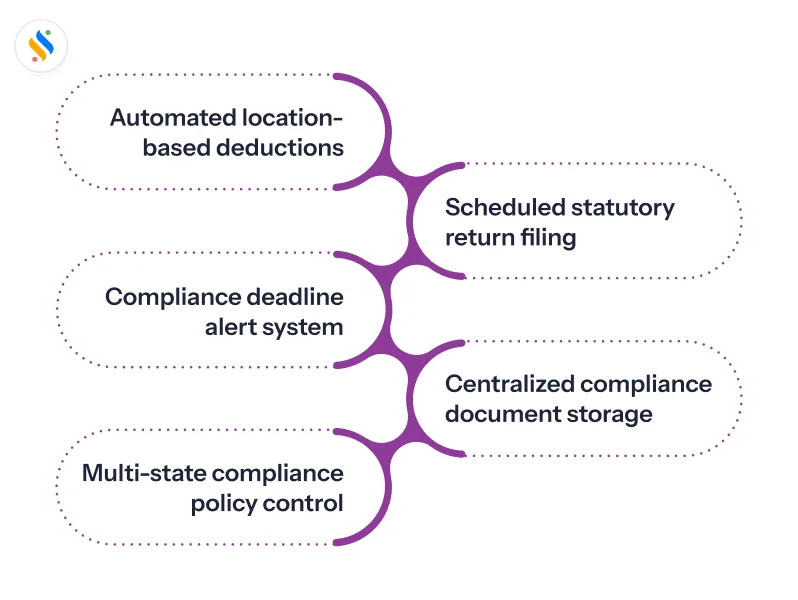
One of the terms that is often used very loosely among the vendors who deal in making businesses compliant is ” HR compliance software.” A payroll tool that computes PF deductions is not the same thing as a dedicated HR compliance tool. Here is where the line should be drawn – and what a proper compliance platform takes entirely off your plate:
Automated, location-aware deductions:
PT slabs, LWF rates, and even ESI applicability differ by employee location. A genuinely capable HR compliance software applies the correct rules automatically when an employee’s work location is set – not because someone configured it manually, but because the logic is built in. So, imagine if Maharashtra revises its PT slab in the next budget cycle; the system should update without a support ticket.
Scheduled return filing in prescribed formats:
PF ECR files, ESI contribution statements, and PT challans each follow a format specified by the respective statutory authority. The software should generate these files in the exact format ready for upload. A generic CSV export that still requires manual reformatting is not automation — it is a halfway measure that still leaves room for human error.
Deadline calendaring and proactive alerts:
PF is due by the 15th of every month. ESI has a different cycle. PT due dates depend on the state. LWF contributions are annual in some states, semi-annual in others. Statutory compliance software should maintain a live calendar of every obligation, surface upcoming deadlines to the right people, and send alerts at configurable intervals before the due date.
Centralised statutory document repository:
Compliance audits are not just about whether returns were filed on time – they are about whether the records can be produced on demand. Employment contracts, appointment letters, wage registers, leave records, muster rolls, and Form I / Form II registers all need to be stored in a structured, searchable archive. Labour law software that forces HR to maintain these in parallel folders is creating the very risk it is supposed to eliminate.
Multi-state policy separation:
This is where most tools expose their limitations. A company with offices in Chennai, Pune, and Hyderabad needs separate S&E compliance, PT slabs, and LWF rules applied to each location. The system must handle this based on the employee’s work location, not the company’s registered HQ.
Audit trail, statutory returns, and compliance reports: The feature standard
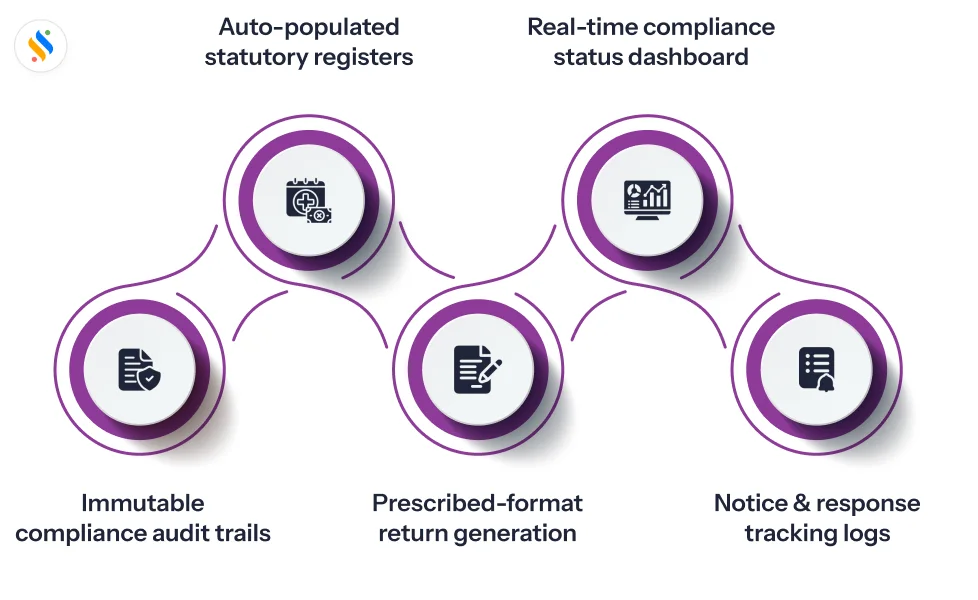
When an auditor walks in — or when your own CFO asks for a compliance status snapshot – you need more than a filed-on-time assurance. Here is the specific feature set that separates an efficient HR compliance software from software with a compliance tab bolted on:
Immutable audit trail:
Every change to salary structure, deduction configuration, or leave balance should be logged with a timestamp, actor ID, and before-and-after values. This is now a governance requirement.
Auto-populated statutory registers:
The Factories Act and most state S&E acts require maintenance of specific registers: register of wages, register of advances, muster roll, and leave register. These should populate automatically from payroll and attendance data. Maintaining them as a parallel manual process is both inefficient and error-prone — the two records eventually diverge, and that divergence is exactly what auditors look for.
Prescribed-format returns, ready to upload:
The PF ECR file, ESI Form 5 and 6, and PT challans all follow formats prescribed by the relevant authority. Good HR regulatory software generates these in the exact required format, not a reformatted version that a payroll executive still needs to manipulate before submission.
Real-time compliance dashboard:
A status dashboard showing each obligation as filed, pending, overdue, or upcoming gives HR leadership an accurate risk view at any point in the quarter. When the same dashboard is used to generate board-level compliance reports, the process becomes efficient. What used to take approx. 2-3 days get done instantly.
Notice and response log:
Statutory compliance has a reactive dimension too: authorities issue notices, and responses have their own deadlines. The software should support logging notices received, tracking response due dates, and attaching supporting documents — all linked to the specific obligation the notice relates to.
Best HR compliance software for India: A comparative look
The Indian HRtech market has several credible options, but coverage depth varies significantly. The table below compares the major platforms across features that matter specifically in the Indian statutory context:
| Features | Superworks | Keka | greytHR | Zoho People |
|---|
| PF / ESI / PT auto-deduction | Yes | Yes | Yes | Yes |
| Labour Welfare Fund (LWF) support | Yes | Partial | Yes | No |
| Multi-state compliance (8+ states) | Yes | Yes | Partial | Partial |
| Shops & Establishments Act mapping | Yes | Partial | Partial | No |
| Real-time, immutable audit trail | Yes | No | Partial | Partial |
| Prescribed-format returns export | Yes | Yes | Yes | Partial |
| Statutory registers (auto-filled) | Yes | Partial | No | No |
| Compliance dashboard with status | Yes | Yes | No | Yes |
| Notice & response tracking | Yes | No | No | No |
How Superworks handles compliance across 8 states and central obligations?
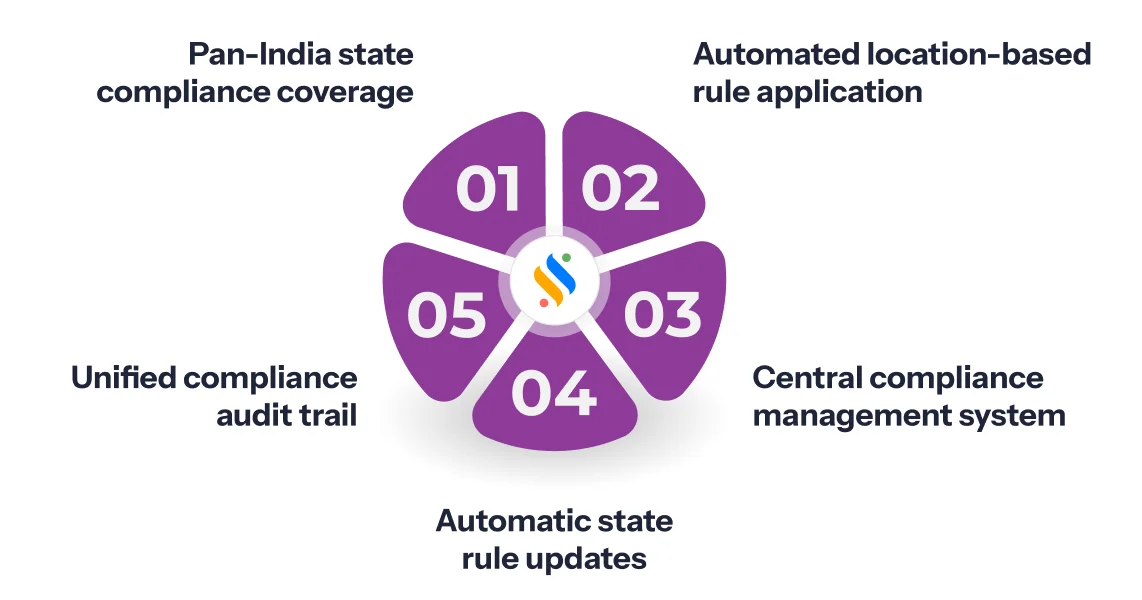
Superworks has been built for Indian businesses that aspire to scale, but fall behind due to complicated compliance. As a comprehensive platform, its products – Super HRMS and Super Payroll are seamlessly integrated, making payroll, attendance, and compliance efficient:
Pan-India state coverage:
Superworks follows compliance standards across all Indian states. No partial support. No missing states.
Location-based rule application:
The correct PT slab, LWF rate, and S&E requirement apply automatically based on where the employee is located, not where the company is headquartered.
Central compliance, fully covered:
EPF, ESI, TDS, gratuity, bonus – all central obligations are managed within the same system, on the same dashboard.
No manual state configurations:
When a state revises its wage notification or PT slab, Superworks updates accordingly. Your HR team doesn’t need to reconfigure anything manually.
One system, one audit trail:
Every compliance action- deduction, filing, register update – is logged in one place, making audits straightforward regardless of how many states you operate in.
Wrapping Up,
If you are an HR manager, C-level executive, or SMB founder, you must have realized by now that operating a business in India can be tricky, especially keeping the Indian compliance architecture in mind. That’s why we created this blog to make you aware that while running a business in multiple states in India can feel challenging, it can make things even worse if you manage all of it manually.
That’s why having a smart solution at your disposal is essential. A reliable HR compliance software doesn’t just reduce the administrative burden – it ensures that your compliance is error-free and that your business remains audit-ready at all times. Combining it with Employee monitoring software in india further strengthens your compliance posture by ensuring transparent, real-time visibility into workforce activities. Now, when so many vendors claim to make compliance efficient, it won’t be easy to choose the right one. But if you’re looking to make your business compliant without breaking your bank, then Superworks is just for you. Considered by many businesses as the best platform for compliance management HR, it is the system you need to keep up with the ever-evolving compliance landscape. Don’t believe us, book a demo and see a difference for yourself.