TL; DR
HCM vs HRMS vs HRIS: these are three terms that have evolved over the decades. Each one ends up adding a new layer on top of the previous one. HRIS (80s) digitized employee records. HRMS (90s) added workflow automation and payroll processing. HCM (2000s) brought in strategic workforce planning. Most modern HR technology platforms blur these lines entirely. For Indian businesses, the terminology matters less than the capability. What actually matters is whether the platform automates payroll with full statutory compliance, manages employee data without manual intervention, scales with your headcount, and gives employees a mobile-first self-service experience. If you’re an MSME or a growing enterprise evaluating HR software, stop asking “Who’s best between HRMS and HRIS,” and start asking “Are they capable of pulling off what my business actually needs?” Super HRMS by Superworks covers the full spectrum on one platform.
A quick answer? Yes. It matters…even in 2026. It’s because there is a difference between the terms.
And one who understands it can be able to make better decisions.
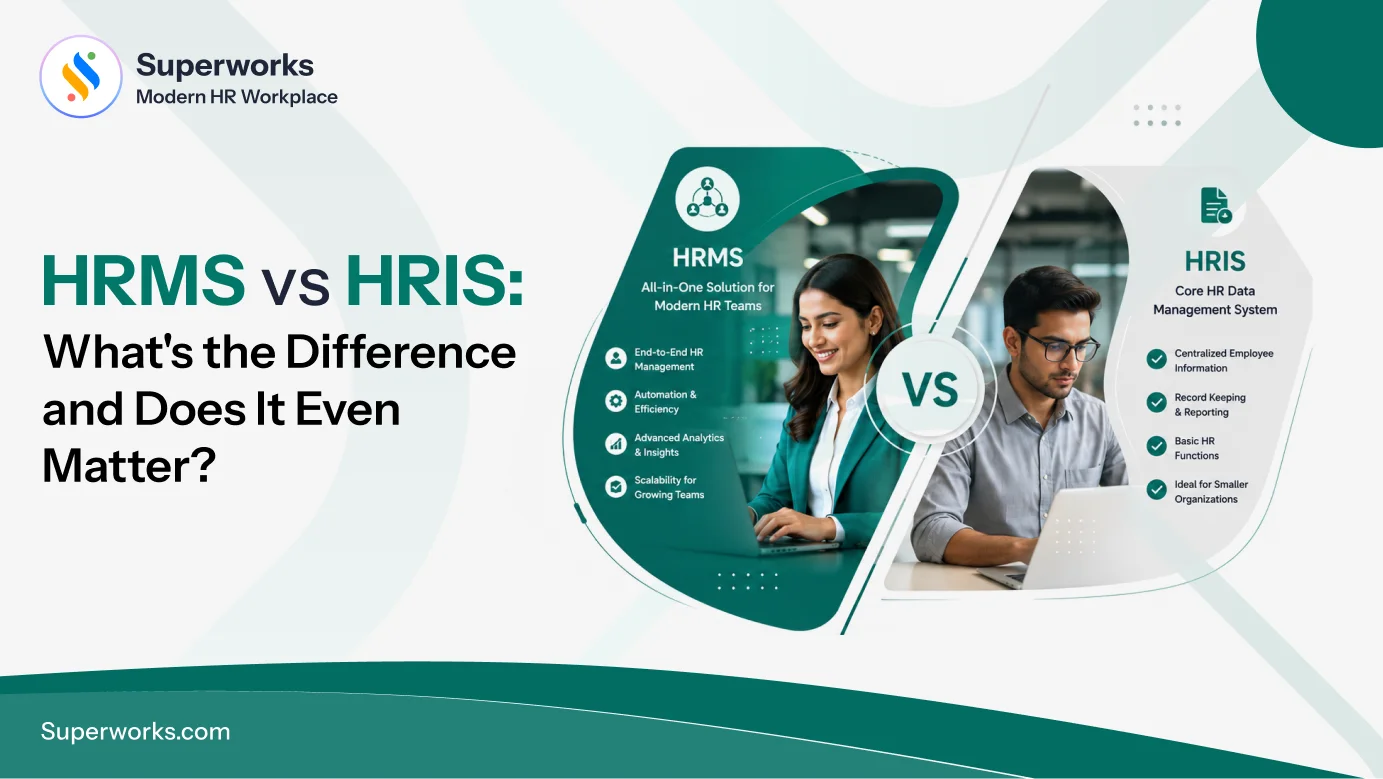
If you have spent your precious time researching HR software for your business, chances are that you must have heard these two terms, HRMS and HRIS. Most CXOs, MSME founders, and even HRs often use these terms interchangeably, with very little understanding that there is a difference!
Now, the confusion seems understandable because most vendors’ websites use whichever term ranks better for them. And most comparison articles on this topic don’t offer anything new. So, it is obvious that your buying decision is bound to get affected by it.
But this article takes a different approach. Here, you will understand the difference between HRMS and HRIS in detail. It will also cover the historical perspectives of all three, so that your buying decision of a software for your business in 2026 becomes much more informed.
The evolution of HRIS, HRMS, and HCM over the years
Let’s go back a few decades to understand these 3 in detail:
The 80s: HRIS: Record-keeping goes digital
The Human Resource Information System, or HRIS, emerged in the 80s. With its advent, businesses began moving employee records from paper files to digital databases. The core purpose was simple: store employee information in one place so it could be retrieved, updated, and reported easily — without the need to go through file cabinets. An HRIS system at this stage was essentially a digital record room. It stored personal details, employment history, payroll operations, and basic compliance information. In other words, HRIS focuses primarily on data storage and organization, with little automation on top.
The 90s: HRMS: Workflow enters the picture
As business operations started to grow more complex and HR tasks began to expand beyond record-keeping, the Human Resource Management System emerged as a solution. Many thought that it would replace HRIS, but it didn’t. Instead, it was built on top of it. The key addition was workflow automation. While HRIS stored data, HRMS systems acted on it. Payroll was now calculated within the system. HR processes like attendance tracking, leave management, and compliance reporting began to be automated, reducing manual data entry significantly.
The 2000s: HCM: Strategy joins operations
Human Capital Management, or HCM, arrived as organizations began treating their workforce as a strategic asset rather than an administrative function. HCM added everything HRMS did not – succession planning, talent acquisition, learning and development, workforce analytics, and long-term workforce planning. If HRIS were a filing system and HRMS an operations engine, HCM would become a strategic planning tool.
Where are we in 2026?
In 2026, the labels have largely blurred. Most modern platforms marketed as HRMS include features that can easily be classified as HCM. Most platforms calling themselves HRIS include workflow automation that goes well beyond the original definition of the term.
HRIS vs HRMS: Features comparison
It is essential to understand that in the discourse of HRMS vs HRIS vs HCM, features play the key part. At the end of the day, each one of them is serving the purpose of streamlining HR operations.
That’s why we prepared a features list of human resource management system, human resource information system, and human capital management system.
| Features | HRIS | HRMS |
|---|
| Employee database and records | Yes | Yes |
| Document storage and management | Yes | Yes |
| Basic attendance records | Yes | Yes |
| Leave records | Yes | Yes |
| Basic reporting | Yes | Yes |
| Payroll processing | No | Yes |
| Statutory compliance automation | No | Yes |
| Shift scheduling and roster management | No | Yes |
| Workflow automation | No | Yes |
| Performance management | No | Yes |
| Recruitment and ATS | No | Yes |
| Employee self-service portal | Limited | Yes |
| HR analytics and dashboards | Basic | Advanced |
| Multi-location support | Limited | Yes |
| India compliance – PF, ESIC, PT, TDS | No | Yes |
HRMS vs HRIS vs HCM: Where does each one fit?
As said in the introduction, buyers often use these terms interchangeably. That’s why it is essential to understand each of their positions and how their core HR functions differ:
HRMS software automates HR operations on top of the data layer. It is best for businesses that need payroll processing, compliance management, attendance tracking, and workforce workflows running efficiently every month. An HRMS system typically covers the entire employee lifecycle — from onboarding to offboarding.
HRIS stores and organizes employee data. Best for businesses that are digitizing HR for the first time and primarily need a structured employee data management system with basic reporting. Basic HR tasks like maintaining an employee directory or tracking leave records are squarely in the HRIS domain.
HCM adds strategic workforce planning on top of operations. Best for enterprises where talent acquisition, succession planning, learning and development, and advanced workforce analytics are active business priorities. HCM systems also support employee development and long-term workforce productivity goals.
Whether it is an MSME or a mid-sized company in India, HRMS is the right starting point. It covers everything HRIS offers and adds the automation that growing businesses actually need.
Still confused about which system meets your business needs?
Get a 15-minute walkthrough and see how Super HRMS covers the full spectrum.
When does the distinction matter? (Hint: Rarely)
Is the difference between HRMS vs HRIS still worth paying attention to? Maybe not in some cases. But there are three specific scenarios where the vocabulary can affect your buying decisions:
When evaluating free platforms:
Several platforms — particularly free ones — often market themselves as HRIS because their features match the original definition. They store employee data, track basic HR functions like attendance, and generate simple reports. They do not process payroll, automate compliance management, or manage employee data across complex workflows. This is a crucial distinction for any business that needs more than a basic record-keeping tool.
When reading vendor contracts:
Some enterprise contracts specify the type of HR system being licensed. An “HRIS module” in a contract may exclude payroll processing, compliance management, and workflow management — features that fall under “HRMS.” Always verify what the contract scope actually covers before signing.
When justifying the budget internally:
Using the correct terminology matters, especially if you are presenting a plan to purchase software to top management. Presenting an HRMS vs HRIS understates its capability and may lead to a budget being allocated for a more basic system than what your HR operations actually require.
What modern buyers should actually look for?
Instead of getting into the discourse of hr management system vs hr information system, ask these questions:
Does it handle Indian statutory compliance?
Compliance is vital, especially for Indian businesses. A system that does not process PF, ESIC, PT, TDS, and other requirements, irrespective of what it calls itself, isn’t good enough for Indian HR operations. During any vendor demo, check if you can upload PT, ESIC, and PF challan. If the upload fails, the system isn’t good for you, no matter what other capabilities it offers.
Does it automate workflows or just store data?
Test this in the demo. Ask the vendor to show you what happens when an employee applies for leave. Does the request automatically route to the manager, update the leave balance on approval, and reflect in the next payroll cycle without manual input? If any step requires manual intervention, you are looking at a system that only stores data.
Does it scale with your growth stage?
Just because a system works for a company with 40 employees doesn’t mean it will work for a company with an employee strength of 400. Evaluate the scalability of the platform. A good HR management system should grow with you — so you don’t have to migrate to new tools as your workforce expands. Complex HR operations require platforms that handle workforce data at scale.
Does the mobile experience work for your entire team?
India’s workforce is mobile-first. If the ESS portal works well on a desktop but poorly on an entry-level Android and iOS device, your self-service won’t be much of use.
Is the platform secure?
Security is one of those factors that most businesses ignore during the evaluation stage, until a data leak or compliance issue forces them to take it seriously. In 2026, a modern HRMS should offer role-based access controls, data encryption, secure cloud backups, audit logs, and multi-factor authentication at the very least.
Where does Superworks sit?
Here is how Superworks aligns with the HRIS vs HRMS, and HCM spectrum:
Core HRIS capabilities:
- Centralized employee database with complete lifecycle tracking.
- Document management with digital storage, expiry tracking, and an audit trail.
- Role-based access control with security compliance.
- Basic reporting and employee directory.
HRMS capabilities:
- Automated payroll with PF, ESIC, PT, TDS, and GST compliance.
- Attendance management with biometric integration, geo-fencing, and mobile punch-in.
- Leave management.
- Shift scheduling and roster management.
- Performance management with OKR and KRA frameworks.
- Recruitment and applicant tracking with structured onboarding.
- Employee self-service portal.
- Responsiveness.
HCM-grade capabilities:
- Real-time HR dashboard with visibility.
- Custom report generations.
- Proactive compliance alerts.
Conclusion
The HRMS vs HRIS debate is something that hasn’t gone away, even in 2026. But for most Indian businesses, the real question is no longer about terminology. It is about capability.
Can the platform automate your payroll with complete India statutory compliance? Can it manage attendance, leave, shifts, and workflows without constant manual intervention? Can your employees actually use the ESS without struggling? And most importantly, can the system scale as your business grows?
That is where modern HRMS platforms separate themselves from basic HRIS tools.
A well-built Core HRMS bridges this gap entirely, combining reliable employee data management with end-to-end automation so growing businesses never have to choose between the two.
And this is exactly where Superworks fits in. A smart solution that not only centralizes your employee data, but also automates payroll, attendance, leave, compliance, onboarding, performance management, and workforce workflows from one platform.
Choosing the right HRMS Tools for your business means evaluating how well the platform handles payroll automation, compliance, and employee self-service at scale.
Whether you are an MSME or a growing enterprise, Superworks gives you the automation, scalability, and visibility – something that modern HR teams actually need in 2026. So, take a first step and get Superworks for your business!










