
TL; DR
Payroll compliance in India has gone through significant changes in the past few years. From the announcement of new labour codes to EPF wage hike and movement toward digital compliance procedures, if you are an HR, a C-level executive, or a founder, it can become increasingly stressful to manage. This blog contains all the essential details you need to keep your business compliant.
Whether you are an HR, a C-level executive, or a founder, you must have realised that payroll compliance in India has never been simple. Reason? Central and state rules keep changing. The biggest example of that is the recent announcement of an EPF wage hike from ₹15000 to ₹25000. It was announced on 17th September, 2026, and it is live. This means that businesses must restructure their workforce’s salaries.
Another example was the consolidation of the old 29 central labour laws into four new labour codes. Both of these are the primary examples of the ever-evolving nature of payroll compliance. And in this, missing even one filing or deadline can lead to serious financial and legal problems.
If you are confused about how payroll compliance in India works and want to keep your business compliant, this guide is for you.
Payroll compliance in India: An overview!
Payroll compliance in India refers to the legal framework that regulates how businesses pay employees’ salaries, calculate statutory deductions, and file returns. This is managed by both central and state governments.
The core components of payroll compliance in India include,
1. EPF (Employees’ Provident Fund):
EPF is a retirement savings scheme for eligible employees covered under the EPF framework. The standard EPF contribution is 12% of basic salary + DA from both the employee and the employer, subject to the prescribed rules.
2. ESI (Employees’ State Insurance):
ESI provides eligible employees with medical and social security benefits to safeguard them for uncertain contingencies. The current contribution rate is 0.75% for employees and 3.25% for employers.
3. TDS (Tax Deducted at Source):
TDS is a tax where employers deduct a certain amount from an employee’s salary and deposit it with the IT Department. You must calculate TDS based on the employee’s projected taxable income, applicable tax regime and eligible claims, then deposit and report the deduction.
4. PT (Professional Tax):
Professional Tax is a state-level tax imposed on employees. It does not apply uniformly across India. States that have levied it have their own applicable rules, slabs and deadlines.
5. LWF (Labour Welfare Fund):
The Labour Welfare Fund is an employee welfare initiative that is governed by state governments. Both employers and employees are required to contribute a certain amount. It is applicable in 16 states and union territories. States where it is applicable have their own slabs. Hence, visit the government website to check the current slabs.
What changed in payroll compliance in India in the last year?
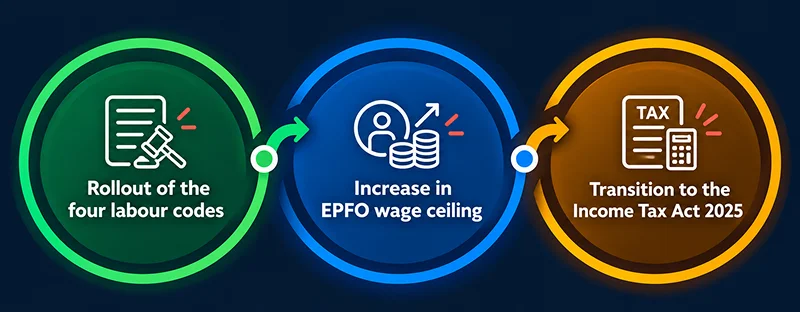
1. The rollout of the 4 labour codes:
The four labour codes came into force on 21st November 2025 and replaced 29 central labour laws. For payroll, the biggest change is the new definition of wages. Excluded allowances such as HRA are capped at 50% of total pay. Anything above that is added back to wages, so your PF, gratuity and bonus base can grow.
2. Hike in the EPFO wage ceiling:
The Labour Ministry raised the PF wage ceiling from ₹15,000 to ₹25,000 per month, effective from 17th September 2026. The old ceiling had been in place since September 2014. Employees earning ₹15,001 to ₹25,000 may now need mandatory PF cover.
3. Transition to the Income-tax Act, 2025:
The Income Tax Act, 2025 replaced the 1961 Act from 1st April 2026. Salary TDS moved from Section 192 to Section 392. The quarterly salary TDS return, Form 24Q, is now Form 138. Form 16 is replaced by Form 130 for Tax Year 2026-27. Form 16 is still valid for FY 2025-26 salary.
Run your payroll without any stress, even with rule changes!
Simplify statutory calculations and stay aligned with the latest requirements
Best Practices for executing payroll compliance
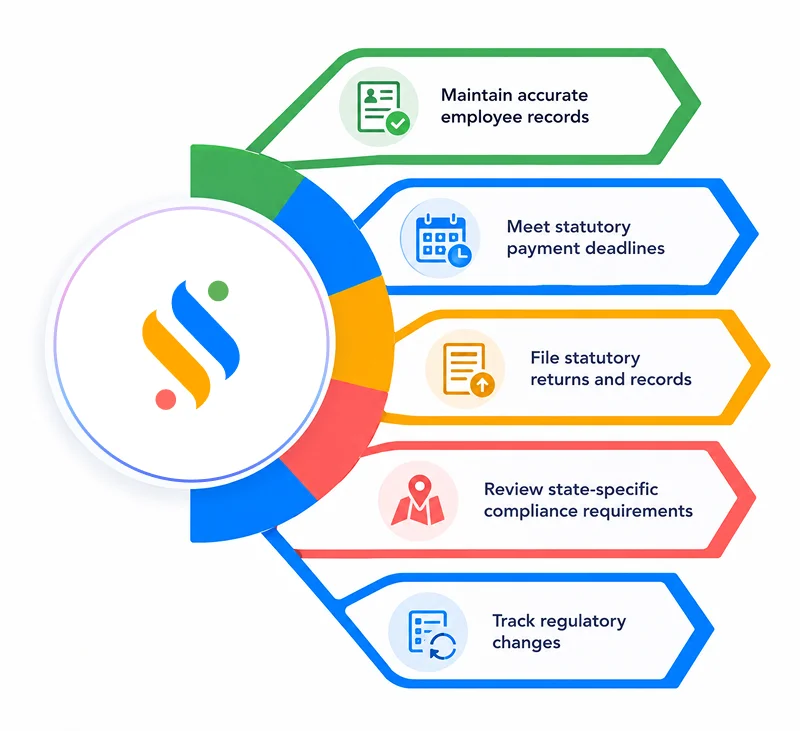
1. Maintain accurate employee records:
Cover employee master data, PAN, Aadhaar where applicable, UAN, ESI details, bank information, onboarding/offboarding dates, salary structure and other details.
2. Meet statutory payment deadlines:
Ensure that there is timely payment of PF, ESI, TDS, PT, LWF and other applicable contributions.
3. File statutory returns and maintain records:
Maintain a record of filings, challans, returns, payslips, salary registers and supporting documents.
4. Review state-specific compliance requirements:
This is particularly important because PT, LWF and certain labour requirements differ across states.
5. Keep track of regulatory changes:
This can naturally connect back to your previous section on the Labour Codes, EPFO changes and the Income Tax Act, 2025.
A quick checklist for your business to stay compliant
Use this payroll compliance checklist to understand what to do and when. Due dates differ by state and can change, so visit official portals before you proceed further.
| When | What to do? |
|---|
| Before payroll | Close attendance and leave. Update joiners, exits and salary changes. Check PF and ESI eligibility against the current wage limits. |
| At payroll | Calculate wages, overtime, PF, ESI, PT, LWF and TDS. Check that allowances do not breach the 50% wage rule. |
| By the 7th | Pay salaries. Deposit the previous month’s TDS. |
| By the 15th | File the PF ECR and pay PF. Pay ESI contributions. |
| As per state schedule | Pay professional tax and LWF where they apply. |
| Quarterly | File the salary TDS return in Form 138. Reconcile it with your TDS deposits. |
| Yearly | Collect tax declarations. Issue Form 130. Review minimum wage revisions and bonus eligibility. |
| On every exit | Settle full and final dues, including leave and recoveries. |
Want to save your HR and payroll team’s time? Check out our payroll templates and use them for your next cycle.
Which payroll reports should Indian businesses keep ready?
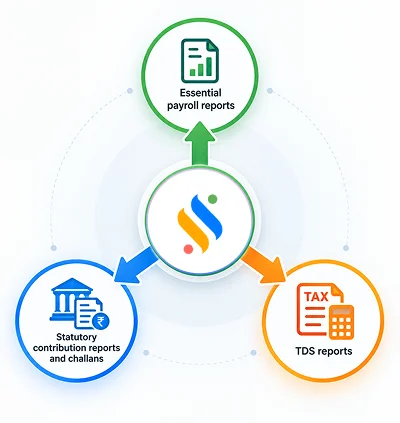
The following are the payroll reports you must maintain for internal audits and government inspections.
1. Essential payroll reports:
These are the base records. Keep the payroll register, and add the payslips, the bank disbursement statement and the leave & attendance data. Keep a full and final settlement sheet for every exit. Auditors usually start from here.
2. Statutory contribution reports & challans:
These prove you deposited what you deducted. Keep the PF ECR with its challan, the ESI contribution challan, and the professional tax and LWF challan for each state. File them month by month. The amounts must match your payroll register. A mismatch between a challan and the register is the most common issue.
3. TDS reports:
These show that tax on salary was calculated, deposited and reported correctly. Keep each employee’s TDS computation sheet and the monthly TDS challans. Add the quarterly Form 138 filings with their acknowledgements, and the Form 130 certificates issued to employees.
4. Statutory labour registers:
These support the wage and working-hour calculations behind payroll. Keep the registers related to wages, attendance, overtime, deductions, and leave. Formats and retention rules vary by state, so check them beforehand.
Common mistakes Indian companies make in payroll compliance
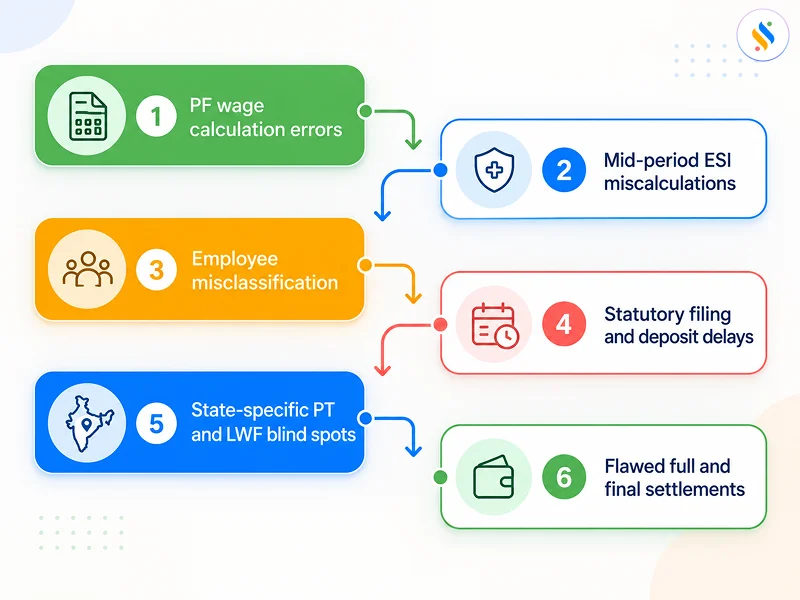
1. PF wage calculation errors:
Many teams still calculate PF on basic pay alone. Under the new wage rules, allowances above 50% of total pay are added back to wages. Also, the PF ceiling rose to ₹25,000 on 17 September 2026. Ignoring this can impact the entire process.
2. Mid-period ESI miscalculations:
ESI is counted in two periods: April to September and October to March. If pay crosses ₹21,000 during a period, the employee usually stays covered until that period ends. Many teams stop deductions early.
3. Employee misclassification:
Calling employees “consultants” or “trainees” to skip PF and ESI is risky. Authorities look at the work done. Review every category and keep a written reason for each.
4. Statutory filing and deposit delays:
PF and ESI are due by the 15th, and TDS by the 7th. Late PF payments attract 12% interest per year, plus damages of 5% to 25%. Most delays start with late attendance data. That’s why it is imperative to fix that.
5. State-specific PT & LWF blind spots:
PT and LWF rules change from state to state. Slabs, rates and due dates all differ. Applying one state’s rule everywhere leads to wrong deductions.
6. Flawed Full and Final (F&F) settlements:
F&F errors usually come from missed items: leave encashment, notice recovery, gratuity or TDS on the final payout. Dues should be cleared at exit, not in the next payroll cycle.
Why is this the right time to have Super Payroll for your business?
Payroll compliance in India is a stressful scenario for HR, C-level executives, and founders. With constant changes in laws and regulations at the central and state levels, your payroll teams need to keep reviewing their processes, just to check that there aren’t any errors.
Managing all this manually can make payroll processing time-consuming, tedious, and error-prone. This is particularly true for areas like calculations and deductions. That’s why you need to have the right payroll software. If you’d rather not handle EPF, ESI, TDS and PT filings in-house, a Payroll service in india can take that compliance workload off your team.
Super Payroll, a module by Superworks, automates, centralizes, and brings payroll processing and compliance management together on a single platform.
From salary calculations to managing statutory deductions and generating payroll reports, you can do everything without any spreadsheets.
With Super Payroll, you can,
- Automate salary calculations for every payroll run.
- Calculate PF, ESI, PT, LWF and TDS automatically.
- Apply state-specific rules for PT and LWF in one place.
- Compare challans with payroll and spot any differences.
- Generate salary, EPF, ESIC and TDS reports from the dashboard in just a few clicks.
- Pull attendance, leave, and shift data straight from Super HRMS.
- Create and share payslips instantly, and let employees view their own payslips through self-service.
- Settle full and final dues accurately.
- Scale without stress, even if your team goes from 100 to 200 employees.
Conclusion
That’s all we have in this blog. We hope that this will come in handy to you and will keep your business compliant. As highlighted, managing payroll compliance in India is no joke. Even overlooking a minor mistake can lead to heavy penalties and can even put companies in legal trouble. That’s why it is advisable to go through this blog and keep your business compliant. Another important thing is that the statutory compliance laws, both central and state ones, keep getting changed. Hence, always visit the government portals to cross-verify before running your payroll cycle. And if you want to save time, then it’s best to ditch spreadsheets and manual work and switch to Super Payroll. Book a demo today!










