TL; DR
Payroll for a large business isn’t just a question of scale; it’s a different problem. Once you cross a few hundred employees spread across states, payroll software has to handle multi-state PF/ESIC/PT/LWF variations, the new Labour Codes rollout, TDS at scale, and DPDP Act obligations around salary data, on top of the usual salary processing. This guide breaks down what actually separates payroll software for large businesses from SMB tools, the India-specific compliance stack you can’t shortcut, the must-have features for large enterprise payroll, and a practical framework to evaluate vendors without vanity feature lists.
Somewhere between 200 and 500 employees, payroll stops being a monthly task and starts being a monthly risk. The spreadsheet that worked fine for 60 people starts producing PF mismatches for one state, PT errors for another, and a Form 16 season that HR dreads instead of manages. By the time a company qualifies as a large business, payroll touches multiple state governments, multiple statutory bodies, and thousands of individual employee records – and a single missed update to a labour law provision can mean penalties that apply per employee, per month, not just once.
This is the point at which “payroll software” as a category stops being one-size-fits-all. The requirements of a 50-person startup will be very different from those of a 1,000-workforce business. This blog looks at what changes once a business is genuinely large, the India-specific compliance layer that most payroll buying guides skip over, the features that actually separate enterprise-ready platforms from scaled-up SMB tools, and a practical way to evaluate vendors before you commit.
Why is payroll software for large businesses a different category?
Ask any HR or finance leader running payroll for 500+ employees, and they’ll tell you the problem isn’t calculating salaries; spreadsheets can do basic math. The problem is that at scale, payroll touches everything: statutory compliance across multiple states, integration with HRMS and finance systems, audit trails, data security, and thousands of individual edge cases (mid-month joiners, arrears, multi-location transfers) that all need to close correctly before the same disbursement date, every single month.
This is exactly why generic “payroll software” recommendations don’t hold up once a company grows past the SMB bracket. Payroll software for large enterprises has to be built for scale, not scaled up from a small-business tool. And for companies operating in India specifically, scale brings a compliance dimension that most international guides simply don’t cover.
What actually changes once your business grows?
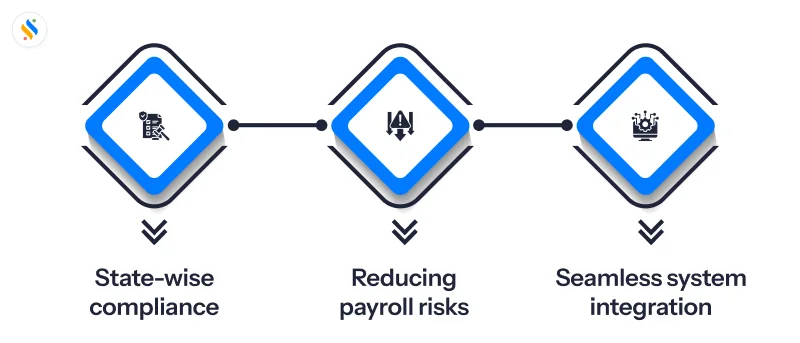
Before comparing tools, it helps to be precise about what “large” changes in payroll operations mean:
Multiple states & rulebooks:
A business with offices in Maharashtra, Karnataka, Delhi, and Tamil Nadu isn’t running one payroll; it’s running four, at minimum. Professional Tax (PT) slabs differ by state. Labour Welfare Fund (LWF) contribution amounts and due dates differ by state. Shops and Establishment Act registrations differ by state. Payroll software for big companies needs to apply the correct state-specific rule automatically, based on each employee’s work location, without HR manually tracking which state uses which slab.
Volume changes the cost of errors:
When 10 employees are on payroll, a calculation error is easy to spot and fix. When 1,000 employees are on payroll, the same class of error can mean lakhs in incorrect disbursement, a statutory filing that doesn’t reconcile, or a compliance penalty that applies per employee, per month. At scale, payroll software isn’t a convenience; it’s risk management.
Integration becomes non-negotiable:
Large businesses run HRMS, attendance, expense management, and finance/ERP systems as separate but connected pieces. Payroll software for large businesses has to sit in the middle of that stack, pulling attendance and leave data automatically and pushing cost-center data to finance because manual data transfer between systems is where large-scale payroll actually breaks.
The India-specific compliance large businesses can’t ignore!
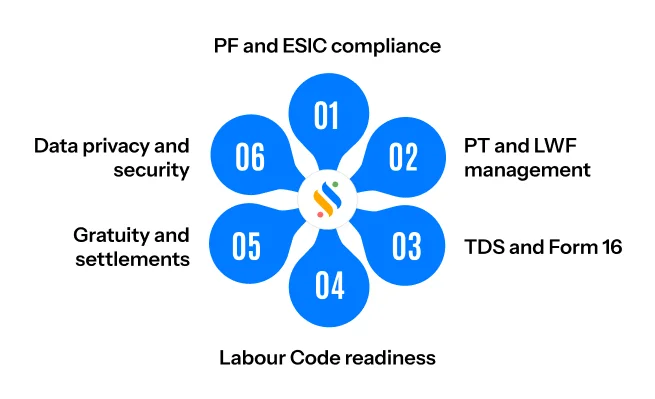
This is the part most payroll buying guides take for granted. If you’re running payroll for a large business in India, here’s the compliance layer your software actually needs to handle correctly, every cycle.
Provident Fund (PF) and ESIC:
Large businesses with employees crossing the PF wage threshold, and those with establishments in different states, need software that computes employer and employee PF contributions correctly per establishment code, generates ECR files in the format EPFO expects, and does the same for ESIC where applicable. Manual PF/ESIC computation for a workforce in the thousands is where most compliance errors originate.
Professional Tax (PT) and Labour Welfare Fund (LWF):
PT is a state subject, and slabs vary significantly. What applies in Maharashtra doesn’t apply in Karnataka. LWF contribution amounts and payment frequency (monthly, half-yearly, or annual depending on the state) add another layer. For a company with a multi-state workforce, payroll software needs a rules engine that maps each employee’s PT and LWF liability to their registered work location automatically.
TDS and Form 16:
Large businesses deal with employees across multiple tax regimes (old vs. new), varying investment declarations, and mid-year joiners with previous employer income to reconcile. Payroll software for large enterprises needs to compute TDS accurately per employee per month, not just at year-end, and generate Form 16 for the entire workforce without a manual reconciliation exercise each March.
Labour codes transition:
India’s four Labour Codes – on Wages, Industrial Relations, Social Security, and Occupational Safety, Health and Working Conditions are being implemented in phases, and they change how components like basic pay, allowances, and gratuity are defined and calculated. A large business with a workforce in the thousands cannot afford to manually re-map salary structures every time a provision is notified. Payroll software built for the Indian market should be updated to reflect these changes as they’re rolled out, rather than leaving your HR team to interpret notifications and adjust structures by hand.
Gratuity, bonus, and full & final settlement:
At scale, gratuity liability calculations, statutory bonus computation under the Payment of Bonus Act, and full and final settlement processing for employees who exit are recurring, high-volume tasks, not occasional ones. Software that automates these calculations against current employee data reduces both errors and the time HR spends chasing exit formalities.
Data privacy law:
The DPDP Act, 2023 is not just a theory anymore. It is shaping how Indian organizations are expected to handle personal data. The right to privacy was affirmed as a fundamental right. That means for a large business, payroll software should offer role-based access controls so only authorized personnel can access and view important data related to salary and compliance.
Enterprise payroll needs more than just automation!
Simplify payroll and stay compliant with the right payroll software.
Common mistakes large businesses make when choosing payroll software
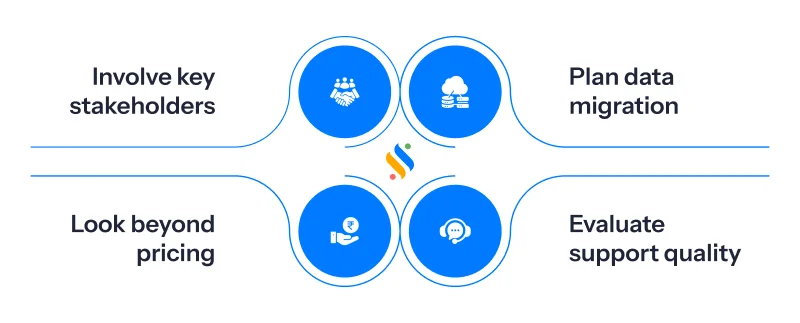
Treating payroll software as an HR-only decision:
One of the key mistakes that large businesses make is that mostly top management takes the call on having payroll software or not. While it is understandable that the ultimate decision of having it falls on them, having key members like the HR manager, compliance manager, and finance member on board in the discussion of having it becomes important.
Underestimating the migration effort:
When you are managing a massive workforce, everyone has a payroll history. Now, migrating the entire system to a new one requires a bit of planning and strategy. Vendors who gloss over data migration timelines during the sales conversation tend to leave gaps that surface during the first live payroll run.
Choosing based on price alone:
The cheapest option is rarely the cheapest once you factor in compliance penalties from a system that doesn’t update statutory rules correctly, or the HR hours spent working around a tool that doesn’t handle multi-state processing natively.
Ignoring how support works at scale:
A generic way of raising tickets is ineffective when the payroll issue affects 1,000 employees. That’s why it needs a faster, more structured resolution. Ask vendors how enterprise-tier support actually works before signing.
What are the must-have features of payroll software for a large business?
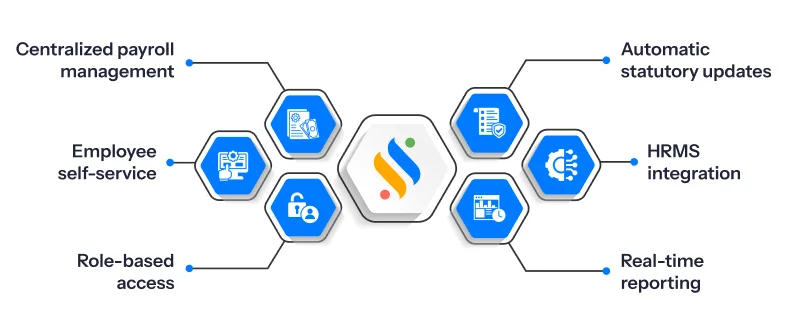
Centralized multi-location payroll processing:
One dashboard should give HR and finance a single view of payroll status across every state and business unit, not separate logins or exports per location. This is what lets a large business close payroll on the same date across the entire organization instead of location by location.
Automatic statutory updates:
Tax slabs, PF ceilings, PT rates, and labour law provisions keep on changing. A top-rated payroll software for large businesses pushes these updates into the system automatically, so HR isn’t manually reconfiguring rules.
Employee self-service:
When an organization has a workforce of thousands, it is impossible to assume HR as the single point of contact for resolving every query. This is where an employee self-service portal becomes essential. With that, employees can perform certain tasks like managing their attendance and leaves, accessing important policies, and view/download payslips on their own.
Integration with HRMS:
Payroll accuracy depends on clean attendance, leave, and employee master data flowing in without manual re-entry. Payroll software that is part of a broader HRMS – rather than a standalone tool requiring exports and imports – removes an entire category of reconciliation errors.
Role-based access:
At the enterprise level, not everyone should see every employee’s salary. Role-based access with a clear audit trail of every change made to payroll data protects both compliance and confidentiality.
Real-time reporting & analytics:
Leadership at large organizations needs visibility into payroll cost trends, headcount cost by department or location, and compliance status without waiting for a manually compiled report each quarter. Built-in dashboards turn payroll data into a planning input rather than a static output.
Where does Super Payroll fit for large organizations?
Businesses in India, especially big enterprises, consider a solution for their business that goes beyond offering just a basic set of features. Sure, they want simplicity and ease-of-use; but they also want something that can handle complex tasks with great ease.
Let’s say state compliance. If you’re running your business in India, you very well understand that every state has their own rules. And if you are found to be non-compliant with even one rule, then you and your business are in serious trouble.
Now, would you trust a tool that just claims to be top-rated payroll software, or would you go for the one that walks the talk?
Super Payroll is that perfect solution. From handling complex compliance, it is built around this exact set of requirements: multi-state statutory compliance handled automatically, native integration with HRMS and attendance data, role-based access controls for payroll data, and a compliance framework grounded in Indian regulations.
For large businesses trying to run payroll across multiple states without multiplying HR headcount to manage it, that India-first design is the difference that shows up at the end of every pay cycle.
If you’re currently evaluating payroll software options for your large enterprise, Super Track is worth checking out.
Conclusion
When we talk about a growing enterprise, one should remember that their products aren’t as similar to the ones for SMBs. That’s because their requirements are different.
If one HR software can take care of the HR operations with 50-100 employees, chances are that it won’t be capable of managing operations with 2000 employees. The same approach is applied to payroll software.
As your business grows, so does your payroll. That’s why it isn’t enough for payroll software for big companies to simply automate salary processing; it should simplify compliance, reduce operational risk, and scale with ease.
The key takeaway here is that a growing business deserves better tools.
Now, if you are one of those business founders whose business is growing and you are planning to expand your workforce, you need an efficient payroll solution. Super Payroll is a made-in-India payroll software that, no matter what your business size is, automates complex payroll processes and compliance.
Whether you’re adding new locations or hiring new employees, Super Payroll is designed to support your business at every stage of growth. It is a part of the Superworks’ ecosystem, which means that it seamlessly integrates with Super HRMS, which also means that all your attendance, leave, shift, and expenses data flows straight into the system.
So, stop going for tools that will outgrow you in a year. Get Super Payroll. Book a demo now!










