Labour Welfare Fund Explained: Rates, Benefits, Applicability, and more
At a glance
Both the employee and the employer pay into the Labour Welfare Fund, with the employer always paying the larger share, and a few states add government contributions on top. In most states, the employee’s share is fixed. This ranges from 75 paise in Delhi to ₹60 in Goa per half-year. Haryana charges 0.2% of wages, capped at ₹35 per month. Depending on the state, LWF is collected monthly, twice a year or only once a year.
Ever noticed a tiny “LWF” line on your June or December payslip and wondered where that ₹25 went? That’s the labour welfare fund. You chip in a little, your employer puts in more, and in a few states the government adds its bit too. All of it lands with the state’s Labour Welfare Board, which uses the pool to run schemes for workers and their families. Think scholarships for kids, help with hospital bills, a hand with a daughter’s wedding, even holiday homes.
Simple enough, right? Not quite. India has no single LWF rate. Sixteen states and UTs run their own version, and each one picks its own amount, its own months and its own deadline. A few of them have changed the rules lately, too. Maharashtra scrapped its wage slabs in 2024 and went to a flat ₹25. Karnataka bumped its rate and now pulls in firms with just 10 people. Haryana nudged its monthly cap up to ₹35 from January 2026. We’ve put the current numbers for all 16 in one place below, and we’ve listed where each figure comes from.
What is the Labour Welfare Fund (LWF)?
In plain terms, LWF is a statutory fund set up under a state law. Your employer cuts the employee share from salary in whichever months the state says, adds the company’s own share, and sends the lot to the Labour Welfare Board before the due date. That’s the whole mechanism.
Three things make it different from the other deductions on a payslip:
1. It is usually a flat amount.
PF is a percentage of basic pay, and ESI is a percentage of gross. LWF is ₹6 in Gujarat and ₹25 in Maharashtra, regardless of salary.
2. It is not deducted every month in most states.
Nine states collect it twice a year and four once a year. Only Haryana, Punjab and Chandigarh (plus Kerala’s separate shops fund) collect monthly.
3. It is a state law.
The four Labour Codes came into force on 21 November 2025, but the state LWF Acts still run. Keep following your state’s Act and Board notices.
LWF applicability: which states and establishments are covered
LWF applies in
- Andhra Pradesh
- Chandigarh
- Chhattisgarh
- Delhi
- Goa
- Gujarat
- Haryana
- Karnataka
- Kerala
- Madhya Pradesh
- Maharashtra
- Odisha
- Punjab
- Tamil Nadu
- Telangana
- West Bengal.
If your staff work anywhere else, there is no LWF currently.
Being in one of those 16 isn’t enough on its own, though. What kind of unit you run and how many people work there both matter. Factories are covered under pretty much every Act. Shops and offices have to cross a headcount line, and that line moves a lot from state to state:
| Coverage test (shops and establishments) | States / UTs |
|---|---|
| 1 or more employees | Madhya Pradesh, Chhattisgarh, Goa |
| 5 or more employees | Maharashtra, Delhi, Tamil Nadu |
| 10 or more employees | Gujarat, Haryana, West Bengal, Karnataka (from 7 January 2026; earlier, more than 50) |
| 20 or more employees | Andhra Pradesh, Telangana, Odisha |
| 10 or 20 | Punjab and Chandigarh |
| Defined by type of unit | Kerala (1975 Act): factories, plantations, registered societies and banks. Kerala shops fund: every shop and commercial establishment |
Who is excluded?
Most Acts leave out people employed mainly in a managerial role, apprentices and part-time staff. Several also exclude supervisors above a wage limit, and those limits are old and very low: ₹1,600 a month in Goa, Telangana and West Bengal, ₹2,500 in Delhi, ₹3,500 in Gujarat and Maharashtra, ₹10,000 in Madhya Pradesh and Chhattisgarh, and ₹15,000 in Tamil Nadu. In practice, almost every non-managerial employee ends up covered.
A five-question LWF applicability check
Run this for each office, plant or store, not for the company as a whole:
- Do this location by location. A company can owe LWF at its Pune office and nothing at its Lucknow one.
- Is the site in one of the 16 LWF states? No? You’re done.
- Is it a factory, or does the headcount clear that state’s threshold? If so, the Act applies.
- Who was on the rolls on the cut-off date? That’s 30 June and 31 December in half-yearly states, 31 December in yearly ones, and every month in monthly ones. Those are the people you pay for.
- Is the site registered with the state Board yet? If not, get that sorted before the next due date.
LWF registration
You register once with the state Labour Welfare Board online. Keep Shops and Establishments or Factory licence number, PAN, headcount and the details of whoever is signing handy. Maharashtra splits it into two rounds. First you validate your PAN and create an account. Then you fill in establishment, licence and employee details and upload documents. At the end you get an establishment code, and you’ll quote it on every payment and return after that. Setting up a new entity and want the full registration list? Our guide to payroll compliance in India walks through it.
LWF contribution rates state-wise (2026)
Every figure here is per employee, per contribution period. One word of warning before you copy these into payroll: states change LWF through notifications, often quietly, and a lot of the tables floating around online are a year or two behind. A quick look at the Board’s latest notice before each payment saves a lot of rework.
| State / UT | Employee | Employer | Frequency | Deduct in | Pay by |
|---|---|---|---|---|---|
| Andhra Pradesh | ₹30 | ₹70 | Yearly | December | 31 January |
| Chandigarh | ₹5 | ₹20 | Monthly deduction | Every month | 15 October (Apr–Sep) 15 April (Oct–Mar) |
| Chhattisgarh | ₹15 | ₹45 | Half-yearly | June, December | 15 July, 15 January |
| Delhi | ₹0.75 | ₹2.25 | Half-yearly | June, December | 15 July, 15 January |
| Goa | ₹60 | ₹180 | Half-yearly | June, December | 31 July, 31 January |
| Gujarat | ₹6 | ₹12 | Half-yearly | June, December | 15 July, 15 January |
| Haryana | 0.2% of wages, max ₹35 | 2 × employee, max ₹70 | Monthly | Every month | Monthly, by month-end |
| Karnataka | ₹50 | ₹100 | Yearly | December | 15 January |
| Kerala (1975 Act) | ₹45 | ₹45 | Half-yearly | June, December | 15 July, 15 January |
| Kerala (shops fund) | ₹50 | ₹50 | Monthly | Every month | 5th of next month |
| Madhya Pradesh | ₹10 | ₹50 | Half-yearly | June, December | 15 July, 15 January |
| Maharashtra | ₹25 | ₹75 | Half-yearly | June, December | 15 July, 15 January |
| Odisha | ₹10 | ₹20 | Half-yearly (₹20 + ₹40 a year) | June, December | 15 July, 15 January |
| Punjab | ₹5 | ₹20 | Monthly deduction | Every month | 15 October (Apr–Sep) 15 April (Oct–Mar) |
| Tamil Nadu | ₹20 | ₹40 | Yearly | December | 31 January |
| Telangana | ₹2 | ₹5 | Yearly | December | 31 January |
| West Bengal | ₹3 | ₹30 | Half-yearly | June, December | 15 July, 15 January |
What changed recently
- Maharashtra had the biggest shake-up. The Maharashtra Labour Welfare Fund (Amendment) Act, 2024 got rid of the old ₹6 and ₹12 wage slabs. Now everyone pays a flat ₹25 and the employer pays ₹75, every half-year, whatever the salary.
- Karnataka raised its yearly rate to ₹50 from the employee and ₹100 from the employer. Since 7 January 2026 it also covers establishments with 10 or more people. Before that, you had to have more than 50. On the plus side, you can now pay by net banking, NEFT, RTGS or UPI.
- Haryana moved the monthly ceiling on its 0.2% from ₹34 to ₹35, effective 1 January 2026. The Board’s notification only came out on 8th May 2026. If your payroll used ₹34 for the early months of 2026. Employers still pay double the employee share.
- West Bengal doubled the employer’s half-yearly share from ₹15 to ₹30. It applies from 1 January 2024, even though the notice was only issued in December 2024. Employees still pay ₹3.
- Madhya Pradesh bumped the employer share from ₹30 to ₹50 per half-year through an amendment to section 9(2) of the Adhiniyam.
- Kerala made a big jump under its 1975 Act. Both shares went from ₹4 and ₹8 to ₹45 each per half-year, through the Kerala LWF Amendment Ordinance, 2021. Oddly, the Board’s own contribution page still shows the old figures, so it’s worth confirming with them before your first deposit.
- Punjab is one to watch. The Vidhan Sabha passed the Punjab Labour Welfare Fund (Amendment) Bill, 2025 on 11 July 2025, which doubled the monthly amounts to ₹10 and ₹40. We couldn’t find a notified start date, so the table still shows ₹5 and ₹20. Check with the Welfare Commissioner before your next deposit.
The government’s share
Some states throw in their own money for every worker you pay for. Maharashtra adds ₹50 per half-year, Karnataka ₹50 a year and Delhi ₹1.50 per half-year. You don’t deposit this part. The state does. It’s partly why the employee share can stay so small.
What LWF costs a 60-person company
| State | Employer share per period | Employee share per period | Total to the Board per year |
|---|---|---|---|
| Gujarat (half-yearly) | 60 × ₹12 = ₹720 | 60 × ₹6 = ₹360 | 2 × ₹1,080 = ₹2,160 |
| Maharashtra (half-yearly) | 60 × ₹75 = ₹4,500 | 60 × ₹25 = ₹1,500 | 2 × ₹6,000 = ₹12,000 |
| Madhya Pradesh (half-yearly) | 60 × ₹50 = ₹3,000 | 60 × ₹10 = ₹600 | 2 × ₹3,600 = ₹7,200 |
| Haryana (monthly, wages ₹17,500+ so the cap applies) | 60 × ₹70 = ₹4,200 | 60 × ₹35 = ₹2,100 | 12 × ₹6,300 = ₹75,600 |
Haryana works out far more expensive because it is monthly and percentage-based. In Haryana, anyone earning ₹17,500 or more a month hits the ₹35 cap (0.2% of ₹17,500 is ₹35).
Want to calculate LWF deductions across multiple states easily?
Automate state-wise LWF deductions, apply the right contribution rates, and manage statutory calculations easily

LWF due date calendar for 2026–27
If you operate in several states, it helps to see the deadlines by month rather than by state:
| Due date | What is due |
|---|---|
| 5th of every month | Kerala shops and commercial establishments fund (previous month) |
| Every month-end | Haryana monthly contribution |
| 15 January | July–December half: Maharashtra, Gujarat, Delhi, Madhya Pradesh, Chhattisgarh, West Bengal, Kerala (1975 Act), Odisha. Yearly: Karnataka |
| 31 January | Yearly: Andhra Pradesh, Telangana, Tamil Nadu. July–December half: Goa |
| 15 April | Punjab and Chandigarh, for October–March |
| 15 July | January–June half: Maharashtra, Gujarat, Delhi, Madhya Pradesh, Chhattisgarh, West Bengal, Kerala (1975 Act), Odisha |
| 31 July | January–June half: Goa |
| 15 October | Punjab and Chandigarh, for April–September |
LWF deduction in salary: how payroll handles it
| Type of state | Examples | What payroll does |
|---|---|---|
| Monthly | Haryana, Punjab, Chandigarh, Kerala shops fund | Deduct the employee share every month and add the employer share. Haryana and Kerala’s shops funds are deposited monthly; Punjab and Chandigarh are deposited every six months. |
| Half-yearly | Maharashtra, Gujarat, Delhi, Madhya Pradesh, Chhattisgarh, West Bengal, Goa, Odisha, Kerala (1975 Act) | Deduct in the June and December salaries for people on the register on 30 June and 31 December. Pay by the July and January due dates. |
| Yearly | Karnataka, Tamil Nadu, Andhra Pradesh, Telangana | Deduct once, in the December salary, for people on the register on 31 December. Pay in January. |
Step by step for a half-yearly state
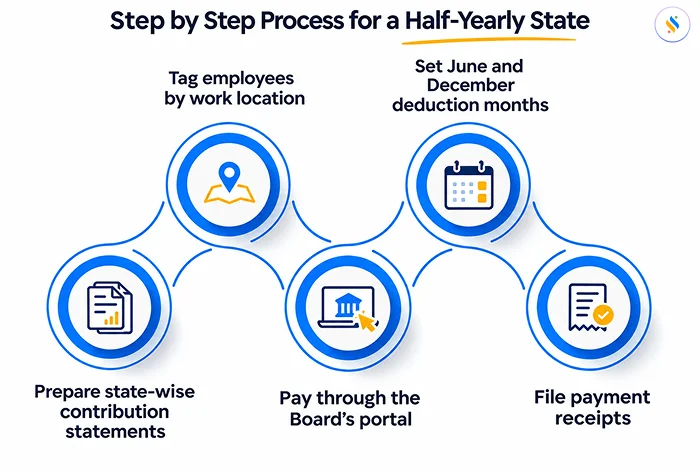
1. Tag every employee with a work-location state.
Start by tagging each employee with the state they actually work in. LWF follows the desk, not the registered office. Say a Surat company has ten people in Mumbai. The Surat team pays Gujarat LWF, and the Mumbai ten pay Maharashtra’s.
2. Set June and December as deduction months.
Mark these months as the deduction months and run payroll as usual. The employee share comes off salary, and the employer share is worked out for the same set of people.
3. Prepare the contribution statement in the state’s format.
Fill in the contribution statement in the state’s own format. Maharashtra and Gujarat use Form A-1, Delhi and Tamil Nadu use Form A, Karnataka and West Bengal use Form D, and Odisha uses Form F.
4. Pay on the Board’s portal
This needs to be done by the due date, and you should download the receipt or challan.
5. File the receipt
Do this with your statutory records, then repeat in December.
Joiners, leavers and transfers
- LWF in half-yearly and yearly states is tied to the register on the cut-off date. Someone who joins on 20 June and is still on the rolls on 30 June is counted for June; someone whose last day is 25 June is not.
- An employee moved from Mumbai to Bengaluru in August counts as a Maharashtra employee in June and a Karnataka employee in December.
- For contract workers, check who deposits LWF under your state’s Act before assuming it is the contractor’s job alone.
Labour welfare fund benefits for employees
This is the part most employees never hear about. The money isn’t a savings account, and you cannot withdraw it. Instead, it pays for schemes you can apply for. Each Board runs its own list, but they usually fall into these groups:
| Benefit type | What Boards typically offer | Who can apply |
|---|---|---|
| Education | Scholarships and merit awards for workers’ children; help with books and uniforms | Children of contributing workers, often below a wage limit |
| Medical | Help with treatment for serious illness or surgery; health camps | The worker, sometimes dependants |
| Family events | Assistance for a daughter’s marriage, maternity support, funeral help | The worker or family |
| Housing | Interest subsidy or lump-sum help in some states | The worker |
| Skills and recreation | Tailoring and computer courses, sports, libraries, excursions, holiday homes | The worker and family |
| Accident and death | Ex-gratia payments for accidental death or disability | The nominee |
To claim, an employee applies to the state Board, usually online, with the employer’s LWF registration number and proof that contributions were paid. Employers can help by putting the Board’s scheme list into the onboarding kit. It costs nothing, and employees appreciate it.
Penalties for late or missed LWF payment
Each Act sets its own consequences, so look up your state. Maharashtra shows the pattern:
- Interest: If you miss the due date and then ignore the Welfare Commissioner’s notice (at least 30 days), simple interest applies: 1.5% a month for the first three months and 2% a month after that (section 6B).
- Fines: Obstructing an inspector or failing to produce records can mean a fine of up to ₹1 lakh for a first offence and ₹2 lakh after that, with a minimum of ₹5,000 (section 17A).
Karnataka also charges interest on late payment, and Punjab’s 2025 amendment bill proposes fines and compounding of offences. Penalties are not the only risk, though. An inspector who finds LWF unpaid will usually ask for the wage register and the PF, ESI and PT challans too.
Common LWF mistakes employers make
- Using the head-office state for everyone. LWF follows the work location.
- Running old rates. Maharashtra’s ₹12 slab, Karnataka’s ₹20 and West Bengal’s ₹15 employer share are all out of date, but still show up in payroll setups.
- Forgetting the yearly states. Karnataka, Tamil Nadu, Andhra Pradesh and Telangana only come up once a year, which makes them easy to miss.
- Missing the Haryana cap change. The ceiling moves with the cost-of-living index, so check it every January.
- Not keeping receipts. Store every challan and contribution statement with your statutory records for each cycle.
LWF vs PF vs ESI vs PT
| LWF | Provident Fund (EPF) | ESI | Professional tax | |
|---|---|---|---|---|
| Law | State LWF Acts | Code on Social Security, 2020 | Code on Social Security, 2020 | State PT Acts |
| Who pays | Employee + employer (employer more) | Employee 12% + employer 12% of basic + DA | Employee 0.75% + employer 3.25% of gross | Employee only |
| Amount | Flat amount in most states; 0.2% in Haryana | Mandatory up to a ₹25,000 wage ceiling (from 17 September 2026) | For employees earning up to ₹21,000 a month | Slab-based; capped at ₹2,500 a year |
| How often | Monthly, half-yearly or yearly | Monthly, by the 15th of the next month | Monthly, by the 15th of the next month | Monthly in most states |
| Applies when | State threshold met (1 to 20 employees) | 20 or more employees | 10 or more employees (20 in some states) | State levies PT |
For details, see our guides to PF deduction from salary, ESI contribution and professional tax in India.
How does Superworks Payroll handle LWF?
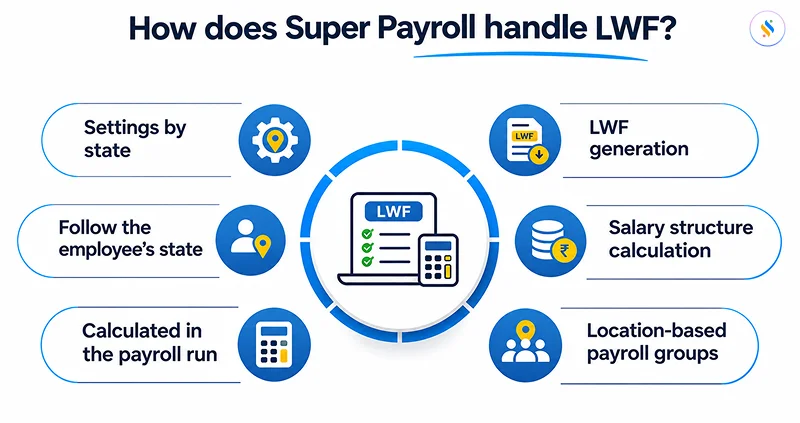
In Superworks, LWF is configured once per legal entity in the payroll software. After that, it runs with each payroll.
1. Settings by state.
For each state you operate in, the admin sets the employee and employer shares, the frequency (monthly, half-yearly or yearly) and the deduction months.
2. Follow the employee’s state.
Payroll deducts LWF in those months based on each employee’s state. A Surat employee gets Gujarat’s ₹6 in June and December; a Gurugram employee gets the Haryana deduction every month, in the same run.
3. Calculated in Step 4 of the payroll run.
You can do this alongside PF, ESIC, PT and TDS, so the June and December payslips carry the LWF line automatically.
4. LWF report.
A monthly statutory summary per employee, which you can use for the Board’s contribution statement.
5. Salary Structure Calculator.
Switch LWF on or off while modelling an offer, so the candidate sees the real take-home pay.
6. Separate payroll groups by location.
This is effective for companies with several sites, plus a location-wise payroll report.
Conclusion
The labour welfare fund is a little money, but it comes with a set of rules. A good way to stay on top of it: make a one-page LWF calendar with one row per state you operate in, filled with the amounts, deduction months and due dates from the table above. Check each row against the Board’s latest notice, and confirm every employee in your payroll master is tagged to the right work-location state, because that is where most LWF errors begin. Setting up statutory deductions from scratch can be a headache. But with our payroll process in India guide, you can keep compliance in order. Want LWF, PT, PF and ESIC calculated by state without a spreadsheet? Book a Super Payroll demo today!
Table Of Content
Recent Things
FAQs
What is LWF in salary?
It's the labour welfare fund deduction. A small amount, like ₹6 in Gujarat or ₹25 in Maharashtra, comes out of your pay in the months your state collects it. Your employer adds a bigger share, and both go to the state Labour Welfare Board.
Is LWF mandatory?
Yes, if you're in one of the 16 states or UTs with an LWF Act and your establishment meets that state's coverage test. Managers, apprentices and part-timers are usually left out. The supervisor wage limits are so low, though, that almost everyone else ends up covered.
What is the LWF due date?
That depends on where you are. Most half-yearly states want the money by 15 July and 15 January, while Goa gives you until 31 July and 31 January. Karnataka's yearly payment is due by 15 January. Andhra Pradesh, Telangana and Tamil Nadu want theirs by 31 January. Haryana is monthly, and Punjab and Chandigarh deposit by 15 October and 15 April.
How is the LWF contribution calculated?
For most states it's simple multiplication. Take the number of covered employees on the cut-off date and multiply by the fixed employee and employer amounts. Sixty people in Maharashtra work out to 60 × ₹25 + 60 × ₹75 = ₹6,000 per half-year. Haryana is different: 0.2% of each person's wages, capped at ₹35 a month, and the employer pays twice that.
Which states do not have a labour welfare fund?
Any state or UT outside the 16 in this guide. That includes Uttar Pradesh, Rajasthan, Bihar, Jharkhand, Uttarakhand, Himachal Pradesh, Jammu and Kashmir, Assam and the rest of the North-East. People working there don't have LWF deducted, even if the company's registered office is in an LWF state.
What is the LWF contribution in Kerala?
Kerala actually has two funds. Under the Kerala Labour Welfare Fund Act, 1975, which covers factories, plantations and similar units, employees and employers each pay ₹45 every six months, due 15 July and 15 January. Shops and commercial establishments pay into a separate fund instead: ₹50 each, every month, by the 5th.
Can an employee withdraw LWF money?
No. Unlike PF, LWF isn't a personal savings account. The money goes into a shared pool, and employees benefit by applying for the Board's schemes, such as scholarships, medical help or marriage assistance.
How do I pay LWF online?
Log in to your state Labour Welfare Board's portal with your establishment code. Enter or upload the employee-wise contribution statement, then pay by net banking. States like Karnataka also take UPI and NEFT. Download the receipt and keep it with your records.

