Best Payroll Software for Retail Businesses in India
At a glance
Running payroll for a retail store is hard work, and it keeps getting harder when you keep adding new stores. Attendance logs in from different stores, shifts keep rotating, and overtime happens during the festive season. Not to mention that employees leave frequently. That’s why good payroll software for retail is essential, as it collects attendance from every store and pays shifts, overtime and incentives correctly. It also clears final dues within the two working days the Code on Wages now allows, and applies each state’s PT, LWF and minimum wage rules. In this blog, we explain those rules, take a look at the six prominent platforms and their prices, and share a checklist to help you pick the right one.
If you run a retail store in India, or five of them, you know how month-end goes. Store managers send attendance on WhatsApp. Nobody wrote down the extra hours from Diwali week. Three people quit mid-month, and they want their full and final settlement this week, not next month. And your payroll team still has to work out professional tax for five different states.
The right payroll software for retail can take most of that off your plate. It pulls attendance from every shop, pays rotating shifts, overtime and sales incentives without manual fixes, closes exits in days, and applies each state’s professional tax, labour welfare fund and minimum wage rules on its own. Most payroll tools can calculate a salary. Retail needs one that also understands how stores actually run.
Below, we look at why payroll for retail is harder than office payroll, the compliance changes from the past year that you can’t ignore, the tools worth shortlisting, and a checklist to help you choose.
Why is retail payroll harder to run?
India’s retail sector employs about 35 million of them, and a V5 Global report from December 2025 estimates that 70 to 75% of retail jobs are frontline roles. These employees aren’t the ones who are limited to working from desks. They’re at billing counters and on shop floors, and a good number of them move on within months.
Take a 400-person apparel chain with 30 stores across eight states. It follows the same payroll laws as a 400-person company in any other industry, but its payroll month looks completely different.
| Retail reality | What it does to payroll |
|---|---|
| Many small locations | Attendance arrives from 30 places, approved by 30 store managers, for one payroll team |
| Rotating shifts and moving weekly offs | Every day’s hours must be judged against that day’s shift; mall stores add late and night shifts |
| Long days in festive season | Overtime beyond the state Shops & Establishments limit, usually paid at twice the ordinary rate |
| Sales targets | Store or individual incentives change take-home pay every month |
| High turnover | Joiners and leavers every month, and final wages now due within two working days of exit |
| Stores in several states | A different PT slab, LWF cycle, minimum wage and holiday list for each state |
| Cash and stock handling | Security deposits, cash shortages and advances that must be recovered correctly |
| Salaries near statutory thresholds | Many store staff earn ₹21,000 or less gross, so ESI applies, and PF is now compulsory up to ₹25,000 of PF wages |
Store attendance that feeds retail store payroll
| Staff | Attendance method that works | Why |
|---|---|---|
| Store floor staff | Face-recognition terminal at the entrance, or a biometric machine | A shared device; staff don’t need their phones on the floor |
| Store managers and supervisors | Mobile clock-in inside a geo-fence around the store | Location-checked, no extra hardware |
| Merchandisers and area managers | Mobile clock-in with location tagging, plus on-duty requests for store visits | They move between stores all day |
| Warehouse and back office | Biometric machine or web clock-in | Fixed location |
If you’re still choosing hardware, our guide on the biometric attendance system compares device types if you’re still choosing hardware.
Shifts, overtime and incentives: the core of retail staff salary management
Rosters
In order to run payroll successfully, payroll needs to know each employee’s shift for each day. Without it, the system can’t tell whether someone was late or took a half day, or whether a long day should count as overtime. Most chains follow one of two patterns: a fixed weekly roster for each store, or a rotation planned out for the whole month. Our employee shift management guide explains how to design rosters.
Overtime
For the staff of a retail store, overtime falls under your state’s Shops & Establishments Act. These state Acts still apply to shops while the new labour code rules settle in, and the limits vary from state to state:
- Karnataka: 9 hours a day and 48 hours a week. Overtime is paid at twice the ordinary rate and capped at 50 hours per quarter.
- Maharashtra: The October 2025 amendment ordinance raised the daily limit from 9 to 10 hours (the weekly limit stays at 48) and the quarterly overtime cap from 125 to 144 hours, for establishments with 20 or more workers.
Example: Here’s how it works out for Ravi, a sales associate at a Bengaluru store earning ₹19,500 a month. One common way to get the ordinary hourly rate is monthly wages ÷ 26 working days ÷ 8 hours:
- Ordinary hourly rate: ₹19,500 ÷ 208 = ₹93.75
- Overtime rate at double: ₹187.50 an hour
- Ten extra hours in Diwali week: 10 × ₹187.50 = ₹1,875, paid in the same month and entered in the overtime register
Not every employer uses this divisor. Some use 30 days, and states differ on which pay components are included, so check the method for each state before you set up the overtime formula.
Incentives and target-linked pay
Variable pay is where most retail payroll errors creep in. The best approach is a salary component that’s calculated from achievement. Three habits keep it accurate:
- Approve achievement before payroll runs. If approval comes late, the incentive turns into next month’s arrears.
- Decide once whether the incentive counts for PF, ESI and tax, and set that on the component. Under the labour codes, allowances above 50% of total pay are added back to “wages” for PF and gratuity.
- Show the calculation on the payslip, for example: “Target ₹2,00,000, achieved ₹1,80,000 (90%), incentive ₹1,800”.
Full and final settlement at retail scale
The four labour codes came into force on 21 November 2025. Under Section 17(2) of the Code on Wages, if an employee is removed, dismissed, retrenched or resigns, or when the establishment closes, their wages must be paid within two working days. Before this, many companies took 30 to 45 days.
For a retail chain, this quickly becomes a volume problem. If a 400-person chain loses 40% of its store staff in a year, that’s about 160 settlements, or roughly three every week.
Here’s what a typical settlement looks like for an employee who earns ₹18,000 gross at a Coimbatore store and leaves on the 12th:
| F&F item | Amount |
|---|---|
| Salary for 12 days worked (12 ÷ 30 × ₹18,000) | ₹7,200 |
| Leave encashment, 4 days of earned leave (4 × ₹600) | ₹2,400 |
| Incentive for the month | As approved by the store manager |
| Less: uniform or ID card not returned | –₹500 |
| Less: cash shortage, advance or notice-period recovery | As recorded, if the appointment letter allows it |
| Gratuity | Only if eligible (see below) |
Gratuity needs five years of continuous service for a permanent employee. Under the Code on Social Security, fixed-term employees qualify after one year. Once it falls due, gratuity has to be paid within 30 days.
In retail, the maths is rarely what holds up an F&F. The clearance is: the uniform, the locker key, the cash drawer count. Give every leaver a task list owned by the store manager, with the last working day as the deadline. Our full and final settlement guide walks through the whole sequence.
Managing payroll across multiple stores shouldn’t be stressful.
Bring store-wise attendance, rotating shifts, overtime, and sales incentives into one smart solution.

Payroll for retail across states: the compliance list
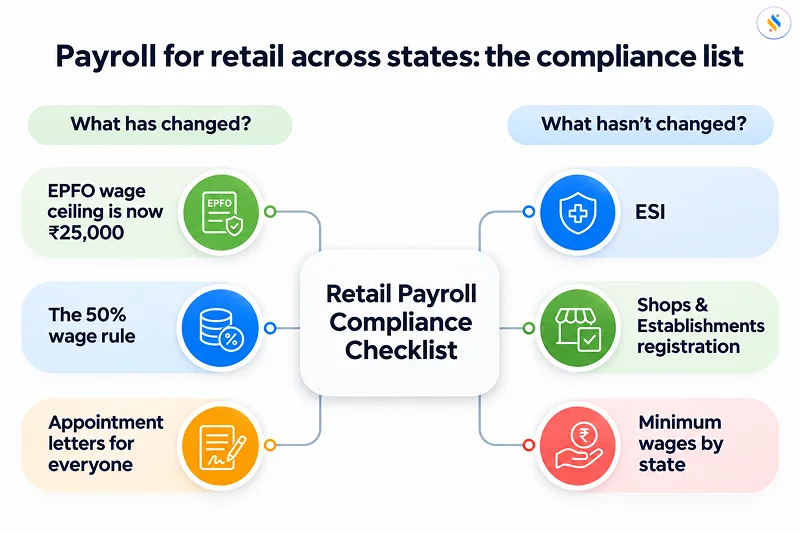
A store in a single city rarely has to deal with most of this. But every new state you open in adds more dates to your compliance calendar.
Changes from the last 12 months
1. EPFO wage ceiling is now ₹25,000.
The Government of India has raised the EPF wage ceiling from ₹15,000 to ₹25,000 a month, effective 17 September 2026. Contribution rates stay at 12% from the employee and 12% from the employer, and EPF is still compulsory for establishments with 20 or more employees. Many store staff who earned above the old ceiling are now covered.
2. The 50% wage rule.
Under the labour codes, if allowances make up more than 50% of total remuneration, the excess is counted as wages for PF and gratuity. Retail salary structures with a small basic and a large special allowance are the ones most affected.
3. Appointment letters for everyone.
The OSH Code requires a written appointment letter for every worker, including seasonal and contract staff.
Rules that haven’t changed
1. ESI:
Covers employees earning up to ₹21,000 gross a month, with contributions of 0.75% from the employee and 3.25% from the employer. It applies to establishments with 10 or more employees.
2. Shops & Establishments registration:
Every store needs its own registration and has to follow that state’s rules on working hours, weekly offs and holidays.
3. Minimum wages by state:
Central-sphere rates were revised from 1 October 2026. In Maharashtra, shop rates for July to December 2026 put an unskilled Zone I worker at ₹14,862.75 a month. Junior store salaries are often close to these floors, so review every revision when it comes out.
Best payroll software for retail in India you should check out
| Tool | Best fit for |
|---|---|
| Superworks | Chains that want store attendance, rosters, incentives and payroll in one system |
| greytHR | Small to mid-size chains wanting a low entry price |
| Keka | Mid-size chains that want HR, performance and payroll together |
| factoHR | Chains with many hourly or field staff |
| Zoho Payroll | Small chains already using Zoho |
| HROne | Larger chains with an HR operations team |
1. Superworks

What sets Superworks apart is that it runs as one connected system. Its two main modules, Super HRMS and Super Payroll, share the same data, so attendance, leave, shifts, and overtime go straight into the payroll run. Each store or region can have its own payroll group. Professional tax for each employee’s work location, and LWF, minimum-wage checks, target-linked incentives, allowance, among others, are all built in. Plans start at ₹4,000 a month for 50 employees.
2. GreytHR

GreytHR offers payroll processing, leave management, employee self-service, and statutory compliance in one platform. Its Growth plan also includes attendance tracking, shift management, overtime calculations, and geo-fencing, making it suitable for small and mid-sized retail businesses managing store employees across locations. However, businesses requiring advanced attendance features will need to opt for a higher plan. Pricing starts at ₹2,495/month for up to 50 employees, with additional employee charges depending on the plan.
3. Keka

Keka is a complete HR suite. Its entry-level Foundation plan includes payroll automation and statutory compliance along with core HR and performance modules, so it suits mid-size chains that want one platform for most of HR, not just salaries. Prices aren’t listed on its public pricing page, so you’ll need to ask for a quote. If your stores fall under more than one legal entity, ask whether you’ll need the Growth add-on and how shift rosters connect to payroll.
4. factoHR

factoHR is worth a close look for retail because it’s the only vendor here with a separate plan for blue-collar workforces. It also offers a selfie-punch add-on for staff who clock in on their phones. Teams of up to 20 employees can start for free, and the Core plan costs ₹4,999 a month for up to 50.
5. Zoho Payroll

Zoho Payroll is the budget option for a business with two or three stores, especially if your books are already on Zoho. It’s free for up to 10 employees, and the Standard plan costs ₹1,000 a month for 25 employees, which works out to the lowest per-head price on this list. Since it focuses mainly on payroll, you’ll need to plan where store attendance and rosters will come from, and how that data will reach payroll each month.
6. HROne

HROne is a mobile-first HRMS with Indian payroll. Its pricing starts at 50 users, so it’s a better fit for larger chains that have their own HR operations team. The Basic plan costs ₹4,950 a month for 50 users.
Checklist for choosing a payroll management system for retail
- Takes attendance from face terminals, mobile apps and biometric machines into one record per store
- Lets each store manager approve attendance, leave and regularisation for their store only
- Handles rotating shifts, moving weekly offs, night shifts and overtime at each state’s rate
- Pays incentives from approved achievement, with the target and shortfall shown on the payslip
- Runs payroll by store, region or state when pay dates or approvers differ
- Applies PT, LWF, minimum wages and holidays by each employee’s work-location state
- Uses the ₹25,000 EPF wage ceiling and applies the 50% wage rule to your salary structures
- Settles F&F within two working days, with a task list, asset recovery and a settlement letter
- Tracks security deposits, cash shortages and advances, with recovery through payroll
- Produces the wages, overtime and advance registers an inspector asks for
- Sends payslips by email or WhatsApp and reports cost by store and state
- Has a pricing model that suits seasonal headcount (per employee vs flat fee), with device costs known up front
How Superworks handles payroll for retail
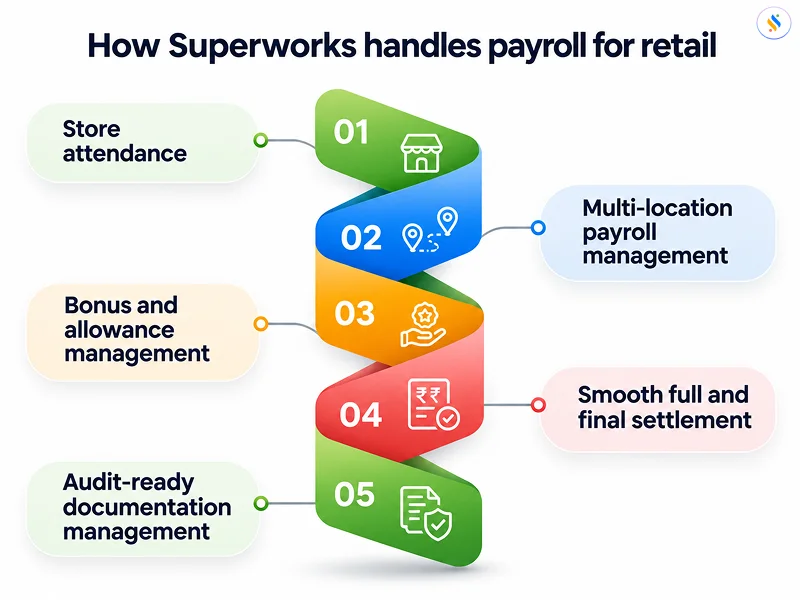
Super HRMS collects store attendance and rosters, and payroll software helps HR of retail stores pay them in one monthly run per legal entity or per location group.
1. Store attendance:
Face-recognition attendance with anti-spoofing and radius-based geo-fences, so a punch only counts if it comes from an approved store location.
2. Multi location payroll management:
Each store, region or contractor group can run on its own pay schedule, and a location-wise payroll report shows the cost for each attendance location.
3. Bonus and allowance management:
Confirm or reject each person’s regular bonus for the month, and pay a fixed amount per night shift, multiplied by the number of night shifts worked.
4. Smooth Full & Final settlement:
A few steps, plus a salary prediction before the last working day. The settlement closes automatically once the exit month’s payroll is marked as paid.
5. Audit-ready documentation management:
Wages, leave, wage slip, fines and deductions, advance and overtime registers (Forms 17 to 23), the EPF register and the gratuity nomination form, all generated from payroll data.
Next step
Before you book a single demo, make two sheets. The first lists your stores by state with each state’s PT slab, LWF cycle, shop-staff minimum wage and holiday list. The second names the attendance method for each type of staff. Together they’re your real specification for payroll software for retail. Take them and the checklist above into every demo, and ask each vendor to run one of your messier months live.
Want store attendance, rosters, incentives and multi-state payroll in one run? Book a demo with Super Payroll.
Table Of Content
Recent Things
- Labour Welfare Fund Explained: Rates, Benefits, Applicability, and more
- How To Calculate CTC From Salary: A Guide For Indian Teams
- Smart Payroll Software for Manufacturing: Built for Indian Factories
- A Complete Guide to Form 16, 16A & 16B
- Plan Your Taxes Better Every Year With Smart Income Tax Calculator
FAQs
What is the best payroll software for retail businesses in India?
It depends on the size and setup of your business. Super Payroll suits chains that want store attendance, rosters, incentives and payroll in one system. greytHR and Zoho Payroll have the lowest published entry prices, while Keka, factoHR and HROne suit mid-size and larger chains. Whichever you consider, judge payroll software based on its capabilities to make HR operations and payroll of retail stores effective.
How much does retail payroll software cost in India?
Based on vendor pricing pages, entry prices range from free for up to 10 employees to about ₹5,000 a month for the first 50 employees.
How do retail stores manage attendance for payroll?
Floor staff punch in on a shared device at the store, such as a face-recognition terminal or a biometric machine. Managers and field staff use mobile clock-in within a geo-fence. All punches go into one record, and attendance is locked on a fixed date before payroll runs.
How is overtime calculated for retail employees in India?
Your state's Shops & Establishments Act sets the daily and weekly limits and usually requires overtime to be paid at twice the ordinary rate. A common method is to divide monthly wages by 26 days and then by 8 hours to get the hourly rate. However, check your state's method and record all overtime in the overtime register.
How do you run payroll for seasonal and festival staff in retail?
Hire them on fixed-term contracts with a written end date and an appointment letter, add them to the attendance system from day one, and pay them in the regular monthly run. PF and ESI apply to them just as they do to permanent staff. Settle each person on their end date, so a 30-person Diwali batch doesn't turn into 30 pending settlements in January.

